
With land bank financing in Australia, lenders typically require a 20-30% deposit for vacant land, and the amount you can borrow depends on factors such as the land’s value, location and your capacity to service the loan.
It’s understandable to want a clear figure before committing to land you may hold for years before construction. The borrowing amount is only part of the decision: you’ll also need to weigh lender criteria, interest and other holding costs, and how the loan fits your plans for the site.
This guide explains what can shape your borrowing capacity, how to compare land finance options and what to plan for during the holding period. It also looks at Australian land finance project examples, so you can see how facilities have been structured for different development scenarios.
Key Takeaways
- Assess zoning, development potential and an exit plan before committing to land held for future growth.
- Compare lender criteria for location, land size, valuation and repayment capacity, not just the headline loan amount.
- Plan how the loan period will support the transition from land purchase to construction, including the timing of approvals and build funding.
- Budget for interest, council rates, land tax and planning costs, especially when the site produces no short-term income.
- Review how land finance has been structured for different Australian projects to understand which factors can shape a facility.
Table of Contents
- Potential capital growth and development opportunities
- Land banking finance and choosing a lender
- Using the loan period to prepare for construction
- Holding costs, council rates and land tax
- Australian land bank finance project examples
- Broker.com.au: Secured Business Loans
Potential capital growth and development opportunities
Land banking means buying vacant, rural or underused land and holding it for future development, resale or subdivision. The investment case rests on a change in land value, such as increased demand or an approved change of land use. Unlike a rental property, vacant land produces no rental income, so the owner relies on capital growth and future development to create a return.
That outcome depends on more than a site’s location. Rezoning is uncertain, and development approval may take several years of council discussions. Even when approval is granted, restrictions can limit what gets built. If a proposal stalls or land remains unsuitable for development, it may be harder to sell or could be worth less than the purchase price. Treat projected growth as a possibility, not a promised result.
Before purchasing, contact the local council for information about current zoning, planning controls and prospects for rezoning or approval. Ask how the proposed use fits local planning priorities and whether infrastructure plans or constraints affect the site. Then compare the council’s information with your intended exit plan: selling the land, subdividing it or developing it. A promoter’s timeline alone doesn’t establish that council approval is likely.
Check the land itself as well as its planning status. Soil conditions can affect whether a proposed building project is practical and what site preparation may involve. Consider proximity to major cities and planned infrastructure, population growth projections, and the council’s approach to development. These factors help explain the investment rationale, but none removes the risk of delays, restrictions or weak demand.
Land banking schemes can involve developers buying land, dividing it into smaller blocks and offering those blocks to investors. Other arrangements give an investor an option to purchase a plot, sometimes triggered by local council development approval. Read the agreement carefully to understand whether you are buying land or an option, who owns the site, and what happens if approval does not arrive before a sunset clause expires. The Parliament of Victoria committee recommended that Consumer Affairs Victoria investigate whether Market First or other parties breached Victoria’s Sale of Land Act 1962 in relation to off-the-plan contracts for the Foscari and Veneziane developments.
Finance also needs to match the development timeline. Some Australian land loan lenders may require building to begin within two to five years, while a land bank finance product may have a term of up to 24 months. These are different requirements: clarify whether the loan period or a build-start condition applies to the proposed loan. If approval takes years, the gap between the finance term and expected development date can shape refinancing, sale or construction plans.
Land banking finance and choosing a lender
For buying vacant land in Australia, the main options are a standalone land loan or a combined land-and-construction loan. Lender assessment and the site’s location, size and intended use influence the amount and terms available.
Market Statistics and Finance Options
Land banking means holding land for future capital growth or development rather than earning rental income. That strategy matters when choosing finance because the land may not generate income to cover interest while you wait.
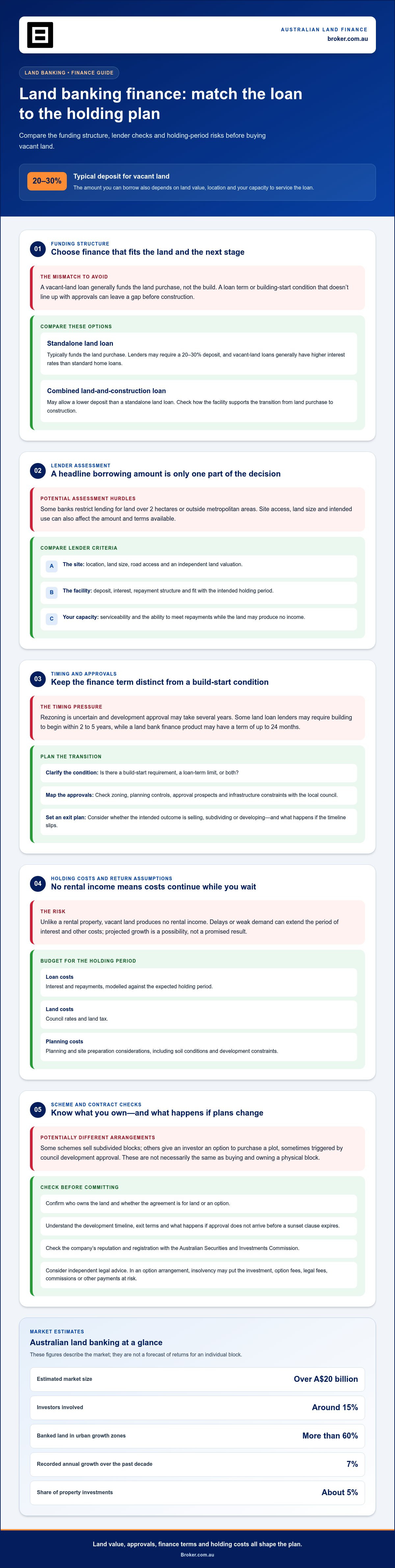
Vacant land loans generally fund the land purchase, while a combined land-and-construction loan may allow a lower deposit than a standalone land loan. Lenders typically require a 20-30% deposit for vacant land. Some banks restrict lending for land over 2 hectares or outside metropolitan areas; lenders may also consider road access and an independent land valuation.
Market estimates put Australian land banking at over A$20 billion, with around 15% of investors involved. More than 60% of banked land is in urban growth zones. The sector has recorded annual growth of 7% over the past decade, and land banking represents about 5% of property investments. These figures describe the market, not a forecast of returns for an individual block.
Compare offers by looking beyond the amount available. Check how the lender assesses the land, the deposit required, interest and repayment structure, and whether the finance fits the intended holding period. Australian land loans typically have higher interest rates than standard home loans, so model repayments alongside other holding costs.
Check the land banking company’s reputation and registration with the Australian Securities and Investments Commission. Before committing, establish who owns the land, whether the agreement transfers a physical asset or grants an option, and what rights apply if development doesn’t proceed. Independent legal advice can help clarify the contract and potential loss of option fees or other payments if an operator becomes insolvent.
Advantages and Risks
Land banking can provide exposure to future capital growth, rezoning or development, with a potential exit through selling, subdividing or developing blocks. Its appeal depends on the site and a realistic holding plan. The risks include no rental income, uncertain approval, stagnant land values and delays that extend the period of interest and other costs.
Some land banking schemes have collapsed without the promoted development proceeding. In an option arrangement, investors may lose their investment if the operator becomes insolvent, and may not recover legal fees, commissions or other payments. Review the ownership, timeline, development strategy and exit terms before committing capital. For a broader look at secured finance options, compare how the loan purpose and land security align.
Using the loan period to prepare for construction
A land loan can give you time to prepare a site, but it doesn’t usually pay for the build. Use the loan period to align planning, finance and construction decisions before the land-only facility needs review or repayment.
Start by reading the loan conditions for any building deadline. Some Australian land loan lenders may require construction to begin within two to five years. A vacant residential block bought for future construction can therefore create a timing mismatch if council approval, design work or finance arrangements take longer than expected. Map the approval process against the loan’s dates and identify what happens if the build hasn’t started.
The deposit affects how much capital remains for preparation. Lenders typically require a 20-30% deposit for vacant land, while a combined land-and-construction loan may allow a lower deposit than a standalone land loan. Don’t treat the deposit as the entire cash requirement: allow for planning, legal work and site preparation when working out how much capital can remain available.
Loan-to-value ratio, or LVR, compares the loan amount with the lender’s assessed value of the land. The lender’s valuation and its view of the site influence the borrowing limit. Land size, location, access and intended use can also matter; some Australian banks restrict lending for land over 2 hectares or in non-metro locations. A large block or a site with limited access may therefore narrow the available finance, even when the purchase plan looks straightforward.
Keep the purpose of each facility clear. A land loan funds the purchase of vacant land, not construction costs. By contrast, Australian construction loans fund building costs through progress payments during the build. Interest is often variable and charged on funds as they are drawn, so repayments change as construction advances. A combined facility may connect these stages, but its structure and conditions need to match the site and project.
Use the holding period to resolve practical questions that can affect a build. For example, confirm the proposed use fits the zoning, prepare plans for council assessment, and investigate soil conditions that could alter site requirements. Then coordinate those findings with a construction budget and funding plan. Each completed task reduces uncertainty about what needs funding next, without assuming approval or construction will follow a fixed schedule.
Before the loan period ends, review progress against the approval pathway, lender conditions and build readiness. If the site is still awaiting council decisions, compare the available choices, such as extending or refinancing the land facility, selling the land, or moving towards construction finance. The right next step depends on the loan terms, land valuation, servicing capacity and project status, not simply the original purchase date.
Holding costs, council rates and land tax
Buying land for future development means budgeting for ownership costs before construction or selling produces income. Interest and council rates can continue throughout the holding period, while vacant land may generate no short-term income. Before purchase, build a cash-flow forecast that includes loan repayments, council charges, legal expenses and planning costs. Separate upfront purchase expenses from recurring costs so the holding budget reflects both the acquisition and the time spent waiting.
Council rates are an ongoing expense to include in the forecast. Check the rates information for the specific property and record the relevant assessment dates, payment arrangements and any outstanding charges. For example, a vacant block awaiting development still needs a budget for council rates while plans progress. Keep notices and payment records together with loan statements. This gives you a clear view of the land’s carrying costs and helps prevent council charges from being overlooked.
Land held for future development may also incur land tax if it isn’t the owner’s principal place of residence. Include this possibility when comparing sites, particularly if the land will remain vacant during a long planning period. Land tax treatment depends on the property and ownership circumstances. Record the ownership structure and land details used in your projections, then account for the applicable tax position in your holding-cost analysis.
Interest can be a major part of the ongoing commitment because land banking usually has no rental income to offset it. Model repayments against your available cash flow, using the loan’s actual repayment structure and interest terms. If the loan has variable interest, allow for changes in repayment amounts when assessing whether you can continue holding the property. Avoid relying on a future sale or approval to cover costs due before either event.
Planning and legal expenses also belong in the budget. A development application can involve council discussions over several years, so the holding plan needs to account for costs during that period. Keep a separate record of consultant invoices, legal work and application expenses. This helps distinguish the original land purchase from later development spending and shows how much capital remains for site preparation or construction.
Review the forecast at each decision point: before purchase, as council planning progresses, and before extending or changing finance. Update expected interest, rates, tax and professional costs against the project timeline. If the expected approval or sale date moves, revise the cash-flow plan rather than leaving the original assumptions unchanged. A practical holding budget links each cost to its timing and identifies how you’ll fund it without relying on short-term land income.
Australian land bank finance project examples
Project examples show how land finance can vary with the site, intended use and development stage. The figures below are Australian case studies, not standard borrowing limits or forecasts for other projects.
The example connects borrowing to a defined residential development objective, rather than simply buying undeveloped land and waiting. For a similar proposal, consider how the site’s zoning, intended design and development pathway support the borrowing purpose. The facility amount alone doesn’t show the deposit, valuation or servicing assessment behind the transaction.
That example involves a larger project scope than a single dwelling. The lot count helps explain why subdivision plans and the development pathway matter when assessing finance. It doesn’t establish that another block can be subdivided or that its values will move in the same way. Site constraints and approval prospects remain specific to each property.
LVR means loan-to-value ratio, comparing the loan with the lender’s assessed property value. The stated ratio gives a useful point of comparison, but it isn’t a universal lending rule. A lender’s valuation, land type, location and project details affect how much capital the borrower must contribute. Don’t use the case study to calculate another site’s borrowing capacity without those inputs.
An August 2026 example describes a land bank facility at 75% LVR for a commercial developer. Read alongside a capital city case study, it shows the same ratio can appear across different project contexts. It doesn’t mean the facilities had identical terms or that every developer can secure finance at that level. The objective is to compare the information each example provides, then identify what’s missing for your own assessment, including loan period, repayment structure and conditions.
Together, these cases illustrate different uses of land finance: a future duplex, a multi-lot subdivision, a development-site acquisition and a metropolitan land bank facility. Use them as reference points, not promises. To assess a proposed project, organise the purchase details, zoning information, development plan, independent valuation and funding contribution. Then compare the facility purpose and conditions against the project timeline, including what happens if approval or construction takes longer than expected.
If you’re preparing a development project, discuss land bank financing australia options against its site details, funding needs and planned stages.
Broker.com.au: Secured Business Loans
Broker.com.au can help assess whether a Secured Business Loan suits a business holding land ahead of future development. The right finance structure depends on the proposed use, available security, repayment capacity and the project’s cash-flow requirements. Clarifying these details can help you compare borrowing options with the land’s expected holding period and development plans.
If the project also needs funds for operating expenses while land is held, Working Capital Finance may be relevant. Keep that need distinct from the land purchase and construction funding, so the purpose of each facility is clear. Broker.com.au can help you consider finance options in the context of your broader business position.
To discuss finance for your land project, contact Broker.com.au.
Plan your next move with confidence
Before committing to a site, define what success would look like for your project. Set out the intended land use, funding purpose and a practical exit pathway, then test whether your cash flow can support the holding period. This gives you a clearer basis for weighing the opportunity against other priorities.
Land bank financing in Australia can form part of a broader business funding plan. Broker.com.au offers Secured Business Loans, Business Acquisition Funding and Unsecured Business Loans. The right option depends on the purpose of the funds, available security and your wider business position.
If you’re ready to discuss your plans, contact Broker.com.au about land finance. A considered next step can help you move forward with a clearer view of the funding pathway.
Frequently Asked Questions
How much can I borrow?
There’s no single borrowing amount for every land purchase. Your capacity depends on the lender’s valuation, the land’s characteristics, available equity and your ability to meet repayments. Assess the proposed repayments against your income and cash-flow commitments.
What are typical Australian land loan deposit requirements, interest rates and loan terms?
Vacant land deposits are typically 20-30%, and Australian land loan rates are generally higher than standard home loan rates. The actual rate depends on factors such as the property and loan structure. A land bank finance product can have a term of up to 24 months; some land lenders also require building to start within two to five years. Compare the full conditions, not just the initial repayment.
How do lenders assess and value land loan applications in Australia?
Lenders assess the property’s value alongside your ability to repay the proposed debt. An independent valuation helps establish the land’s lending value, which can differ from the purchase price. The assessment can also consider location, land size, road access, zoning and intended use. Prepare clear purchase information and explain how you’ll manage repayments during the holding period, especially if the land won’t generate income.
Can you get a mortgage or construction loan for land banking in Australia?
Yes, land can be financed with a land loan, while construction finance is designed for building costs. A land loan covers the vacant land purchase; it doesn’t fund construction. Construction loans typically release funds through progress payments, with variable interest charged on drawn funds. If the plan involves buying land now and building later, align loan conditions and construction funding with the project’s approval and preparation stages.
What due diligence should buyers do before financing vacant land in Australia?
For land bank financing in Australia, first establish what the contract gives you: ownership of a parcel or an option to purchase. Review the title, zoning, intended use, approval pathway and any option sunset clause. Ask the local council about planning prospects, and assess soil conditions against the intended build. Check the land banking company’s reputation and ASIC registration, and obtain independent legal advice on ownership and investor rights.
Which Australian banks and specialist lenders offer land loans, and how do their requirements compare?
Australian banks and specialist lenders offer land finance, but their criteria differ by location, land size and intended use. Some banks restrict lending for land over 2 hectares or in non-metro areas. Lenders also assess valuation and road access, and may apply different deposit, term and building conditions. Compare those requirements against the specific site and your project timeline, rather than assuming one lender’s criteria apply across the market.