
A site report and a property’s planning status can shape how a lender assesses development finance for residential projects. They help show what can be built, which constraints could affect delivery and where further planning or site work may be needed. This information supports a finance decision, but does not replace an assessment of the project’s feasibility and funding structure.
It’s understandable to focus on a site’s potential, particularly when planning rules and development conditions feel complex. This article explains how site reports can clarify project risks and readiness, and how a State Government Priority Development Area may factor into an assessment.
You’ll learn what site checks can reveal, how planning information may inform a lender’s view of a residential proposal, and which project details to consider together. The aim is to help you build a clearer picture before deciding how to finance the development.
Key Takeaways
- Understand how lenders assess your equity contribution by weighing the site, project feasibility and funding structure together.
- See why interest rates, fees and loan-to-value ratios can vary with the project’s risk, security and delivery plan.
- Identify which development costs may fit within a loan and how the proposed funding aligns with the project budget.
- Prepare for lender scrutiny of your experience, project viability, cash flow and presale position.
- Compare how banks, specialist lenders and private lenders may assess a project, and how site reports and Priority Development Area status can inform the decision.
Table of Contents
- What deposit or equity contribution do Australian lenders require for residential development finance?
- What are typical interest rates, fees and loan-to-value ratios for Australian development finance?
- What project costs can residential development loans in Australia cover?
- What are the eligibility criteria and presale requirements for development finance in Australia
- How do banks, specialist lenders and private lenders compare for Australian residential development finance
- Broker.com.au: Secured Business Loans
What deposit or equity contribution do Australian lenders require for residential development finance?
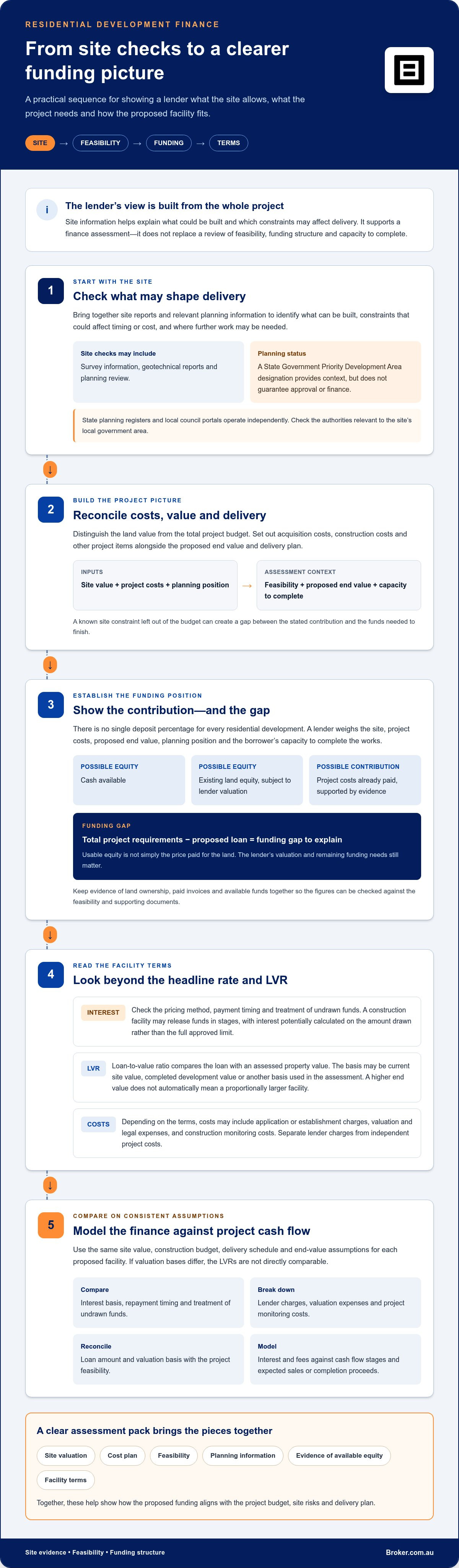
There’s no single deposit percentage for every Australian residential development. The required equity depends on the lender’s assessment of the site, project costs, proposed end value, planning position and borrower’s capacity to complete the works. A smaller, straightforward project with clear planning and strong feasibility may be assessed differently from a complex site with unresolved constraints.
Start by distinguishing the land value from the total project budget. A lender may compare its assessment of the land and completed development with acquisition costs, construction costs and other items in the project feasibility. Owning the site may contribute equity, for example, but the lender’s valuation and the project’s remaining funding needs still matter. Usable equity is not simply the price paid for the land.
Cash is only one possible contribution. Existing land equity or project costs already paid may also form part of the overall funding position. The lender assesses what those contributions represent and how they relate to the proposed facility. Keep evidence of land ownership, paid invoices and available funds together so the figures can be reconciled with the feasibility and supporting documents.
Site checks can affect the equity assessment by revealing risks that may change costs, timing or development value. A survey, geotechnical report or planning review may identify issues requiring design changes or further work. If the budget leaves out a known constraint, the lender may see a gap between the stated contribution and the funds needed to finish. Resolve assumptions in the feasibility before relying on a particular equity figure.
Planning status matters, too. A State Government priority development designation provides relevant context, but does not guarantee approval or finance. State planning registers and local council portals operate independently, meaning applicants must consult the specific authorities relevant to their local government area. Compare the relevant planning records with the site report and proposed development before finalising project assumptions.
To estimate the likely contribution, assemble the site valuation, cost plan, feasibility, planning information and evidence of available equity. Then identify the funding gap between the project’s total requirements and the proposed loan. For development finance for residential projects, that gap depends on how the lender values the security and assesses project risk, not on a universal deposit rule. A clear, documented budget makes the contribution easier to explain and assess.
What are typical interest rates, fees and loan-to-value ratios for Australian development finance?
Australian residential development loans don’t have a standard interest rate, fee schedule or loan-to-value ratio (LVR). A lender prices each proposal according to its security, project structure and assessed risks. A site with clear planning information and a detailed cost plan, for example, presents a different risk profile from land with unresolved constraints. Those differences influence the terms offered.
Interest costs depend on the facility’s pricing method and how funds are drawn. A construction facility may release funds in stages as work progresses, so interest may be calculated on the amount drawn rather than the full approved limit. Ask for the interest basis, payment timing and treatment of undrawn funds in the written terms. Then model those costs against project cash flow and expected sales or completion proceeds.
LVR compares the loan amount with an assessed property value. The valuation basis matters: a lender may consider the site’s current value, the completed development’s value or another basis set out in its assessment. A higher end value doesn’t automatically mean a proportionally larger facility, because the lender also weighs project costs, feasibility and delivery risk. Read the valuation assumptions alongside the proposed loan limit.
Fees can arise at different stages of a finance application and project. Depending on the facility’s terms, they may include application or establishment charges, valuation and legal expenses, and construction monitoring costs. Distinguish lender charges from independent project costs. For example, a quantity surveyor’s assessment relates to construction monitoring, while a lender’s establishment charge relates to setting up finance.
- Compare: interest basis, repayment timing and treatment of undrawn funds.
- Break down: lender charges, valuation expenses and project monitoring costs.
- Reconcile: the loan amount and valuation basis with the project feasibility.
- Model: interest and fees against the development’s cash flow stages.
For a practical comparison, use the same project assumptions for each proposed facility. Align the site value, construction budget, delivery schedule and end-value assumptions before comparing terms. If one proposal uses the current land value and another uses a completed value, their LVRs aren’t directly comparable. Ask how each lender’s calculation relates to the project’s funding needs.
Consider fees and interest together, rather than comparing them as separate headline figures. A facility with a lower stated rate can still have different costs or drawdown conditions. Record each cost, when it applies and whether it’s payable upfront or during the project. This shows how finance terms affect feasibility and the cash available through construction.
What project costs can residential development loans in Australia cover?
An Australian residential development loan can be structured around eligible costs in a project budget. The lender assesses the proposed facility, security and feasibility before deciding which costs it will fund. A townhouse project, for example, may include land acquisition, construction and professional fees. The approved facility’s purpose and drawdown conditions determine how those costs are funded.
Divide the budget into land, pre-construction, construction and completion costs. This shows when each expense arises and whether finance is needed upfront or during the works. A land purchase may occur before construction begins, while contractor invoices arrive as work progresses. Clear categories also help identify expenses that need separate funding or borrower contributions.
- Land: acquisition costs and related transaction expenses included in the project feasibility.
- Pre-construction: design, engineering, surveying and planning-related professional work.
- Construction: building contracts, labour, materials and site works.
- Project oversight: cost monitoring, inspections and other professional services.
- Completion: final works needed to prepare dwellings for occupation or sale.
For a subdivision, the cost plan may also include civil works such as access, drainage and service connections. A site report can identify physical conditions that affect this work. Ground conditions or access limitations, for example, may require design changes. Record each assumption in the feasibility so the budget reflects the actual site and proposed scope.
Pay particular attention to planning and design expenses before construction finance is drawn. Applications, consultant work and design revisions can arise at different stages. Whether a lender includes a specific expense depends on its facility structure and assessment. Show the expected timing, supporting documents and connection to the proposed development instead of grouping every item under “soft costs”.
Not every business or holding expense is automatically a development cost. General overheads, unrelated borrowing repayments or costs from another project may fall outside the approved purpose. Keep project-specific expenses separate from ongoing business expenses. For instance, distinguish invoices for a site’s engineering work from the developer’s general office costs.
Prepare a cost schedule linking each item to a contract, consultant proposal, report or other supporting record. Reconcile it with the construction programme and funding drawdowns. If the project changes, such as through added dwellings or a revised design, update the cost plan and timing. This helps show whether the existing facility still matches the revised scope and cash requirements.
Don’t confuse these project cost categories with the Australian Government’s development finance initiatives. They describe a separate policy context, not an eligibility rule for a residential facility. The Australian Government has established Australian Development Investments, building on the Emerging Market Impact Investment Fund pilot program.
The Australian Government requires all development finance to have a gender equality objective, and set a target for 80 per cent of new development finance investments to effectively address gender equality in implementation. It joined 2X Global to support gender lens investing through shared practices and investment opportunities. The Australian Government will continue to provide highly concessional finance for affordable, productive and climate-resilient infrastructure in Pacific Island countries, while avoiding unsustainable debt burdens.
What are the eligibility criteria and presale requirements for development finance in Australia
Australian lenders assess the borrower and proposed development together. They examine the applicant’s financial position, development experience, project feasibility and capacity to manage delivery. A first-time developer may need to demonstrate capable project partners and a credible plan. An experienced builder-developer can support an application with completed project records and evidence of managing budgets and construction timelines.
Control of the site is another key consideration. The lender needs to understand who owns the land, the proposed development entity and any existing commitments over the property. Provide title information, purchase documents and details of related parties. If a company or trust owns the site, its structure and financial records help explain who is borrowing and which assets support the proposal.
Planning readiness affects the project’s risk profile. Lenders review the proposed use, relevant planning information, site constraints and status of required approvals. A site report can identify issues that may change design, cost or delivery assumptions. For Brisbane’s Priority Development Areas, the Department of State Development, Tourism and Innovation maintains a register independent of Brisbane City Council’s register of current and decided development applications. Reviewing relevant planning records alongside site reports can clarify the proposal’s context.
Presales can help demonstrate market demand and forecast repayment sources, particularly when completed dwellings are intended for sale. A lender may examine the number and value of contracts, their conditions, purchaser deposits and settlement timing. An expression of interest is not the same as an executed sale contract, so present each category clearly. The strength of the evidence depends on contract terms and how closely expected settlements align with project funding needs.
There’s no presale threshold that applies to every Australian development loan. The required level may depend on the project’s scale, end value, borrower equity, construction risk and proposed exit strategy. A project relying on unit sales may be assessed differently from one intended for long-term rental. Consider presales alongside the full feasibility, not as a standalone measure of approval.
- Borrower: document relevant delivery experience, financial capacity and the project team’s roles.
- Site: organise ownership records, planning information and reports on physical constraints.
- Feasibility: align construction costs, programme, end values and funding assumptions.
- Presales: separate executed contracts from expressions of interest and show key conditions.
Before seeking terms, reconcile presale records with the project schedule and cash-flow forecast. A contract settling after construction completion, for example, may not provide funds during earlier building stages. Showing contract timing, construction milestones and the intended repayment path gives lenders a clearer view of how the development will be funded from commencement to completion.
How do banks, specialist lenders and private lenders compare for Australian residential development finance
Australian development lenders differ in credit appetite, assessment methods and facility terms. A bank, specialist lender and private lender may assess the same townhouse proposal differently. Compare their requirements with the project’s planning position, borrower experience, funding structure and intended repayment path. The lender category alone doesn’t determine which option suits a particular development.
Banks assess applications under their own credit policies and documentation processes. Their review may focus on the borrower’s financial position, project feasibility, security and evidence supporting sales or rental income. A proposal with established approvals, a detailed cost plan and clear repayment sources, for example, gives assessors concrete information to consider. The key is how the bank’s criteria align with the project’s structure and timing.
Specialist lenders focus on particular types of finance or security, which can shape their assessment of a residential development. Their experience with construction facilities may put project-specific details at the centre of the review, including staged drawdowns, cost monitoring and the proposed exit. When comparing options, clarify how the lender assesses land value, completed value and project risks. These inputs affect the proposed structure, not just the headline rate.
Private lenders can provide another funding route, often for projects whose timing or circumstances don’t fit a conventional credit process. Examine their terms closely, including interest calculation, fees, repayment date, security and any drawdown conditions. A facility intended to bridge a planning or construction stage, for example, needs a credible repayment plan. Model the full funding period against sales settlements or refinancing assumptions.
- Assessment: compare required evidence, borrower criteria and treatment of planning status.
- Structure: review drawdown stages, construction monitoring and repayment conditions.
- Cost: assess interest and all applicable charges across the expected facility period.
- Exit: match loan maturity with realistic sales, settlement or refinancing timing.
Use one project information pack to compare proposals across lender categories. Keep the site report, planning records, feasibility, construction programme and sales assumptions consistent. Then record each lender’s valuation basis, required equity, conditions and exit expectations. If one proposal assumes completed value while another relies on current land value, compare the underlying calculations before weighing the headline terms.
For a residential project with unusual planning conditions or a complex construction programme, the assessment method may matter as much as the rate. Set out the project’s key constraints and funding milestones clearly. You can discuss development finance options in light of the project’s structure and funding needs.
Broker.com.au: Secured Business Loans
Broker.com.au can help you assess whether a Secured Business Loan suits your residential project’s funding needs. It may be relevant when the proposal involves suitable security and you’re considering how finance could support project costs. The right structure depends on the project, borrower position and lender assessment.
Bring together the feasibility, site information, cost plan and expected cash flow. These details help define the funding requirement and show how it relates to the development’s stages. If your project needs a different funding approach, Broker.com.au also offers Business Acquisition Funding, Unsecured Business Loans and Working Capital Finance.
For a considered discussion about your project’s funding needs, contact Broker.com.au.
Turn your site findings into a clear finance plan
Turn your project information into a concise funding brief. Set out the intended development, ownership structure, delivery plan and decisions still to be made. This keeps conversations focused on how finance should work alongside the project, rather than treating funding as a standalone decision.
Broker.com.au offers Development Finance, Secured Business Loans, Business Acquisition Funding and Unsecured Business Loans. For a residential project, discuss Development Finance in the context of your proposed structure and funding needs. The other options may suit different business funding requirements.
Before starting that conversation, bring your site findings and project assumptions together. Clear information makes it easier to explore how development finance for residential projects could align with your next steps. Contact Broker.com.au to discuss your options and move forward with a more organised view of the project.
Frequently Asked Questions
What is residential property development finance in Australia?
Residential property development finance is funding arranged for a project that creates or substantially develops homes, rather than a standard owner-occupier mortgage. It can support a developer through activities such as preparing a site, building dwellings and completing the project. A proposal to construct townhouses for sale, for example, has different funding needs from buying an established home to live in. The facility’s structure depends on the project’s stages and intended outcome.
How do state planning rules, council approvals and taxes affect residential development finance in Australia?
Planning status and site checks can influence a lender’s view of project risk, costs, timing and feasibility. A Priority Development Area designation doesn’t guarantee approval or finance, so compare relevant planning records with the site report. The material provides no information about taxes.
What are the steps to apply for residential development finance in Australia?
Assemble the site valuation, cost plan, feasibility, planning information and evidence of available equity. Reconcile these against the project’s total funding needs, identify any funding gap, and review the proposed facility’s terms and drawdown conditions.