
What if the strongest expansion loan isn’t simply the one with the lowest rate, but the one whose repayments fit the cash flow your project can generate? Securing a large business loan for expansion can feel daunting when you’re weighing future revenue against repayments, security and the risk of narrowing your finance options with an incomplete application.
Lenders want to understand how the expansion will work, what it will cost and how your business will service the debt. A confident forecast helps, but it needs to be backed by clear financial evidence and realistic assumptions. The funding structure should also match the project’s repayment source, whether that’s new equipment, additional capacity or another growth opportunity.
This guide explains how Australian lenders assess expansion plans and what they may look for in your financials, cash flow, security and contribution. You’ll learn how to compare funding structures, prepare an evidence-led application and assess whether projected repayments are manageable. With a clearer view of the process, you can approach your options with greater confidence.
Key Takeaways
- See when an expansion loan fits your project and how to distinguish growth investment from routine working-capital needs.
- Understand how lenders weigh business performance, repayment capacity, loan purpose and security.
- Compare funding structures against what the money will achieve and where repayments are expected to come from.
- Make securing a large business loan for expansion more straightforward by organising project evidence and clearly labelling forecast assumptions.
- Learn how Broker.com.au’s FinMatch® process can help compare lender options, with access to 100+ lenders.
Table of Contents
- When a large business loan makes sense for expansion
- What lenders assess before funding a major business expansion
- Compare expansion loan options by what the funding will achieve
- Prepare a stronger application for a large expansion loan
- Secure expansion finance with Broker.com.au’s lender-matching process
When a large business loans makes sense for expansion
A loan is “large” in the context of your business and the project it funds, not because it crosses a universal dollar threshold. Start by asking what the funds will achieve, how the project fits your broader finances and where repayments will come from. A substantial request needs a coherent plan linking the funding amount to specific costs and a realistic repayment path.
Expansion investment often funds a defined growth opportunity, while routine working capital helps manage day-to-day cash needs such as supplier payments. The distinction isn’t always clear-cut. A new site, for instance, may need both fit-out funding and cash to cover its early operating costs. Understanding the differences between business loan structures can help frame the questions to consider, but the right fit depends on the project and its cash flow.
What counts as expansion finance for an Australian business?
Expansion finance can support a new site, increased production capacity, equipment, commercial property or buying an existing business. Each purpose may call for a different structure. Equipment finance may align funding with an asset purchase, while commercial property finance may suit a property-led project. Business Acquisition Funding can support buying an existing business, with the lender assessing the purchase and the acquired business’s ability to contribute to repayments.
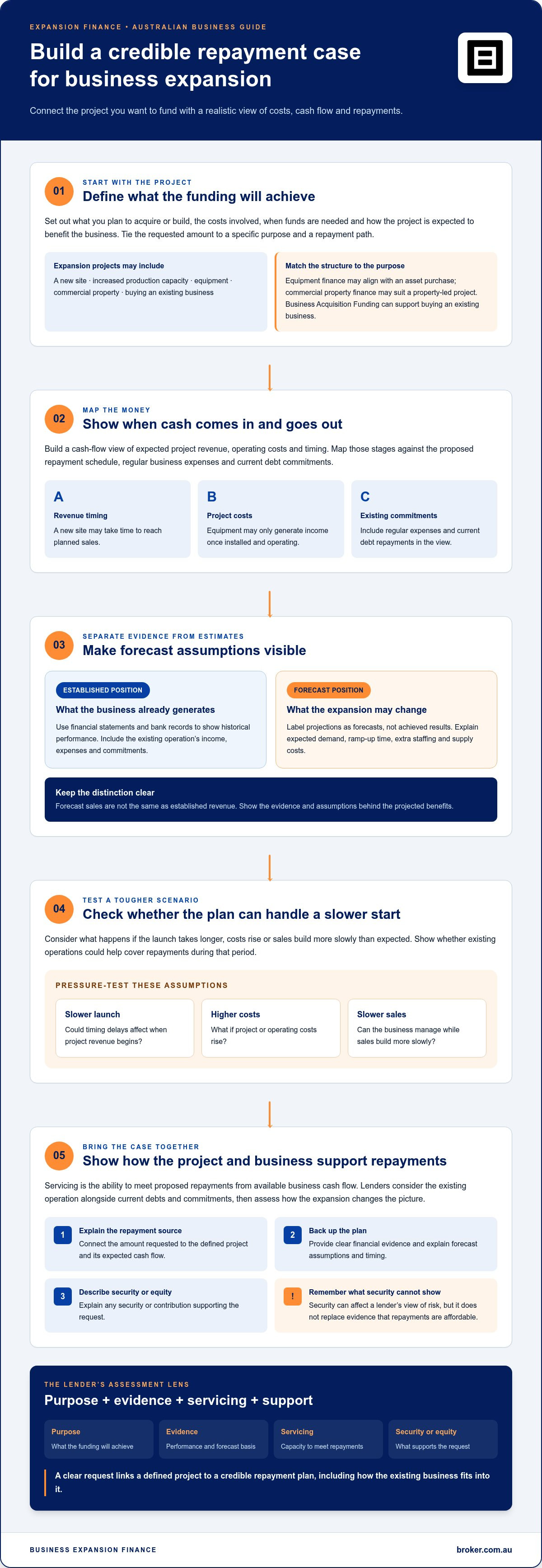
Keep the request tied to a defined project. Set out what you plan to acquire or build, the costs involved, when funds are needed and how the project is expected to benefit the business. If the plan includes buying a business, consider the purchase price alongside your cash contribution, ongoing costs and the target business’s trading performance. This gives lenders a clearer basis for assessing the proposed acquisition finance.
How to test whether the project can support more debt
Build a cash-flow view that shows the project’s expected revenue, operating costs and timing. A new site may take time to reach planned sales; additional equipment may only generate income once it’s installed and operating. Map those stages against the proposed repayment schedule, as well as the existing business’s regular expenses and current debt commitments.
Keep projected benefits separate from money the business already generates. Forecast sales are not the same as established revenue, so show the assumptions behind them, such as expected demand, ramp-up time and extra staffing or supply costs. This helps a lender understand the basis of your projections rather than treating hoped-for growth as proven income.
Then test a more cautious scenario. What if the launch takes longer, costs rise or sales build more slowly than expected? Show whether existing operations could help cover repayments during that period, and identify where the pressure points would be. The aim isn’t to make the forecast look flawless. It’s to demonstrate that you’ve considered timing risk and can explain how the business would manage a slower start.
That’s the practical test for securing a large business loan for expansion: connect the amount requested to a defined project, and show how both the project and the existing business fit into a credible repayment plan.
What lenders assess before funding a major business expansion
A lender won’t assess a major expansion on the headline loan amount alone. They’ll consider the funding purpose alongside the business’s financial performance, its capacity to repay and any security or equity supporting the request. These factors connect: a strong asset position may help explain the risk, but it doesn’t show by itself that repayments are affordable.
Historical results and future projections each tell a different part of the story. Financial statements and bank records show how the business has performed; forecasts explain what the expansion may change. Lenders may also consider the business’s credit history, trading record, existing commitments and the experience behind the plan. As a general guide to common assessment considerations, the Australian Government’s business grants and programs information can help you explore potential supplementary funding, though eligibility and program availability vary.
A lender needs to understand the purpose, the evidence behind the plan, the source of repayments and the security or equity supporting the request.
How servicing and cash flow shape borrowing capacity
Servicing is the ability to meet proposed repayments from available business cash flow. A lender will consider the existing operation’s income and expenses alongside current debts and other operating commitments, then assess how the expansion changes that picture. There’s no single threshold that applies to every lender or transaction, so present the cash-flow case clearly rather than relying on a generic borrowing estimate.
Support assumptions with evidence where possible, and label projections as forecasts rather than achieved results. Explain when new revenue is expected to begin, which costs arrive first and how a slower ramp-up could affect the repayment plan. That context helps lenders judge whether the forecast is credible and how the business may manage less favourable conditions.
What security, deposit or equity may contribute
Security can affect a lender’s view of risk and the structure they consider, but it doesn’t replace evidence that the loan can be serviced. For a business buyer, the proposed deposit or equity contribution is also part of the assessment. Explain where that contribution comes from and how the transaction is structured, including what the loan funds and what the buyer contributes.
There’s no universal deposit percentage for buying a business. The required contribution can depend on the lender, purchase details, available security and the strength of the servicing case. Prepare a clear account of the buyer’s contribution and the acquired business’s financial information so the lender can assess the deal as a whole. Requirements and acceptable evidence vary by lender and transaction, so organise the information to make the connections easy to follow.
For a broader view of funding pathways, review the Australian Government’s grants and programs alongside loan options, keeping any grant funding separate from confirmed funds in your financing plan. If you’re weighing structures for an expansion, explore business finance options with Broker.com.au, which can help compare lender requirements against your project.
Compare expansion loan options by what the funding will achieve
When securing a large business loan for expansion, start with the project’s purpose and match the funding structure to the asset or activity involved. A repayment plan should make sense alongside that choice: equipment may generate income over time, while a property purchase or business acquisition has different costs and cash-flow drivers. The options below are starting points for comparison, not a guarantee that a particular structure will suit every business.
| Expansion purpose | Possible structure | Potential repayment source | Key assessment considerations |
|---|---|---|---|
| Machinery or operational assets | Equipment or asset finance | Cash flow generated by the expanded operation | Asset details, project timing and the business’s capacity to meet repayments |
| Business premises | Commercial property finance | Business cash flow, including any income the premises may support | Property and transaction details, available equity and servicing capacity |
| Short-term cash-flow timing | Line of credit or invoice finance | Incoming receipts or customer invoice payments | Cash-flow cycle, expected use of funds and how the facility will be managed |
| Purchase of an existing business | Business acquisition funding | Cash flow from the acquired business and, where relevant, the buyer’s existing operations | Purchase terms, buyer contribution, transaction structure and evidence of sustainable earnings |
Choose a structure for equipment, property or working capital
For machinery or operational assets, equipment or asset finance may align funding with the item being acquired. If premises are central to the expansion, commercial property finance is a more directly relevant option to assess. A line of credit or invoice finance may suit a defined gap between paying operating costs and receiving customer payments. These facilities address timing needs, so consider whether the underlying cash-flow cycle can support their use.
Secured and unsecured business loans are also worth comparing. Security may affect the lender’s risk assessment and the terms considered. An unsecured structure may avoid pledging a particular asset, but still depends on the lender’s assessment of repayment capacity and the business. Neither is automatically preferable. Compare the full structure against the project, repayment source and security available.
Business acquisition finance for buying an existing business
Acquisition finance needs to account for more than the purchase itself. A business buyer should set out the purchase terms, deposit or equity contribution, supporting financial evidence and any transition costs that affect early cash flow. Lenders may assess the acquired business’s trading performance alongside the buyer’s ability to service the proposed debt. Keep purchase funding distinct from any additional working capital required after settlement.
One Broker.com.au case involved an $800k business acquisition funded at 80% LVR, with no property security and a 20% cash deposit. It’s an example of one transaction, not a standard offer or a promised outcome for other buyers. Requirements depend on the lender and deal. If personal funds are part of the contribution, keep personal and business liabilities clear in your records. The ATO’s guidance on study and training support loans relates to that separate personal obligation, rather than business lending.
To compare structures against your expansion plan, explore tailored business finance options with Broker.com.au.
Prepare a stronger application for a large expansion loan
A well-prepared application makes it easier for a lender to see how the project, business finances and proposed loan fit together. Before approaching lenders, organise the request in a clear sequence. That preparation can help you explain not only how much funding you need, but why the structure suits the project and how repayments are expected to be managed.
- Define the project. Describe what the expansion involves, its purpose, key stages and expected timing. Identify the costs the loan will cover and separate them from any contribution the business will make.
- Set out the request. State the amount sought and how it connects to the project budget. If costs or timing are still estimates, label them as such and explain the basis for your figures.
- Present the business position. Summarise trading performance, existing debts and material operating commitments. Use confirmed financial information to show what the business has already achieved, rather than presenting expected growth as established income.
- Show the repayment pathway. Explain where repayments are expected to come from and when. Connect projected revenue to the project’s timing, account for associated costs and show how the business could respond if growth takes longer than planned.
- Match the funding structure. Relate the proposed finance to the asset or activity being funded, the available security or equity and the repayment source. A clear connection helps lenders assess the request on its merits.
Build an evidence-led expansion proposal
Support the proposal with relevant records, such as financial statements, recent business bank statements, current debt details, project quotes or contracts and a cash-flow forecast. Keep confirmed information distinct from projections. For each forecast, state the assumptions behind expected sales, costs and timing, and explain dependencies such as installation, recruitment or customer demand. A realistic downside scenario can show how you’ve considered delays or slower growth.
Keep the documents easy to follow. Use clear file names and group material by topic so a lender can connect each claim in the proposal to its supporting evidence. Requirements differ between lenders and transactions, so a prepared business can respond more efficiently if additional information is requested.
Organise information for lender assessment
Arrange the application into sections for business details, financial records, existing commitments, proposed security and project documents. For business acquisition funding, include purchase details, the buyer’s deposit or equity contribution, information about the target business and a view of cash flow during the ownership transition. Explain how the proposed borrowing will be serviced as the handover takes place.
Accuracy matters. Check that figures agree across the proposal, financial records and forecasts, and flag any material changes or assumptions rather than leaving lenders to infer them. A clear application won’t guarantee approval, but it gives lenders a more coherent basis for assessing the request.
If you’re ready to discuss your plans, explore expansion finance options with Broker.com.au. With your project mapped out, it’s easier to consider structures that align with its purpose and repayment plan.
Secure expansion finance with Broker.com.au’s lender-matching process
A clear funding plan is the starting point. Broker.com.au’s process connects your expansion requirements with lender products, with a broker supporting you as the application progresses. Whether you’re funding equipment, premises or a business acquisition, the aim is to compare structures in light of the project and its repayment source, not assume that one option suits every business.
How FinMatch® and a broker support the funding process
FinMatch® analyses the information you provide and matches it to lender products. Broker.com.au has access to 100+ lenders, creating an opportunity to compare potential structures across a broad lender panel. That access doesn’t guarantee approval, a particular rate or a specific offer. Each lender assesses the application against its own criteria and the details of the transaction.
The process follows four steps:
- Complete the form. Share information about your business, expansion purpose and funding needs.
- Get matched via FinMatch®. Your details are matched to lender products for consideration.
- Work with a broker. A broker can help compare relevant structures and coordinate the application as it moves through assessment.
- Secure finance. If a lender approves the application and you accept its terms, the process can move towards settlement.
You’ll work with a single point of contact through settlement, helping keep communication and application details connected as the process progresses. Broker.com.au’s three senior advisors bring 65+ years of combined experience. This can be valuable when the funding request involves several moving parts, such as coordinating a project’s funding needs with the proposed loan structure.
Turn a finance plan into a next step
Before discussing options, have your project purpose, funding requirement and repayment plan clearly mapped. For an expansion involving new assets, premises or an acquisition, matching the finance structure to what the funds will achieve can help keep the request focused. Across its finance offering, Broker.com.au arranges funding from $50K+ to $100M+, with the appropriate option depending on the business and transaction.
Broker.com.au has originated $1.5B+ in business loans since late 2021. That experience provides context for the team’s work, but it doesn’t guarantee a particular result. Securing a large business loan for expansion still depends on the lender’s assessment of your individual application, the project and its servicing case.
If you have a plan taking shape, start a conversation with Broker.com.au about your expansion goals. The first step doesn’t commit you to a particular loan or outcome.
Make your next move with a clear funding plan
Growth plans become easier to act on when the funding request is grounded in a practical repayment pathway. Before taking the next step, consider what needs to happen first, which costs are essential and how you’ll track whether the expansion is delivering the results your forecast anticipates. That discipline can help you make informed decisions as the project develops, whether you’re investing in capacity or buying an existing business.
For securing a large business loan for expansion, the right conversation starts with your priorities, not a one-size-fits-all structure. Broker.com.au was named 2025 Cash Flow Brokerage of the Year and 2025 Innovator of the Year, reflecting its focus on finance solutions and innovation.
If you’re ready to explore how your plan could be funded, discuss your expansion finance options with Broker.com.au. Take the next step with a clearer view of the choices ahead and support to move forward with confidence.
Frequently Asked Questions
How much can a business borrow for expansion in Australia?
There’s no single borrowing limit that applies to every Australian business. The amount a lender may consider depends on the project, the business’s financial position, its capacity to service repayments and the proposed finance structure. For a useful starting estimate, prepare a costed project plan and show how each funding requirement has been calculated. A broker can help compare lender options, but approval and borrowing capacity are assessed individually.
What do lenders look at when assessing a large business loan?
Lenders look at whether the funding purpose and the business’s financial evidence support the amount requested. They may review financial statements, bank activity, existing liabilities, credit history and the assumptions behind your forecasts. Make sure the figures in your proposal reconcile with supporting records, and explain unusual fluctuations, such as a one-off expense or seasonal revenue dip. Clear context helps a lender interpret the business’s performance rather than relying on a headline figure alone.
Do I need to provide security for a large business loan?
Not always. Some business loans are secured against assets, while unsecured options may be assessed more heavily on the business’s financial strength and repayment capacity. Whether security is required depends on the lender, the requested structure and the transaction. Before applying, identify assets that may be available and any existing claims over them. Also consider the implications of offering security, rather than assuming collateral alone will support approval.
Can I use business acquisition finance to fund expansion?
Yes. Business acquisition finance can fund expansion through buying an existing business, including a purchase involving goodwill, assets or working capital for the transition. A business buyer should distinguish the purchase funding from any additional funds needed to support operations after settlement. Prepare information about the target business, purchase terms and expected cash flow under new ownership so the lender can assess how the acquisition fits the buyer’s wider business plans.
How much deposit or equity is needed to buy a business?
There’s no fixed deposit requirement that applies to every business purchase. The buyer’s contribution depends on the lender’s assessment, the transaction structure, available security and the evidence supporting repayment capacity. Before committing, map out the funds needed for the purchase and transition, then identify how much equity you can contribute and where it comes from. Keep supporting records for that contribution ready as part of the acquisition finance application.
How can I show that my expansion can service a loan?
Use a cash-flow forecast that shows expected income and costs by timing, then compare available cash with proposed repayments and existing obligations. For securing a large business loan for expansion, make assumptions visible. For example, show when a new site is expected to open and when revenue may start. Include a slower-growth scenario and explain what costs could be delayed or adjusted if the project takes longer to generate income.
Should I use one loan or several types of finance for expansion?
It depends on whether the project has distinct funding needs and repayment sources. One facility may keep borrowing simpler, while separate structures could align funding with different uses, such as equipment, premises or a temporary gap between invoices and receipts. Weigh that alignment against the extra administration and repayment commitments of multiple facilities. A clear schedule of project costs can help show whether combining finance types adds useful flexibility or unnecessary complexity.