
What if the strength of a business growth loan application depends less on the amount you request and more on how clearly you explain its purpose and repayment plan? It’s understandable to be unsure which financial records to gather, especially when existing debt or uneven cash flow may affect what you can borrow. Knowing what lenders require for a business growth loan can help you prepare with confidence.
A well-supported request connects your growth plan to evidence: how the business is performing, what the funds will pay for and how repayments could be managed. Whether you’re investing in equipment, expanding operations or considering business acquisition funding, choosing finance that fits the purpose matters.
This guide explains the information lenders may assess, from financial statements and cash flow to existing commitments and supporting documents. You’ll also learn how to present a clear funding case. With a focused plan and organised evidence, you can make the funding conversation more straightforward.
Key Takeaways
- Understand what lenders require for a business growth loan, while allowing for differences in lender criteria, loan type and your circumstances.
- Build a clear picture of loan servicing by organising evidence of cash flow, revenue and existing liabilities.
- Compare how security, guarantees and your own contribution may vary, particularly when considering business acquisition finance.
- Start with the funding purpose, amount and timing, then prepare supporting records and projections to explain the request.
- Broker.com.au’s FinMatch® technology analyses your information to match it with lender products. It supports the process but doesn’t guarantee approval.
Table of Contents
- What lenders require for a business growth loan: the core assessment
- How lenders assess cash flow, financials and loan servicing
- Security, equity and loan structure: what can differ between lenders
- How to prepare a business growth loan application
- How Broker.com.au can help you approach growth finance
What lenders require for a business growth loan: the core assessment
Lenders assess the business, the proposed borrowing and whether the business appears able to manage repayments. That means what lenders require for a business growth loan depends on more than the amount requested. The lender may consider the loan type, purpose, security offered, applicant circumstances and the information available to support the application. There isn’t one universal checklist or threshold that guarantees approval.
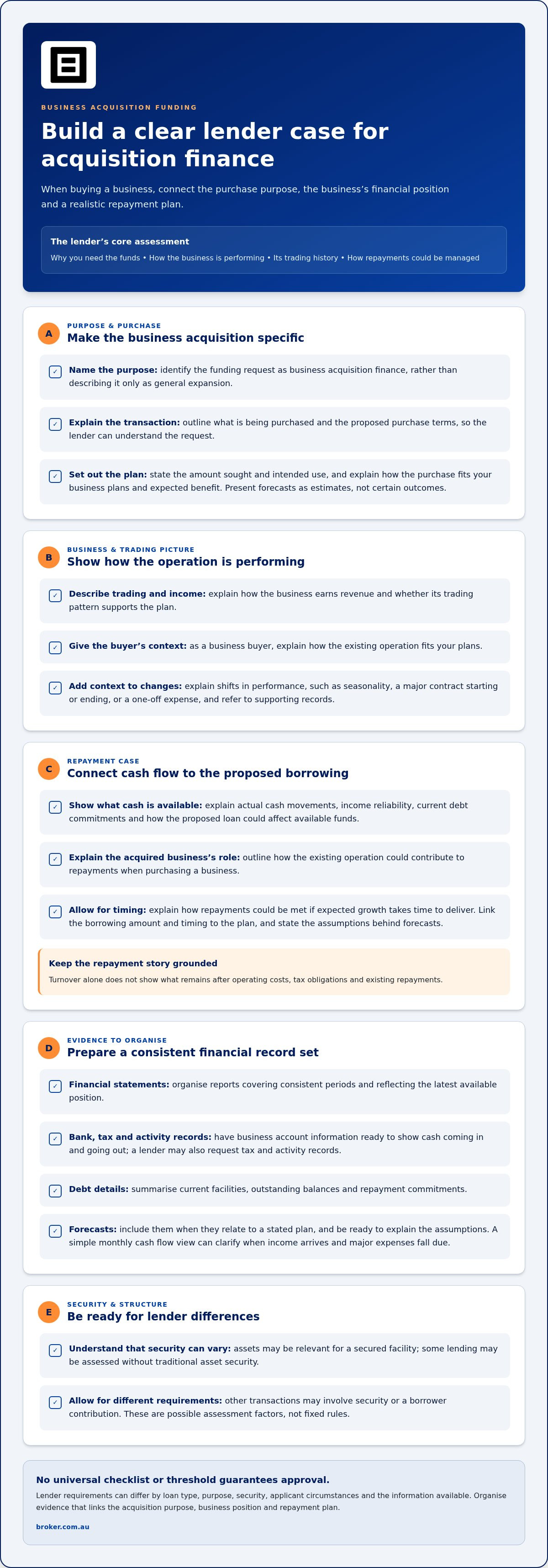
Prepare to explain four connected areas: why you need the funds, your financial position, your trading history and how the business could meet repayments. Together, these details help a lender understand the request. For a general introduction to how business borrowing can be structured, see Understanding Business Loans.
How a clear growth purpose helps frame the request
Describe what the funds will pay for and how the spending supports your plan. An expansion request might cover additional premises or increased operating capacity. Equipment finance may relate to a specific asset, while working capital could help manage the costs of scaling activity. State the amount sought and intended use, then explain the expected business benefit without presenting forecasts as certain outcomes.
If the growth plan involves buying a business, identify business acquisition as the purpose rather than describing it only as general expansion. Acquisition finance adds a transaction to the assessment: the lender may need to understand what is being purchased, the proposed purchase terms and how the acquired business could contribute to repayments. A business buyer should also explain how the existing operation fits their plans.
What lenders may consider about the business
Lenders may look at trading history, income patterns, current liabilities and the broader financial position to understand how the business operates. The key question is whether available cash flow can support the proposed repayments alongside existing obligations. A profitable period on its own may not tell the full story if revenue varies or the business already has substantial commitments. Explain relevant changes and provide supporting evidence.
Show how your growth case connects these details:
- Trading and income: explain how the business earns revenue and whether its trading pattern supports the plan.
- Commitments: account for current loan repayments and other financial obligations that affect available cash.
- Repayment case: explain how repayments could be met, including if the expected growth takes time to deliver.
Assets may also be relevant, particularly where a facility is secured, but security requirements vary. Some lending may be assessed without traditional asset security, while other transactions may involve security or a borrower contribution. These are possible assessment factors, not fixed rules. Start with an evidence-backed request that links the funding purpose, business position and repayment plan.
How lenders assess cash flow, financials and loan servicing
Loan servicing is the business’s ability to meet proposed repayments alongside its other financial obligations. Lenders assess repayment capacity in the context of the business’s financial position. They may consider actual cash movements, the reliability of income, current debt commitments and how the proposed loan would affect available funds. Revenue matters, but turnover alone doesn’t show what remains after operating costs, tax obligations and existing repayments.
For a growth application, connect the borrowing amount and timing to the plan. For example, if you’re seeking funds to install equipment before a planned increase in production, show when the expense is due, how it relates to the business plan and when you expect the change to affect cash flow. Treat forecasts as estimates, and explain the assumptions behind them. This helps the lender assess the request against the business’s current position.
Financial information to organise before applying
Gather the financial records you have available and make sure the periods covered are easy to compare. Depending on the application, a lender may request financial statements, business bank information, tax and activity records, and details of current debts. Use this as a preparation base, as requirements vary by application.
- Financial statements: organise reports for consistent periods and make sure they reflect the latest available position.
- Bank information: have business account records ready to show cash coming in and going out.
- Debt details: summarise facilities, outstanding balances and repayment commitments.
- Forecasts: include them when they relate to a stated growth plan, with assumptions you can explain.
If performance has shifted, add context rather than leaving a lender to guess. A change in revenue might relate to seasonality, a major contract starting or ending, or a one-off expense. Keep the explanation factual and refer to the records that support it.
Explaining existing debt and changing cash flow
Set out how existing facilities fit into the business’s cash commitments, including any planned changes such as refinancing or paying down a balance. For seasonal or variable income, use records across a period that shows the pattern, rather than relying on one unusually strong month. A simple monthly cash flow view can help explain when income arrives and when major expenses fall due.
This is especially useful for a business buyer assessing acquisition finance: the buyer’s existing commitments and the target business’s cash flow both inform the repayment picture. Don’t assume the acquired business’s revenue will automatically be available to service a new loan. Explain how the transition, operating costs and proposed repayments fit together, using evidence where available.
A clear financial summary can make gaps and pressure points easier to identify before an application is considered. To organise a growth funding request around its cash flow and purpose, explore business finance support.
Security, equity and loan structure: what can differ between lenders
Security and borrower contribution can shape a growth loan, but neither follows one standard formula. A lender’s approach may depend on the facility, amount, purpose, available assets and applicant’s circumstances. To understand what lenders require for a business growth loan, consider the proposed structure alongside how the funds will be used and repaid. Don’t assume every lender asks for the same security or deposit.
Secured and unsecured growth finance
With secured finance, an asset may be offered to support the loan. The asset and any conditions depend on the lender and transaction. Unsecured finance doesn’t use that same form of asset security, but repayment capacity still matters. The business’s financial position and ability to meet its commitments remain relevant. Compare the proposed repayments and obligations with the funding purpose, not just whether a facility is secured.
A guarantee or borrower contribution may also form part of a particular structure, but neither is an automatic requirement for every application. Before proceeding, understand what the proposed arrangement asks of the business and any relevant parties, including obligations attached to security or guarantees. Consider whether the structure suits the purpose, available contribution and expected cash flow.
When the growth plan involves buying a business
Business acquisition funding has a different transaction context from finance for general expansion or working capital. A business buyer should be ready to explain what is being purchased, how the funds will be allocated and how the transition from seller to buyer is expected to work. Depending on the transaction, the purchase may involve goodwill, business assets or working capital. Set out the components clearly so the funding request reflects the acquisition plan.
Broker.com.au has funded an $800k business acquisition at 80% LVR, with no property security and a 20% cash deposit. This is a specific transaction, not a standard deposit requirement or a promise that a lender will offer the same terms. Security and equity requirements can vary with the lender and transaction.
When purchasing a business, distinguish the purchase price from other funding needs. If working capital is also required after settlement, explain that use separately rather than assuming it is included in the acquisition funding. A clear breakdown gives the lender a more accurate view of the requested structure and the obligations the business would take on.
- Purpose: separate acquisition costs from expansion or working capital needs.
- Contribution: show the proposed source and amount of the buyer’s equity, where relevant.
- Structure: understand any security, guarantee and repayment obligations attached to the proposal.
How to prepare a business growth loan application
A clear application helps a lender understand the growth initiative, the amount requested and the evidence behind your plan. Use this sequence to build a focused request. It’s a practical starting point, as the information required can vary with the finance type and your circumstances.
- Define the purpose, amount and timing. State what the funds will cover, how you arrived at the requested amount and when they’re needed. Separate distinct uses, such as equipment purchases and working capital, so the request has a clear structure.
- Describe the growth opportunity. Explain what the business plans to do and the expected operational effect. For example, outline how additional equipment could support planned production, while making clear that forecasts are estimates, not assured results.
- Bring together business and financial information. Organise available financial statements, bank information, current liabilities and relevant business details. Use consistent reporting periods, check figures agree across documents and briefly explain any material changes.
- Match evidence to each cost. Include supporting material that relates directly to the proposed use, such as supplier quotes for planned purchases or relevant transaction information for an acquisition. Avoid adding documents that don’t help explain the request.
- Make assumptions visible. If you provide forecasts, state the assumptions behind them and connect them to the growth plan. Explain how the initiative is expected to affect operations and cash flow, without presenting projected revenue as guaranteed.
Build an evidence-backed funding request
Keep the core explanation concise: what the opportunity is, what you’ll spend the funds on and how the proposed change may affect the business. When buying a business, organise the available purchase and target-business information alongside your proposed funding use. Include transaction details and a transition or handover plan where relevant, so the lender can see how the acquisition fits your operating plans.
This preparation helps you address what lenders require for a business growth loan: the purpose, supporting evidence and repayment case can be considered together. It can also help you spot missing information before the application progresses.
Respond to lender questions and compare suitable options
An organised request may not be the end of the information-gathering process. A lender may ask follow-up questions or request additional documents as it assesses the application. Keep a record of what you’ve provided and respond with consistent figures. If something has changed, explain the difference rather than sending an unexplained new version.
As you consider options, compare how well each structure fits the funding purpose, repayment pattern, security expectations and the business’s overall obligations. Indicative terms aren’t an approval or final offer. Broker.com.au can help organise your evidence around the funding purpose and discuss your business finance options, with support through the process and settlement.
How Broker.com.au can help you approach growth finance
Preparing a funding request can feel complex when you’re weighing lender requirements against the practical needs of your business. Broker.com.au is an Australian business loan broker, not a direct lender. Its advisers help organise the request around your funding purpose and supporting information, then use FinMatch® to analyse client information and match it with lender products. FinMatch® helps match a request to lenders, but it doesn’t guarantee approval.
Broker.com.au provides access to 100+ lenders through one broker, with a single point of contact to support you through the process and settlement. This can help bring structure to a request when you’re considering different funding purposes, financial evidence and potential lending options. The business has originated $1.5 B+ business loans since late 2021, and its senior team brings 65+ yrs of combined experience.
A guided process for matching the request to finance options
The process moves from an outline of your needs to a lender-matched request, with broker support along the way. You provide information about the business and funding purpose, then work with an adviser to develop the request. The steps are:
- Complete a form with information about your business and funding needs.
- Get matched via FinMatch®, which analyses your information and matches it with lender products.
- Work with a broker to discuss the request and available finance options.
- Progress towards securing finance, with support through the process and settlement. Any lending remains subject to the relevant lender’s assessment and decision.
This gives you a guided way to discuss how your funding purpose and business evidence fit together, while recognising that lender requirements and decisions differ. A broker can help you understand the information needed and keep the process moving as questions or documentation needs arise.
Business growth and acquisition funding conversations
The finance conversation can be shaped around how you plan to use the funds. Business loans may suit broader funding needs, working capital finance can address cash-flow requirements, and asset finance may be relevant when growth involves equipment or other assets. If your next step is buying a business, business acquisition finance frames the request around the purchase and its transaction details. The broker can help organise the request around that purpose, rather than treating an acquisition like routine expansion.
Exploring options doesn’t assure approval, a particular rate or a specific outcome. It’s a practical first step towards understanding how your funding request may fit lender products and what information may be needed. I’m interested in exploring business finance options.
Turn your growth plan into a confident next step
A funding request can be more than a set of documents. Use it to test whether the opportunity, timing and proposed commitments still make sense together. If the plan changes, revisit the amount or structure before proceeding rather than stretching the business to fit an outdated request.
Knowing what lenders require for a business growth loan is a useful starting point, but the request needs to be specific to your business. Set out the decision you’re preparing to make, the evidence that supports it and the questions you still need answered. If buying a business is part of your plans, include the acquisition’s role in your wider growth strategy.
Broker.com.au can help you shape a finance conversation around your purpose and circumstances, without assuming one structure suits every business. I’m interested in exploring business finance options.
A clear plan puts you in a stronger position to assess the options ahead and move towards your next stage with confidence.
Frequently Asked Questions
Do lenders require a minimum time in business for a growth loan?
There isn’t one minimum trading period that determines what lenders require for a business growth loan; criteria vary by facility and applicant. A longer trading record may give a clearer picture of performance, while a newer business can explain when trading began and any changes in ownership or operations. Prepare consistent records showing the business’s activity to date, so the lender can assess its actual history rather than rely on an assumed threshold.
Can a business get a growth loan with variable revenue?
Possibly. Variable revenue doesn’t automatically rule out finance, but a lender will need to understand the pattern and whether repayments appear manageable through quieter periods. Use records that show a full trading cycle where available, and distinguish seasonal peaks from recurring income or one-off sales. For example, a business with busy summer months can explain how it manages supplier and wage costs during slower parts of the year.
How much deposit or equity do I need for a business growth loan?
There’s no universal deposit or equity percentage for every business growth loan. Whether you need to contribute funds depends on the lender, facility and transaction. General expansion finance may be structured differently from borrowing to purchase an existing business. Work out what cash the business or buyer could contribute and how that affects the requested borrowing and funds left for operations. A specific deal shouldn’t be treated as a standard requirement.
Do lenders require security for a business growth loan?
Not always. Some facilities may be unsecured, while others may involve assets as security, depending on the lender and purpose. Security affects what’s pledged and can create obligations beyond the repayment schedule, so read proposed terms carefully and understand which assets or parties are involved. Even without specific collateral, a lender may still assess the business’s financial position and ability to manage the proposed debt.
Can I apply for growth finance if my business already has debt?
Yes, existing borrowing doesn’t automatically prevent a business from applying. A lender may consider how proposed repayments fit alongside current commitments and request balances or repayment schedules. Prepare a concise debt summary and ensure it agrees with account records. If existing borrowing funded an asset or expansion, explain whether it continues to support operations and how its repayments affect the cash available for the new growth plan.
Can a business growth loan be used to buy an existing business?
Yes, business acquisition finance can help fund the purchase of an existing business, subject to lender assessment and the transaction structure. A business buyer should clarify what is being acquired, such as business assets or shares, and whether the funding request also includes working capital. This helps frame the request around the actual purchase rather than treating it as general expansion finance under a different name.