
Could the kitchen equipment that helps your business grow also put unnecessary pressure on cash flow? A new oven, refrigeration system or full kitchen upgrade can be a major outlay, especially when wages, stock and other operating costs still need attention. Commercial kitchen equipment finance can help spread the cost, but the repayment structure should suit both the asset’s working life and your business’s capacity to pay.
Comparing finance and lease-style options isn’t always straightforward. The right approach depends on the equipment you need, how it will be used and the shape of your cash flow. To compare options, look beyond the regular repayment: consider ownership, the total commitment and what happens when the agreement ends. A well-planned facility can help you access essential assets while keeping funds available for day-to-day priorities.
This guide explains common finance structures, what lenders may assess and which documents you may need to prepare. It also shows how to test repayments against operating cash flow, so you can approach your next equipment decision with greater clarity.
Key Takeaways
- Commercial kitchen equipment finance can fund essential assets while preserving working capital, but repayments still need to fit your cash flow.
- Compare equipment finance and lease-style arrangements by who owns the equipment, how payments work and what choices apply at the end.
- Weigh the costs and commitments of financing against paying upfront. Neither option is best for every business.
- Prepare an equipment shortlist, supplier quotes and business information, then review affordability before progressing an application.
- Broker.com.au arranges equipment finance through various lenders and can help organise an application around your equipment needs.
Table of Contents
- What commercial kitchen equipment finance can cover for an Australian business
- Commercial kitchen equipment finance options: understand ownership and repayments
- Is equipment finance more suitable than paying upfront? Compare the trade-offs
- What lenders may assess for commercial kitchen equipment finance
- Arrange commercial kitchen equipment finance with a clear next-step plan
What commercial kitchen equipment finance can cover for an Australian business
Commercial kitchen equipment finance is funding arranged to acquire assets used in a business kitchen. Unlike general-purpose business funding, which can cover a range of costs, this finance is linked to specific equipment. The equipment may also be relevant to the lender’s security assessment, depending on the arrangement.
Financing an asset can spread its cost over time instead of using the full purchase amount upfront. That may leave more working capital available for stock, wages and other operating needs, but repayments and finance costs still need to fit the business’s cash flow. Before choosing a term, consider how often the asset will be used and how long it is expected to remain useful. In some arrangements, equipment may be offered as security, a principle associated with asset-based lending.
Which commercial kitchen assets might be financed?
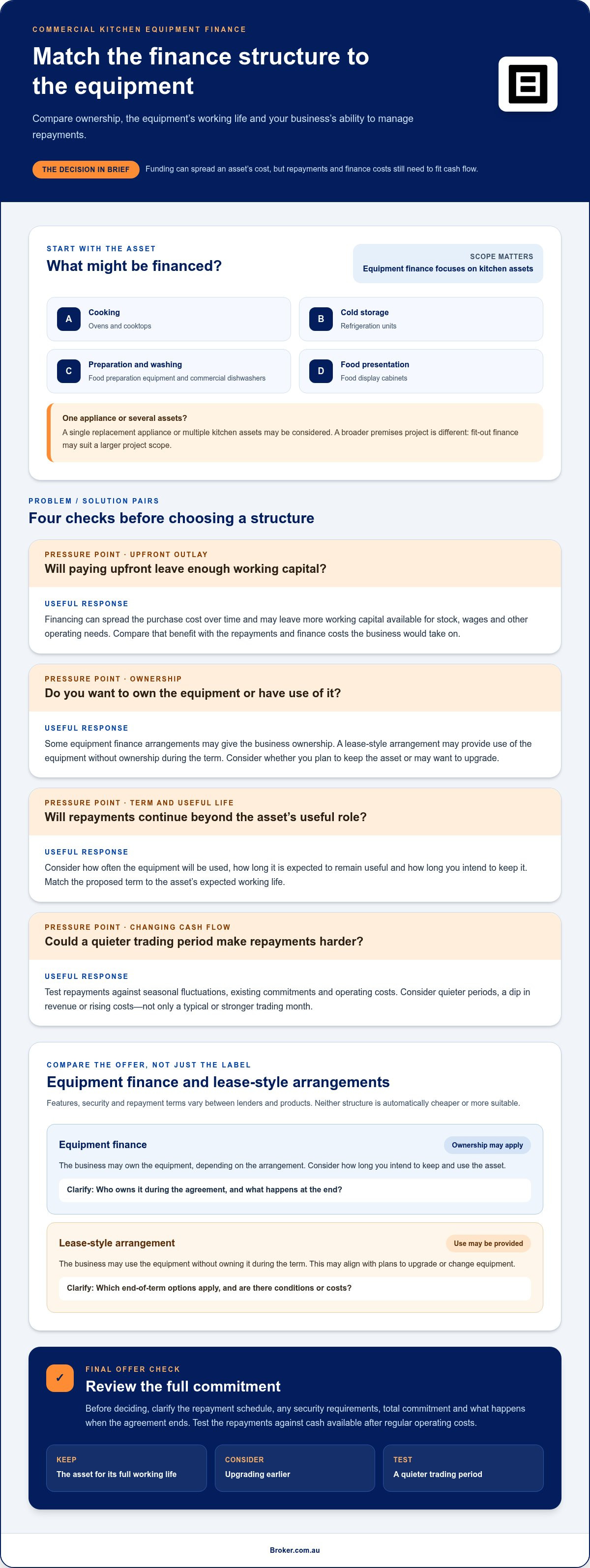
Potential purchases span several parts of a working kitchen: ovens and cooktops, refrigeration units, food preparation equipment, commercial dishwashers and food display cabinets. A business might seek finance for one replacement appliance or several assets needed to prepare, store, wash or present food.
Eligible assets and finance structures depend on the lender and arrangement. Financing individual pieces of equipment is also different from funding a broader kitchen fit-out. If the equipment is part of a wider premises project, fit-out finance may suit that larger scope, while equipment finance focuses on acquiring kitchen assets.
When might finance suit a kitchen upgrade?
Replacing essential equipment is one reason to explore finance, particularly when an asset is unreliable or no longer meets the kitchen’s operational needs. Finance may also be considered when expanding capacity or setting up a new hospitality venture. Connect the purchase to a clear business requirement rather than assuming new equipment will automatically increase sales or profitability.
Before proceeding, consider how often the asset will be used, its role in daily operations and whether its expected working life aligns with the proposed repayment period. Then assess repayments against cash available after regular operating costs. If paying upfront would leave too little room for other priorities, finance may be worth comparing. If repayments would strain cash flow, paying upfront or revisiting the equipment list may be more suitable. The right decision depends on the business’s circumstances and the terms available.
Commercial kitchen equipment finance options: understand ownership and repayments
The right structure depends on more than the repayment amount. Consider whether you want to own the equipment, how long you expect to use it and whether you may want to upgrade before it reaches the end of its working life. Equipment finance and lease-style arrangements can both fund business use of kitchen assets, but ownership, payment structures and end-of-term choices can differ.
The Australian Government’s guide to business funding options outlines asset finance and equipment leases among the approaches businesses can consider. For commercial kitchen equipment finance, compare the details of the actual offer rather than relying on the product label. Features, security and repayment terms vary between lenders and products.
Equipment finance versus leasing: what changes?
With some equipment finance arrangements, the business may own the asset. A lease-style arrangement may provide use of the equipment under agreed payments instead. End-of-term choices depend on the specific offer, so check what happens when the agreement finishes. Leasing may suit a business that values access to equipment or expects to upgrade, while ownership may appeal if the business plans to use an asset over a longer period. Neither is automatically cheaper or more suitable.
| Structure | Ownership position | Flexibility to consider | Questions to clarify in the offer |
|---|---|---|---|
| Equipment finance | The business may own the equipment, depending on the arrangement. | Consider how long you intend to keep and use the asset. | Who owns it during the agreement, and what happens at the end? |
| Lease-style arrangement | The business may have use of the equipment without owning it during the term. | May align with plans to upgrade or change equipment. | What end-of-term options apply, and are there conditions or costs? |
Use the table as a starting point, then review the full offer. Clarify the repayment schedule, any security requirements and the total commitment. Match the proposed term to the equipment’s expected working life: repayments that continue beyond the asset’s useful role may not suit your plans.
How should repayments fit the business’s cash flow?
Test proposed repayments against trading patterns, seasonal fluctuations and existing commitments. Look at quieter periods as well as stronger trading months. Consider whether the business could still meet repayments if revenue dips or other operating costs rise. A payment that looks manageable in a typical month may feel different during a slower one.
Compare scenarios before deciding: keeping the asset for its full working life, upgrading earlier or managing through a quieter trading period. For information about the finance options Broker.com.au arranges, explore equipment finance.
Is equipment finance more suitable than paying upfront? Compare the trade-offs
Financing can spread payments, but it also creates costs and commitments that an upfront purchase may avoid. Paying outright uses available cash immediately, while equipment finance or a lease-style arrangement spreads payments according to the offer. Compare the kitchen asset’s urgency and expected useful life with your cash reserves and other business obligations.
The suitable option depends on the total terms, how the asset will be used and the business’s capacity to meet payments. For commercial kitchen equipment finance, don’t judge an offer by its headline repayment alone. Compare like-for-like arrangements and consider how ownership, payment timing and flexibility affect the business over the full term.
| Approach | Cash impact | Key trade-off to assess |
|---|---|---|
| Pay upfront | Uses available funds at purchase | May avoid finance commitments, but reduces cash available for reserves and other obligations |
| Equipment finance | Spreads payments according to the offer | Consider total repayments, ownership position and how long you expect to use the asset |
| Lease-style arrangement | Payments are made under the lease terms | Review ownership, flexibility and any end-of-term conditions in the offer |
When might paying upfront be worth considering?
Paying upfront may be worth exploring if the business has funds available after allowing for cash reserves and essential commitments. Consider the full cash impact, not just whether the purchase amount is currently accessible. For example, retaining cash may matter if the business needs room for stock, wages, rent or unexpected operating costs. The urgency of replacing an essential appliance and how long you expect to use it can also shape the decision.
Tax treatment can depend on the asset and circumstances. For information on depreciation and capital allowances, refer to the Australian Taxation Office and seek advice from an accountant about your situation. Keep tax considerations separate from the cash-flow comparison.
What trade-offs should a finance comparison show?
Set each option alongside the actual offer terms. Compare the total amount payable, payment timing, ownership position, repayment commitments and flexibility to change or upgrade equipment. Include fees or end-of-term conditions where they’re documented. A lower regular repayment may come with a different overall commitment, so assess the complete offer rather than assuming it costs less.
Test the payments against expected trading patterns and quieter periods, while accounting for existing obligations. This gives you a clearer basis for deciding whether preserving working capital is worth the finance costs and commitments, or whether using available funds better suits the business.
What lenders may assess for commercial kitchen equipment finance
A clear application starts with a clear equipment need. Before discussing commercial kitchen equipment finance, identify the assets you plan to acquire, gather supplier quotes and organise relevant business information. Then consider whether likely repayments could fit alongside existing commitments and realistic trading patterns.
Lenders may consider the business’s trading history and financial position, its capacity to meet repayments and the proposed equipment. The asset’s intended business use and the finance structure may also inform the assessment. Criteria and documentation vary by lender, applicant and finance arrangement, so use any preparation list as a guide rather than a universal checklist.
What information could a lender request?
Depending on the application, it may help to organise:
- Equipment details: An itemised shortlist describing what you plan to acquire and how each asset will be used.
- Supplier quotations: Quotes showing the proposed equipment and purchase details.
- Business information: Basic details about the business, its operations and trading history.
- Financial information: Relevant records that help explain the business’s financial position and ability to manage repayments.
- Existing commitments: An overview of current repayment obligations and regular business costs.
A lender may request further information based on the applicant, proposed asset and its assessment process. Requirements differ, so don’t assume one set of documents or a particular trading period applies to every application. Keep information consistent and ready to clarify if questions arise.
How can you prepare a clear application?
Link each item of equipment to a practical business purpose. For example, explain whether a purchase is intended to replace an essential asset, support a kitchen expansion or equip a new operation. This helps show why the asset is needed and how it fits the business’s plans.
Next, compare proposed repayments with current commitments and expected trading patterns, including quieter periods. Consider whether the business could manage those payments if revenue fluctuates or operating costs change. A realistic view of affordability is more useful than relying only on an optimistic forecast.
Broker.com.au arranges equipment finance through various lenders and can help organise an application around your project. Learn about equipment finance options.
Arrange commercial kitchen equipment finance with a clear next-step plan
A considered application starts with a practical equipment plan. Set out what the kitchen needs, why each item matters and how repayments could sit alongside operating costs. With those details organised, it’s easier to discuss commercial kitchen equipment finance in the context of your project rather than as a standalone purchase.
Use this sequence to prepare:
- Shortlist the equipment: Identify the assets and separate essential purchases from items that could wait.
- Gather supplier quotations: Keep the proposed equipment and purchase details together.
- Summarise the business need: Explain whether you’re replacing equipment, expanding operations or setting up a new kitchen.
- Review affordability: Organise current business information and consider repayments against existing commitments and realistic trading patterns.
- Review the finance offer: Compare the structure, repayments, ownership position, security and relevant conditions before deciding how to proceed.
What should you have ready before discussing finance?
Bring your equipment list, supplier quotations and a concise explanation of the role each asset will play. A summary of the business, relevant financial information and a realistic view of repayment capacity can also help frame the discussion. Be clear about the scope: is the request for equipment only, or are the assets part of a wider premises fit-out? Separating equipment from other project elements helps explain the finance requirements.
How can a broker help move the application forward?
Broker.com.au arranges equipment finance through various lenders and can help coordinate an application around the equipment and business circumstances. A broker can help clarify structures for consideration, organise application information and explain lender-specific requirements. Broker.com.au’s proprietary AI technology supports quick, accurate loan applications, while the lender’s assessment determines the terms and whether finance is approved.
Once an offer is presented, review its full commitments and conditions against your equipment plan and cash flow. Make sure you understand the payment obligations, security arrangements and what happens at the end of the agreement, where applicable. Reviewing the details can help you make an informed decision without losing sight of the kitchen’s operational priorities.
To discuss a finance approach for your kitchen equipment, get in touch with Broker.com.au.
Take the next step with confidence
The right commercial kitchen equipment finance structure should reflect the asset’s expected use, your plans for ownership and what your business can comfortably repay. Compare the full offer, not just the regular payment, and weigh financing against paying upfront with your working capital needs in mind.
A prepared shortlist, supplier quotes and a clear view of your business finances can make the next discussion more focused. Lender criteria and available terms vary, so review each offer carefully before deciding whether it suits your kitchen and cash flow.
Broker.com.au is an award-winning business loan broker that arranges equipment finance through various lenders. Its proprietary AI technology supports quick, accurate loan applications, while the lender determines the outcome and terms. To explore an option tailored to your equipment needs, discuss equipment finance with Broker.com.au.
With a clear plan and the right information prepared, you can make a considered decision that supports your business’s next stage.
Frequently Asked Questions
What equipment can commercial kitchen equipment finance cover?
Commercial kitchen equipment finance may cover business-use assets such as ovens, cooktops, refrigeration units, food preparation equipment, commercial dishwashers and food display cabinets. Funding can relate to one item or several assets, depending on the arrangement. Prepare a clear list of what you plan to acquire, with supplier quotations and the business purpose for each item.
Can a new café or restaurant apply for kitchen equipment finance?
A new café or restaurant may be able to apply, but approval and available terms depend on the lender’s assessment. With limited trading history, be ready to explain the business plan, proposed equipment, expected use and how repayments could fit projected cash flow. Lenders may consider the applicant’s financial position and other relevant information. There’s no single trading-history requirement that applies to every application.
How much deposit is needed for commercial kitchen equipment finance?
There isn’t one deposit amount that applies across all commercial kitchen equipment finance options. Whether a deposit is required, and how much, depends on the lender, applicant, asset and finance structure. Review the offer for any upfront contribution and other payment obligations, then consider the effect on working capital. Broker.com.au can help organise an application across various lenders, but the lender determines the available terms.
Is it better to finance kitchen equipment or pay for it upfront?
Neither option is automatically better. Compare the full costs and cash impact against your business priorities. Paying upfront avoids finance repayments but uses funds that may be needed for wages, stock or reserves. Financing spreads payments but adds commitments and may involve other costs. Compare total obligations, ownership, payment timing and flexibility using the actual offer terms, then test affordability against realistic trading patterns, including quieter periods.
What do lenders look at when assessing equipment finance?
Lenders may assess the business’s trading history, financial position and capacity to meet repayments, as well as the proposed equipment and its intended business use. They may request business information, financial records and supplier quotations. Criteria and paperwork vary by lender, applicant and finance structure, so treat any document list as a preparation guide, not a universal requirement. Organised, consistent information can help explain the request clearly.
Can I lease commercial kitchen equipment instead of buying it?
Lease-style arrangements may provide use of commercial kitchen equipment without the business owning it during the agreement, though details depend on the offer. They may suit a business that prioritises access or expects to upgrade, while equipment finance may suit other ownership plans. Compare payment commitments, security, flexibility and end-of-term choices in the actual terms. Don’t assume a lease is cheaper or more suitable without comparing the full obligations.
Can equipment finance include a full kitchen fit-out?
Equipment finance focuses on acquiring equipment, while a full kitchen fit-out may cover a wider premises project. If kitchen assets are part of broader fit-out or refurbishment work, fit-out finance may be relevant to that project. The appropriate structure depends on the scope, lender and finance arrangement. Separate the equipment list from other project elements, such as construction or furnishings, to make the funding requirements clearer.