
What if your due diligence file could do more than uncover hidden liabilities? For a business purchase loan, it can also help show a lender why the acquisition is worth considering. This due diligence checklist for business purchase loan helps you organise your checks and build a clear, evidence-based funding case.
Buying a business can be time-sensitive, and lender requirements vary. A missed contract, cash flow issue or compliance concern could affect your decision, funding application or settlement plans. A thorough review gives you a stronger basis for assessing the business and preparing an application for Business Acquisition Funding.
This guide covers financial, legal, operational and compliance checks, as well as documents lenders may request. It also explains how to prepare for questions about your contribution, repayment capacity, cash flow and security, so you can approach acquisition finance with a practical plan.
Key Takeaways
- Use a due diligence checklist for business purchase loan to organise evidence for a lender and test the seller’s claims before you commit.
- Check whether the profit and loss statements show sustainable earnings, and whether the balance sheet gives a reliable picture of assets and liabilities.
- Review the lease and confirm the business’s intellectual property and trademarks are documented and can be transferred or licensed as needed.
- Involve an accountant, lawyer and broker early. Request the seller’s records promptly, then confirm what the prospective lender needs.
- Broker.com.au’s proprietary AI technology helps match borrowers with lenders, while its corporate advisory services can support complex acquisition funding needs.
Table of Contents
- Understanding Due Diligence for Business Purchase Funding
- Financial Scrutiny: What Lenders Look for in the Books
- Legal and Operational Checks to Secure Your Loan
- Your Step-by-Step Due Diligence Checklist for 2026
- How Broker.com.au Simplifies the Acquisition Loan Process
Understanding Due Diligence for Business Purchase Funding
Buying an existing business means assessing more than its asking price. Due diligence is the structured investigation of its financial position, legal obligations and ability to keep operating after the sale. This overview of due diligence explains the general concept. For an Australian buyer seeking Business Acquisition Funding, the checks also need to help answer a lender’s central question: can the borrower and proposed business support the loan?
Seller-provided information is a starting point, not proof that earnings, assets or obligations are as presented. Independent checks can help you avoid taking on an unsuitable purchase. They also help a lender assess risk, repayment capacity, available security and whether the proposed structure is workable. These aims overlap, but they are not identical. A business may suit your plans and still fall outside a lender’s servicing or security criteria.
The Three Pillars of Loan-Focused Due Diligence
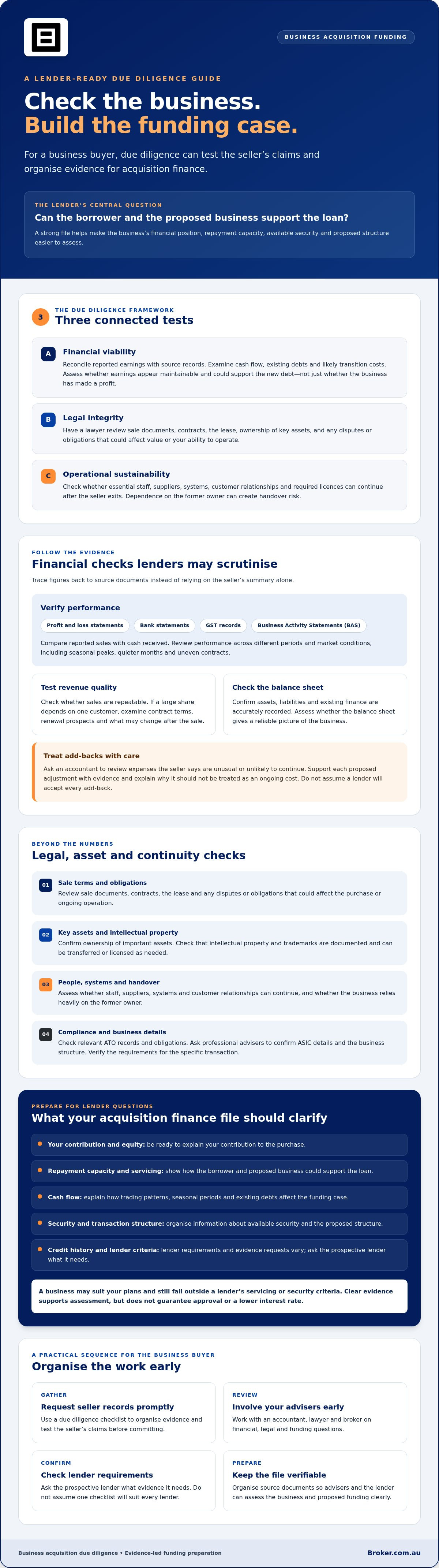
Build your due diligence checklist for business purchase loan around three connected tests:
- Financial viability: Reconcile reported earnings with source records. Examine cash flow, existing debts and likely transition costs. The aim is to show how the business could service the new debt, not simply that it has made a profit.
- Legal integrity: Ask your lawyer to review sale documents, contracts, the lease, ownership of key assets and any disputes or obligations that could affect the business’s value or your ability to operate it.
- Operational sustainability: Check whether essential staff, suppliers, systems, customer relationships and required licences can continue after the seller exits. Heavy dependence on the former owner can create handover risk and weaken the funding case.
Clear, verifiable evidence can help a lender assess the application. It does not guarantee approval or a lower interest rate. Pricing and conditions depend on the lender’s policy, the transaction, available security and your overall financial position.
Why 2026 Requires a More Rigorous Approach
Do not rely on gut feel or assume one checklist will satisfy every lender. Lenders can request different evidence and may consider financial capacity, your contribution, security, market conditions and credit history. Keep records organised and ask early what the prospective lender needs.
Check relevant ATO records and obligations, and ask your professional advisers to confirm the business’s ASIC details and structure. Requirements depend on the business and transaction, so verify the specific circumstances rather than assume everything is in order.
Automated tools, including AI, may help sort or assess information, but lender processes vary and technology does not replace complete, verifiable documents. Broker.com.au uses proprietary AI technology to match borrowers with lenders and facilitate loan applications. It does not guarantee an outcome. A well-prepared file gives your advisers and prospective lender clearer information to assess.
Financial Scrutiny: What Lenders Look for in the Books
For Business Acquisition Funding, a profit figure is useful only if the records support it and the business has cash available to meet repayments. A lender will assess reported performance alongside the purchase price, your equity contribution and the proposed loan. Use your due diligence checklist for business purchase loan to trace figures back to source documents, rather than relying on the seller’s summary alone.
Start with the profit and loss statements, then compare them with bank statements, GST records and Business Activity Statements (BAS). Look for unexplained gaps between reported sales and cash received. Review performance across different periods and market conditions. A business with seasonal peaks or uneven contracts may be profitable overall but still have quieter months when repayments are due.
Verify Revenue, Profit and the Balance Sheet
Test whether revenue is repeatable. If a large share of sales depends on one customer, check the contract terms, renewal prospects and what could happen after the sale. Customer concentration can make earnings less secure than headline figures suggest.
Ask your accountant to review proposed add-backs, which are expenses the seller claims are unusual or unlikely to continue under new ownership. Examples might include a documented one-off expense or a personal expense recorded through the business. Do not assume a lender will accept every adjustment. Support each one with evidence and explain why it should not be treated as an ongoing cost. The aim is to show maintainable earnings, not inflate profit.
For a secured business loan, check that the balance sheet accurately records assets, liabilities and existing finance. An asset listed in the accounts may be leased, encumbered or worth less than expected. Ask your advisers to investigate discrepancies and confirm which assets may be available as security.
Understand Debt Service Coverage
Lenders may use a debt service coverage ratio (DSCR) to compare available income with required debt repayments. A basic expression is:
DSCR = cash flow available for debt service ÷ total debt repayments
The precise calculation and treatment of income vary by lender. A ratio above 1 means the measured cash flow exceeds debt payments in that calculation, but it does not guarantee approval. A lender may also consider existing commitments, working capital needs and your personal financial position.
Your deposit or equity contribution is another key part of the funding case. A lender may ask how much you are contributing, where the funds came from and whether they will be available for settlement. Be ready to document the source and timing of your contribution, and distinguish your own funds from money that must be repaid. The required contribution and acceptable sources vary by lender and transaction.
Budget for purchase costs and retain enough working capital for the transition, rather than committing every available dollar to the deposit. Lenders may also review owner’s drawings and personal living expenses to understand what cash remains for repayments. Discuss the proposed borrowing amount, contribution and repayment structure with your accountant and broker, and keep cash flow projections realistic. For help preparing an application, explore business acquisition funding with Broker.com.au.
Legal and Operational Checks to Secure Your Loan
A profitable business can still be difficult to fund if key agreements, operating rights or assets will not carry over to you. These checks help a lender establish whether the business can keep trading and whether assets supporting the proposed loan are available and documented. Add them to your due diligence checklist for business purchase loan, and ask your lawyer to flag issues that could affect settlement, security or ongoing operations.
Start with the premises. Review the lease term, rent, renewal options and any conditions for assignment or a change of control. Confirm what landlord consent is needed and whether you will have the right to occupy the premises after the sale. If the business depends on that location, uncertainty around the lease may affect continuity and the lender’s assessment.
Check that intellectual property, including registered trademarks, trading names, software rights and relevant domain names, is owned by the seller or can be transferred or licensed to the buyer. Review employee contracts, accrued entitlements and key-person dependencies with professional advice. If important customer relationships or know-how rest with one person, consider how the handover will work and what happens if that person leaves.
Operational, Compliance and Data Risks
Confirm which licences, permits and approvals the business relies on, whether they can continue or need to be obtained by the incoming owner, and whether any conditions could interrupt trading. Requirements depend on the business and its activities, so verify them with the relevant authority or adviser.
Include practical technology checks. Ask how customer and business data is stored, who can access it, how backups are handled and whether any known cyber incidents need investigation. If the business handles personal information, ask an adviser to assess which privacy obligations apply and whether its practices meet them. Environmental, social and governance matters may also come up in lender assessments, but expectations differ. Ask the prospective lender what information it requires rather than assuming there is a uniform ESG test.
Contracts, Assets and Existing Claims
Read key supplier, customer and finance agreements for change-of-control, assignment or termination provisions. A contract that ends when ownership changes could disrupt revenue or supply and affect a lender’s view of future trading. Ask your lawyer to investigate current or threatened litigation and review a Personal Property Securities Register (PPSR) search for security interests over assets included in the purchase.
Inspect significant equipment and confirm its ownership, condition and supporting records. An asset may be leased, subject to a security interest or unsuitable as loan security, even if it appears on a list of assets. If equipment finance is being considered as part of the acquisition, ask the lender what valuation and asset evidence it needs. Organised documents make these questions easier to resolve. For guidance with the funding side of an acquisition, explore Business Acquisition Funding through Broker.com.au.
Your Step-by-Step Due Diligence Checklist for 2026
A structured process helps you keep the purchase moving while giving a prospective lender evidence it can assess. Use this due diligence checklist for business purchase loan as a working file, then confirm the lender’s specific requirements early. Criteria vary, including what lenders need for secured and unsecured funding.
- Step 1: Assemble your advisory team. Engage a broker, accountant and lawyer before key decisions or deadlines. Your accountant can review the financial evidence, your lawyer can check sale and legal documents, and a broker can help clarify lender requirements for Business Acquisition Funding.
- Step 2: Request the seller’s information pack. Ask for a clearly indexed set of records, but do not assume there is a standard “Lender Information Pack”. Agree on what is available, flag missing documents and ask the prospective lender whether it needs anything else.
- Step 3: Check the financial and tax records. Ask your accountant to reconcile statements, tax returns and cash flow records, and investigate inconsistencies or unexplained liabilities. Confirm relevant tax lodgements and obligations using the seller’s records and professional advice.
- Step 4: Count and inspect stock and assets. Compare inventory with the seller’s schedule and note discrepancies, condition and ownership. For a secured loan or equipment finance, ask the lender what evidence it needs to assess assets offered as security. An unsecured application may place greater emphasis on repayment capacity and other lender criteria.
- Step 5: Review legal obligations and contracts. Have your lawyer check the sale agreement, lease, customer and supplier contracts, employee arrangements, licences and any disclosed claims. Identify terms that could change, end or require consent when ownership transfers.
Financial Documents to Request
Start with three years of financial statements and tax returns, noting that a lender may request additional periods or supporting records. Request current aged accounts receivable and payable reports to assess overdue debts and upcoming commitments. Ask for a detailed plant and equipment register, including serial numbers, ownership details and any finance or security interests. Reconcile these records with the sale information and follow up on gaps.
Legal and Statutory Records to Check
Request the current business name registration and, if the business is a company, a current ASIC company extract. Review insurance policies, including public liability and professional indemnity where relevant, with your adviser. Verify applicable workers’ compensation or WorkCover arrangements and payroll tax status for the business’s circumstances and jurisdiction. Requirements vary, so treat this as a starting point rather than a universal document list.
Keep a record of what you have received, what remains outstanding and who is following up. A well-organised file can make lender questions easier to address. To discuss funding for an existing-business purchase, explore Business Acquisition Funding with Broker.com.au.
How Broker.com.au Simplifies the Acquisition Loan Process
A completed due diligence file is more than a record of checks. It helps explain the acquisition to a lender: how the business earns revenue, what could affect future cash flow, which assets may be available and how much equity you are contributing. Broker.com.au can bring this evidence into the Business Acquisition Funding discussion and help connect the deal details with lender requirements.
Broker.com.au uses proprietary AI technology to match borrowers with lenders and facilitate loan applications. The right option depends on the purchase, your financial position and lender policy. Depending on eligibility and deal structure, funding may include secured or unsecured business loans. A match does not guarantee approval, a particular rate or a specific funding amount.
From Checklist to Settlement
Well-organised due diligence can make it easier to answer lender questions and explain the purchase price and repayment case. Broker.com.au can use the information you have assembled to help prepare and present your application, then support you as lender queries arise. Its corporate advisory services can also help with complex deals and consideration of how the proposed structure aligns with funding needs.
Preparation may help you compare lender terms, but rates and conditions depend on each lender’s assessment. Broker.com.au’s brokerage and advisory support can help you understand available options and work through a transaction with several moving parts. The aim is to make the process clearer, without promising a particular outcome.
Starting a conversation does not commit you to a loan. If you are weighing up your next step, I’m interested is a way to enquire about your acquisition funding needs.
Plan for the Transition After Purchase
Settlement is a milestone, not the end of the planning. Consider whether the new business will need working capital to manage the handover and the timing difference between customer payments and expenses. If equipment needs replacing or upgrading, asset finance or equipment finance may also be options to explore, subject to lender assessment. Include these needs in your acquisition plan early so you can ask what funding may be considered and how it could affect overall servicing.
A carefully prepared due diligence checklist for business purchase loan helps turn your findings into clear questions, evidence and funding requirements. Broker.com.au can guide you through the application process and help you assess Business Acquisition Funding options.
Prepare with confidence for your acquisition
A well-prepared due diligence checklist for business purchase loan helps you test the seller’s claims, identify risks and present a clearer case to lenders. Focus on evidence of the business’s financial performance, legal standing and ability to continue operating after the handover.
Connect that evidence to the lender’s key questions: can the business and borrower service the debt, how much equity will you contribute, and what security may be available? Requirements vary, so organise your records early and be ready to explain gaps or unusual items.
Business Acquisition Funding can feel complex, especially when settlement timing and lender requests compete for attention. Broker.com.au is an Australian business loan broker offering proprietary AI matching technology and corporate advisory services to help borrowers work through acquisition finance. No tool or adviser can guarantee approval, but clear preparation can make the process easier to manage.
Ready to explore funding options for buying a business? I’m interested in business acquisition funding. Contact Broker.com.au to discuss your acquisition funding needs.
Frequently Asked Questions
How long does due diligence usually take for an Australian business purchase?
There is no fixed timeframe. It depends on the business, the records available, the complexity of the deal and the time allowed under the sale documents. Reviewing straightforward accounts may take less time than investigating incomplete records, multiple contracts or complex assets. Agree a realistic due diligence period with your lawyer, accountant and seller, and allow for lender assessment and settlement requirements.
Can I get a business loan if the seller’s books are not up to date?
Possibly, but incomplete or outdated books can make it harder for a lender to verify earnings, cash flow and liabilities. Ask the seller for current records and supporting evidence, such as bank statements, tax and BAS information, and aged debtor and creditor reports. Your accountant can help reconcile gaps. A lender may request more information, change its assessment or decline to proceed if it cannot establish the business’s financial position.
What is the most common red flag found during due diligence?
There is no single red flag that is most common across every business purchase. A material mismatch between reported earnings and source records deserves close attention because it may affect both your purchase decision and a lender’s assessment of repayment capacity. Other concerns include undisclosed liabilities, reliance on one major customer, or agreements that may not continue after ownership changes. Investigate discrepancies with your accountant and lawyer before relying on the seller’s claims.
Do I need to pay for due diligence myself or can it be added to the loan?
It depends on the lender, the proposed facility and the purpose of the costs. Do not assume accountant, legal or valuation costs can be included in acquisition finance. Ask the lender or broker before committing funds, and clarify which costs you must pay upfront and whether any can form part of the requested funding. Include these expenses in your purchase budget so they do not unexpectedly reduce the cash available for your deposit or transition needs.
What happens if I find a problem during the due diligence period?
Pause and get advice before taking action. Ask your accountant or lawyer to assess the issue, its financial impact and whether further records or assurances are needed. Depending on the sale agreement and the seller’s response, you may discuss revised terms, request that the issue be resolved, or decide not to proceed. Your rights and options depend on the contract, so have your lawyer review deadlines and conditions promptly.
Is a “Letter of Intent” binding before I finish my due diligence?
It may be binding in part, or not binding, depending on its wording and the circumstances. Do not rely on the document’s title or assume that a “subject to due diligence” phrase settles the question. Ask your lawyer to review the Letter of Intent before signing, including any confidentiality, exclusivity, deposit or negotiation provisions. Make sure the proposed due diligence period and any conditions are clearly documented in the relevant sale documents.
How does a business broker differ from a business loan broker during this process?
A business broker generally assists with the sale process, such as connecting buyers and sellers and helping progress the transaction. A business loan broker focuses on arranging finance, understanding lender requirements and presenting the buyer’s funding application. Roles can vary, so confirm each adviser’s scope and responsibilities. Broker.com.au specialises in Business Acquisition Funding and uses proprietary AI technology to match borrowers with lenders.
What is the difference between goodwill and tangible assets in a loan application?
Goodwill is the value attributed to benefits such as reputation, customer relationships and established trading, rather than a separately identifiable physical item. Tangible assets are physical items such as equipment, vehicles or stock. In a loan application, lenders may assess these differently. Goodwill can support the purchase rationale, while eligible tangible assets may be considered as security, subject to lender policy, ownership and valuation. Ask what evidence the lender requires for each.