
What if the biggest risk in a family business succession isn’t who takes over, but whether the purchase can be financed without draining the business? Financing a family business succession means treating the handover as a commercial acquisition as well as a personal milestone. Goodwill can be difficult to value between relatives, and lenders may scrutinise an intra-family transfer closely.
If you’re buying a business from family, those concerns are understandable. A workable acquisition finance plan needs to reflect the business’s cash flow, a supportable purchase price and the buyer’s capacity to meet lender requirements, while leaving the company on a sustainable footing.
This guide explains business acquisition funding options, including acquisition loans, vendor finance and buyer equity. It also covers what lenders may assess, such as historical cash flow, available security, experience and deposit contribution, and how to prepare a funding plan around the business’s ability to service debt. Broker.com.au specialises in Business Acquisition Funding and uses proprietary AI technology to facilitate loan applications.
Key Takeaways
- Approach financing a family business succession as a commercial purchase, with a clear plan for the ownership transfer and funding.
- Compare secured and unsecured acquisition finance against the business’s cash flow and the assets available as security.
- Consider whether lender finance, vendor finance and buyer equity could be combined in a workable structure.
- Prepare to show how the purchase price, buyer contribution and expected cash flow support repayment of the acquisition loan.
- A business loan broker can help you understand lender requirements and explore potential funding options.
Table of Contents
- Navigating the Complexity of Family Business Succession
- Essential Business Acquisition Funding Options for 2026
- Comparing Funding Structures: Traditional Debt vs. Vendor Finance
- Lender Requirements: Deposit, Equity, and Cash Flow Servicing
- Strategic Partnering: How Broker.com.au Streamlines Your Acquisition
Financing a family business succession: navigating the complexities
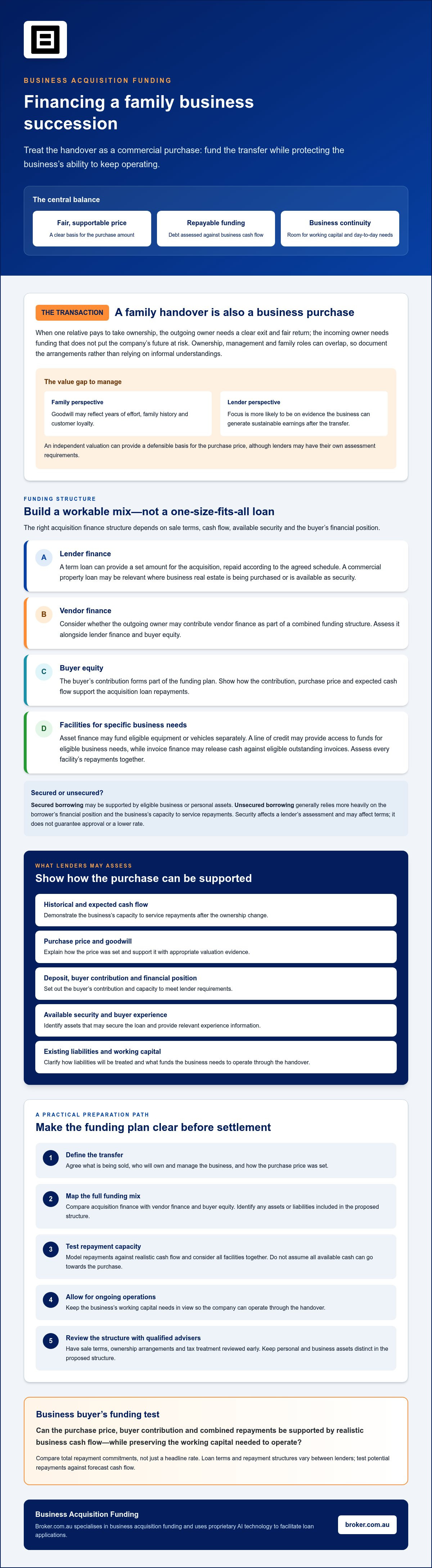
A family handover may feel like an internal arrangement, but if one relative pays to take ownership, it is also a business acquisition. The outgoing owner needs a clear exit and a fair return. The incoming owner needs to fund the purchase without putting the company’s future at risk. Treating the transfer as a structured transaction helps clarify expectations, documents and repayments.
Start by agreeing what is being sold, who will own and manage the business after settlement, and how the purchase price was set. The proposed ownership and sale arrangements may have tax and legal implications, so seek advice from qualified advisers early. Planning ahead also gives the buyer time to prepare an acquisition finance application and assess how the business will support repayments.
Family relationships can add complexity because ownership, management and family roles may overlap, as explained in this overview of family business dynamics. Common pitfalls include relying on an informal price, overlooking liabilities or working capital needs, and assuming goodwill has the same value to the family as it does to a lender or independent buyer.
The Emotional vs. Commercial Value Gap
To an outgoing owner, goodwill may represent years of effort, family history and customer loyalty. A lender assessing Business Acquisition Funding is more likely to focus on evidence that the business can generate sustainable earnings after the transfer. An independent valuation can provide a defensible basis for the purchase price and support finance discussions, although lenders may have their own assessment requirements. If the family agrees to a discounted price, check that the amount to be funded and the business’s ongoing needs still make the transaction viable.
Why Structured Acquisition Finance is Essential
A documented funding plan helps separate the purchase from the company’s day-to-day needs. Model repayments against realistic cash flow and identify the working capital the business needs to operate through the handover. Don’t assume all available cash can go towards the purchase.
Set out who is borrowing, what is being acquired, which assets may secure the loan and how existing business liabilities will be treated. Keep personal and business assets distinct in the proposed structure, and have the valuation, sale terms and tax treatment reviewed by qualified advisers. This gives the buyer, seller and lender a clearer basis for making decisions, although it won’t remove every complication.
Essential Business Acquisition Funding Options for 2026
Business Acquisition Funding is finance arranged to purchase an existing business. In a family succession, it can help the incoming owner buy shares or business assets from a relative, with a clear plan for funding and repayment. The right structure depends on the sale terms, the business’s cash flow, available security and the buyer’s financial position.
One important distinction is whether the lender requires security. A secured business loan may be supported by eligible business or personal assets. An unsecured loan generally relies more heavily on the borrower’s financial position and the business’s capacity to service repayments. Security affects the lender’s assessment and may affect the terms, but it doesn’t guarantee approval or a lower rate. Compare the total repayment commitment, not just the headline rate.
A succession may involve more than one facility. For example, asset finance for eligible equipment or vehicles could fund those assets separately, leaving more of the acquisition facility available for the purchase itself. This won’t necessarily reduce the total debt burden. Assess the repayments on every facility together and check that the business can support them after the ownership change.
Term Loans and Commercial Mortgages
A term loan provides a set amount for the acquisition, repaid according to the agreed schedule. A commercial property loan may be relevant if business real estate is part of the purchase or available as security. Secured borrowing may have different pricing from unsecured finance, depending on the lender, security and application. Terms and repayment structures vary, so don’t assume a standard duration or payment arrangement. Use a business loan calculator to test potential repayments across different loan amounts, rates and terms, then compare the results with forecast cash flow.
Alternative Funding: Lines of Credit and Invoice Finance
A line of credit may provide access to funds for eligible business needs, while invoice finance may release cash against eligible outstanding invoices. These facilities can help manage a working capital timing gap during a transition, but they shouldn’t be treated as automatic substitutes for a purchase loan. If family members are being bought out in stages, clarify the payment schedule and ask lenders whether the proposed facility can be used for that purpose.
For example, a buyer might plan a term loan for the agreed purchase and separately assess a line of credit for short-term cash flow needs. The proposed mix needs to fit lender criteria and the business’s ability to service all its debts. Broker.com.au specialises in Business Acquisition Funding. To explore finance for a business purchase, see Business Acquisition Funding options.
Comparing Funding Structures: Traditional Debt vs. Vendor Finance
Financing a family business succession doesn’t have to rely on one source of capital. A hybrid structure can combine lender debt with vendor finance and the buyer’s equity. For example, an acquisition loan might fund most of the agreed purchase price, while the outgoing owner accepts deferred payment for an agreed portion. This can address a funding gap, but it isn’t automatically cheaper or easier. Compare interest, fees, repayment timing, security and conditions across the entire arrangement.
Consider the impact on both sides. The buyer needs repayments the business can service after the handover, with enough cash left for operations. The selling family member needs clear terms and confidence that deferred amounts will be paid. More borrowing can also increase the business’s liabilities relative to its equity, affecting its debt-to-equity position and potentially its capacity to borrow later. Model the combined obligations against realistic cash flow before committing.
The Pros and Cons of Vendor Finance
Vendor finance can bridge a gap if a lender won’t fund the full purchase price, but the family seller takes on repayment risk and may wait for part of the sale proceeds. Agree in writing on the amount deferred, interest calculation, payment dates, default process and any security. An earn-out can link some payment to agreed future performance measures, but those measures need precise definitions and a process for handling disputes. Get independent legal and tax advice so expectations are documented and family relationships aren’t left to resolve ambiguous terms.
Bank Finance: Requirements for a Business Buyer
Banks and other lenders assess acquisition applications according to their own criteria. They may consider the business’s historical cash flow, available security, the buyer’s experience, equity contribution and proposed transaction structure. A family sale still needs credible evidence for the purchase price and a repayment case. The relationship between buyer and seller doesn’t replace lender due diligence.
Prepare a forecast covering the first three years after settlement, showing revenue assumptions, operating costs, debt repayments and the working capital needed to run the business. Explain what could happen if trading is weaker than expected or the outgoing owner’s role changes sooner than planned. This helps the buyer test whether the proposed funding remains viable under pressure and gives lenders a clearer view of servicing capacity.
Lenders have different risk appetites, and some non-bank lenders may consider applications outside a major bank’s criteria. Broker.com.au specialises in Business Acquisition Funding and uses proprietary AI technology to facilitate loan applications. A broker can help you understand lender requirements and explore potential options, but compare any offers on total cost and structure, not rate alone. A well-documented proposal makes the commercial case easier for both the lender and the family seller to assess.
Lender Requirements: Deposit, Equity, and Cash Flow Servicing
For a business acquisition, lenders look beyond the agreed price. They assess the buyer’s contribution, available security and whether the business can service the proposed debt after settlement. The article’s indicative guide of 20–40% buyer contribution through deposit or equity is not a guaranteed minimum. Requirements vary with the lender, transaction and business.
Existing property equity may support an application if a lender accepts the property as security. That may reduce the cash deposit needed, but it puts the property at risk if the loan isn’t repaid. A lender may also ask for personal guarantees. Understand who would be liable and what assets could be exposed before agreeing to either arrangement.
Equity and Deposit Strategies
Document where the buyer’s contribution comes from, especially if a family member is helping. A gifted deposit may be treated differently from a repayable family loan, and lenders set their own evidence and eligibility requirements. Confirm the lender’s policy early and disclose any repayment obligation. In a family succession, clarity about the contribution can protect both the application and family relationships.
Demonstrating Future Cash Flow
Historical performance helps a lender assess the business, but it doesn’t guarantee future earnings. Build a forecast that accounts for the founder’s departure, customer relationships that depend on them, any transition support and the incoming owner’s salary. Test whether cash flow can cover operating costs, loan repayments and a reasonable wage, including in a less favourable trading scenario.
Debt Service Cover Ratio (DSCR) is the measure a lender uses to compare cash flow available for debt repayments with the scheduled debt obligations under its assessment. Lenders set their own assessment methods and thresholds, so ask how they’ll calculate servicing for the proposed acquisition.
Prepare a well-organised application pack. Requirements vary, but a business buyer may be asked for:
- The sale agreement, proposed purchase structure and independent valuation, if available.
- Historical financial statements and tax records for the business, plus current trading information.
- A cash flow forecast showing repayments, working capital needs and the buyer’s salary.
- Details of the buyer’s experience, personal financial position, proposed deposit and available security.
A coherent purchase price, equity contribution and servicing case can help lenders assess the transaction on its merits. For support with Business Acquisition Funding, explore options with a specialist familiar with Australian lender requirements.
Strategic Partnering: How Broker.com.au Streamlines Your Acquisition
Financing a family business succession involves more than identifying a loan. The proposed ownership structure, purchase documents and finance application need to tell a consistent story. A business loan broker can help you organise funding information and understand what different lenders may require, so you can address gaps before they complicate the transition.
Broker.com.au specialises in Business Acquisition Funding and uses proprietary AI technology to facilitate quick and accurate loan applications. This can support the application process, but it doesn’t guarantee approval or a particular rate. Each lender makes its own assessment of the buyer, business, transaction and repayment capacity.
Tailored Solutions for Complex Successions
In a succession, timing and responsibilities can be as important as the funding structure. Map out key milestones, such as when purchase terms are settled, when the lender needs supporting documents and when ownership is expected to transfer. Clarify who will manage customer, supplier and staff relationships during the changeover. A well-organised plan helps the buyer anticipate questions and keeps finance discussions aligned with the practical handover.
A broker can help you understand application requirements and facilitate the loan process. Keep legal, tax and other professional advice with the appropriate independent advisers, particularly where the sale structure or family arrangements need specialist review.
Your Next Steps in the Acquisition Journey
Before approaching a specialist, gather a concise overview of the proposed purchase. Include:
- The business activity and what the sale includes.
- The proposed purchase and ownership structure, plus the expected settlement timing.
- Your available equity, potential security and any funding already discussed with the seller.
- Business financial information and your initial view of post-purchase cash flow.
You don’t need every detail resolved before making an initial enquiry. A clear outline helps focus the conversation on funding needs, potential lender requirements and what information to prepare next. Before proceeding to settlement, check that finance conditions, sale documents and handover arrangements are confirmed with the relevant lender and professional advisers.
To discuss your funding needs, contact Broker.com.au about your succession.
Set Your Succession Up for a Confident Next Chapter
Financing a family business succession works best when the handover is treated as a commercial acquisition, with clear sale terms and a purchase price the buyer can support. The funding structure should balance lender debt, any vendor finance and the buyer’s contribution without overlooking the cash flow the business needs to keep operating.
A strong application connects the purchase details, available equity and security, the buyer’s experience and a realistic repayment plan. Start organising these early, and involve qualified legal and tax advisers to review the sale structure and family arrangements.
The team can help you explore funding options for your circumstances, while lenders make their own assessments and approval decisions. Complex transactions may also call for independent professional advice beyond finance.
Ready to take a considered first step? Start a conversation with Broker.com.au about Business Acquisition Funding.
Frequently Asked Questions
Is it harder to get acquisition finance for a family business than a standard purchase?
Not necessarily, but a family transaction may need extra explanation because the lender must understand how the purchase price was set and how the transfer is structured. The family relationship doesn’t replace normal credit assessment. Be ready to provide sale terms, valuation support, business financials, details of any vendor finance and a forecast showing the buyer can service repayments while preserving working capital.
How much deposit do I need to buy out my parents’ business in Australia?
There’s no single deposit amount that applies to every business acquisition. The article’s indicative guide is buyer equity of around 20–40% of the purchase price, but the lender’s requirements depend on the business, available security, buyer experience and servicing capacity. Ask prospective lenders how they’ll treat gifted funds, vendor finance or other equity, and confirm what evidence they need.
Can I use my home as security for a business acquisition loan?
Potentially, if a lender accepts your property as security and the application meets its criteria. Using your home may support an acquisition finance application, but it exposes the property to risk if the loan isn’t repaid. Ask what security is required, whether other assets may also be involved and what happens if the business can’t meet repayments. Consider independent legal advice before committing your home.
What is the “family discount” and how does it affect my loan application?
A family discount is a purchase price set below what the seller might otherwise seek from an unrelated buyer. A lower price may reduce the amount you need to fund, but the lender may still want evidence that the agreed value is commercially supportable. Obtain an independent valuation where appropriate, document how the family arrived at the price and explain any difference between the valuation and sale price in your application.
Do lenders require a personal guarantee for family succession loans?
Some lenders may require a personal guarantee, while others assess the transaction differently. The family connection doesn’t automatically remove this possibility. Before signing, ask who must guarantee the loan, which obligations the guarantee covers, whether it is limited and what circumstances could trigger it. A guarantee can make personal assets or finances relevant if the borrower defaults, so obtain independent legal advice and make sure every guarantor understands the commitment.
How does vendor finance work alongside a traditional bank loan?
Vendor finance allows the seller to defer payment for an agreed part of the purchase price, while a bank loan funds another portion. For example, the buyer and seller might agree that some of the price is paid over time under documented terms. The bank must know about the arrangement, as it affects the transaction and the buyer’s overall repayment commitments. Agree on interest, payment dates, defaults and any security with professional advice.
What role does a business loan broker play in a family succession?
A business loan broker can help organise the funding proposal, explain lender requirements and facilitate loan applications. A broker can help you explore potential lender options, but each lender makes its own assessment and decision. Prepare the purchase details, financial information, deposit position and cash flow forecast for discussion.
Can I fund a business acquisition through my SMSF?
An SMSF loan isn’t a general-purpose loan for buying an operating business. Broker.com.au’s SMSF Loans offering is for self-managed super funds seeking to invest in commercial or residential property. If a succession purchase includes business premises, get specialist advice on whether an SMSF property investment is appropriate and how it would be separated from the business acquisition. Don’t assume superannuation funds can be used to buy the business itself.