
Commercial debt consolidation isn’t an emergency manoeuvre; it’s a strategic balance sheet restructure. When you’re managing conflicting repayments across high-interest merchant facilities, overdrafts, and outstanding liabilities, exploring structured business debt consolidation options Australia wide is the most decisive way to reclaim control. You already know how rapidly disjointed credit arrangements erode daily cash flow, tie up working capital, and throttle your commercial borrowing capacity when real opportunities arise.
Combining disparate debts into a single, optimised facility does far more than reduce monthly overheads. It repairs your balance sheet health, protects your margins, and restores the borrowing strength required to fund long-term growth. For an ambitious business buyer, this structural reset is often the critical step required to satisfy lender serviceability rules and secure acquisition finance when buying a business. This guide details how Australian commercial lenders assess consolidated facilities, unpacks key security requirements, and outlines how to strategically restructure your commercial liabilities for sustainable scale.
Key Takeaways
- Evaluate strategic business debt consolidation options Australia wide to replace fragmented, high-cost liabilities with a single facility that preserves operational working capital.
- Compare asset-backed commercial loans against flexible unsecured business loans to determine the right balance between lower interest margins and security exposure.
- Understand why an ambitious business buyer must clean up legacy balance sheet debt and lift debt service coverage ratios (DSCR) before securing competitive acquisition finance.
- Unpack the precise serviceability benchmarks, security requirements, and financial documentation Australian commercial lenders demand during credit assessment.
- Learn how to conduct a structured commercial debt audit to evaluate discharge fees against measurable cash flow improvements and long-term interest savings.
Table of Contents
- Understanding Business Debt Consolidation in Australia
- Primary Business Debt Consolidation Options for Australian Enterprises
- Restructuring Balance Sheets to Fund Business Acquisition
- Australian Lender Requirements, Serviceability, and Credit Criteria
- Structuring and Executing Your Business Debt Consolidation Strategy
Understanding Business Debt Consolidation in Australia
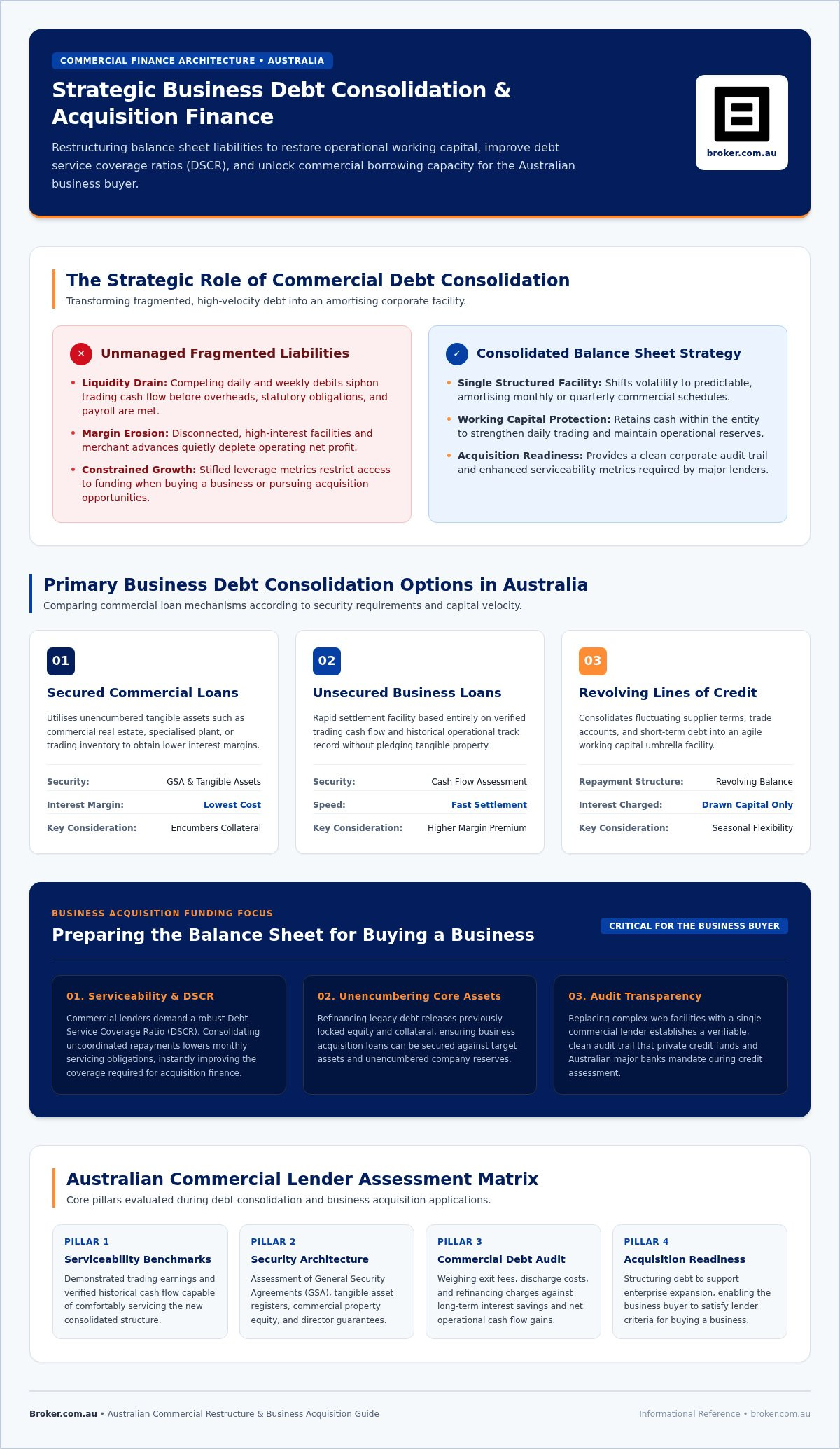
At its core, commercial debt consolidation is the process of refinancing multiple separate commercial liabilities into a single, structured debt facility. Australian trading companies, partnerships, and unit trusts frequently accumulate disparate obligations during growth phases. These include overdrafts, supplier payment arrangements, and high-interest merchant cash advances. Left unmanaged, these short-term liabilities create competing repayment schedules that drain liquid reserves. Reviewing strategic business debt consolidation options Australia wide allows commercial operators to transition from reactive cash management to a coherent corporate debt profile, immediately restoring working capital finance and safeguarding trading margins.
How Commercial Debt Consolidation Functions
Consolidation unifies fragmented commercial credit lines into one comprehensive loan agreement with clear, sustainable terms. Rather than managing multiple creditors with varied covenants, a company establishes an amortising facility with a single commercial lender. This transition shifts repayment structures away from volatile daily debits toward structured monthly or quarterly schedules. Beyond lowering capital servicing pressures, unifying these obligations simplifies balance sheet reporting, cuts bookkeeping friction, and provides corporate clarity. For an active business buyer looking to scale via acquisition, this administrative transparency creates a clean audit trail that private lenders and major banks expect.
Key Signs Your Business Requires Debt Restructuring
Identifying the warning signs of debt distress early prevents balance sheet degradation from stalling your broader commercial plans. Operational indicators that point toward a debt restructure include:
- Strained liquidity from overlapping debits: High-frequency daily or weekly withdrawals from merchant advances siphon revenue before trading operations can cover inventory, statutory obligations, and payroll.
- Divergent interest rates eroding net profit: Maintaining disconnected credit facilities means expensive interest margins quietly eat into gross earnings across business units.
- Constrained borrowing capacity: Fragmented liabilities impair core leverage metrics, restricting access to growth funding or acquisition finance when buying a business or purchasing commercial property.
Primary Business Debt Consolidation Options for Australian Enterprises
Selecting the right structure depends entirely on your balance sheet composition, asset register, and immediate cash flow requirements. Australian enterprises evaluating business debt consolidation options australia wide generally weigh the lower margins of secured facilities against the agility of unsecured funding. Determining the most effective route ensures you minimise interest leakage without tying up critical collateral needed for subsequent commercial projects.
Secured vs Unsecured Commercial Consolidation Loans
Secured business loans use unencumbered tangible assets, such as commercial property, specialised plant, or company inventory, to secure lower interest margins from lenders. These facilities typically require a General Security Agreement (GSA) over company assets alongside personal director guarantees. In contrast, unsecured business loans offer rapid settlement without pledging physical assets. While unsecured facilities carry higher margins, approval relies strictly on verified trading cash flow and strong historical performance. This makes them practical for companies needing immediate relief from high-velocity liabilities without encumbering core operational plant.
Revolving Lines of Credit and Working Capital Facilities
Rather than locking into a rigid term loan, many trading entities utilise a commercial line of credit or working capital finance to roll up scattered short-term debt. This structure lets you pay down fluctuating trade accounts, supplier obligations, and high-frequency liabilities into a single revolving umbrella. You pay interest solely on the capital actively drawn. This mechanism provides essential breathing space during seasonal trading dips, preserving daily liquidity while systematically reducing legacy balances.
Refinancing Commercial Property for Debt Consolidation
For enterprises holding commercial real estate, commercial property loans offer the most cost-effective consolidation mechanism on the Australian market. Tapping accumulated commercial equity allows you to extinguish expensive short-term debts and stretch amortisation terms across longer horizons. This substantially reduces monthly commitments, instantly improving debt servicing capacity. For an active business buyer preparing for an upcoming business acquisition, restructuring real estate debt clears the balance sheet and establishes the leverage needed to secure subsequent acquisition finance. If you’re seeking inside access to competitive commercial lending terms, an experienced commercial broker can model your balance sheet to ensure your restructure supports future enterprise growth.
Restructuring Balance Sheets to Fund Business Acquisition
For an expanding enterprise, commercial debt restructuring isn’t merely defensive; it’s the primary foundation for scale. When a business buyer sets out to acquire a competitor or enter a new market, existing liabilities directly dictate lending capacity. Commercial credit underwriters assess your consolidated corporate commitments before approving any expansion funding. Navigating strategic business debt consolidation options Australia wide ensures legacy liabilities don’t throttle your financial standing when target opportunities arise.
Strengthening Serviceability for Acquisition Loans
Lenders scrutinise serviceability ratios above all else during acquisition assessments. Multiple overlapping debts, such as fragmented lines of credit and vendor loans, artificially inflate calculated monthly liabilities under credit stress-testing models. This drag depresses your Debt Service Coverage Ratio (DSCR), often causing underwriters to reduce lending caps or reject deals outright.
Consolidating these disjointed obligations into a single amortising commercial loan smooths repayment schedules and stretches the servicing profile. This structural adjustment delivers measurable operational advantages:
- Optimised DSCR benchmarks: Lower aggregated monthly commitments immediately lift net servicing margins across trading operations.
- Enhanced credit certainty: Presenting a streamlined repayment history demonstrates financial discipline to tier-one institutions and private credit funds.
- Sustained post-settlement liquidity: Lower core commitments protect ongoing operating cash flow once purchase completion takes place.
Deposit and Equity Requirements for Business Buyers
Securing acquisition finance in Australia typically requires a significant equity contribution. Lenders in Australia generally expect a deposit or equity injection ranging between 10% and 30% of the target enterprise’s purchase price. If balance sheet equity is tied up across multiple encumbered assets, satisfying these capital hurdles becomes exceedingly difficult.
Strategic balance sheet restructuring solves this liquidity barrier. Refinancing fragmented liabilities against established property or unencumbered business assets releases cash reserves to fund the transaction deposit. It also frees up working capital needed to cover initial integration costs. A business buyer can then package dedicated Business Acquisition Funding alongside asset finance facilities to cover operational plant, vehicles, or fit-out needs within the target entity. This dual structure funds tangible machinery separately, keeping core corporate borrowing facilities clear to finance operational goodwill when buying a business.
Australian Lender Requirements, Serviceability, and Credit Criteria
Securing competitive terms across commercial business debt consolidation options Australia wide demands transparent financial presentation. Australian institutional underwriters assess trading businesses through a strictly analytical lens. Tier-one banks focus heavily on historical balance sheet strength and hard property security. Specialised non-bank lenders, by comparison, take a more commercial view, prioritising active trading velocity, forward contract books, and realistic cash flow viability.
Essential Financial Documentation and Reporting
Underwriting a commercial consolidation requires an orderly audit file. Incomplete records immediately stall credit assessment or trigger unwanted risk margins. Prepare the following records upfront:
- Company financial statements: Provide two consecutive years of accountant-prepared profit and loss statements and full balance sheets.
- Tax compliance verification: Lodge the latest company tax returns alongside recent Business Activity Statements (BAS) and running balance portal statements.
- Trading bank histories: Supply six months of primary commercial transaction accounts to demonstrate operational liquidity and uninhibited cash flow.
- Detailed debt schedule: Itemise all current facilities, showing current principal balances, regular repayment schedules, interest margins, and associated PPSR charges.
Serviceability Ratios and Credit Assessment Benchmarks
Underwriters test consolidation viability by running corporate earnings through two core metrics: the Interest Coverage Ratio (ICR) and the Debt Service Coverage Ratio (DSCR). Commercial lenders benchmark your historic and projected EBITDA against ongoing principal and interest commitments. They also apply sensitivity stress buffers above headline rates to verify cash flow buffers against future rate shifts.
Underwriters also review commercial credit bureau files, such as Equifax and Illion, checking both the corporate entity and individual directors. Unresolved payment defaults or late trade payments can restrict bank eligibility, pushing the transaction toward flexible private credit or specialised non-bank capital.
Navigating ATO Tax Liabilities and Legacy Debts
Tax debt restructuring is a significant driver of commercial refinancing. Following the July 1, 2025 tax law change that stripped tax deductibility from ATO interest charges, leaving statutory liabilities on the tax office portal has become financially punitive. Commercial lenders can roll outstanding tax obligations into a manageable, term-based commercial facility. Paying out the tax office with a commercial loan converts non-deductible statutory penalties into standard commercial debt, where interest costs are typically tax-deductible.
Proactive restructuring demonstrates management competence. For an enterprising business buyer, cleaning up past statutory liabilities is mandatory to maintain borrowing capacity. When you’re ready to optimise your balance sheet, you can submit an I’m interested enquiry to connect with a commercial broker who can present your restructuring profile directly to national lending desks.
Structuring and Executing Your Business Debt Consolidation Strategy
Executing a successful corporate restructure requires methodical execution and accurate financial modelling. Exploring business debt consolidation options Australia wide isn’t merely about finding a lower headline margin; it’s about systematically unravelling restrictive covenants, calculating discharge friction, and building a capital foundation that supports long-term commercial goals.
The Debt Audit and Financial Modelling Process
A strategic restructure starts with a granular debt audit. You must catalogue every active liability, recording floating interest margins, repayment frequencies, director guarantees, and existing Personal Property Securities Register (PPSR) encumbrances.
Next, weigh early termination fees and legal discharge expenses against long-term interest reductions. Financial modelling must confirm that extending amortisation periods produces tangible operational cash flow improvements rather than simply stretching interest liabilities. For a strategic business buyer preparing for an upcoming business acquisition, this audit reveals which balance sheet assets can be unencumbered to satisfy deposit prerequisites.
Leveraging Broker Expertise and Proprietary Technology
Managing concurrent payout letters, title releases, and security discharges across multiple incumbent lenders places immense strain on executive resources. Working with an experienced commercial loan broker simplifies this transition into a seamless, coordinated process.
At Broker.com.au, proprietary AI technology scans lending criteria across tier-one banks and specialised private credit funds nationwide, matching your balance sheet metrics with the ideal commercial product. Experienced specialists negotiate directly with commercial underwriters, synchronising payout figures, releasing encumbered collateral, and structuring clean debt facilities. This structural reset strengthens your leverage profile to secure competitive acquisition finance when buying a business. If you want to see how award-winning advisory gives you inside access to competitive institutional terms, submit an I’m interested enquiry to begin a straightforward consultation.
Restructure Your Balance Sheet for Enterprise Growth
Consolidating fragmented corporate liabilities is one of the most decisive actions an executive team can take to protect operational liquidity. By exploring strategic business debt consolidation options Australia wide, you eliminate punitive interest drag, lift your serviceability metrics, and establish the robust balance sheet needed to pursue new commercial ventures or acquisitions with total confidence.
As an award-winning commercial brokerage firm with nationwide coverage, Broker.com.au combines proprietary AI technology with seasoned corporate advisory to navigate multi-facility debt restructures seamlessly. Our specialists negotiate directly across tier-one banks and specialised private credit funds, giving you inside access to competitive commercial facilities designed around your enterprise cash flow. Taking command of your liabilities today ensures your capital works for your future, not your past. If you’re ready to streamline obligations and unlock vital working capital, select I’m interested in restructuring business debt to start a low-pressure conversation with our commercial finance team.
Frequently Asked Questions
Can an Australian business consolidate debt without providing real estate security?
Yes, Australian trading entities can consolidate debt without pledging real estate by securing unsecured business loans or facilities backed by alternative balance sheet assets. Lenders assess serviceability through verified bank turnover and cash flow rather than physical property. While interest margins on unsecured commercial facilities are typically higher than asset-backed options, they offer viable business debt consolidation options Australia wide for enterprises wanting to avoid encumbering commercial or personal real estate.
How does business debt consolidation affect borrowing power when buying a business?
Consolidating debt significantly expands your borrowing capacity when buying a business. Rolling fragmented short-term liabilities into a single, amortising loan reduces total monthly debt service commitments. Underwriters assess your Debt Service Coverage Ratio (DSCR) favourably when cash flow isn’t drained by competing repayments. A business buyer who restructures legacy liabilities presents a much cleaner servicing profile, making it substantially easier to secure approval for dedicated acquisition finance.
Can outstanding Australian Taxation Office (ATO) tax debts be included in consolidation?
Yes, outstanding ATO liabilities can be rolled into a structured commercial loan. Since tax law changes removed the deductibility of ATO interest charges, consolidating tax debt into a commercial facility has become a common strategy. Paying out the Australian Taxation Office with commercial debt replaces compounding statutory charges with structured repayments, restoring balance sheet credibility and often converting non-deductible tax interest into standard deductible corporate borrowing costs.
What financial documentation is required to qualify for commercial debt consolidation?
Lenders typically require two consecutive years of accountant-prepared company financial statements, complete tax returns, and recent Business Activity Statements (BAS). You’ll also need six months of commercial bank statements and a comprehensive liability schedule detailing current balances, interest margins, and PPSR registrations. Clean financial reporting allows underwriters to stress-test your cash flow accurately and approve competitive business debt consolidation options Australia wide without unnecessary underwriting delays.
What is the typical difference between bank and non-bank consolidation lenders in Australia?
Tier-one banks enforce strict balance sheet hurdles, lower loan-to-value ratios, and almost always demand tangible property security or extensive trading history. Non-bank and private credit lenders offer greater credit flexibility, assessing applications on trading momentum and future cash flow potential rather than rigid historical metrics. Non-banks approve and settle complex multi-facility consolidations faster, though their flexibility generally comes with a moderately higher interest margin.
Will consolidating existing commercial loans trigger break fees or payout penalties?
Refinancing fixed-rate commercial loans, merchant cash advances, or early-stage equipment contracts can trigger early termination fees or break costs. Floating-rate facilities and standard lines of credit usually involve minimal discharge expense. A commercial loan broker conducts a thorough debt audit beforehand, calculating whether the long-term interest reductions and improved cash flow from consolidation comfortably outweigh any short-term exit charges from incumbent lenders.
How quickly can a commercial debt consolidation facility settle in Australia?
Settlement timeframes vary according to loan structure and security requirements. Streamlined unsecured business loans can approve and settle within 24 to 48 hours once financial data is verified. Secured facilities backed by commercial real estate or specialised balance sheet assets usually take between two to four weeks. This period accommodates independent property valuations, formal discharge requests, and legal documentation across all outgoing lenders.