
What if refinancing a commercial loan for better rates wasn’t merely about trimming a few points off your monthly interest bill, but about unlocking capital for your next commercial move? If restrictive bank covenants and heavy monthly repayments are currently squeezing your operating cash flow, questioning whether the refinance process is worth the effort makes complete sense. Dealing with major Australian lenders often feels rigid and exhausting, especially when inflexible legacy facilities trap equity that could be working for you.
This guide shows you how to restructure existing liabilities, sharpen your interest margins, and release balance sheet equity to secure tailored business acquisition funding. Whether you are an established operator buying a business to expand your market share or an ambitious business buyer looking for competitive acquisition finance, strategic restructuring changes everything. Below, you will discover how to liberate working capital, satisfy lender credit hurdles, and position your balance sheet for a successful business acquisition in 2026.
Key Takeaways
- Learn how refinancing a commercial loan for better rates allows you to strip away punitive margins, reduce monthly overheads, and ease working capital pressure.
- Discover how to transition expensive, short-term acquisition finance into optimised, long-term business acquisition funding once your revenue stabilises.
- Master debt recycling strategies that release locked balance sheet equity to fund your deposit when buying a business or expanding operations.
- Understand the critical cash flow and EBITDA benchmarks Australian credit teams evaluate, giving every business buyer a distinct advantage during assessment.
- Follow an actionable roadmap that pairs proprietary matching technology with inside access to over 40 commercial lenders across Australia.
Table of Contents
- Is Refinancing Your Commercial Loan the Right Move in 2026?
- Refinancing Business Acquisition Funding for Future Growth
- Key Considerations for a Business Buyer Looking to Refinance
- The Roadmap to Refinancing a Commercial Loan for Better Rates
- How Broker.com.au Simplifies the Refinance Process
Is Refinancing Your Commercial Loan the Right Move in 2026?
Commercial refinancing involves replacing an existing commercial debt facility with a new structure offering more favourable interest margins, extended loan tenures, or flexible covenant terms. In 2026, with the Reserve Bank of Australia cash rate holding at 4.35%, many Australian business owners face lingering pressure on operating margins. While some operators settle for a basic interest-rate reduction, established enterprises often execute a full facility restructure. Applying core loan refinancing principles enables businesses to consolidate liabilities, free up working capital, and build liquidity for their next strategic expansion.
When you look beyond basic interest margins, refinancing a commercial loan for better rates serves as a powerful balance-sheet catalyst. Lowering your monthly debt commitments directly strengthens net operating profit and interest coverage ratios. For an ambitious business buyer, this liberated cash flow provides the critical serviceability needed to secure tailored Business Acquisition Funding down the track.
Signs You Are Overpaying on Your Commercial Debt
Lenders adjust their pricing models constantly, leaving unreviewed debt behind. If your facility hasn’t been re-examined in the last 24 months, you are likely carrying a “lazy loan” priced well above current benchmarks. Consider these common warning signs:
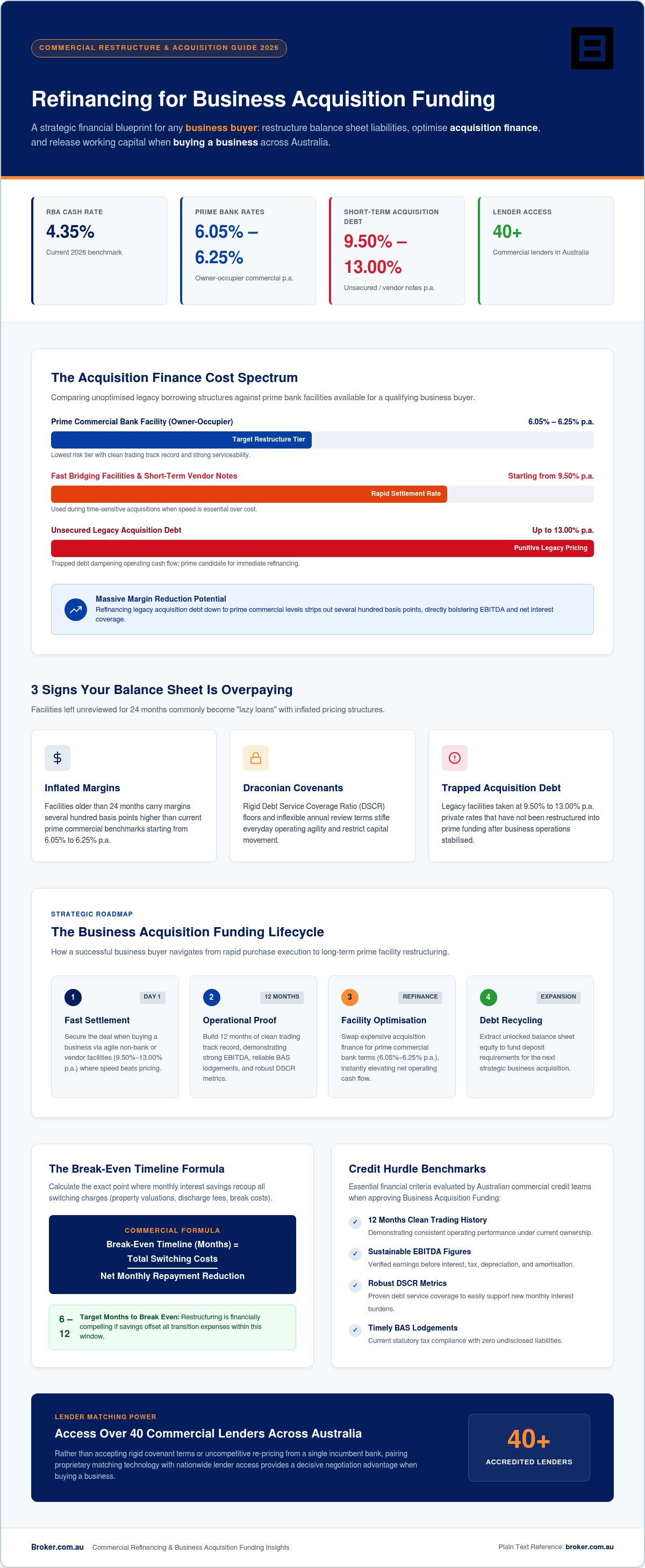
- Inflated margins: Current prime bank commercial owner-occupier rates start from 6.05% to 6.25% p.a., whereas older, unmanaged debt often carries margins several hundred basis points higher.
- Draconian covenants: Rigid Debt Service Coverage Ratio (DSCR) floors or strict annual review clauses that hinder your everyday trading agility.
- Trapped acquisition debt: Legacy acquisition finance taken at private or unsecured rates (often 9.50% to 13.00% p.a.) that has not transitioned to bank pricing after operations stabilised.
The Real Cost of Switching: Break Fees and Charges
Switching lenders is rarely free, which makes calculating your exact break-even point essential before initiating a transition. Commercial refinances often involve third-party commercial property valuations, registration discharge charges, and potential fixed-rate break costs. A simple break-even formula divides the total switching costs by your projected monthly interest savings:
Break-Even Timeline (Months) = Total Switching Costs / Net Monthly Repayment Reduction
If your projected savings recoup these expenses within 6 to 12 months, pursuing a full restructure makes immediate financial sense. Before jumping ship, an experienced broker can approach your incumbent institution to test their willingness to re-price. However, when an incumbent lender remains rigid, refinancing a commercial loan for better rates across the broader market gives you the leverage and clean balance sheet required when buying a business.
Refinancing Business Acquisition Funding for Future Growth
Speed often dictates terms during a business purchase. When competing against rival suitors, acquiring a business frequently requires fast non-bank facilities or short-term vendor notes carrying interest rates upwards of 9.50% p.a. to settle in days rather than months. While this gets the deal over the line, holding onto expensive debt dampens your operating momentum. As Australian Government guidance on how to refinance to another lender highlights, reviewing debt costs regularly protects cash reserves. Strategic refinancing a commercial loan for better rates allows an enterprise to transition away from high-friction bridging structures into lower-cost, sustainable Business Acquisition Funding.
Optimising Acquisition Finance After a Purchase
Most institutional credit teams hesitate to finance unproven operational changes. Once you establish 12 months of clean trading history under your own management, the risk profile shifts in your favour. Showing consistent EBITDA, timely BAS lodgements, and robust Debt Service Coverage Ratios allows you to swap expensive acquisition finance for prime commercial bank terms. This shift often shaves hundreds of basis points off your interest margin. Consolidating disparate liabilities into an amortised commercial facility immediately lifts free cash flow, directly improving the valuation of your enterprise.
Unlocking Equity for Your Next Business Acquisition
Savvy operators rarely view balance-sheet debt as static. Instead, they use debt recycling to extract accumulated enterprise value. Refinancing an existing commercial facility releases trapped equity from trading cash flows or commercial property holdings, providing the necessary capital to meet the 20% to 40% equity deposit required when buying a business.
- Portfolio flexibility: Consolidate scattered debt from past acquisitions under one streamlined framework.
- Security uncoupling: Release personal assets or residential property previously pledged as collateral.
- Growth readiness: Secure dedicated working capital facilities alongside your primary debt to act decisively on off-market opportunities.
For an acquisitive business buyer, refinancing a commercial loan for better rates transforms passive liabilities into proactive expansion capital. If you plan to scale your portfolio through strategic purchases, you can explore structured Business Acquisition Funding with specialist guidance designed around your investment timeline.
Key Considerations for a Business Buyer Looking to Refinance
Every commercial refinance involves satisfying strict institutional risk frameworks. While speed matters when executing an initial acquisition, refinancing a commercial loan for better rates requires demonstrating operational stability. Commercial lenders evaluate debt using entirely different parameters than consumer mortgages. They examine tangible security quality, normalised trading profits, and the viability of cash reserves. Understanding these credit benchmarks gives an expanding business buyer the strategic upper hand when presenting a refinance submission.
Deposit and Equity Requirements for Commercial Debt
Collateral backing dictates both your pricing tier and maximum borrowing capacity. Banks typically cap Commercial Property Loans between 60% and 70% Loan-to-Value Ratio (LVR), though strong owner-occupier premises can reach 75% to 80% LVR. Pure business acquisitions involving unbacked goodwill face stricter limits, often capped at 50% to 55% LVR. Providing additional security, such as plant equipment, commercial real estate, or equity across trading entities, significantly softens pricing. It also reduces or removes director guarantee exposure, protecting your personal estate while locking in lower margins.
Servicing and Cash Flow: What Lenders Look For
A business cannot refinance on historical turnover alone. Credit assessors evaluate operational serviceability by stress-testing your historical and projected figures. As detailed in Reserve Bank of Australia research on business lending, bank and non-bank lenders continually adjust underwriting criteria to account for economic conditions. When presenting your books, expect underwriters to scrutinise three core performance metrics:
- Debt Service Coverage Ratio (DSCR): Lenders want to see a DSCR of 1.20x to 1.50x, proving that net operating income comfortably outstrips all ongoing principal and interest commitments.
- Assessment buffer: Credit teams apply a mandatory assessment buffer of roughly 2.0% above contract rates to ensure you can handle rate fluctuations without defaulting.
- Leverage ratio (Net Debt / EBITDA): Senior lenders enforce caps on acquisition debt, generally restricting total exposure to between 3.0x and 4.5x EBITDA.
Financial modelling turns raw figures into a compelling credit narrative. Clean balance sheets, up-to-date interim management accounts, and zero unpaid ATO liabilities show lenders your enterprise is running smoothly. By illustrating strong Debt Service Coverage alongside reliable post-settlement working capital, refinancing a commercial loan for better rates moves from a theoretical exercise into an achievable reality.
The Roadmap to Refinancing a Commercial Loan for Better Rates
Approaching a commercial debt restructure requires methodical execution. Unlike residential borrowing, commercial credit assessments involve bilateral negotiations across multiple risk parameters. Simply walking into a branch often results in rigid credit queues and terms skewed heavily toward bank margins. Business buyers navigating an acquisition or refinancing established facilities need a systematic pathway to secure optimal debt terms.
Executing a successful transition follows five structured milestones:
- Step 1: Facility audit: Analyse your current credit contracts to isolate pain points, including steep line fees, ongoing review hurdles, or over-collateralised assets.
- Step 2: Financial dossier collation: Compile rolling cash flow models, interim profit and loss reports, and verified tax compliance portal statements.
- Step 3: Multi-lender engagement: Partner with a specialist intermediary who can bypass frontline credit queues and engage decision-makers across Tier 2 institutions and non-bank lenders.
- Step 4: Holistic term comparison: Evaluate total facility costs rather than fixating exclusively on headline borrowing percentages.
- Step 5: Settlement and liquidity redeployment: Complete facility discharge and allocate reclaimed cash reserves toward growth initiatives or prospective business acquisition funding.
Preparing Your Documentation for a Fast Approval
Major Australian banks typically take 6 to 12 weeks to finalise commercial underwriting, whereas specialist lenders can complete reviews within 7 to 21 business days. Speed hinges directly on presentation quality. Lenders examine the last two years of company tax returns, accountant-prepared balance sheets, and trailing Business Activity Statements (BAS). If extraordinary one-off expenses impacted recent earnings, such as redundancy costs or relocation charges, document these clearly as EBITDA add-backs. Clean credit files for both the trading entity and key directors eliminate avoidable red flags during preliminary underwriting checks.
Comparing Terms: It’s More Than Just the Interest Rate
Headline percentages reveal only part of the story. A truly competitive restructure balances raw pricing against operational autonomy. Negotiating a two-year interest-only window can preserve working capital during consolidation phases, whereas principal-and-interest structures rapidly amortise senior exposure. Evaluate the ongoing governance burden carefully. Waiving onerous annual reviews or securing covenant-light terms gives you the commercial breathing room needed when managing unexpected trading fluctuations or preparing to buy a business.
Successfully refinancing a commercial loan for better rates hinges on matching your specific balance sheet requirements with an institution eager to fund your industry. If you want an expert team to review your current debt structures, you can get started with our commercial finance team today.
How Broker.com.au Simplifies the Refinance Process
Approaching traditional credit channels often feels like an uphill battle. Protracted bank queues, bureaucratic underwriting delays, and opaque criteria can easily derail an ambitious commercial roadmap. As an award-winning finance broker, Broker.com.au replaces institutional inertia with speed, precision, and clarity. Whether you want to restructure existing facilities or build liquidity for an upcoming business acquisition, having an expert guide handle the heavy lifting ensures your capital structure matches your true commercial potential.
Securing the right outcome requires more than basic rate shopping. It demands strategic debt structuring that aligns with your operational cash flow, tax positioning, and future expansion plans.
Proprietary AI: Faster Applications, Better Matches
Commercial credit policies vary significantly across lenders, making manual comparisons inefficient and frustrating. Broker.com.au deploys proprietary FinMatch technology to scan and match your specific financial profile against lending criteria from across the market. Instead of waiting weeks for an indicative response, our technology reduces the “time to yes” by pinpointing institutions with an active appetite for your specific sector and balance-sheet profile. This data-driven process removes the guesswork from commercial credit policy, delivering faster pathways to conditional approval.
Tailored Solutions for the Modern Business Buyer
One-size-fits-all finance models from the major banks rarely accommodate complex trading structures, trust distributions, or multi-entity portfolios. When refinancing a commercial loan for better rates, working with an experienced corporate advisory team gives you inside access to over 40 Australian bank and non-bank lenders. Our specialists, including senior advisers like Matt and the team, routinely go above and beyond for scenarios that sit outside conventional lending boxes.
From restructuring restrictive debt covenants to releasing trapped equity for Business Acquisition Funding, our advisory approach gives every business buyer complete clarity and confidence. We manage the dialogue with underwriters, present your EBITDA in the strongest light, and handle settlement logistics from start to finish. If you want to optimise your debt facilities, lower your repayments, and prepare your balance sheet for future growth, I’m interested – get a free refinance health check.
Take Control of Your Commercial Capital in 2026
Staying tethered to an outdated credit structure limits your operational reach. By actively refinancing a commercial loan for better rates, you do far more than reduce monthly interest overheads; you build the liquidity and borrowing capacity required for continuous expansion. Transitioning stabilised trading figures into lower-margin bank facilities liberates the working capital needed to satisfy lender debt service coverage benchmarks. For any ambitious business buyer, that unlocked balance-sheet equity becomes the catalyst for your next strategic business acquisition.
Restructuring commercial debt does not need to be an administrative grind. Broker.com.au pairs award-winning finance solutions with proprietary AI technology to deliver seamless applications, giving you inside access to over 40 Australian lenders. Whether you are optimising existing trading debt or preparing to secure acquisition finance when buying a business, our specialist advisers ensure your capital structure works in your favour. Take the next step toward balance-sheet flexibility: I’m interested: discover better commercial rates today.
Frequently Asked Questions
How much can I save by refinancing my commercial loan?
Savings depend on your total loan balance and existing interest margin. Replacing an unreviewed commercial facility with prime market rates can shave between 1.00% and 3.00% p.a. off your debt, saving tens of thousands in annual interest. Beyond headline pricing, extending your loan tenure or removing restrictive covenants frees up vital monthly cash flow, giving you the liquidity needed to invest directly into operational expansion.
What are the typical costs involved in refinancing a commercial loan in Australia?
Refinancing costs usually include lender establishment fees, commercial property valuation charges, and legal documentation costs. You must also factor in state title registration and discharge charges, alongside possible fixed-rate break costs from your current provider. Running a break-even calculation ensures your net monthly interest savings comfortably recoup these upfront expenses within six to twelve months of settlement.
Can I refinance a loan I used for a business acquisition?
Yes, refinancing a commercial loan for better rates is a proven strategy once an acquired entity establishes consistent trading figures. Many buyers initially rely on fast, higher-cost acquisition finance to secure a transaction when buying a business. After twelve months of proven management and healthy cash flow, an astute business buyer can refinance into structured Business Acquisition Funding with lower interest margins and extended terms.
How long does the commercial refinancing process usually take?
Turnaround times vary significantly depending on the lender. Major Australian commercial banks typically take between six and twelve weeks to complete credit assessments, property valuations, and formal settlements. Specialist non-bank and private commercial lenders move much faster, often issuing approvals and completing settlements within seven to twenty-one business days, particularly when applications are processed using proprietary matching technology.
Will I need a new valuation for my commercial property to refinance?
Most incoming commercial lenders require an up-to-date independent property valuation to verify security value and enforce Loan-to-Value Ratio (LVR) thresholds. The lender orders this report directly from an approved valuation panel at the borrower’s expense. Certain non-bank lenders may waive full physical valuations or rely on desktop assessments if your requested debt level represents a conservative proportion of overall property equity.
Can I consolidate my business and home loans into one facility?
Australian lenders keep residential home loans and commercial debts legally separate due to differing consumer regulations and tax rules. However, you can restructure both facilities concurrently through the same finance broker. Releasing equity from your residential property allows you to inject capital into your commercial enterprise, helping fund your next business acquisition while keeping accounting and liability structures cleanly segregated.
What is the difference between a secured and unsecured commercial refinance?
Secured refinancing uses tangible collateral, such as commercial property, business equity, or capital machinery, to unlock the lowest interest rates and highest borrowing limits. Unsecured refinancing requires no physical collateral, relying instead on proven cash flow and business turnover. While unsecured facilities settle quickly with minimal paperwork, secured commercial facilities provide substantially lower interest margins and longer loan terms.
Is it possible to refinance if my business cash flow has fluctuated recently?
Yes, but success depends on presenting your trading figures effectively. When refinancing a commercial loan for better rates after temporary dips, non-bank lenders offer far greater underwriting flexibility than major banks. An experienced broker can demonstrate normalized earnings by adjusting for one-off costs or seasonal factors, ensuring assessors focus on your true ongoing Debt Service Coverage Ratio.