Restructuring commercial liabilities isn’t an admission of corporate defeat; it’s a decisive financial strategy to reclaim operational control before traditional lenders dictate your options. Juggling multiple high-interest facilities, looming ATO obligations, and restrictive covenants can quickly choke weekly cash flow. If you are worried about risking director guarantees or damaging your credit profile through formal insolvency, you aren’t alone. Knowing how to restructure business debt successfully allows you to replace fragmented, high-pressure obligations with sustainable funding, protecting your enterprise well before acute distress takes hold.
This 2026 guide reveals how to consolidate high-friction borrowings into a single commercial debt facility, unlock vital working capital, and negotiate manageable repayment terms with competitive institutional and non-bank lenders. Whether you are stabilising current trading or an active business buyer evaluating acquisition finance to tidy up balance-sheet debt after buying a business, the fundamentals remain identical. Ahead, we outline practical commercial loan options, underwriting criteria, and proactive restructuring steps that preserve company assets and safeguard your financial future without entering administration.
Key Takeaways
- Discover how proactive debt reorganisation acts as a commercial refinancing mechanism to unlock working capital rather than signalling pre-insolvency distress.
- Compare tailored commercial lending vehicles, from secured business loans to lines of credit, designed to replace fragmented, unaligned liabilities.
- Master the proven five-step roadmap on how to restructure business debt successfully by optimising dynamic cash flow modelling and debt profiling.
- Learn how an astute business buyer integrates structured acquisition finance and business acquisition funding to reorganise balance-sheet debt when buying a business.
- Understand how partnering with an award-winning finance broker secures inside access to tier-1 banks and private non-bank lenders while protecting director guarantees.
Table of Contents
- What Is Business Debt Restructuring and When Is It Vital?
- Core Strategies to Restructure Corporate Liabilities and Manage Debt
- Funding Vehicles That Fuel a Successful Commercial Debt Restructure
- The 5-Step Process: How to Restructure Business Debt Successfully
- Why Engaging an Award-Winning Finance Broker Maximises Restructure Success
What Is Business Debt Restructuring and When Is It Vital?
Commercial debt restructuring reorganises a company’s outstanding obligations to restore cash liquidity, recalibrate debt maturities, and realign repayment schedules with ongoing revenue. At its core, knowing what is business debt restructuring allows company leaders to replace restrictive, high-friction borrowings with sustainable, tailored credit instruments before creditors force their hand. Proactive balance-sheet management protects your corporate credit rating, shields personal director guarantees, and preserves stakeholder equity far more effectively than reacting to an immediate financial crunch.
This process is equally vital when executing a strategic business acquisition. An astute business buyer evaluating a target enterprise rarely accepts historical liabilities as fixed. Instead, securing tailored acquisition finance allows the purchaser to refinance legacy obligations immediately post-settlement. By integrating debt optimisation directly into the capital stack when buying a business, leaders ensure the newly acquired asset maintains sufficient working capital from day one.
Commercial Debt Refinancing vs Formal Insolvency
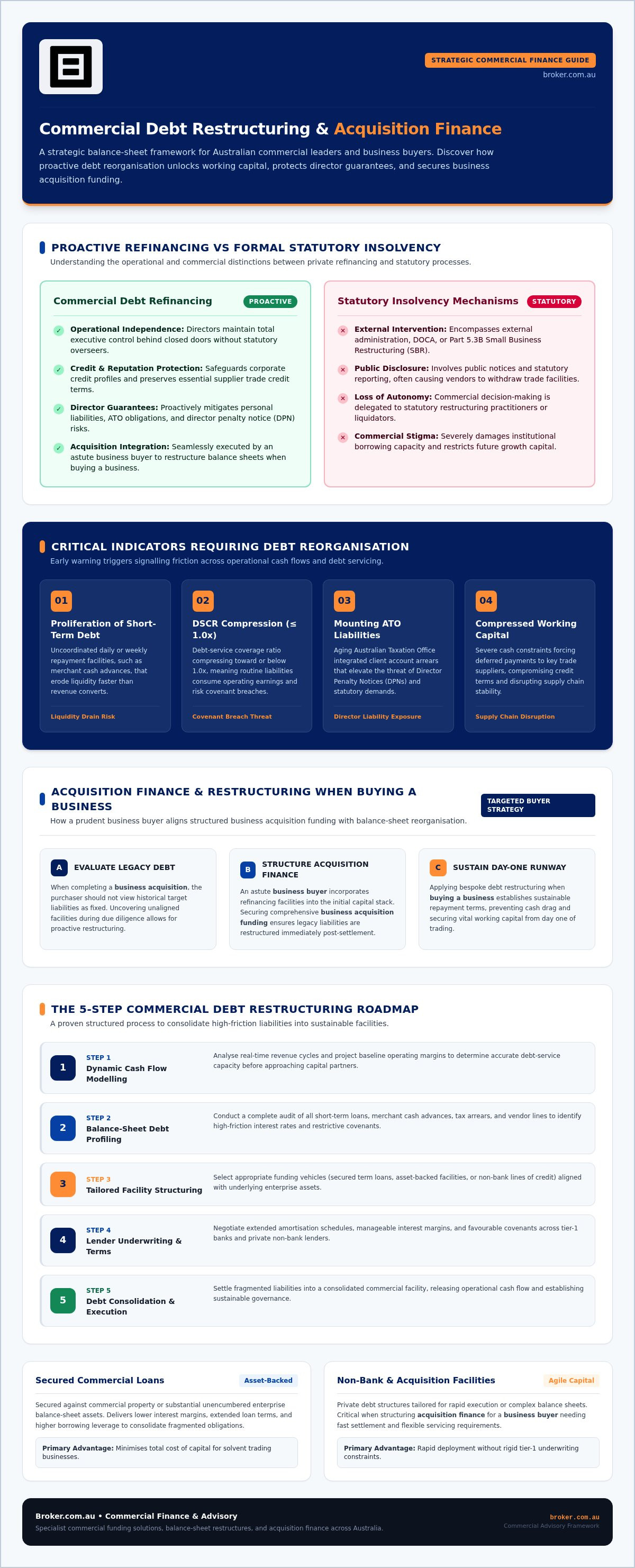
Many directors mistakenly confuse proactive debt restructuring with statutory insolvency mechanisms, such as external administration, Deeds of Company Arrangement (DOCA), or formal Small Business Restructuring (SBR) under Part 5.3B of the Corporations Act 2001. Formal insolvency appointments involve statutory oversight, external reporting, and public disclosures that can permanently impair supplier relationships and cancel trade credit accounts. Conversely, private commercial debt refinancing retains complete operational independence. Directors preserve executive decision-making, protect vendor goodwill, and maintain standard commercial terms while renegotiating or replacing debt facilities behind closed doors.
Critical Indicators Your Company Needs Debt Restructuring
Early identification of balance-sheet friction is essential to executing a successful reorganisation before traditional institutions tighten lending parameters. Consider restructuring your commercial facilities when you encounter these common indicators:
- Proliferation of short-term borrowings: Relying on unaligned daily or weekly debt facilities, such as merchant cash advances, drains operational liquidity faster than revenue converts.
- Deteriorating debt-service coverage: When your debt-service coverage ratio (DSCR) compresses toward or below 1.0x, routine debt obligations overwhelm operating earnings, signalling imminent bank covenant breaches.
- Mounting taxation liabilities: Carrying aging Australian Taxation Office (ATO) integrated client account debts invites severe director penalty notices (DPNs) and statutory demands if left unaddressed.
- Compressed working capital: Constrained cash flow forces deferred payments to key trade suppliers, compromising credit limits and endangering critical supply chains.
Addressing these warning signs early through structured business acquisition funding or asset-backed commercial refinancing creates the financial runway required to run your enterprise smoothly. Mastering how to restructure business debt successfully means moving from defensive crisis mitigation to decisive balance-sheet optimisation.
Core Strategies to Restructure Corporate Liabilities and Manage Debt
Fixing balance-sheet drag requires moving beyond surface-level budget trims to implement structural commercial refinancing. While formal statutory avenues like the Australian Government’s simplified debt restructuring process exist for distressed entities with total liabilities under $1 million, solvent enterprises benefit far more from market-led liquidity reorganisations. Proactive debt management restructures the balance sheet entirely outside statutory court systems, protecting operational reputations while lowering borrowing costs.
Understanding how to restructure business debt successfully hinges on matching your operational liabilities with the right commercial facility. Choosing between secured business loans and unsecured options dictates your leverage and terms. Pledging commercial property or balance-sheet plant and equipment reduces lender risk, delivering extended loan terms and lower repayment margins. Conversely, unsecured facilities provide speed and preserve unencumbered collateral, though they demand higher cash servicing capacity.
Consolidating Fragmented and Short-Term Debts
Uncoordinated borrowing creates acute liquidity traps. Relying on multiple high-interest short-term lines or stacked merchant facilities leads to compounding daily debits that deplete operating margins. Rolling these dispersed obligations into a single, consolidated commercial facility transforms your liabilities:
- Single monthly servicing: Replacing irregular, high-frequency withdrawals with one structured payment stabilises working capital forecasts.
- Term amortisation extensions: Extending obligations over a manageable three-to-seven-year term materially reduces monthly principal drain, immediately freeing operating cash.
- Rate optimisation: Eliminating secondary and tertiary risk margins drops total borrowing expenses, directing capital back into operational expansion.
Restructuring Liabilities in a Business Acquisition
Liability reorganisations frequently centre on corporate transactions. When buying a business, a prudent business buyer evaluates target debts during due diligence, ensuring historical vendor payables and unaligned facilities don’t compromise future performance. Structuring comprehensive business acquisition funding allows the purchaser to wipe legacy lender liens and establish clean credit lines upon completion.
Smart acquisition finance embeds tailored working capital buffers directly alongside the core purchase loan. This strategic capital cushion funds ongoing operational integration while meeting strict bank debt covenants. For tailored assistance structuring these complex facilities, speak with an advisory specialist at Broker.com.au to explore your funding options.
Renegotiating Loan Covenants and Amortisation Profiles
Proactive engagement with existing institutional lenders can relieve immediate operational pressure before breaches occur. Strategic covenant recalibration generally involves negotiating three key adjustments:
- Interest-only transitions: Converting facilities to interest-only repayments for six to twelve months provides the cash buffer required during revenue turnarounds.
- Covenant waivers: Presenting dynamic cash flow forecasts to Tier-1 lenders allows directors to secure formal waivers for temporary debt-service coverage ratio (DSCR) dips.
- Tailored balloon structures: Shifting from accelerated amortisation to deferred residual balances aligns debt payouts with anticipated capital events or refinancing milestones.
Applying these strategies methodically teaches management how to restructure business debt successfully, swapping balance-sheet friction for resilient commercial growth.
Funding Vehicles That Fuel a Successful Commercial Debt Restructure
Replacing unaligned, high-pressure borrowing requires targeted funding vehicles that match your underlying balance sheet. Rather than defaulting to statutory administration when credit tightens, forward-thinking operators look to commercial lending structures that inject immediate liquidity and rebalance cash flow. Selecting the right capital mix forms the practical backbone of how to restructure business debt successfully, insulating core operations while extinguishing short-term debt traps.
For an ambitious business buyer, choosing the right funding package proves equally decisive. When buying a business encumbered by inefficient legacy liabilities, relying on structured business acquisition funding allows you to roll debt into an amortising facility backed by stable enterprise value. Combining tailored acquisition finance with flexible revolving facilities ensures the target firm trades smoothly from day one without starving its growth pipeline.
Asset Finance and Equipment Sale-and-Leaseback
Dormant capital locked in yellow goods, manufacturing plant equipment, or transport fleets offers an immediate refinancing solution. A sale-and-leaseback structure allows an enterprise to sell existing unencumbered machinery to an equipment finance lender, who immediately leases it back to the business under manageable monthly terms. This releases an immediate lump sum of unencumbered equity to pay down urgent, high-friction creditor accounts. Crucially, your daily operational use of critical plant assets remains completely uninterrupted.
Debtor and Working Capital Facilities
Slow debtor turnarounds frequently trigger liquidity crunches, even for profitable enterprises with robust order books. Deploying dedicated working capital finance instruments bridges the gap between delivering goods and receiving customer remittances:
- Invoice finance: Advances up to 85% to 90% of outstanding debtor ledgers within 24 hours of billing, transforming unpaid receivables into continuous cash flow without fixed monthly debt amortisation.
- Revolving business line of credit: Supplies an on-demand liquidity buffer that charges interest solely on drawn funds, allowing management to navigate seasonal troughs and supplier early-payment deadlines effortlessly.
- Trade finance facilities: Pays international or domestic component suppliers directly upon dispatch, preventing supply-chain gridlocks while protecting domestic cash reserves.
Secured vs Unsecured Restructuring Facilities
Balancing pricing, speed, and asset exposure requires careful alignment between secured business loans and unsecured business loans. Leveraging unencumbered commercial real estate via commercial property loans provides Tier-1 and specialist non-bank lenders with high-grade security. In return, lenders deliver extended loan terms and the lowest possible corporate borrowing margins, significantly reducing monthly cash outflows.
Conversely, unsecured business loans dispense with asset valuations and legal mortgages, delivering rapid settlement when immediate cash injections are mandatory. While carrying tighter amortisation terms, they preserve pristine asset ownership. Deploying a bespoke hybrid structure, blending asset-backed facilities for core debt with a flexible working capital line, provides the comprehensive blueprint for how to restructure business debt successfully across fluctuating Australian market cycles.
The 5-Step Process: How to Restructure Business Debt Successfully
Executing a corporate debt overhaul demands precision, institutional-grade documentation, and methodical negotiation. Leaving lender conversations until liquidity runs thin invites punitive terms or outright credit rejections. By deploying a systematic five-step framework, directors regain the initiative, realign liabilities with operational earnings, and discover how to restructure business debt successfully without triggering credit degradation.
This disciplined process works equally well during corporate transactions. When buying a business, a forward-looking business buyer conducts this structured diagnostic across the target entity’s balance sheet. Applying these steps ensures your business acquisition funding seamlessly incorporates both the purchase consideration and the complete reorganisation of inherited liabilities.
Step 1 & Step 2: Comprehensive Debt Audit and 13-Week Cash Forecasting
Begin by mapping every outstanding financial liability across the company ledger. Your audit must capture maturity dates, interest rates, registered Personal Property Securities Register (PPSR) charges, and personal director guarantees. Once your liability register is clear, build an integrated 13-week dynamic rolling cash flow model. This model isolates real trading receipts from fixed overheads, identifying exact liquidity troughs and establishing the sustainable debt servicing capacity of the business based on normalised EBITDA.
Step 3: Formulating the Information Memorandum and Debt Solution
Lenders evaluate risk through credit clarity. Step three involves compiling an institutional-grade Information Memorandum that explains past financial bottlenecks, presents operational turnarounds, and provides forward-looking servicing models. This document frames your funding requirements, matching fragmented liabilities with specialised facilities such as secured business loans, an asset refinance, or tailored acquisition finance. Transparent credit packaging separates proactive business leaders from distressed borrowers in the eyes of Tier-1 and private non-bank underwriters.
Step 4 & Step 5: Executing Lender Negotiations and Post-Restructure Governance
With an Information Memorandum ready, execute competitive lender tenders across multiple capital desks simultaneously:
- Run competitive tenders: Approach both bank and specialist non-bank lenders concurrently to create genuine terms competition, which improves covenant parameters and loan margins.
- Manage security releases: Oversee settlements meticulously, ensuring outgoing creditors provide clean Deeds of Release and PPSR discharges so your incoming credit facilities step into clean first-ranking positions.
- Install ongoing treasury governance: Enforce strict monthly variance reporting post-settlement. Continuous monitoring prevents working capital slippage and guarantees perpetual compliance with updated bank covenants.
If managing fragmented debts or navigating acquisition funding feels overwhelming, connect with the corporate advisory specialists at Broker.com.au to structure a tailored restructure plan today.
Why Engaging an Award-Winning Finance Broker Maximises Restructure Success
Approaching institutional lenders during times of balance-sheet friction without professional representation places directors at a serious disadvantage. Credit committees prioritise their own capital protection over your commercial viability. Engaging an award-winning finance brokerage levels the playing field, giving company leadership an authoritative intermediary with inside access to elite credit desks. By leveraging proprietary AI matching technology alongside seasoned corporate advisory, specialist brokers pair complex balance sheets with receptive Tier-1 banks and private lenders, demonstrating exactly how to restructure business debt successfully without risking corporate autonomy.
Accessing Non-Bank Capital and Private Debt Markets
Traditional banks often retreat when trading performance dips or debt service ratios tighten, enforcing rigid underwriting rules that leave little room for turnaround strategies. In contrast, specialised non-bank lenders and private credit funds offer pragmatic flexibility, assessing underlying enterprise value rather than relying strictly on backward-looking financial statements.
This agility is vital for an astute business buyer navigating a complex business acquisition. Arranging tailored acquisition finance through private debt markets allows purchasers to embed covenant holidays and custom repayment profiles while buying a business. Partnering with an expert brokerage ensures these bespoke funding structures are secured swiftly, keeping operational cash flow unimpaired.
Mitigating Director Guarantees and Cross-Collateralisation
A major hidden danger facing Australian directors is cross-collateralisation, where legacy commercial lenders secure trading lines against personal family residences. When trading conditions soften, this entanglement puts personal wealth at immediate risk. Knowing how to restructure business debt successfully requires methodically uncoupling private assets from commercial borrowings:
- Isolating commercial liabilities: Replacing blended residential facilities with standalone commercial property loans or dedicated asset finance confines lender recourse strictly to enterprise assets.
- Capping director exposure: Expert brokers negotiate limited, proportional director guarantees, preventing individual directors from bearing unconstrained joint and several liability.
- Discharging unaligned PPSR charges: Removing historical personal encumbrances restores clean balance-sheet separation between your household finances and corporate obligations.
Transitioning from uncoordinated liabilities to structured, non-bank facilities removes acute financial pressure. With seasoned advisors managing delicate creditor discussions, business leaders can focus entirely on operational execution and sustainable profitability.
Reclaim Operational Liquidity and Secure Your Commercial Future
Proactive balance-sheet management turns unaligned commercial liabilities from an operational drag into a sustainable foundation for growth. By consolidating fragmented borrowings, releasing dormant capital tied up in enterprise assets, and aligning debt maturities with predictable cash cycles, you insulate your business against shifting economic winds. Mastering how to restructure business debt successfully ensures you maintain complete operational control, protect personal director assets, and preserve essential supplier credit without the disruption of statutory insolvency.
Whether you want to stabilise trading cash flow or secure structured business acquisition funding to reorganise balance-sheet debt when buying a business, experienced credit advisory transforms your outcome. At Broker.com.au, our corporate advisory team combines proprietary AI matching technology with an extensive national panel of Tier-1 banks and private lenders to deliver bespoke funding packages. Take the first step toward lasting balance-sheet resilience: I’m interested in restructuring our business finance with an award-winning broker.
Frequently Asked Questions
Can you restructure business debt in Australia without entering formal insolvency or liquidation?
Yes, commercial debt restructuring is entirely distinct from statutory insolvency procedures like liquidation or voluntary administration. Proactive debt restructuring involves refinancing fragmented loans, negotiating terms directly with creditors, or introducing non-bank facilities. Because this process occurs privately through commercial agreements rather than statutory court mechanisms, your company avoids external administrators, public notices, and operational disruptions. This approach demonstrates how to restructure business debt successfully while maintaining total board-level control of daily trading.
How does commercial debt consolidation differ from an ATO payment arrangement?
An ATO payment arrangement is merely an agreed schedule to clear outstanding tax liabilities while interest continues accruing on the balance. In contrast, commercial debt consolidation refinances that tax liability alongside other business debts into a single, long-term commercial facility. This clears the ATO ledger entirely, removes the threat of Director Penalty Notices (DPNs), and simplifies repayment terms into one predictable monthly instalment structured to suit your operating cash flow.
Will restructuring business loans impact the company’s or director’s credit rating?
Private commercial refinancing typically protects credit scores rather than harming them, provided you act before loan defaults occur. Consolidating high-friction borrowings into a single, performing facility prevents missed payments, covenant breaches, and statutory defaults that damage commercial credit files. While initial lender credit inquiries create minor, temporary footprint entries, establishing a structured, serviceable debt profile significantly strengthens both the company’s and director’s borrowing standing over time.
Can a business buyer restructure existing liabilities when buying a business?
Yes, a business buyer frequently restructures inherited liabilities as a core condition of an acquisition. When buying a business, you can deploy structured acquisition finance alongside dedicated business acquisition funding to refinance legacy vendor debts, replace expensive unaligned equipment loans, and inject fresh working capital into the company. Cleaning up the target balance sheet during settlement ensures the enterprise trades with manageable covenants and sufficient liquidity from day one.
What types of collateral can be used to secure a business debt restructure?
Commercial lenders accept diverse forms of collateral depending on the structure of the facility. Common security assets include commercial property, unencumbered yellow goods, manufacturing machinery, transport fleets, and active debtor ledgers. For enterprises lacking fixed tangible assets, specialist non-bank lenders also arrange unsecured business loans or floating charges over company balance sheets, ensuring business owners can tailor their security profile without risking personal residential property.
How long does a commercial business debt restructure typically take to complete?
A standard commercial debt restructure generally takes between two to six weeks from financial audit to final settlement. Simpler unsecured working capital injections can settle within days, whereas complex multi-tiered restructures involving asset valuations, PPSR discharges, and commercial property refinancing require more underwriting time. Partnering with an experienced brokerage accelerates this timeframe by using AI matching tools to place proposals with the most suitable lenders immediately.
What happens to personal director guarantees when business debts are refinanced?
When legacy loans are fully repaid through refinancing, the outgoing lenders must issue formal Deeds of Release and discharge corresponding director guarantees. Knowing how to restructure business debt successfully allows directors to negotiate cleaner credit terms with incoming non-bank lenders. This process often includes limiting guarantee values, removing personal residential cross-collateralisation, and confining lender recourse strictly to enterprise assets, providing welcome peace of mind for business owners.