
Being a successful company director shouldn’t make you a “high-risk” borrower, yet complex tax structures often trigger more red tape than a standard PAYG application. It’s frustrating when your business is thriving, but your personal borrowing power feels throttled by “cookie-cutter” bank assessments. You’ve likely spent years building a profitable enterprise, only to find that lenders struggle to separate your personal wealth from company assets. This friction is particularly draining when you’re looking to scale or explore business acquisition funding to expand your portfolio.
This 2026 guide explains how low doc home loans for company directors provide a streamlined path to securing competitive rates using alternative verification like BAS or accountant letters. You’ll discover how to bypass typical hurdles and gain “inside access” to rates usually reserved for salaried employees. We also dive into how a business buyer can leverage property equity for acquisition finance, ensuring you have the capital for buying a business without the usual corporate lending headache. From APRA’s latest debt-to-income caps to smart ways to fund a business acquisition, we’ll show you how to move from uncertainty to confidence.
Key Takeaways
- Learn how to use Business Activity Statements (BAS) and accountant letters to verify your income without the need for finalised company tax returns.
- Discover how low doc home loans for company directors offer a streamlined application process with access to competitive rates previously reserved for PAYG earners.
- Explore how to leverage personal property equity to secure Business Acquisition Funding, providing a cost-effective path for any business buyer looking to expand.
- Understand the 2026 lending landscape, including why non-bank lenders are often more flexible regarding APRA’s debt-to-income caps for self-employed directors.
- Identify the essential steps for a stress-free application, from reviewing company cash flow to engaging an expert broker for tailored acquisition finance solutions.
Table of Contents
- Understanding Low Doc Home Loans for Company Directors
- Beyond the Pay Slip: How Income is Verified in 2026
- Comparing Low Doc vs. Full Doc for Business Owners
- Integrating Property and Business Acquisition
- The Roadmap: Applying for Your Director Home Loan
Understanding Low Doc Home Loans for Company Directors
In the 2026 Australian lending market, the term “low doc” has evolved into a sophisticated “alt-doc” category. A low-documentation loan isn’t about hiding details; it’s about providing evidence that traditional bank systems aren’t built to read. For many, low doc home loans for company directors are the only way to bypass the “pay slip problem,” where a high-earning director appears “unserviceable” on paper because their income is tied up in company profits or complex trusts. While the name suggests a lack of paperwork, it actually refers to alternative verification. You’re swapping standard tax returns for real-time data that reflects your true financial strength.
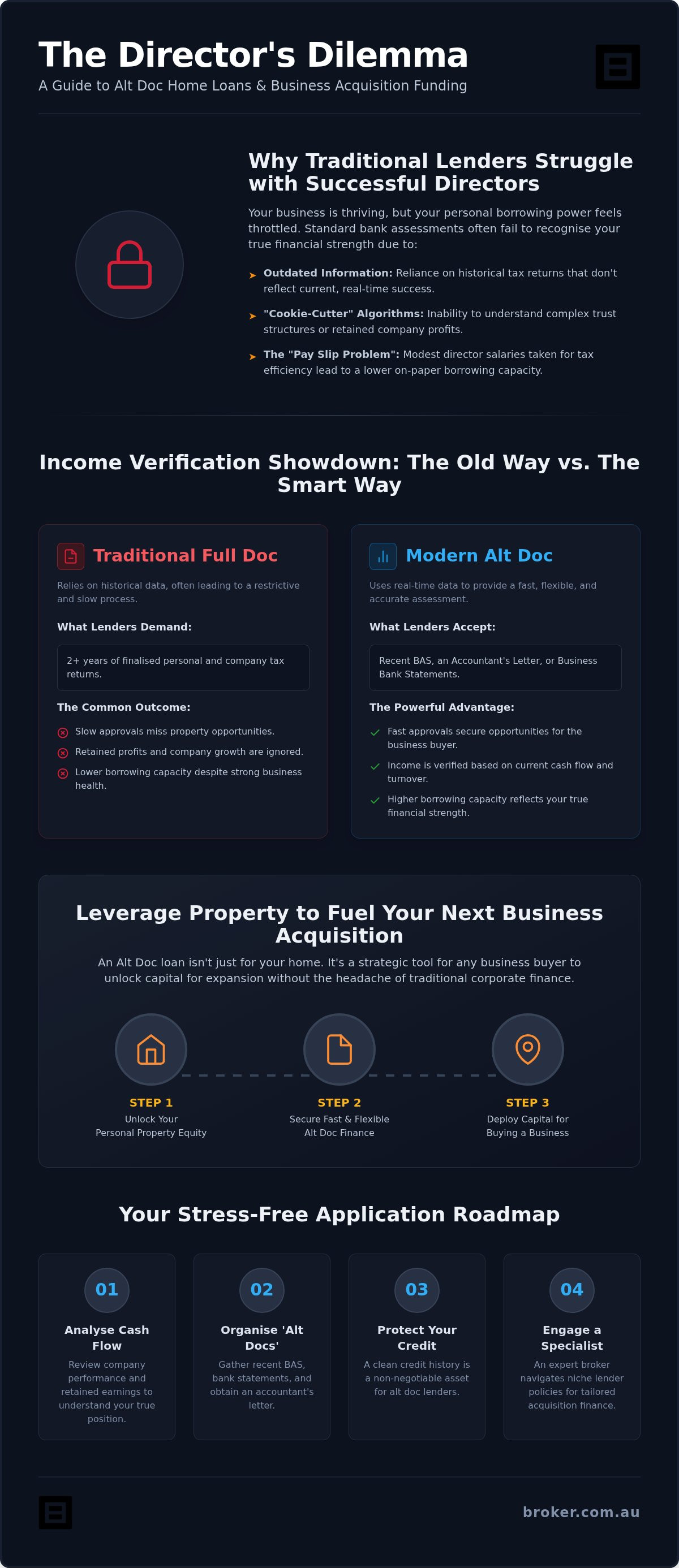
Banks often demand two years of finalised tax returns, which is rarely practical for a proactive director. By the time your accountant lodges your latest returns, the property you wanted is often sold. Modern Alt Doc solutions focus on current cash flow using Business Activity Statements (BAS) and business bank statements. This shift allows for a more accurate reflection of your current earning capacity rather than relying on historical tax data that might be eighteen months out of date.
Why Company Directors Face Unique Challenges
The primary hurdle is the disconnect between personal drawings and actual company profit. You might take a modest salary for tax efficiency while the business retains significant earnings for future growth. Standard lenders often ignore these retained earnings, which significantly lowers your borrowing capacity. Additionally, many directors use complex trust structures to manage assets. While these are excellent for tax planning, they often confuse “cookie-cutter” bank algorithms, leading to unnecessary rejections despite a strong financial position. We specialise in looking past the structure to the underlying cash flow.
The Benefits of a Tailored Director Loan
Efficiency is the greatest advantage. Approval happens quickly because you aren’t waiting for the ATO to process historical returns. This speed is vital for any business buyer who needs to move fast on a property to secure their personal lifestyle while managing a business acquisition. Speed ensures you don’t miss out on opportunities while your files sit on a credit assessor’s desk.
Flexibility also plays a massive role. If you are currently buying a business or restructuring your group, traditional banks will likely put your application in the “too hard” basket. A tailored director loan understands the nuances of acquisition finance. It allows you to use your property equity as part of your Business Acquisition Funding strategy, ensuring you aren’t bogged down in corporate auditing when you should be focusing on scaling your enterprise.
Beyond the Pay Slip: How Income is Verified in 2026
The landscape for low doc home loans for company directors has shifted from “reduced info” to “real-time data.” Lenders now prefer the transparency of a Business Activity Statement (BAS) because it reflects the current health of your enterprise. While a traditional bank might penalise you for a dip in profit from two years ago, alt-doc lenders look at your last four quarters of GST turnover. This is particularly helpful for any business buyer who has recently completed a business acquisition and hasn’t yet produced a full year of tax returns for the new entity.
According to the Australian government definition of a low-doc loan, these arrangements are specifically designed for self-employed borrowers who cannot provide standard financial statements. In 2026, an accountant’s letter acts as a verified declaration of your income, often referred to as “self-certifying.” When paired with six months of business bank statements, this creates a powerful profile of your servicing capacity. Success hinges on a clean credit history. Lenders view a spotless repayment record as the ultimate proof of character when tax returns are off the table.
The “Alt Doc” Revolution
Digital data feeds and AI verification have replaced the manual slog of older applications. At Broker.com.au, we use proprietary AI to scan niche lender criteria, matching your specific cash flow patterns with the best available rates. This technology often unlocks higher Loan to Value Ratios (LVR). While a 60% LVR was once the standard for directors, many 2026 products now allow for 80% LVR, provided your business demonstrates consistent quarterly growth. This flexibility is essential for those looking to preserve capital for acquisition finance.
Director Loan Accounts and Dividends
Dividends are no longer viewed as “one-off” payments. Modern lenders treat regular dividend distributions as stable, recurring income. If you’re using property equity for Business Acquisition Funding, you must manage your director loan accounts carefully. Large, unexplained debits can trigger red flags during the assessment process. Servicing is simply the lender’s mathematical certainty that your net monthly cash flow can cover repayments at a rate 3% higher than the current offer. If you’re currently buying a business and need to understand how your new structure affects your borrowing power, our team can provide a tailored review of your position.
Comparing Low Doc vs. Full Doc for Business Owners
For many company directors, the choice between low doc and full doc isn’t about the rate alone. It’s about timing. While standard variable rates in 2026 average around 5.90% p.a., low doc home loans for company directors typically sit between 7% and 8.5% p.a. This spread might seem significant on a spreadsheet, but it pales in comparison to the cost of a lost opportunity. If waiting six months for your accountant to finalise tax returns means missing out on a prime property or a strategic business acquisition, the slightly higher interest margin becomes a small price for agility. We provide inside access to non-bank lenders who offer rate-parity for directors with high equity, ensuring you aren’t penalised for your corporate structure.
Lenders Mortgage Insurance (LMI) works differently in this space. For full doc loans, you can often push to 80% or 90% LVR before LMI becomes a hurdle. In the low doc world, that threshold usually drops to 60% or 70%. If you’re a business buyer looking to keep your cash liquid for acquisition finance, understanding these LMI triggers is vital to protecting your working capital. Our proprietary AI streamlines this search, matching you with lenders who have a higher appetite for director-led applications without the usual red tape.
The Cost-Benefit Analysis
It makes financial sense to pay a slightly higher rate when the flexibility allows you to scale. You aren’t locked into these rates forever. Many directors use a low doc product as a short-term bridge. Once your next set of tax returns is lodged and shows the full strength of your business acquisition, you can often refinance to a standard full doc product. High equity levels also play a massive role here. If you can provide a 30% deposit, the interest rate margin between low doc and full doc narrows significantly, sometimes to as little as 0.5%.
Lender Requirements Matrix
Evaluating your loan readiness involves categorising yourself as “Prime” or “Near Prime.” Prime low doc lenders want to see a clean credit history and at least 12 months of ABN registration. Near Prime lenders are more flexible with those currently buying a business or those with minor credit defaults, though they charge a premium for the risk. With over 100 lenders in the Australian market, a broker is essential to identify which ones understand Business Acquisition Funding. We look at your total financial story, ensuring your personal borrowing power supports your corporate growth goals.
Integrating Property and Business Acquisition
A sophisticated director views their home not just as a residence, but as a strategic lever for corporate growth. In the 2026 market, the synergy between property equity and Business Acquisition Funding has become a primary driver for portfolio expansion. By utilising low doc home loans for company directors, you can unlock the equity in your home to provide the necessary capital for buying a business without exhausting your liquid cash reserves. This “cash-out” strategy often provides a significantly lower interest rate than unsecured commercial facilities, making it a highly efficient form of acquisition finance.
The timing of these moves is critical. If you’re currently a business buyer, any new corporate debt can impact your personal debt-to-income (DTI) ratio. Under the APRA regulations that came into effect in February 2026, banks are restricted in how much high-DTI lending they can hold. This makes it essential to work with a partner who understands the intersection of M&A and residential lending to ensure one side of your balance sheet doesn’t compromise the other.
Acquisition Finance for the Strategic Director
Structuring debt correctly is the difference between a seamless approval and a rejected application. When buying a business, you must consider the deposit and equity requirements of the target entity. A savvy business buyer will use financial modelling to demonstrate that the new acquisition will generate sufficient cash flow to cover both the business debt and the personal mortgage. Lenders in 2026 are increasingly focused on these integrated models to verify that your total “servicing” remains robust even after a major purchase.
Managing Cash Flow Across Portfolios
Restructuring a group of companies can often trigger red flags for traditional lenders who prefer simple, linear income streams. We act as a “High-Level Fixer” in these complex scenarios, helping you present a narrative that highlights the strength of your combined assets. In 2026, lenders require a “clear separation” of business and personal liabilities to ensure your personal mortgage remains secure regardless of corporate fluctuations. If you’re looking to scale your portfolio while securing your dream home, I’m interested in discussing your acquisition strategy to find a tailored solution that fits your long-term vision.
The Roadmap: Applying for Your Director Home Loan
Securing low doc home loans for company directors requires a shift from traditional compliance to strategic storytelling. Your first step involves a preliminary review of your company cash flow and the last four quarters of your Business Activity Statements. This ensures your “top-line” turnover supports the loan amount before you ever approach a lender. Once your internal numbers are clear, you must engage an expert broker who understands the nuances of acquisition finance and director-led entities. This prevents your application from being rejected by the automated, “cookie-cutter” algorithms used by major banks that often fail to recognise the strength of a complex corporate group.
The next phase is preparing your “Alt Doc” pack, which typically includes a verified accountant letter and six months of business bank statements. We then use proprietary AI-driven financial modelling to stress-test your application against the current 3% serviceability buffer required in 2026. This proactive step ensures your personal mortgage and any Business Acquisition Funding plans are sustainable even if interest rates fluctuate. Finally, we leverage our network to provide “inside access” to competitive rates and niche lenders, guiding you through to a seamless settlement. This structured approach transforms a high-stakes financial move into a managed, predictable process.
Why Broker.com.au is the Expert Choice
We’ve built our reputation as “High-Level Fixers” for Australians with complex financial needs. Our award-winning status isn’t just a badge; it’s a reflection of our commitment to helping nearly one million people find tailored solutions. While our technology is “best in class,” our team provides the essential human touch. Experts like Matt, Kylie, and Flavio understand that behind every business acquisition is a director with a personal dream. Our “I’m interested” approach replaces high-pressure sales with a low-pressure conversation, ensuring you feel supported from the first click to the final signature.
Final Checklist for Success
Before you lodge your application, ensure your corporate house is in order. Lenders in 2026 are particularly focused on superannuation and ATO obligations; any outstanding liabilities here can halt a business buyer in their tracks. You should also have a clean exit strategy for your business debt to demonstrate long-term stability. If you’re currently buying a business and want to ensure your personal borrowing power remains intact, we’re here to help. I’m interested – Start your stress-free application today and let our team organise a finance solution that matches your corporate ambition.
Empowering Your Next Strategic Move
Navigating the 2026 lending landscape doesn’t have to be a source of frustration. By choosing low doc home loans for company directors, you’re opting for a modern, cash-flow-centric approach that respects the complexity of your business structure. You can bypass the traditional “pay slip problem” by using real-time data like BAS and accountant letters. This flexibility is vital for any business buyer who needs to move quickly on property while simultaneously managing acquisition finance for their next enterprise.
Our award-winning Australian brokerage combines proprietary AI with deep expertise in Business Acquisition Funding to ensure you aren’t held back by rigid bank algorithms. We provide the “inside access” you need to secure competitive rates while you focus on the nuances of buying a business or scaling your current operations. You’ve built a successful company; now it’s time to ensure your personal finance is just as streamlined and efficient as your corporate strategy.
I’m interested – Speak with our expert team about your director loan
You’re in good hands with a team that understands the intersection of corporate growth and personal wealth. We look forward to helping you turn your next property or business goal into a reality.
Frequently Asked Questions
Can I get a home loan as a company director with only 12 months of ABN registration?
Yes, you can certainly secure finance with 12 months of ABN registration. While traditional banks often demand two full years of trading history, many specialist lenders in the 2026 market accept 12 months or even as little as 6 months in specific cases. This flexibility is essential for any business buyer who has recently completed a business acquisition and needs to establish their personal residency while the new venture scales.
How much deposit do I need for a low doc home loan in 2026?
A minimum deposit of 20% is generally required, representing an 80% Loan-to-Value Ratio (LVR). Some lenders may allow up to 85% LVR; however, this usually incurs higher interest rates. If you’re looking for the most competitive terms for low doc home loans for company directors, providing a 30% deposit is ideal. This larger equity stake often removes the need for Lenders Mortgage Insurance, which typically triggers at 60% or 70% for alt-doc products.
Is an accountant’s letter enough to prove my income to an Australian lender?
An accountant’s letter is a powerful tool, but it’s rarely used in isolation. In the current lending environment, most lenders require this letter to be supported by 6 to 12 months of Business Activity Statements (BAS) or business bank statements. This combination provides a verified declaration of your income. It’s a highly effective way for a business buyer to prove current cash flow without waiting for the next financial year’s tax returns to be finalised.
What is the maximum I can borrow on a low doc loan as a company director?
Maximum borrowing limits are determined by your equity and your ability to meet the 3% serviceability buffer. While there isn’t a fixed “cap,” most low doc products are restricted to an 80% LVR. For context, the average new home loan in early 2026 was $734,881. Your specific limit will depend on whether your company cash flow can support the repayments at a higher “test” rate, ensuring you remain “in good hands” throughout the process.
How does business acquisition funding affect my personal home loan application?
Acquisition finance can impact your personal borrowing power by increasing your total debt-to-income (DTI) ratio. APRA regulations now limit the amount of high-DTI lending banks can hold, so buying a business right before a home loan requires careful planning. We specialise in Business Acquisition Funding and can help you structure your corporate debt so it doesn’t derail your personal mortgage application. This integrated approach ensures your total portfolio remains balanced and sustainable.
Do low doc loans have higher interest rates than standard mortgages?
Yes, interest rates for low doc products are typically 0.5% to 1.5% higher than standard variable rates. As of mid-2026, these rates generally range from 7% to 8.5% p.a. While the cost is slightly higher, the value lies in the speed and flexibility of the approval. This is particularly useful for a business buyer who needs to secure a property quickly without the red tape of exhaustive corporate auditing or finalised tax returns.
Can I use a low doc loan for an investment property or just a home?
Low doc loans are available for both owner-occupied homes and investment properties. In fact, lending to investors saw a 25.3% year-on-year increase in early 2026. Many company directors use these products to build their property portfolios while focusing their liquid capital on buying a business. Whether you’re securing a family home or an investment asset, the verification process remains focused on your company’s current cash flow and BAS statements rather than historical tax data.
What happens if my company has an ATO debt? Can I still get a home loan?
Having an ATO debt makes the process more complex, but it doesn’t automatically result in a rejection. Specialist non-bank lenders may still consider your application if you have a clear repayment plan or an exit strategy to clear the debt. It’s vital to be transparent about these liabilities early. We act as a “High-Level Fixer” in these scenarios, helping you present a narrative that highlights your business’s overall strength and your path to resolution.