
Did you know that in 2026, 61% of Australian SMEs walked away from bank loan applications simply because the documentation felt like an insurmountable mountain? It’s a frustrating reality for any ambitious business buyer. Between the RBA holding cash rates at 4.35% and traditional lenders tightening their grip on residential property, the dream of buying a business can quickly feel like a personal liability nightmare. You’re likely facing strict collateral requirements for business acquisition loan approvals that put your family home on the line, all while trying to bridge a valuation gap with a seller who expects top dollar.
We understand the pressure of trying to secure Business Acquisition Funding without risking everything you’ve built. You’ll discover how to structure the perfect deal by balancing the stability of bank loans with the flexibility of seller financing. This approach allows you to achieve a funded business acquisition while keeping your personal risk to a minimum. We’ll provide a clear breakdown of deposit requirements and show you how to use tailored acquisition finance to ensure a smooth transition of ownership, giving you the confidence to move from a state of uncertainty to a successful handover.
Key Takeaways
- Learn why the savvy Australian business buyer is moving toward hybrid funding models when buying a business in the 2026 high-interest environment.
- Understand how to meet the collateral requirements for business acquisition loan applications without necessarily risking your personal residential assets.
- Discover how to structure acquisition finance that balances the stability of a bank loan with the flexibility of seller-led vendor notes.
- Identify the “Servicing Trap” where seller debt can impact your bank borrowing capacity and how to structure your deal to avoid it.
- Find out how an expert broker provides “inside access” to the best rates through proprietary AI technology and bespoke corporate advisory for your business acquisition.
Table of Contents
- The 2026 Landscape for Buying a Business in Australia
- Acquisition Finance 101: Traditional Bank Loans vs Seller Financing
- The Crucial Comparison: Servicing, Cash Flow, and Equity
- Negotiating the Deal: Australian Business Buyer’s Guide
- Optimising Your Business Acquisition Funding with Expert Guidance
The 2026 Landscape for Buying a Business in Australia
The Australian M&A market for small to medium enterprises is currently defined by a unique tension. While the Reserve Bank of Australia (RBA) held the cash rate at 4.35% in May 2026, the appetite for buying a business remains remarkably high. New lending to SMEs surged to $153.7 billion according to recent OECD data, proving that acquisition remains a primary vehicle for wealth creation. For many corporate professionals, a business acquisition offers a faster, more stable route to independence than a start-up, providing immediate cash flow and established systems.
However, the 2026 market presents specific hurdles. We’re seeing a persistent valuation gap between what sellers expect and what a business buyer can realistically service. Traditional lenders have become more conservative, creating a credit squeeze that forces buyers to be more creative with their deal structures. Success in this environment requires a sophisticated understanding of how to bridge the distance between a seller’s price tag and a bank’s valuation.
The Evolution of Business Acquisition Funding
Lending criteria have undergone a significant shift. In 2026, lenders are prioritising robust, historical cash flow over simple asset backing. This evolution means that acquisition finance is no longer a one-size-fits-all product. You need to demonstrate that the target business can comfortably service debt even if interest rates fluctuate further. A modern buyer needs a comprehensive strategy that includes a solid deposit, a clear business plan, and a deep understanding of the collateral requirements for business acquisition loan approvals in a high-rate climate.
Why Traditional Bank Loans Aren’t Always Enough
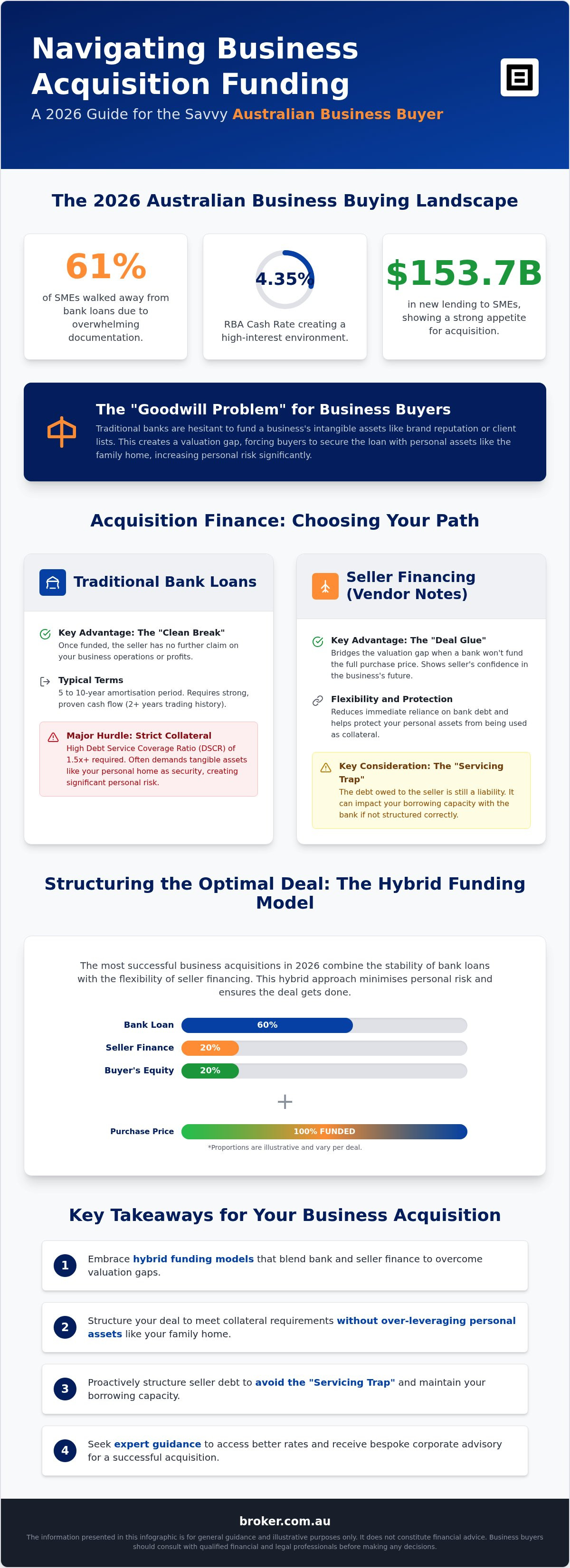
The most common roadblock in Australian business purchases is the “Goodwill Problem.” Banks are notoriously hesitant to fund the intangible value of a business, such as its brand or client list. If you’re looking at a service-based business where assets are minimal, a traditional bank might only offer a fraction of the purchase price. This often leads to a heavy reliance on personal assets, where the bank demands the family home as security. Such stringent collateral requirements for business acquisition loan facilities can create unnecessary personal risk.
To navigate this, savvy buyers are turning to alternative structures. This is where seller financing has become an essential tool. By allowing the seller to carry a portion of the purchase price as a loan, you reduce the immediate burden on bank debt and often secure better terms. It’s about moving away from the rigid constraints of major banks and toward a more tailored, flexible funding model that protects your personal equity while ensuring the deal gets done.
Acquisition Finance 101: Traditional Bank Loans vs Seller Financing
Choosing the right Acquisition finance model is a pivotal moment for any Business buyer. You’re essentially deciding between a clean break with a traditional lender or an ongoing financial partnership with the person selling the business. Both paths have distinct impacts on your cash flow and your level of control over the operation. While a bank loan offers a finality that many prefer, seller financing often acts as the “glue” that holds a complex deal together when valuations don’t quite align.
The Mechanics of a Traditional Bank Loan
Traditional bank loans for a business acquisition typically come with a five to ten-year amortisation period. Lenders in 2026 remain focused on stability, usually requiring at least a two-year trading history from the target business to prove it can handle the debt. The primary advantage here is the “Clean Break.” Once the transaction is finalised, the seller has no further claim on your profits or your decision-making process.
However, the collateral requirements for business acquisition loan approvals from major banks can be stringent. They often look for a Debt Service Coverage Ratio (DSCR) of 1.5x or higher to ensure the business can survive market fluctuations. When you examine the collateral requirements for a business loan, it’s clear that banks prefer tangible security, like commercial or residential property, to back the facility. This can be a significant hurdle if the business you’re buying a business for is light on physical assets but heavy on goodwill.
How Seller Financing (Vendor Finance) Works
Seller financing, often called vendor finance in Australia, involves the seller “loaning” you a portion of the purchase price. This is documented via a Vendor Note, which outlines the deferred payment schedule. It’s a powerful “skin in the game” argument. If a seller is willing to wait for their money, it signals their confidence that the business will remain profitable under your leadership.
Interest rates in these arrangements are highly negotiable. They can be lower than bank rates to help the deal close, or higher to compensate the seller for their risk. To protect their remaining interest, the seller will typically register a security interest on the Personal Property Securities Register (PPSR). This ensures they have a claim on the business assets if the buyer defaults. If you’re trying to determine if this structure suits your goals, it’s often worth a quick chat to see how different models compare for your specific scenario.
This hybrid approach is becoming a standard for the modern Business buyer. By combining a secured bank loan for the bulk of the price with a smaller vendor note, you can often satisfy the bank’s equity requirements while keeping more of your own cash in reserve for working capital.
The Crucial Comparison: Servicing, Cash Flow, and Equity
Success for any Business buyer relies on more than just finding the right target; it’s about surviving the first 12 months of ownership. You must model your cash flow with surgical precision, accounting for the dual burden of debt servicing and operational working capital. While you explore Australian government funding options and private debt, the way these liabilities interact determines your viability. Australian banks in 2026 are particularly focused on “stress testing” your projections against potential rate rises, ensuring the business remains profitable even if the RBA shifts its stance.
The “Servicing Trap” is a common pitfall. Many buyers assume that seller financing is viewed as equity by the bank because it’s not a traditional loan. In reality, most Australian lenders treat a vendor note as a hard liability. If you’re paying the seller $5,000 a month, the bank subtracts that $60,000 annual obligation from your total servicing capacity. Unless the seller’s debt is fully subordinated (meaning they only get paid after the bank), it can actually reduce the amount of Acquisition finance a bank is willing to provide.
Impact on Monthly Cash Flow
When you balance a bank loan with seller finance, you’re often managing two different repayment schedules. Bank loans typically require monthly principal and interest payments. Seller finance can be more flexible, allowing for interest-only periods or “earn-outs” where payments are tied to the business hitting specific performance targets. This protects you if the transition is rockier than expected. However, you must plan for the “Balloon Payment” risk. If the vendor note expires in three years, you’ll need a clear strategy to refinance that debt or pay it out from accumulated profits.
Equity and Deposit Requirements
We often get asked if seller finance can count as the deposit. The unvarnished truth is that most major Australian banks still require 30% to 50% “real” equity. They want to see “hurt money” from the Business buyer, usually in the form of cash or equity in a residential property. This is why collateral requirements for business acquisition loan approvals remain a significant barrier. To reduce the upfront cash burden, we often help clients use equipment or vehicle finance to “unbundle” the assets of the business, effectively lowering the amount of goodwill that needs to be funded through a secured loan.
Interest deductibility is another critical factor. In Australia, interest on Acquisition finance is generally tax-deductible if the loan is used to produce assessable income. Whether it’s a bank facility or a vendor note, ensuring the loan is structured correctly from day one can significantly improve your net cash flow. A Business Acquisition Funding specialist can help you navigate these complex collateral requirements for business acquisition loan structures to ensure you aren’t over-leveraged while keeping your personal assets as protected as possible.
Negotiating the Deal: Australian Business Buyer’s Guide
Negotiating a successful business acquisition in Australia is a delicate dance between financial reality and the seller’s legacy. You’ve modelled the cash flow and understood the servicing trap; now you must codify those findings into a binding deal. The process begins with rigorous financial due diligence. You aren’t just looking for profit; you’re looking for the sustainability of that profit once the current owner exits. This investigation informs your negotiation of the Vendor Note, where you should push for interest-only periods or specific covenants that protect your cash flow during the critical first year.
Once the terms are agreed upon, you must align the bank’s Letter of Offer with the Sale of Business Agreement. Any discrepancy here can derail the funding at the eleventh hour. Finally, manage the transition period by ensuring the seller stays on for a defined term. This isn’t just for training; it’s a form of insurance that the business’s relationships and institutional knowledge don’t walk out the door on day one.
The Hybrid Funding Model
In the 2026 market, we often recommend the “60-20-20 Rule” as a starting point for negotiation. This involves securing 60% of the price through a bank loan, 20% via seller financing, and providing 20% in cash equity. Banks generally favour this structure because it significantly de-risks the deal. When a seller is willing to wait for a portion of their payout, it signals to the lender that the business is a viable, ongoing concern.
This hybrid approach also helps manage the collateral requirements for business acquisition loan approvals. By reducing the total amount you need to borrow from a traditional bank, you may be able to avoid cross-collateralising your family home or other personal assets. If you’re facing a wary seller, pitch this as a way to achieve their desired valuation while ensuring the buyer has the working capital needed to grow the business they built. If you need help structuring this pitch, you can get expert guidance on Business Acquisition Funding to ensure your offer is both competitive and bankable.
Legal and Security Considerations
The legal framework of your deal is just as important as the interest rate. A Deed of Subordination is almost always required by Australian banks. This document ensures the bank is the “first-ranking” creditor, meaning they get paid before the seller if things go south. You must also ensure all PPSR registrations are handled correctly so you receive a clear title upon completion. To protect yourself further, include clawback provisions in the Sale of Business Agreement. These allow you to reduce the final payout to the seller if the business fails to meet the financial benchmarks established during due diligence. This creates a powerful incentive for the seller to provide a transparent and honest handover.
Optimising Your Business Acquisition Funding with Expert Guidance
Securing a business in 2026 requires more than just a healthy balance sheet; it demands a sophisticated approach to the capital stack. While we’ve discussed the complexities of the 60-20-20 model and the nuances of vendor notes, the actual execution often feels like a full-time job. This is where an award-winning broker becomes your secret weapon. Instead of wrestling with traditional bank bureaucracy, you gain a partner who acts as a high-level fixer, navigating the collateral requirements for business acquisition loan approvals on your behalf.
The difference between a standard mortgage broker and a corporate advisory approach is profound. A specialist doesn’t just look for a loan; they look at the deal structure. They understand how to pitch your acquisition to lenders so that your residential property isn’t the only security on the table. By leveraging deep industry relationships, we provide inside access to rates and terms that aren’t available to the general public, ensuring your Acquisition finance is as efficient as possible.
The Broker.com.au Advantage
We’ve integrated proprietary AI technology to streamline what used to be a months-long ordeal. Our system scans the 2026 lending market in minutes, matching your unique Business acquisition profile to the lenders most likely to approve your specific industry and deal size. This technology is particularly effective at identifying non-bank lenders who specialise in goodwill and cash flow funding, often providing a vital alternative when major banks are too slow to move.
- Stress-free applications: We manage the intense Lender Q&A process, allowing you to focus on due diligence and operational handover.
- Inside access: Our volume and reputation give us leverage to negotiate better covenants and lower interest rates.
- Expert modelling: We help you stress-test your first 12 months to ensure your servicing remains robust.
Your Next Steps to Ownership
The path to buying a business starts with preparation. Before you approach a lender, ensure your personal financial statement is up to date and your equity position is clear. We prefer a low-pressure conversation about your goals through our “I’m interested” approach, which moves you from uncertainty toward a streamlined path to completion. Our corporate advisory services simplify the M&A process by bridging the gap between complex financial modelling and successful ownership. If you’re ready to bypass the Business buyer candidates who abandon their applications due to paperwork, it’s time to change your strategy. We ensure the collateral requirements for business acquisition loan facilities don’t become a permanent roadblock to your entrepreneurial dreams.
Securing Your Future in the 2026 Acquisition Market
Success in the current Australian landscape requires a shift from traditional debt toward a smarter, hybrid approach. By balancing bank stability with seller flexibility, you can bridge valuation gaps while protecting your hard-earned equity. Navigating the complex collateral requirements for business acquisition loan approvals doesn’t have to mean risking your family home, provided you structure the deal with precision and foresight.
As an award-winning Australian brokerage, we specialise in these complex M&A deal structures. Our proprietary AI technology matches your profile to the right lender in minutes, giving you a distinct advantage in a competitive market. Whether you’re a first-time buyer or an expanding firm, we provide the expert guidance needed to secure goodwill funding and cash flow lending without the usual bank bureaucracy. It’s time to move from uncertainty toward a streamlined transition of ownership.
I’m interested in exploring my acquisition funding options
Your dream of business ownership is within reach. We’re here to ensure your path to a funded acquisition is professional, efficient, and above all, successful.
Frequently Asked Questions
Can I use seller financing as a deposit for a bank loan in Australia?
Most Australian banks won’t accept seller financing as a substitute for your cash deposit. Lenders typically require a 10% to 20% cash contribution or equity in existing property to ensure you have “skin in the game.” While vendor finance helps bridge the valuation gap, it’s viewed as a liability that affects your serviceability rather than an equity contribution. We recommend preparing a clear statement of your available cash reserves before applying for finance.
What is a typical interest rate for seller financing in 2026?
Interest rates for seller financing are entirely negotiable and don’t strictly follow the RBA cash rate. In 2026, these rates often sit between 7% and 12% depending on the risk profile of the deal. Some sellers offer lower rates to facilitate a quicker sale, while others charge a premium for the risk of not being paid upfront. It’s vital to model these repayments alongside your primary bank debt to ensure your monthly cash flow remains positive.
Do I need to provide my home as security for a business acquisition loan?
You don’t always need to provide your home as security, but it’s the most common path to lower interest rates. Many major banks have rigid collateral requirements for business acquisition loan approvals that demand residential property. However, alternative structures like cash flow-based lending or asset finance can help you avoid this. We focus on matching you with lenders who prioritise the business’s performance over your personal assets, keeping your family home out of the deal.
What happens if the business fails and I still owe the seller money?
If the business fails, your legal obligation to pay the seller usually remains unless the contract specifies otherwise. Sellers typically secure their interest via the Personal Property Securities Register (PPSR). This means they can claim business assets to recover their funds. Because most bank loans involve a Deed of Subordination, the bank is paid first, leaving the seller to recover whatever remains. It’s a high-stakes scenario that highlights the importance of thorough due diligence before purchase.
Is vendor finance legal for all types of business purchases?
Vendor finance is legal for almost all business types in Australia, from retail shops to complex industrial firms. The key is ensuring the arrangement is documented through a formal Vendor Note and a Sale of Business Agreement. There are no specific regulatory prohibitions against it, but both parties should seek independent legal and financial advice. This ensures the structure complies with Australian tax laws and doesn’t conflict with any existing bank covenants or security interests you’ve already signed.
How long does it take to get a bank loan for a business purchase?
A traditional bank loan for a business purchase usually takes between four and eight weeks from application to settlement. This timeline includes the bank’s assessment of your financial position and their due diligence on the target business. At Broker.com.au, we use proprietary AI technology to match you with lenders faster, often reducing the initial approval phase significantly. Having your financial modelling and tax portals ready for review is the best way to accelerate this process.
Can I combine a bank loan, seller finance, and asset finance?
Yes, combining these sources is a strategic way to meet the collateral requirements for business acquisition loan structures while preserving your capital. By using asset finance for machinery or fleets and seller finance for a portion of the goodwill, you reduce the burden on your primary bank loan. This hybrid approach is common in the 2026 market because it de-risks the deal for the bank. It allows you to leverage different assets to achieve a fully funded acquisition.
What is a Deed of Subordination and why do I need one?
A Deed of Subordination is a legal agreement required by banks when seller financing is involved. It ensures that the bank is the “senior” lender, meaning they have the first right to be repaid if the business faces financial trouble. Banks won’t usually fund a business acquisition unless the seller agrees to wait behind them for payment. It’s a standard requirement in Australian M&A that protects the primary lender’s security position during the critical transition period.