Why would you continue paying rent to a landlord when you could be your own landlord, especially when the combined security of a business and its freehold property often unlocks the sharpest interest rates in the market? For many an aspiring business buyer, the process of buying a business while simultaneously acquiring the property feels out of reach due to high deposit requirements for goodwill. While some search for a commercial land and construction loan Australia-wide to build from scratch, savvy investors in 2026 are increasingly targeting existing ‘going concerns’ that include the freehold title to simplify their path to ownership.
We know that complex servicing calculations across two different asset classes can feel overwhelming, and the fear of cross-collateralisation risks often stalls a promising business acquisition. This guide will help you master the nuances of acquisition finance so you can leverage property equity to secure better terms. You’ll discover a streamlined approach to business acquisition funding that avoids common pitfalls and provides a clear roadmap to securing your future premises. We’ll break down exactly how to structure your loan to ensure your transition from tenant to owner is seamless and professional.
Key Takeaways
- Learn how to structure a ‘going concern’ acquisition to combine business goodwill and freehold premises, unlocking more competitive interest rates through asset-backed security.
- Discover how to leverage existing residential equity to bridge the deposit gap, reducing the need for large cash reserves when buying a business.
- Understand why an established freehold acquisition may provide more immediate servicing benefits compared to a commercial land and construction loan australia, particularly in a shifting interest rate environment.
- Master the ‘Three Pillars’ of lender due diligence-Character, Capacity, and Collateral-to navigate complex cash flow stress-tests with confidence.
- Gain inside access to tailored funding solutions by using AI technology to match your specific acquisition profile with a panel of over 50 specialised Australian lenders.
Table of Contents
- Securing a Loan to Buy an Existing Business with Property in Australia
- Types of Acquisition Finance for the Modern Business Buyer
- Deposit and Equity Requirements: What You Need to Bring
- Lender Requirements: Servicing, Cash Flow, and Due Diligence
- How Broker.com.au Organises Your Acquisition and Property Finance
Securing a Loan to Buy an Existing Business with Property in Australia
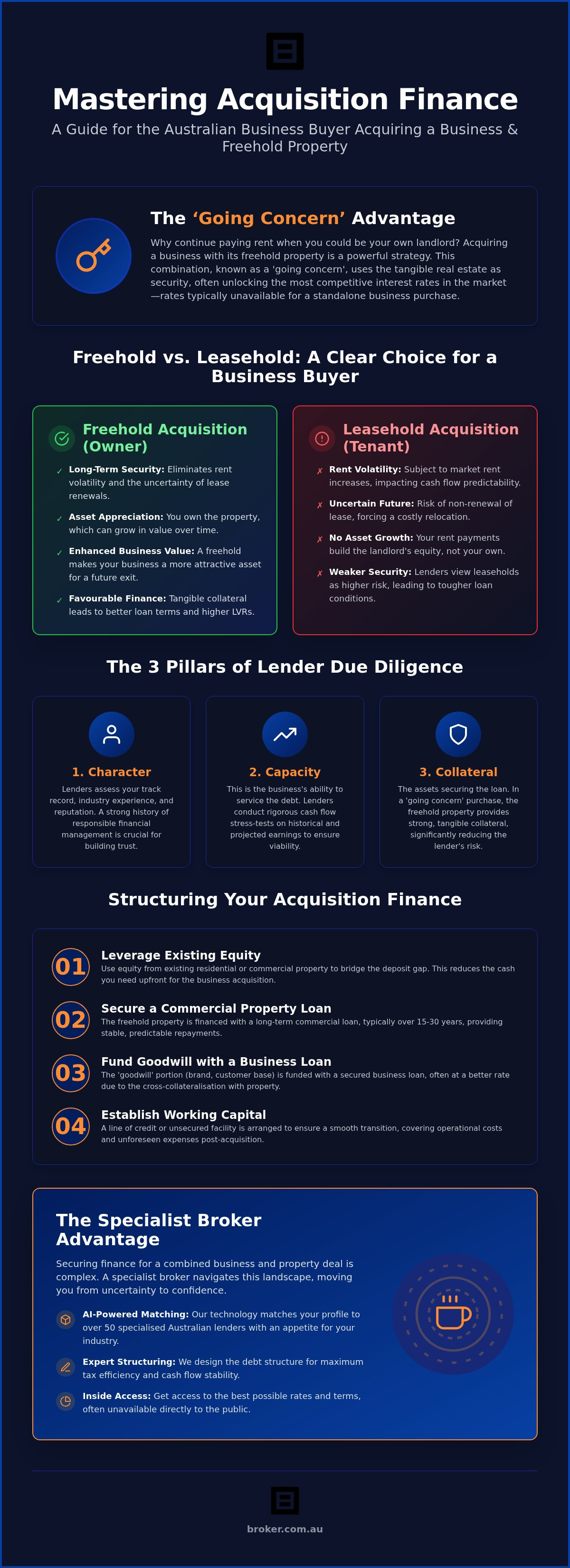
Purchasing a “Going Concern” in Australia involves a sophisticated dual-asset strategy. You aren’t just buying a brand or a customer list; you’re acquiring the physical freehold premises alongside the operational goodwill. In 2026, this approach is particularly strategic as every business buyer seeks to lock in long-term occupancy costs. The core advantage for a business buyer is the ability to use real estate to secure cheaper acquisition finance. Lenders generally view “Total Facilities” that include property as significantly lower risk than standalone business loans. This tangible collateral often unlocks interest rates that would be unavailable for a pure goodwill purchase.
While some investors explore a commercial land and construction loan australia to build their own facilities, purchasing an established going concern offers immediate cash flow. This existing revenue is vital for satisfying the lender’s servicing requirements from day one. By combining the business and property into a single funding package, you create a more robust financial structure that appeals to a wider variety of Australian lenders. This synergy often results in a higher loan-to-value ratio (LVR) than you’d receive for a leasehold-only purchase.
The Difference Between Leasehold and Freehold Acquisitions
Choosing freehold over leasehold provides a level of operational security that a lease simply cannot match. You remove the threat of rent volatility and the uncertainty of lease renewals; this directly enhances the long-term valuation of your business. When the premises are included in the sale, the business becomes a more attractive asset for future exit strategies. Additionally, many people buying a business benefit from the “Going Concern” GST exemption, provided the sale meets specific ATO criteria. This can significantly reduce the upfront capital required, allowing you to maintain a healthy cash reserve for post-acquisition growth.
Why a Specialist Broker is Essential for M&A Finance
Securing business acquisition funding for a combined business and property deal is complex. The major banks often have rigid lending criteria that may not suit the nuances of your specific industry. This is where a specialist broker acts as your expert guide. By using proprietary AI technology, we match your acquisition profile with lenders who have a genuine appetite for your sector. A professional broker doesn’t just find a loan; they structure the debt to ensure maximum tax efficiency and cash flow stability. This high-level intervention moves you from a state of uncertainty toward a feeling of streamlined confidence, ensuring you get inside access to the best possible rates for your business acquisition.
Types of Acquisition Finance for the Modern Business Buyer
Modern acquisition finance isn’t a one-size-fits-all product. For a business buyer, the most efficient path often involves a combination of facilities designed to protect cash flow while securing the asset. Standard secured business loans allow you to leverage the freehold property to fund the goodwill portion of the purchase. This is a common strategy when buying a business because it reduces the need for massive cash deposits. If your acquisition involves a commercial land and construction loan australia deal, the structure changes significantly, as the lender focuses on the future value of the developed site rather than just the current ‘going concern’ value.
When the deposit for a business acquisition falls short of traditional bank requirements, mezzanine and second-tier funding become essential tools. These options act as a bridge, allowing you to complete the deal without diluting your equity. We also recommend that every business buyer considers the role of working capital finance. Having a line of credit or an unsecured facility in place ensures a smooth post-acquisition transition, covering unexpected operational costs while you find your feet in the new venture.
Commercial Property Loans for Business Owners
In 2026, commercial property loan terms typically range from 15 to 30 years, depending on the asset class and lender appetite. For those involved in a commercial land and construction loan australia wide, LVRs often sit between 65% and 75% of the total project cost. Choosing between principal and interest or interest-only periods is a vital decision for your bottom line. Interest-only periods can preserve vital cash flow during the first 12 to 24 months of ownership, giving you the breathing room to implement growth strategies before you start tackling the principal debt. You can explore tailored funding structures that align with your specific industry needs to ensure your debt levels remain sustainable.
Specialised Business Acquisition Funding
Lenders distinguish between physical assets and “Goodwill,” which represents the intangible value of an established brand and customer base. Acquisition finance is unique because it considers the future earnings potential of the business rather than just historical tax returns. Unlike standard business loans, these facilities are often structured around the specific cash flow cycles of the industry. When buying a business, you might also require specific funding for equipment, vehicles, or intellectual property within the purchase deal. A specialised approach ensures that each component of the acquisition is funded by the most appropriate and cost-effective debt instrument.
Deposit and Equity Requirements: What You Need to Bring
The “Deposit Gap” is often the biggest hurdle for a business buyer. While you might be used to the 10% or 20% deposits required for residential real estate, a business acquisition is a different beast altogether. Lenders view goodwill as a higher-risk intangible asset, typically requiring 30% to 50% equity to offset that risk. However, when you bundle the business with its freehold premises, the property acts as a powerful anchor. In 2026, Australian commercial lenders are looking for stability, and having property in the mix significantly lowers the “skin in the game” required for the goodwill portion of your acquisition finance.
If you’re short on cash, don’t lose hope. Many successful acquisitions are funded by leveraging existing residential equity. A specialist broker can help you unlock the value in your home to provide the necessary business acquisition funding without depleting your operational cash reserves. This strategy is far more common than many realise, especially when compared to the rigid structures of a commercial land and construction loan australia deal where capital is often drip-fed through stages. By using your home as additional security, you can often secure a much higher total loan amount than if you were relying on the business assets alone.
Industry type plays a massive role in your equity requirements. For example, medical or accounting practices often enjoy much higher LVRs, sometimes reaching 90% or even 100% for the right candidate, because their revenue is seen as recession-proof. Retail or hospitality ventures, conversely, are often held to stricter 30-40% deposit benchmarks due to their perceived volatility in the current 2026 economic climate.
Calculating Your Loan-to-Value Ratio (LVR)
Property LVRs for commercial assets generally sit between 70% and 80%, whereas standalone business LVRs rarely exceed 50%. By blending these two into a single facility, you simplify your equity requirement; the property’s higher LVR essentially cross-subsidises the business purchase. In the context of a “going concern” purchase with property, the LVR is the ratio of the total loan amount compared to the combined value of the physical real estate and the business goodwill. This combined approach often makes the difference between a deal that stalls and one that settles.
Alternative Equity Sources for Business Buyers
If traditional paths are blocked, look at your super. Using a Self-Managed Super Fund (SMSF) to buy the commercial property component is a tax-efficient way to secure your premises while keeping your personal capital for buying a business. Vendor finance is another rising trend in 2026, where the seller leaves a portion of the purchase price in the deal as a loan to you. This reduces your upfront deposit and aligns the seller’s interests with your long-term success. Finally, for businesses with high recurring revenue, cash flow lending can provide acquisition finance based on EBITDA multiples rather than just physical collateral.
Lender Requirements: Servicing, Cash Flow, and Due Diligence
Approval for acquisition finance rests on three pillars: Character, Capacity, and Collateral. While the property provides the tangible collateral, your professional background (Character) and the business’s ability to repay the debt (Capacity) are equally vital to a lender’s credit team. In the 2026 interest rate environment, Australian banks are particularly cautious. They don’t just look at today’s rates; they stress-test your servicing at 2% to 3% above current market levels. This ensures your business acquisition remains sustainable even if the RBA shifts its stance unexpectedly. Even for a multi-million dollar commercial land and construction loan australia wide, your personal credit history acts as a proxy for how you’ll manage corporate debt. A clean record suggests a reliable business buyer who can be trusted with significant capital.
When calculating the true cash flow of an existing business, we focus heavily on “add-backs.” These are one-off or non-cash expenses, such as depreciation, interest on existing debt, or the previous owner’s personal discretionary spending, that won’t apply to you after the purchase. Correctly identifying these can significantly boost your perceived servicing capacity. By presenting a normalised EBITDA (Earnings Before Interest, Taxes, Depreciation, and Amortisation), you provide the lender with a clear picture of the business’s ability to cover its new loan obligations. This technical depth often moves your application from the “uncertain” pile to a streamlined approval.
Demonstrating Debt Servicing Capacity
Most Australian lenders look for a Debt Service Cover Ratio (DSCR) of at least 1.5x. This means that for every $1 of debt repayment, the business must generate $1.50 in net profit. To prove this, you’ll need a robust 3-year financial forecast that is grounded in historical performance but adjusted for your specific growth strategies. Be mindful of proposed directors’ salaries; if you plan to draw a high wage immediately, it reduces the cash available to service the loan, which can shrink your total borrowing power. We recommend a balanced approach that prioritises debt retirement in the first 24 months.
The Due Diligence Checklist for Funding
Your funding application is only as strong as your documentation. For the business component, you’ll need at least two years of Profit & Loss statements, recent BAS filings, and an Aged Receivables report to prove income quality. On the property side, checks for zoning, environmental risks, and existing lease encumbrances are mandatory for any commercial land acquisition. Finally, an independent business valuation is a non-negotiable requirement for acquisition finance approval. It provides the lender with an objective benchmark for the goodwill you’re purchasing. If you’re ready to begin the process, apply for a tailored assessment with our expert team to see where you stand.
How Broker.com.au Organises Your Acquisition and Property Finance
Broker.com.au acts as your seasoned partner in the complex world of commercial lending. We provide inside access to a panel of over 50 Australian lenders, many of whom specialise in high-stakes business acquisition deals that traditional banks might overlook. Our proprietary AI technology is a game-changer for the modern business buyer; it rapidly scans the market to match your specific acquisition profile with the lender most likely to approve your facility. This technological edge ensures you don’t miss out on a competitive deal in a fast-moving market. While a commercial land and construction loan australia might be the right fit for some, our focus is on ensuring you secure the most efficient funding for your unique going-concern purchase.
The journey from your initial enquiry to final settlement is designed to be entirely stress-free. We understand that buying a business is a high-pressure event, so we take the administrative burden off your shoulders. Our team manages the entire application process, from financial modelling to the final handover. This expert-led approach moves you from a state of complexity toward a feeling of streamlined confidence. You get to focus on the operational transition while we secure the acquisition finance that makes your dream of freehold ownership a reality.
A Tailored Approach to Complex Lending
We often structure “split” facilities to ensure you get the best possible terms. By separating the property component from the business goodwill, we can often secure lower interest rates on the bricks-and-mortar portion of the loan. This sophisticated way of managing business acquisition funding ensures your cash flow remains healthy from day one. Our “stress-free” promise means we handle the gritty bank negotiations on your behalf. Even after settlement, we remain your partner, offering ongoing support to restructure your debt as the business grows and your equity increases.
Get Started with Your Business Acquisition
Your path to ownership begins with a low-pressure initial consultation. We assess your borrowing power and provide local insights into the current lending landscape without any upfront commitment. For our team, when a business buyer says “I’m interested,” it’s the beginning of a professional partnership, not just a transaction. We pride ourselves on being a high-level fixer for situations that fall outside the norm, including complex commercial land and construction loan australia deals. You can speak with an expert about your business acquisition funding today to discover your options and lock in the best rates available in 2026.
Take Control of Your Business Future
Transitioning from a tenant to a freehold owner is a transformative step for any ambitious business buyer. By combining your business acquisition with the purchase of its physical premises, you unlock more competitive interest rates and long-term operational security. Whether you’re considering an established going concern or exploring a commercial land and construction loan australia wide to develop a bespoke site, the right financial structure is essential. You’ve learned how property equity can bridge the deposit gap and how lenders stress-test cash flow in the current market.
Our award-winning team, including experts like Matt and Flavio, uses proprietary AI technology to navigate the complex lending landscape for you. We provide inside access to the best rates across more than 50 lenders, ensuring your application is tailored for success. You don’t have to manage these high-stakes decisions alone; we’re here to provide the expert guidance you need for a seamless experience. If you’re ready to move toward a stress-free settlement, I’m interested in acquisition finance. We look forward to helping you achieve your dream of ownership.
Frequently Asked Questions
Can I get one loan to buy both the business and the property?
Yes, you can often secure a single total facility that covers both the business goodwill and the freehold premises. Lenders generally prefer this structure because the property provides tangible security for the business loan component. While the bank might split the facility into two sub-accounts to manage different interest rates, the application is assessed as one combined transaction. This approach simplifies your servicing requirements and leads to a more efficient approval process.
What is the typical deposit needed for a business acquisition with property?
Most Australian lenders require a deposit of 30% to 50% for business goodwill, while the property component often allows for a lower deposit of 20% to 30%. When you combine them, the overall equity requirement usually sits around 25% to 35% of the total purchase price. If you’re looking at a commercial land and construction loan australia wide, these capital requirements might differ based on the project’s total cost and your previous development experience.
How does a lender value a business when the property is included?
Lenders perform a dual valuation: one for the physical bricks and mortar and another for the business’s earnings potential. The property is valued based on comparable sales and market yield, while the business is valued using a multiple of its EBITDA. This combined “Going Concern” valuation often results in a higher total borrowing capacity than if you were buying the business as a standalone leasehold. It provides a more secure foundation for your application.
Can I use my home as security for a business acquisition loan?
Yes, leveraging existing residential equity is a common strategy for many a business buyer in Australia. By using your home as additional security, you can often bridge the deposit gap and secure a lower interest rate on your business acquisition funding. This reduces the amount of cash you need to provide upfront, allowing you to keep your working capital intact for the crucial first few months of operation after the handover.
How long does it take to get acquisition finance approved in Australia?
The timeline typically ranges from four to eight weeks from the initial enquiry to formal approval. This period includes the time needed for independent valuations, financial modelling, and the lender’s internal credit assessment. Our proprietary AI matching technology can help speed up the process of finding the right lender, but the due diligence phase for a complex business acquisition or a commercial land and construction loan australia cannot be rushed. Start the conversation early to avoid delays.
What is the difference between a secured and unsecured acquisition loan?
A secured loan is backed by physical assets, such as commercial property or residential real estate, which usually results in lower interest rates and longer repayment terms. An unsecured loan doesn’t require specific collateral but relies entirely on the business’s cash flow and your credit profile. For a business buyer, secured options are almost always the preferred choice for large acquisitions because they provide the stability and scale needed for sustainable long-term growth.
Will the bank look at my personal income when I buy an existing business?
Yes, lenders will assess your personal financial position alongside the business’s performance. They’ll look at your existing debts, living expenses, and any other sources of income to ensure you have a personal safety net. This is part of the “Character” and “Capacity” pillars of the approval process. Even if the business is highly profitable, your personal credit history and financial conduct remain critical factors in securing a competitive acquisition finance package.
How do interest rates for commercial property loans compare to business loans?
Interest rates for commercial property loans are generally lower than standalone business loans because the real estate provides a lower risk profile for the bank. While a business loan might attract a higher margin due to the intangible nature of goodwill, property-backed finance is seen as more stable. By structuring your deal with both assets, you can often achieve a weighted average interest rate that is significantly more affordable than a pure business loan.