
Did you know that 61% of Australian small businesses abandoned their loan applications with traditional banks in 2026 because the documentation process was simply too exhausting? When you’re dreaming of steam wands and sourdough, the last thing you want is to be buried under a mountain of invoices from different trades and suppliers. Finding the right cafe fit out financing options shouldn’t feel like a second job, yet many owners find themselves underestimating the total cost of labour and high-end equipment before they even open their doors.
We understand that your working capital is the lifeblood of your new venture, especially during those first six months of trade. This guide explores how to secure a single, manageable monthly repayment that covers everything from the grease trap to the latest espresso technology. You’ll learn how to preserve your cash for day-to-day operations while gaining the inside access needed to get projects off the ground without the stress. From asset finance to tailored fit-out solutions, we’ll show you how to build your space while keeping your bank balance healthy and your focus on the coffee.
Key Takeaways
- Understand the current 2026 fit-out costs per square metre to build a realistic budget that accounts for both complex trades and high-end kitchen technology.
- Explore the most effective cafe fit out financing options that allow you to preserve working capital for wages and stock during your first six months of trade.
- Discover the strategic benefit of bundling multiple supplier invoices into a single, manageable monthly repayment to simplify your project’s financial management.
- Learn how to strengthen your finance application by highlighting your hospitality experience and professional business projections to attract specialist lenders.
- Find out how to bypass traditional bank delays by using proprietary AI technology and human-led advisory to secure the right funding for your unique concept.
Table of Contents
- The Reality of Cafe Fit-Out Costs in Australia
- Cafe Fit-Out Financing Options: Choosing the Right Path
- The Strategic Advantage of Bundled Fit-Out Packages
- Preparing a Winning Finance Application
- How Broker.com.au Streamlines Your Cafe Launch
The Reality of Cafe Fit-Out Costs in Australia
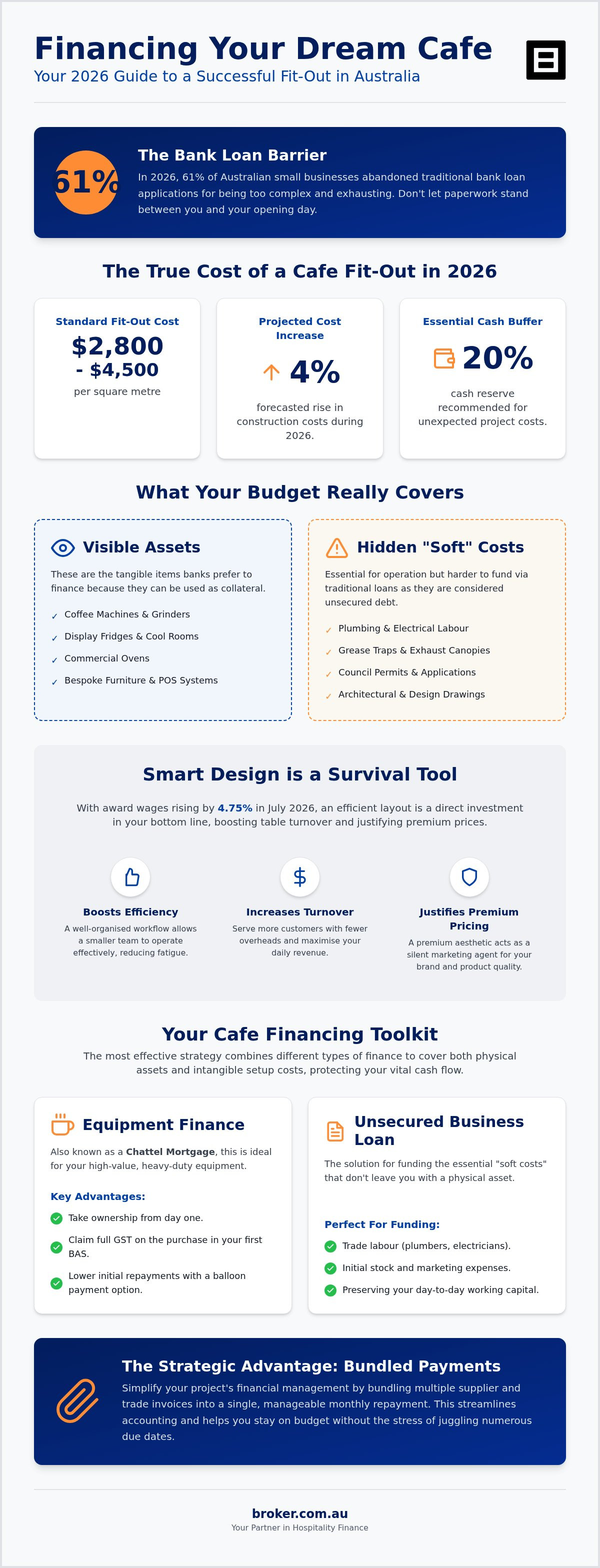
Opening a new venue is an exhilarating milestone, but many owners stumble because they view the fit-out as a simple asset purchase. It’s far more accurate to treat it as a holistic construction project that blends architectural design, specialised trades, and high-end technology. For 2026, securing the right cafe fit out financing options requires a strategy that accounts for current market shifts. Industry estimates suggest that a standard cafe build-out costs between $2,800 and $4,500 per square metre, though high-end concepts with extensive kitchen requirements can easily exceed these figures. With construction costs forecasted to rise by 4% throughout 2026, precise budgeting is no longer optional.
Understanding the nuances of Small and medium-sized enterprise (SME) finance is vital here, as your funding strategy must cover more than just the items you can touch. “Soft costs” such as council permits, architectural drawings, and trade labour frequently catch first-time owners off guard. Because these expenses don’t leave you with a physical asset a bank can repossess, traditional lenders are often hesitant to fund them. Experienced operators always maintain a 20% cash buffer to manage the inevitable surprises that occur when trades start peeling back the layers of an old building’s plumbing or electrical systems.
Visible vs. Hidden Fit-Out Expenses
It’s easy to get excited about the visible elements that define your brand. However, the hidden costs often carry the heaviest price tags and are the most difficult to fund through traditional banks because they lack “resale value.” Exploring specialised cafe fit out financing options helps bridge this gap. Consider the breakdown of where your capital actually goes:
- Visible: Coffee machines, high-end grinders, display fridges, and bespoke furniture.
- Hidden: Grease traps, exhaust canopies, council permits, and trade labour for plumbing and electrical.
Traditional banks prefer funding the visible list because the equipment serves as collateral. The hidden costs, while essential for compliance, are often viewed as unsecured debt, which is why many owners feel stuck between high-interest personal loans or draining their life savings.
The Impact of Design on Efficiency and ROI
Smart design is about more than just looking good; it’s a tool for survival. With award wages having increased by 4.75% in July 2026, a floor plan that allows a smaller team to operate efficiently is a direct investment in your bottom line. A well-organised layout increases table turnover and reduces staff fatigue, allowing you to serve more customers with fewer overheads.
Beyond workflow, your interior design acts as a silent marketing agent. A premium aesthetic justifies the higher menu prices needed to offset rising operational costs in the current economy. While choosing cheap equipment might seem like a win during the build, the long-term maintenance costs and potential downtime usually make “cutting corners” a very expensive mistake. High-quality kitchen technology doesn’t just last longer; it ensures your product remains consistent during the morning rush.
Cafe Fit-Out Financing Options: Choosing the Right Path
Selecting between various cafe fit out financing options is about balancing immediate access to capital with long-term repayment sustainability. While the SME lending market grew to $153.7 billion in 2024, the hospitality sector remains a specialised niche. Most owners find that a combination of secured and unsecured debt works best to cover both physical assets and intangible setup costs. There is no one-size-fits-all loan for a hospitality launch. Instead, you should look for a structure that protects your cash flow while allowing you to open your doors on schedule.
Equipment Finance and Chattel Mortgages
For heavy-duty items like espresso machines, cool rooms, and commercial ovens, a chattel mortgage is often the preferred choice. It allows your business to take ownership of the gear from day one, which is a significant advantage over traditional leasing. One of the most attractive features of this structure is the potential to claim the full GST amount on the asset’s purchase price in your first Business Activity Statement (BAS) after the acquisition. You can also organise these loans with balloon payments at the end of the term. This keeps your monthly repayments lower during the critical early stages of trade when every dollar counts.
Unsecured Business Loans for Hospitality
Not every part of your fit-out leaves you with a physical asset to secure a loan against. Branding, interior painting, signage, and your initial stock orders are “soft costs” that traditional banks typically won’t fund through asset finance. An unsecured business loan bridges this gap efficiently. While interest rates for these loans generally fell between 9.5% and 18% p.a. in mid-2026, the speed of access is often worth the trade-off. If you have robust cash flow projections and a solid business plan, you can often secure funding based on your business’s potential rather than physical collateral.
Landlord Contributions and Rent Abatements
Your lease agreement can be a hidden financing tool. Many Australian landlords offer a “fit-out contribution,” which is a cash payment towards your build-out, or a rent abatement, which provides a rent-free period while you get established. These are excellent ways to reduce your initial debt load. Be cautious, however. Landlords sometimes use these contributions as leverage to justify higher market rent during future reviews. It is a complex negotiation, which is why having an expert guide to review your options can prevent costly mistakes and ensure your lease supports your long-term growth.
The Strategic Advantage of Bundled Fit-Out Packages
Managing a cafe build often feels like conducting a chaotic orchestra. Between the cabinet makers, the coffee roasters, and the flooring contractors, most owners end up juggling twenty different invoices simultaneously. Adopting a “Project vs Purchase” philosophy transforms this administrative nightmare into a streamlined financial strategy. Instead of applying for multiple small loans for individual assets, a bundled package treats your entire fit-out as a single, cohesive project. This high-level fix is exactly what sets successful launches apart from those that struggle with early-stage complexity.
When you evaluate various cafe fit out financing options, the ability to consolidate debt is a significant psychological and operational win. Specialist lenders actually prefer this bundled approach. They would rather assess one comprehensive $250,000 project that results in a functional, revenue-generating business than review five fragmented credit applications for separate pieces of equipment. This holistic view gives lenders more confidence in your venue’s viability, often leading to more competitive structures that traditional banks simply cannot offer.
What Can Be Included in a Bundled Loan?
The true power of bundling lies in its ability to cover the “soft costs” that usually drain your personal savings. While a standard bank might only finance a fridge with a serial number, a specialist bundled facility can include:
- Trade Labour: Invoices from your plumber, electrician, and cabinet maker that are essential for the build.
- Core Equipment: Everything from the espresso machine to the front-of-house bespoke furniture.
- Technology Stacks: Your POS systems, security cameras, and digital menu boards, all grouped into one repayment.
By including these intangible trade costs, you avoid the common trap of using your high-interest credit cards to pay the sparky on a Friday afternoon.
Preserving Your Working Capital
Cash is the oxygen of a new hospitality business. Many owners “run out of puff” in the first 90 days because they spent their liquid capital on the fit-out rather than keeping it for operations. You need that cash for items that cannot be financed, such as staff training, liquor licences, and your first month of coffee beans and milk.
Consider a simple case study. If you spend $150,000 of your own cash on the fit-out, your bank balance is zero on opening day. If you finance that $150,000 through a bundled package, you keep that cash in the bank. This provides a vital safety net for wages and marketing during those unpredictable first months. Keeping your working capital intact ensures you can focus on perfecting your menu rather than worrying about next week’s payroll. It is about building a buffer that allows your dream to breathe while the business finds its rhythm.
Preparing a Winning Finance Application
Securing the best cafe fit out financing options requires more than just a decent credit score; it requires a compelling narrative. Lenders in 2026 are increasingly selective. To stand out, you must present your business as a calculated investment rather than a risky dream. This means your “hospitality resume” often carries as much weight as your financial modelling. If you’ve successfully managed a high-volume venue or run a profitable kitchen, lead with that experience. It proves you understand the operational pressures of the industry and can navigate the complexities of a new launch.
Your documentation must be professional and itemised. Lenders won’t approve a loan based on “ballpark figures” or rough sketches. You need a signed lease agreement, a detailed business plan, and professional fit-out quotes from reputable trades. This level of preparation signals that you’re in control of the project. It alleviates the inherent anxiety lenders feel about the hospitality sector, moving your application from the “risky” pile to the “approved” one.
The Lender’s Checklist: What They Really Look For
When a specialist lender reviews your file, they’re looking for three pillars of stability. First is experience. They want to see that you’ve run a profitable venue before or have a team around you that has. Second is location. They’ll scrutinise the foot traffic and local competition to ensure your site can actually support the debt. Finally, they look for “skin in the game.” Contributing some of your own capital shows you’re fully committed to the project’s success. If you can demonstrate these three things, you’ll find that the doors to premium rates open much faster.
Common Mistakes to Avoid
Don’t damage your prospects before you even begin. One of the most frequent errors is applying to multiple lenders simultaneously. Every “hard hit” on your credit file can lower your score, making you look desperate to risk-averse banks. It’s much better to work with a specialist who knows which lender is the right fit for your specific concept. You should also account for the GST on your equipment purchases. While you can often claim this back on your first BAS, failing to fund the initial GST payment can create a sudden cash flow crunch right when you’re trying to open.
To ensure your application is positioned for success from the start, it’s wise to speak with an award-winning broker who can provide inside access to the best rates and structures for your unique situation.
How Broker.com.au Streamlines Your Cafe Launch
Launching a hospitality venue is a high-stakes financial decision that often comes with a layer of inherent anxiety. At Broker.com.au, we act as your “High-Level Fixer,” stepping in to manage the complexity so you can focus on perfecting your menu and hiring your team. Our award-winning approach combines professional authority with a deeply supportive advisory service. We understand that you aren’t just looking for a loan; you’re looking for a partner who knows the Australian hospitality landscape as well as you know your coffee beans. By providing inside access to the best rates through our extensive panel of specialist lenders, we ensure your project moves from uncertainty toward streamlined confidence.
Speed is critical when you’re trying to secure a prime location or order equipment with long lead times. We use proprietary AI technology to scan the market and match your specific needs with the most suitable cafe fit out financing options in minutes, not days. This efficiency doesn’t mean we sacrifice the human touch. Our technology handles the data, while our experts handle the strategy. This ensures you get a tailored solution that respects your cash flow and long-term business goals without the cold, impersonal feel of a traditional large-scale bank.
The “I’m Interested” Conversation
We believe the best financial partnerships start with a low-pressure conversation rather than an aggressive application form. That’s why our signature call-to-action is simply “I’m interested.” It’s the beginning of a stress-free advisory process where you’ll meet real experts like Matt and Kylie. They understand the nuances of the Australian cafe scene and are proactive in finding solutions for situations that fall “outside of the norm.” Whether you’re a first-time owner or a seasoned operator expanding your brand, our team provides the local insights and technical expertise needed to lead you through the lending environment with ease.
Managing Your Suppliers and Progress Payments
A cafe fit-out isn’t a single transaction; it’s a series of complex milestones. We don’t just secure the funds and walk away. Our team works directly with your builders, cabinet makers, and equipment suppliers to manage progress payments. We ensure that funds are released at the correct stages of construction, protecting your interests and keeping your trades happy. This seamless coordination means you won’t be stuck in the middle of multiple invoices and conflicting payment deadlines. We handle the administrative heavy lifting, ensuring a professional and efficient path to your opening day.
Ready to build your dream venue? I’m interested in cafe fit-out finance and want to explore the most effective ways to fund my hospitality project while preserving cash flow.
Building Your Hospitality Future with Confidence
Navigating the complexities of a venue launch requires more than just a passion for coffee; it demands a sophisticated approach to capital management. By bundling your trade labour and equipment into a single repayment, you protect the working capital needed to thrive during your critical first six months of trade. We’ve explored how the right cafe fit out financing options can transform a chaotic pile of invoices into a streamlined construction project that respects your bank balance and your vision.
As an award-winning Australian brokerage, Broker.com.au provides the specialised fixer service your project deserves. Our proprietary AI-driven matching quickly identifies the best-fit lenders, while our team offers human-led advisory for even the most complex hospitality setups. You don’t have to handle the stress of progress payments and supplier negotiations alone. We ensure the financial heavy lifting is managed professionally, allowing you to stay focused on your menu and your customers while we unlock the best rates for your business.
If you’re ready to move from uncertainty to opening day, we’re here to help. I’m interested in cafe fit-out finance and want to see how a tailored solution can bring my vision to life. Your dream venue is within reach, and with the right financial partner, the process can be as smooth as your first morning espresso.
Frequently Asked Questions
How much does a typical cafe fit-out cost in Australia in 2026?
A typical cafe fit-out in 2026 generally costs between $100,000 and $350,000 depending on the size and complexity of the venue. For a standard build, you should budget approximately $3,000 to $5,000 per square metre. A high-end fit-out with a full commercial kitchen can exceed $5,000 per square metre. It’s recommended to include a contingency of 10% to 20% to cover unforeseen construction costs or inflation during the build.
Can I get fit-out finance if I am a first-time business owner?
Yes, first-time business owners can access fit-out finance, though lenders will look closely at your industry experience and business plan. Demonstrating a strong hospitality resume or having a management team with a proven track record significantly improves your chances of approval. While traditional banks might be hesitant, specialist hospitality lenders often provide tailored cafe fit out financing options for new entrants who can show realistic cash flow projections and a clear vision.
What is the difference between equipment finance and a fit-out loan?
Equipment finance focuses specifically on tangible assets like coffee machines, grinders, and refrigeration units that can be used as collateral. In contrast, a fit-out loan is a more comprehensive facility that covers the construction of your space, including trade labour, plumbing, cabinetry, and flooring. While equipment finance is asset-backed, a fit-out loan often includes soft costs that don’t have a physical resale value, requiring a more specialised lending structure to manage the risk.
How long does the cafe finance approval process take?
The approval timeline varies significantly depending on the lender and the complexity of your project. Using proprietary AI technology, we can often match you with a suitable lender in minutes and provide an indicative offer shortly after. While traditional bank applications are frequently abandoned due to documentation delays, a streamlined brokerage process can move from initial conversation to final approval in a matter of days, provided your business plan and lease agreements are ready.
Can I finance 100% of my fit-out costs including labour?
It is possible to finance 100% of your fit-out costs, including trade labour, by using a bundled finance package. This approach allows you to group multiple invoices from builders, electricians, and plumbers into a single monthly repayment. Financing the labour component preserves your liquid cash for operational needs like wages and stock. However, some lenders may still require a small deposit or a demonstration of skin in the game to secure the most competitive interest rates.
Do I need to provide my home as security for a cafe fit-out loan?
You don’t necessarily need to use your home as security. Many cafe fit out financing options utilise the equipment itself as collateral through a chattel mortgage or offer unsecured business loans based on your projected cash flow. Unsecured options are particularly useful for covering intangible costs without risking personal property. While secured loans often provide lower interest rates, we specialise in finding flexible structures that protect your personal assets while funding your hospitality dream.
Is cafe fit-out finance tax-deductible for my business?
In most cases, the interest paid on your fit-out loan and the depreciation of your kitchen assets are tax-deductible business expenses. If you use a chattel mortgage, you may also be able to claim the full GST amount on the equipment’s purchase price in your first Business Activity Statement (BAS). Because every business structure is different, it’s vital to consult with a qualified accountant to understand exactly how these deductions will apply to your specific situation.
What happens if my fit-out project goes over budget?
If your project exceeds the initial budget, a flexible Line of Credit can act as a safety net to cover the shortfall. Construction costs are forecasted to rise by 4% throughout 2026, so having access to additional working capital ensures your launch isn’t delayed by unexpected trade invoices. We proactively work with your suppliers to manage progress payments, but having a pre-approved buffer allows you to handle surprises without draining your day-to-day operational cash.