With 68% of Australian SMEs now using equipment finance to stay competitive, the traditional model of buying machinery outright is becoming an outdated relic of the past. You likely understand that keeping your production line at the cutting edge is essential, yet the high upfront costs of CNC machines or automated systems often make asset finance for manufacturing equipment the only viable path to growth. It’s a stressful balancing act between wanting to innovate and needing to keep your daily operations stable.
This 2026 guide shows you how to secure high-value machinery while keeping your working capital intact through tailored funding solutions. We’ll explore the latest tax incentives, such as the permanent $20,000 instant asset write-off, and show you how to structure repayments that align with your seasonal revenue. You’ll discover how our AI-enhanced approach provides the inside access you need to move from financial uncertainty to streamlined confidence, ensuring your specialised production line remains world-class.
Key Takeaways
- Understand how the machinery itself can act as the primary security, allowing you to upgrade without tying up other vital business assets.
- Discover how to align your repayment schedule with the expected lifespan and seasonal output of your new production line to maintain healthy cash flow.
- Learn the most effective ways to use asset finance for manufacturing equipment to claim immediate tax deductions under the 2026 permanent write-off thresholds.
- Identify why specialised industrial assets require a tailored lending approach compared to general-purpose equipment to secure the most competitive terms.
- Explore how a specialist broker packages your application to provide inside access to a broader panel of lenders that traditional banks often overlook.
Table of Contents
- The 2026 Manufacturing Landscape: Why Asset Finance is Essential
- Core Asset Finance Structures for Australian Manufacturers
- Matching Your Assets to the Right Finance Solution
- Maximising Tax Benefits and ROI in 2026
- Securing Your Funding: The Specialist Broker Advantage
The 2026 Manufacturing Landscape: Why Asset Finance is Essential
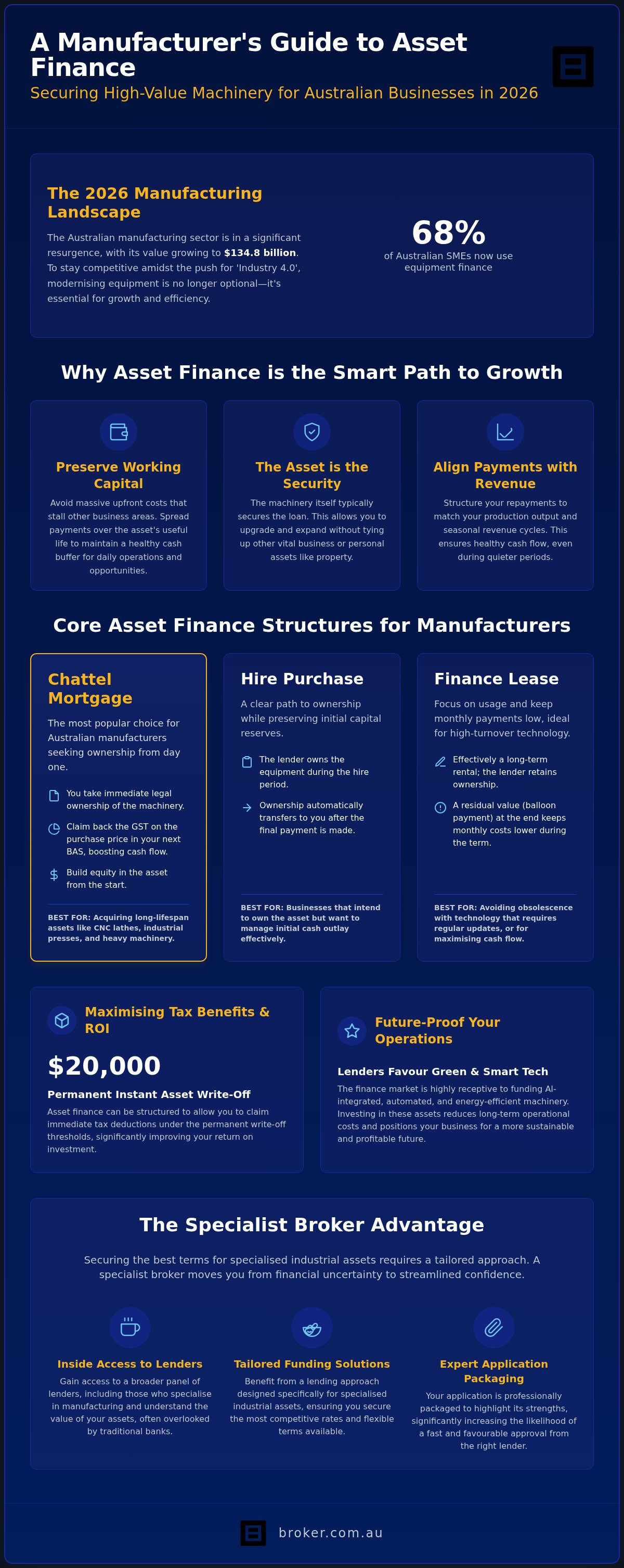
The Australian manufacturing sector is currently experiencing a significant resurgence. With the industry value added growing to $134.8 billion in the last financial year, the pressure to modernise has never been higher. In this environment, asset finance for manufacturing equipment serves as a sophisticated tool for business owners who want to scale without compromise. It’s a tailored funding solution designed to put high-performance machinery on your floor while keeping your cash flow predictable. As the push for “Industry 4.0” accelerates in 2026, the most successful firms are those that treat equipment as a service to be utilised rather than a burden to be owned.
The High Cost of Traditional Acquisition
Buying a single piece of specialised machinery outright often creates a massive “opportunity cost” that can stall other areas of your business. When you exhaust your cash reserves on capital expenditure, you lose the agility needed to handle sudden raw material price hikes or unexpected supply chain disruptions. In 2026, maintaining a robust cash buffer is a hallmark of a well-managed firm. Using Core Asset Finance Structures allows you to spread the cost over the machine’s useful life, ensuring your daily operations remain stress-free and well-funded. Asset finance also protects your business from the financial sting of technological obsolescence by making it easier to cycle through equipment generations.
Automation and Green Manufacturing Trends
Modern lenders are increasingly prioritising “green” manufacturing assets and energy-efficient technology. If you’re looking to acquire AI-integrated packing lines or robotic assembly systems, you’ll find that the finance market is highly receptive to these upgrades. These machines don’t just speed up production; they significantly reduce long-term operational costs by minimising waste and lowering energy consumption. By securing finance for these high-tech assets, you’re not just buying a machine; you’re investing in a more sustainable and profitable future. Our role is to act as your expert guide, providing the inside access needed to secure competitive rates for these essential, future-proof investments.
Core Asset Finance Structures for Australian Manufacturers
Choosing the right structure is just as critical as choosing the right machine. In the Australian market, asset finance for manufacturing equipment is typically secured by the equipment itself, which means your other business or personal assets often remain untouched. This asset-backed nature makes it a powerful tool for scaling production without over-leveraging your balance sheet. Because the lender’s risk is mitigated by the machinery’s value, you can often access more competitive terms than you would with a general-purpose business loan.
You’ll need to decide between on-balance sheet structures, where you own the asset and claim depreciation, and off-balance sheet options that focus on the right to use the equipment. Matching these to your specific cash flow cycle is where we provide our best-in-class expertise. We ensure your repayments don’t choke your growth during quieter production months, especially when Securing Your Funding for complex, multi-stage automation projects. If you want to see how these structures could work for your specific setup, I’m interested in showing you the possibilities.
Chattel Mortgage: The Popular Choice
For many Australian manufacturers, the chattel mortgage is the preferred path. It’s an on-balance sheet solution where you take legal ownership of the machine immediately, while the lender takes a mortgage over it as security. A major advantage is the ability to claim back the GST on the purchase price in your next BAS period, providing an immediate cash flow injection that can be reinvested into raw materials. This structure is particularly efficient for assets with a long lifespan, such as heavy-duty CNC lathes or industrial presses, as it allows you to build equity in the machine from day one.
Hire Purchase and Equipment Leasing
While a chattel mortgage offers ownership, Hire Purchase and Leasing provide alternative ways to manage high-turnover technology. In a Hire Purchase agreement, the lender owns the equipment until your final payment is made. This is a common choice for businesses that want to preserve capital but intend to own the asset eventually. Conversely, a Finance Lease allows you to use the asset while the lender retains ownership, often including a residual value or “balloon payment” at the end to keep monthly costs lower.
Operating leases are particularly effective for technology that ages quickly, such as certain computerised controllers or robotic assembly arms. These structures allow you to return the equipment or upgrade to the latest model once the term ends. This ensures your production line never falls behind the competition due to outdated hardware, effectively shifting the risk of obsolescence onto the lender.
Matching Your Assets to the Right Finance Solution
Not all machinery carries the same weight on a balance sheet. When you apply for asset finance for manufacturing equipment, lenders assess the “lendability” of an item based on how easily it could be resold if the business circumstances change. Standardised gear like forklifts, air compressors, or common CNC mills are often seen as low-risk because there’s a thriving secondary market for them. Conversely, bespoke assembly lines or highly specialised chemical processing units require a more nuanced approach. We act as your expert guide, helping you package these complex deals to ensure lenders see the long-term value of your investment rather than just the risk of a niche asset.
Specialised vs. Standard Machinery
Standard equipment is the bread and butter of industrial lending. Because valuations are straightforward, approvals are often faster and require less documentation. However, if your production requires a custom-built solution, the valuation process becomes more rigorous. Lenders may require an independent appraisal to confirm the asset’s worth before they’ll commit to the deal. If you’re importing equipment from overseas, you’ll also need to manage longer lead times. We can help structure progress payments, ensuring your supplier is paid at key milestones while your cash flow remains protected throughout the shipping and installation phase.
Financing Used and Reconditioned Equipment
In 2026, the market for reconditioned machinery is stronger than ever. Most Australian lenders apply age restrictions, typically preferring the asset to be no more than 15 years old at the end of the finance term. The “useful life” of the machine is the deciding factor here; while 68% of SMEs use equipment finance, the five-year loan term remains the most popular choice for industrial gear. Financing a private sale involves more legwork, including mechanical inspections and proof of clear title, whereas dealer sales are generally more streamlined due to existing warranties. Whether you’re buying a brand-new robotic arm or a reliable used lathe, we’ll ensure the documentation is handled with precision.
Deciding between a lease or a purchase often comes down to the asset’s expected lifespan. If the machine is likely to be obsolete in three years due to rapid software changes, a lease offers the flexibility to upgrade. For heavy iron that will last twenty years, a chattel mortgage allows you to build equity and claim depreciation over the long haul. This strategic approach ensures your production line remains modern without over-extending your capital.
Maximising Tax Benefits and ROI in 2026
The 2026 financial landscape offers unique advantages for manufacturers willing to modernise. The Instant Asset Write-Off (IAWO) threshold of $20,000 is now a permanent fixture for businesses with an annual turnover below $10 million, providing a reliable foundation for capital expenditure planning. When utilising asset finance for manufacturing equipment, you can effectively lower your taxable income while simultaneously increasing your production capacity. While the principal portion of your loan repayments is not deductible, the interest component and the depreciation of the asset usually are. This dual benefit ensures that the net cost of your finance is often significantly lower than the face-value interest rate suggests.
Depreciation Strategies for Industrial Assets
Your choice of depreciation method should reflect the actual usage and expected lifespan of your machinery. The diminishing value method accelerates your tax deductions in the first few years, which is highly effective for technology-heavy assets like robotic assembly arms. Conversely, the prime cost method provides a steady, predictable deduction over the asset’s life, which is often preferred for heavy-duty presses or lathes. A critical signature of the chattel mortgage is that it allows you to claim the entire GST amount on the purchase price in your very first Business Activity Statement (BAS) after acquisition. This provides an immediate boost to your working capital that can be used to fund raw materials or labour.
Calculating Return on Investment (ROI)
Evaluating the success of a new acquisition requires a focus on net gain rather than just the debt. To find your ROI, compare the monthly finance cost against the total of your increased production revenue plus your operational savings. Modern, energy-efficient equipment reduces power bills and minimises expensive downtime, which directly offsets the cost of the loan. In 2026, many manufacturers are also looking at the Corporate Tax Loss Carry-Back provisions, which became eligible for certain entities from July 1, to further soften the impact of large investments.
Finding the “breakeven point” where the machine pays for its own repayment is the moment your finance structure converts from a liability into a growth engine. Because every business has unique tax requirements, it is vital to speak with your accountant to confirm how these incentives apply to your specific turnover. If you’re looking for a partner who understands these complexities and provides inside access to the best rates, get started with our expert team to secure a finance package that maximises your return.
Securing Your Funding: The Specialist Broker Advantage
Approaching a traditional bank for industrial funding often feels like trying to fit a square peg into a round hole. Most major lenders have rigid checkboxes that don’t always account for the nuances of a specialised production line. If your machinery doesn’t fit their standard “yellow goods” category, you might face higher rates or outright rejection. A specialist broker understands asset finance for manufacturing equipment as a distinct discipline. We act as a “High-Level Fixer,” packaging your application to highlight the operational strength of your business rather than just the resale value of the collateral. This professional oversight ensures your deal is positioned for approval before it even reaches a lender’s desk.
Inside Access to Niche Lenders
Many of the most competitive industrial lenders in Australia operate exclusively through broker channels and do not deal directly with the public. These niche players often have a deeper appetite for specific manufacturing sub-sectors, such as food processing or advanced robotics. We compare dozens of products to find the lowest total cost of credit, looking far beyond the headline interest rate to identify hidden fees or restrictive covenants. You’ll have a single point of contact, a human advisor like Matt or Kylie, who manages the entire process from the first enquiry to final settlement. This provides you with inside access to rates and terms that the average consumer simply cannot obtain on their own.
Streamlining the Approval Process
The traditional loan application is frequently a source of significant anxiety for busy manufacturers. We’ve removed this friction by using proprietary AI technology that instantly identifies the right lender for your specific asset type and financial profile. This digital transformation allows for faster, more consistent decisions, moving you from uncertainty to a state of streamlined confidence. Our AI doesn’t replace the human element; it empowers our team to handle your application with surgical precision, ensuring no detail is overlooked.
Our goal is to make the journey toward a modern production line as stress-free as possible. We handle the complex document collection and lender negotiations, allowing you to stay focused on your daily operations. This proactive approach builds a foundation for a long-term partnership that can support your future needs, from vehicle fleet expansion to commercial property loans. If you’re ready to explore how a tailored structure can transform your production capacity, start a low-pressure conversation by telling us I’m interested today.
Future-Proof Your Production Line with Strategic Finance
The 2026 manufacturing landscape demands agility and technological precision. By leveraging asset finance for manufacturing equipment, you can secure the “Industry 4.0” automation your business needs while preserving vital working capital for daily operations. Whether you’re utilising the permanent $20,000 instant asset write-off or structuring a chattel mortgage to claim GST upfront, the right financial framework converts a high-value purchase into a sustainable growth engine. You don’t have to choose between innovation and liquidity.
Securing these complex deals shouldn’t be a source of anxiety. As an award-winning broker, we provide you with inside access to a panel of over 40 specialist lenders that understand the Australian industrial sector. Our proprietary AI-driven process ensures your application is handled with speed and accuracy, moving you toward a modern production line with streamlined confidence. We’re here to act as your expert guide, ensuring you’re always in good hands throughout the entire process.
If you’re ready to see how a tailored solution can scale your operations, I’m interested in exploring manufacturing finance options today. Your next era of production starts with a single, low-pressure conversation.
Frequently Asked Questions
Can I get asset finance for used manufacturing equipment?
Yes, you can certainly organise asset finance for manufacturing equipment that is used or reconditioned. Most Australian lenders will consider machinery that will be no more than 15 years old at the end of the loan term. While brand-new gear is straightforward, used assets require a valuation or a mechanical inspection to confirm their “useful life.” Private sales are also eligible, though they involve more rigorous title checks than buying through an established dealer.
How does a chattel mortgage differ from an equipment lease for tax purposes?
The primary difference lies in ownership and the timing of tax benefits. With a chattel mortgage, you own the asset from day one and can usually claim the full GST amount in your next BAS. You also claim depreciation and interest. In contrast, an equipment lease means the lender retains ownership, and you generally claim the monthly lease payments as a tax-deductible business expense. Your accountant can help decide which structure suits your 2026 cash flow.
What is the typical deposit required for manufacturing machinery finance?
Many manufacturers can secure funding with a 0% deposit, provided the business has a strong trading history. If you are a newer entity or seeking low-doc options, lenders might request a deposit between 10% and 20% to reduce their risk. The specific amount often depends on the “lendability” of the machinery, with standard gear like forklifts requiring less upfront capital than highly specialised, custom-built production lines that have a more limited secondary market.
Do I need to provide my home as security for a manufacturing equipment loan?
No, you generally don’t need to use your family home as collateral for this type of funding. Asset finance is specifically designed to be “asset-backed,” which means the machinery itself serves as the primary security for the loan. This structure protects your personal property and keeps your home equity available for other needs. It’s one of the most effective ways to scale your operations while keeping your personal and business risks entirely separate.
How long does it take to get approval for manufacturing finance in 2026?
In 2026, our proprietary AI technology allows us to provide initial approval for asset finance for manufacturing equipment in as little as 24 to 48 hours. The total time from enquiry to settlement depends on how quickly you can provide financial statements and the complexity of the asset valuation. We focus on a seamless, stress-free process that cuts through traditional bank bureaucracy, ensuring your new machinery is on the floor and productive without unnecessary delays.
Can I finance equipment that is being imported from overseas?
Yes, financing imported machinery is a standard part of our service. We can help you arrange progress payments to overseas suppliers or set up letters of credit to satisfy international trade requirements. This process ensures the manufacturer is paid at key milestones, such as when the equipment is shipped or installed. It’s a complex area of lending where our “High-Level Fixer” approach provides the professional oversight needed to manage currency and delivery risks.
What happens to my finance if the equipment becomes obsolete before the term ends?
If your machinery becomes obsolete, you remain responsible for the remaining balance of the loan or lease. This is why we often recommend an operating lease for technology that evolves rapidly, such as AI-integrated assembly robots. An operating lease allows you to return or upgrade the equipment at the end of the term. For “heavy iron” with a long lifespan, a chattel mortgage is usually better as it allows you to build long-term equity in the machine.
Is it possible to finance the installation and fit-out costs along with the machinery?
It is absolutely possible to bundle installation, delivery, and fit-out costs into your total finance package. We often facilitate fit-out finance alongside machinery loans to cover the electrical, plumbing, and structural changes required for your new production line. This holistic approach ensures you don’t have to dip into your working capital for the “soft costs” of commissioning the equipment. It keeps your cash flow stable while your new assets begin generating revenue for the business.