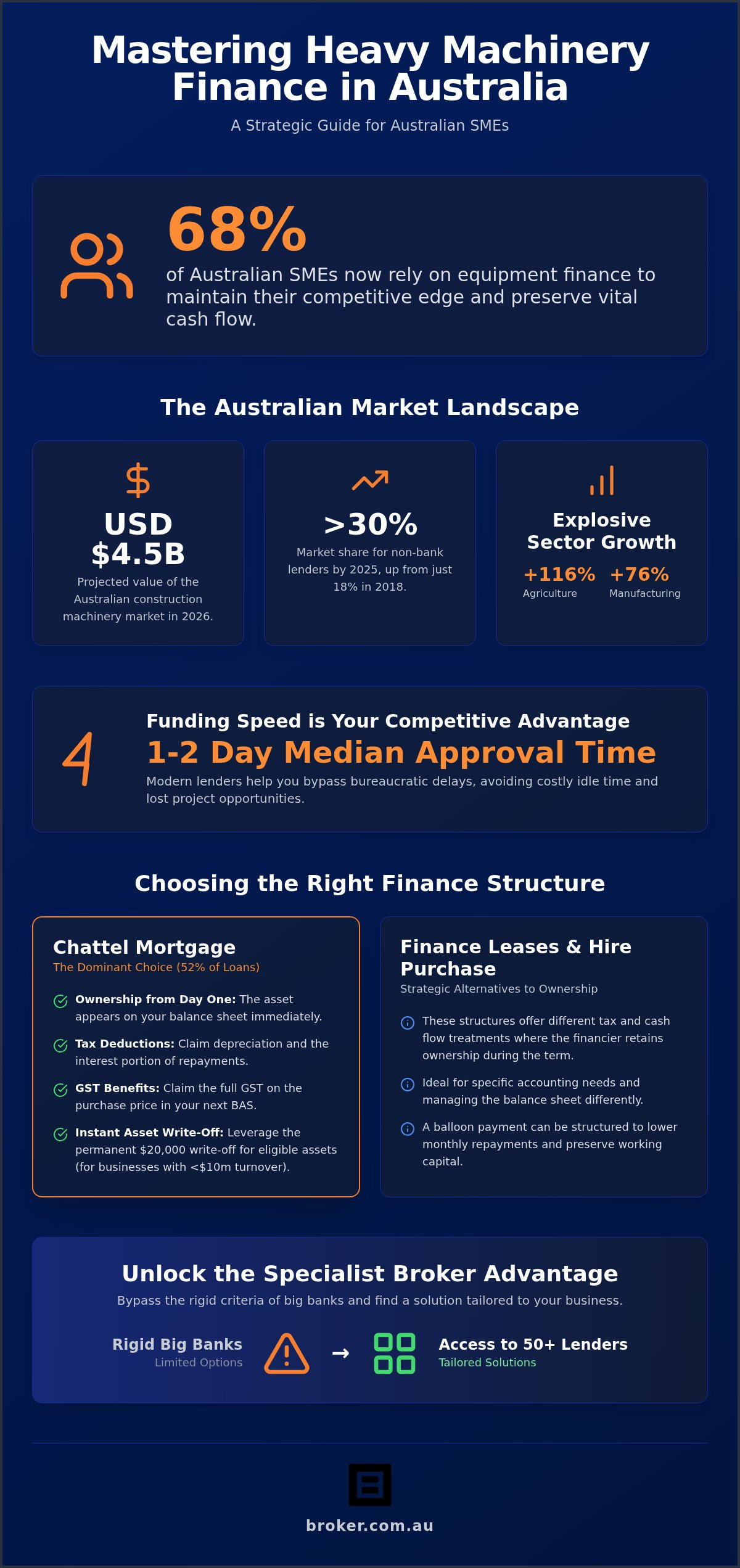
Did you know that 68% of Australian SMEs now rely on equipment finance to maintain their competitive edge? It’s a significant figure that reflects a shift in how the nation’s most successful firms manage their balance sheets. You’ve likely felt the sting of high upfront costs threatening to drain your hard-earned cash reserves while searching for the right funding for heavy machinery purchase. It is entirely reasonable to feel frustrated when a bank’s slow approval process causes you to miss a project deadline or when complex tax treatments turn a vital upgrade into a confusing administrative burden.
The good news is that securing the gear you need doesn’t have to be a source of stress. We’ll show you how to master the complexities of asset finance to protect your business cash flow while scaling your operations. This guide provides a clear roadmap to securing fast approvals and competitive interest rates. You will discover how to structure your repayments to align with seasonal cash flow, ensuring your new machinery starts paying for itself from the very first day of operation.
Key Takeaways
- Discover why preserving your operational liquidity is vital and how asset finance serves as a strategic alternative to draining your cash reserves.
- Compare the tax and GST implications of Chattel Mortgages versus Finance Leases to identify the most efficient structure for your specific needs.
- Navigate the 2026 market with confidence to secure the right funding for heavy machinery purchase, whether you are investing in new technology or reliable used equipment.
- Streamline your approval process by mastering the essential documentation checklist and exploring low-doc options tailored for established businesses.
- Unlock inside access to a panel of over 50 lenders to find tailored solutions that bypass the rigid lending criteria of traditional big banks.
Table of Contents
- Navigating the Landscape of Heavy Machinery Funding in Australia
- Choosing the Right Finance Structure: Chattel Mortgages vs. Leases
- Financing New vs. Used Equipment: Market Realities in 2026
- The Application Process: Positioning Your Business for Approval
- Why Partnering with a Specialist Asset Finance Broker Makes the Difference
Navigating the Landscape of Heavy Machinery Funding in Australia
Heavy machinery serves as the engine room for Australian SME growth, providing the literal muscle needed to scale operations across the continent. In 2026, the Australian construction machinery market is projected to reach a value of USD 4.5 billion, reflecting a massive investment in national infrastructure. While the urge to own assets outright is strong, purchasing equipment with cash can jeopardise your operational liquidity. Sinking several hundred thousand dollars into a single machine leaves your business vulnerable to unexpected market fluctuations or urgent repair costs. Successful operators increasingly favour specialised asset finance to keep their cash reserves intact for day to day expenses.
The industry has seen a significant shift away from traditional big banks. Non-bank lenders have grown their market share from 18% in 2018 to over 30% in 2025, offering more flexible terms than the rigid structures of the past. This evolution is particularly evident in sectors like agriculture, where machinery finance grew by 116% in late 2025, and manufacturing, which saw a 76% increase. Business owners now prioritise lenders who understand the nuances of Chattel Mortgages vs. Leases and how these different structures impact their specific tax obligations and balance sheets.
The High Cost of Idle Time: Why Funding Speed Matters
In the competitive Australian landscape, project deadlines are often non-negotiable. If your fleet lacks the capacity to meet a contract’s requirements, you risk losing lucrative tenders to better equipped competitors. Securing the right funding for heavy machinery purchase with speed is a strategic advantage. With modern median approval timeframes now sitting at just one to two days, there’s no reason to let bureaucratic delays stall your progress. In the context of equipment acquisition, opportunity cost is the potential revenue and growth your business forfeits while waiting for machinery that remains stuck in a lengthy finance approval queue.
Beyond “Yellow Goods”: A Broad View of Industrial Assets
While “yellow goods” like excavators and backhoes often dominate the conversation, heavy machinery encompasses a vast range of industrial assets. This includes precision CNC machines for manufacturing, harvesters for the agricultural sector, and heavy-duty prime movers for logistics. Different lenders have varying appetites for these assets based on their resale value and “effective life” projections. Working with a specialist who understands these preferences ensures your application for funding for heavy machinery purchase is directed to the lender most likely to offer competitive terms for your specific equipment category. This tailored approach reduces the risk of rejection and ensures the finance structure aligns with the asset’s actual usage cycle.
Choosing the Right Finance Structure: Chattel Mortgages vs. Leases
Selecting the correct finance structure is just as critical as choosing the machinery itself. It dictates your tax position, your GST obligations, and your monthly cash flow for years to come. In the Australian market, the chattel mortgage remains the dominant choice, accounting for 52% of equipment finance loans. However, the best funding for heavy machinery purchase depends entirely on your business’s specific accounting methods and long term goals. A common strategic move is the inclusion of a balloon payment, which is a larger sum paid at the end of the loan term. This effectively lowers your monthly repayment obligations, keeping your working capital available for daily operational costs.
The Chattel Mortgage: Ownership from Day One
Under a chattel mortgage, your business takes legal ownership of the equipment at the time of purchase. This is the preferred model for firms with long term asset retention plans. Because you own the machine, it sits on your balance sheet as an asset, allowing you to claim depreciation and interest as tax deductions. One of the primary advantages is the GST treatment. You can typically claim the full GST on the purchase price as an Input Tax Credit in your next Business Activity Statement (BAS). When Financing New vs. Used Equipment, small businesses with an aggregated turnover under $10 million can also leverage the permanent $20,000 instant asset write-off for eligible assets, providing an immediate boost to the bottom line.
Finance Leases and Commercial Hire Purchase (CHP)
Finance leases and Commercial Hire Purchase agreements offer distinct alternatives to direct ownership. A finance lease is essentially a rental agreement where the lender owns the asset and you pay for its use. This preserves your capital because it often requires no upfront deposit. GST is typically charged on the monthly rental payments rather than the total purchase price upfront. For businesses using the accruals method of accounting, a Commercial Hire Purchase (CHP) provides a middle ground. The lender buys the equipment and hires it to you over a set term. Ownership only transfers to your business once the final payment is made. If you need a machine for a specific project but want to avoid the long term risks of ownership, an operating lease may be the more efficient choice. If you are unsure which structure best fits your tax profile, our specialists can provide inside access to tailored finance structures that align with your seasonal cash flow.
Financing New vs. Used Equipment: Market Realities in 2026
The decision between new and used gear often boils down to a balance between immediate capital outlay and long term operational reliability. In 2026, the demand for used heavy machinery remains exceptionally strong. This trend is largely driven by operators seeking to bypass long delivery lead times for new factory stock. While a used excavator might offer a lower purchase price, you must factor in higher maintenance costs and the potential for increased downtime. Lenders assess the “effective life” of an asset to ensure the loan term doesn’t outlast the machine’s productivity. If you’re looking at specialised or “outside the norm” gear, securing funding for heavy machinery purchase requires a lender who understands the niche value of that specific equipment.
New Equipment: Manufacturer Incentives vs. Broker Rates
Dealers often lure buyers with 0% interest headline rates, but these offers frequently come with rigid terms and inflated purchase prices. Broker-sourced loans provide the flexibility to tailor repayments to your specific cash flow needs, which is vital for seasonal businesses. Newer models also bring the benefit of Industry 4.0 technology, offering better fuel efficiency and telematics that can lower your insurance premiums. The cheapest headline rate is rarely the most cost-effective over a five-year term if it lacks the structural flexibility to accommodate seasonal shifts in your business income. Our expert guides help you look beyond the sticker price to find a solution that supports your long term goals.
Used Machinery: Navigating Age Restrictions and Hours
Securing funding for heavy machinery purchase for used assets involves navigating specific lender criteria. Most traditional banks impose strict “age at end of term” limits, often capping the combined age of the machine and the loan term at 10 to 15 years. If you’re eyeing a high-hour machine or a private sale, an independent valuation is usually mandatory to confirm the asset’s market value. We also ensure rigorous title checks via the Personal Property Securities Register (PPSR) to protect you from buying equipment with existing encumbrances. For older gear that falls outside standard bank appetites, we leverage inside access to specialised lenders who see the value in well-maintained, high-performing legacy assets. This proactive approach ensures you’re in good hands, regardless of the equipment’s age or history.
The Application Process: Positioning Your Business for Approval
The traditional path to securing funding for heavy machinery purchase often felt like a marathon of paperwork and uncertainty. In 2026, the landscape has shifted toward data-driven speed and transparency. To position your business for a fast approval, you must present a clean financial narrative. This typically begins with a standard documentation checklist including your most recent Business Activity Statements (BAS) and up-to-date profit and loss reports. For large-scale fleet expansions, a well-documented business case that outlines the expected return on investment (ROI) from the new assets can significantly strengthen your application.
Established businesses with strong equity or a proven trading history may qualify for low-doc machinery finance. This streamlined path allows you to bypass the exhaustive requirement for two years of full tax returns, which is a common stumbling block for rapidly growing firms. Instead, lenders may rely on your credit score and a simple declaration of income. This flexibility is essential for seizing immediate opportunities, such as winning a short-notice tender that requires an immediate increase in fleet capacity.
Streamlining with AI: The Broker.com.au Advantage
Our proprietary AI technology serves as a high-level fixer for your finance needs. By using advanced algorithms, we match your specific business profile with the lenders most likely to offer an approval. This process reduces human error and identifies the most competitive terms within seconds. Moving from a state of uncertainty to streamlined confidence is much easier when you have inside access to a panel of over 50 lenders, including non-bank specialists and private credit providers. This technology ensures your application is directed toward the right door, avoiding the “one size fits all” rejection common at traditional banks.
Common Pitfalls and How to Avoid Them
One of the most significant risks for business owners is cross-collateralisation. Traditional lenders often attempt to secure a machinery loan against your commercial property or even your family home. We prioritise standalone asset finance to ensure your business debt remains separate from your personal assets, providing a vital layer of protection. You should also be wary of making multiple direct enquiries with different banks. Every formal credit hit can damage your score, making it harder to secure competitive rates in the future.
Finally, ensure your cash flow modelling accounts for the inevitable seasonal downturns of the Australian climate. A finance structure that allows for lower repayments during the wet season or harvest off-periods can be the difference between a stress-free operation and a liquidity crisis. If you are ready to scale your operations without the administrative headache, our team is here to help. You can easily discover your options and see how our expert guides can simplify your next purchase.
Why Partnering with a Specialist Asset Finance Broker Makes the Difference
Traditional banks often struggle with the specific requirements of the civil, mining, and agricultural sectors. Their rigid, “one size fits all” criteria can make securing funding for heavy machinery purchase feel like an uphill battle. A specialist asset finance broker operates as a corporate advisor rather than a simple transactional middleman. We don’t just find a loan; we structure a financial solution that integrates with your broader business strategy. With inside access to a diverse panel of over 50 lenders, we look far beyond the “Big Four” to find competitive rates and flexible terms that traditional banks often reserve for their largest corporate clients.
This level of insight allows for repayments that match your actual income cycles. If your revenue is tied to specific project milestones or seasonal harvest periods, your finance structure should reflect that. We ensure the process is seamless and professional, handling everything from the initial enquiry through to final settlement. This end to end service removes the anxiety from high stakes decisions. It leaves you free to focus on managing your site and your crew while we handle the heavy lifting of the application.
A Holistic Approach for Business Owners
Many Australian business owners find that their personal and professional finances are deeply intertwined. We take a holistic view, acting as an expert guide who can manage your equipment finance and residential home loans under one roof. This is particularly valuable for owners with complex structures involving trusts or SMSFs. Our team specialises in handling cases that fall outside of the norm, providing a proactive, can-do attitude when traditional lenders say no. As your business scales, we remain by your side to review and restructure debt, ensuring your finance remains efficient as your fleet grows.
Next Steps: Securing Your Machinery
The path to upgrading your fleet starts with a low pressure conversation. Once you reach out with an “I’m interested” enquiry, our proprietary AI technology begins matching your needs with the highest probability of approval. The typical timeline is efficient. With median approval timeframes often sitting between one and two days, you can move from enquiry to having a machine on-site much faster than you might expect. Enquire today to see how our AI-driven process can fund your next machine.
Power Your Fleet with Streamlined Finance
Securing the right equipment is about more than just finding a machine; it’s about building a financial foundation that supports your long term growth. By choosing a structure that aligns with your seasonal cycles and tax requirements, you protect your operational liquidity and keep your business resilient. Whether you’re eyeing new technology or reliable used gear, the right funding for heavy machinery purchase should feel like a strategic advantage rather than a bureaucratic hurdle.
As an award winning Australian brokerage, we provide the inside access you need to move beyond the limitations of traditional banks. Our proprietary AI technology streamlines the application process, identifying the highest probability of approval across our panel of over 50 specialist lenders. This ensures you’re in good hands from the first enquiry to the final settlement on the site.
Ready to take the next step without the administrative stress? I’m interested in heavy machinery funding — Speak to an expert. We look forward to helping you secure the assets your business needs to thrive.
Frequently Asked Questions
What is the best way to finance heavy machinery in Australia?
The best method depends on your specific tax profile and cash flow needs, though a chattel mortgage is the most popular choice for 52% of Australian equipment loans. This structure allows for immediate ownership and upfront GST claims. When seeking the right funding for heavy machinery purchase, it’s vital to consider how repayments align with your seasonal income. Our expert guides help you compare options from 50+ lenders to ensure the structure matches your long term business goals.
Can I get machinery finance with a low deposit?
Yes, securing machinery finance with a low or even zero deposit is entirely possible for established businesses with a strong trading history. Many lenders in the Australian market offer 100% finance, meaning you don’t have to drain your working capital for a significant upfront payment. This approach preserves your cash reserves for operational expenses and unexpected costs. We utilise proprietary AI to quickly identify the lenders on our panel most likely to offer these flexible deposit terms.
How does a chattel mortgage differ from a finance lease for tax purposes?
A chattel mortgage allows you to take ownership immediately, enabling you to claim the full GST upfront and deduct depreciation. In contrast, a finance lease is a rental model where the lender retains ownership. You generally claim the monthly lease payments as a tax deduction, and GST is charged on each instalment rather than as a lump sum at the start. Your choice impacts your balance sheet and whether the asset is viewed as on-balance or off-balance sheet.
Is it possible to finance used machinery over 10 years old?
Financing used machinery over 10 years old is achievable through our network of specialist lenders. While traditional banks often impose a strict “age at end of term” limit of 10 to 15 years, our panel includes non-bank lenders who fund equipment up to 20 years of age. This is particularly useful for well-maintained “yellow goods” or agricultural gear that retains high resale value. We often require an independent valuation to confirm the asset’s market worth before settlement.
How long does it take to get approval for equipment finance?
You can typically expect a median approval timeframe of one to two days when using our streamlined application process. Our proprietary AI technology significantly reduces the human error and administrative delays common in traditional bank settings. By matching your business profile with the right lender immediately, we move you from a state of uncertainty to streamlined confidence. This speed is essential for businesses that need to secure equipment quickly to meet urgent project deadlines or tender requirements.
What documents do I need for a low-doc machinery loan?
Low-doc machinery loans generally require fewer documents than traditional full-doc applications. You typically won’t need to provide two years of full tax returns. Instead, lenders may ask for your recent Business Activity Statements (BAS), a simple declaration of your income, or bank statements to verify your cash flow. This path is ideal for established business owners who have strong equity in their firm but want to avoid the administrative burden of exhaustive financial modelling.
Do I need to provide my home as security for a machinery purchase?
No, you don’t need to provide your family home as security for a heavy machinery purchase. We specialise in standalone asset finance where the equipment itself serves as the primary collateral for the loan. This approach prevents cross-collateralisation and ensures your personal residential assets remain separate from your business debt. It’s a vital safeguard that provides peace of mind while allowing you to scale your fleet and take on larger contracts with confidence.
Can I include the cost of delivery and installation in the finance package?
Yes, most lenders allow you to bundle “soft costs” such as delivery, installation, and even initial fit-out expenses into your total finance package. Including these costs ensures you don’t face unexpected out-of-pocket expenses before your new machine starts generating revenue. This comprehensive funding for heavy machinery purchase allows you to preserve your cash flow for day to day operations. We work with you to ensure the final loan amount covers the entire cost of getting the machine operational.