
Is your current loan structure a catalyst for growth, or is it a quiet drain on your monthly capital? With the RBA cash rate sitting at 4.35% and APRA maintaining strict serviceability buffers, many Australian directors feel trapped by the “rate cliffs” of 2026. Understanding the modern commercial mortgage refinancing process is no longer just about finding a cheaper rate; it’s about a strategic restructure to ensure your business remains agile in a tightening market.
We know the frustration of navigating sluggish bank approvals and opaque lending covenants that seem designed to slow you down. You’ve worked hard to build equity, and you deserve inside access to the best rates and flexible terms that the big banks often keep behind closed doors. Whether you’re looking to slash interest costs or secure funding for a major acquisition, our team, led by experts like Matt and Kylie, is here to provide the high-level guidance you need.
This guide provides a clear, step-by-step roadmap to mastering your refinance. You’ll learn how to leverage proprietary AI technology to bypass traditional delays, unlock vital equity, and transition to a more flexible repayment structure that puts your business goals first.
Key Takeaways
- Navigate the 2026 economic climate by identifying when to initiate a strategic restructure to bypass looming rate cliffs and high serviceability buffers.
- Master the six-step commercial mortgage refinancing process to streamline your debt and secure more flexible terms like Interest Only options.
- Calculate the true ROI of a switch by weighing upfront valuation and legal fees against the significant long-term interest savings available in the current market.
- Speed up your approval by choosing the right documentation pathway, whether “Full-Doc” or “Alt-Doc,” to suit your business’s specific financial reporting.
- Gain a competitive edge with tech-enabled insights that provide inside access to tailored lending solutions not available to the general public.
Table of Contents
- Why Refinance Your Commercial Mortgage in the 2026 Australian Market?
- The 6-Step Commercial Mortgage Refinancing Process Map
- Calculating the ROI: Refinancing Costs vs. Long-Term Savings
- Documentation Checklist: Getting Your ‘Ducks in a Row’
- The Broker.com.au Advantage: A Tech-Enabled Refinance
Why Refinance Your Commercial Mortgage in the 2026 Australian Market?
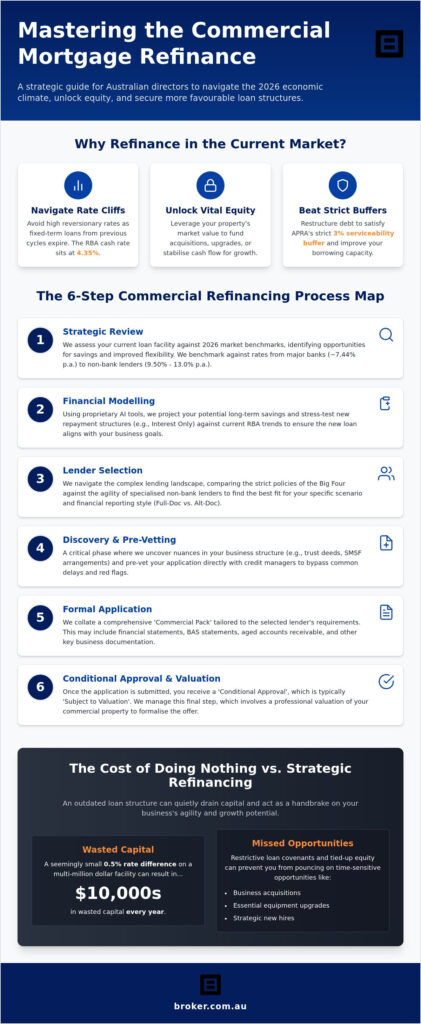
At its core, understanding what refinancing is involves replacing an existing debt obligation with a new one, typically under more favourable terms or a structure that better aligns with your current business trajectory. With the Reserve Bank of Australia (RBA) holding the cash rate at 4.35% as of August 2026, the commercial mortgage refinancing process has evolved from a simple cost-cutting exercise into a vital strategic restructure. Many directors are moving out of survival mode after years of inflationary pressure and into growth mode. This shift often requires unlocking equity to fund a business acquisition or to stabilise cash flow against the 3 percentage point serviceability buffer maintained by APRA.
A simple rate-switch might save you a few dollars each month, but a strategic loan restructure looks at the bigger picture. It considers your tax position, your future borrowing capacity, and the specific covenants that could either restrict or enable your next move. In a market where owner-occupier external refinancing totalled $42.9 billion in the March quarter of 2026, staying with an outdated facility is a choice that carries significant opportunity cost.
Common Triggers for a Commercial Switch
The most pressing trigger in 2026 is the expiration of fixed-rate terms secured during previous cycles. Falling into a lender’s ‘reversionary rate’ trap can see your interest costs spike overnight, often without the flexibility you now require. Beyond rates, many businesses initiate a refinance to secure working capital for essential equipment or vehicle fleet upgrades. Improving your Debt Service Coverage Ratio (DSCR) is another common driver; by restructuring debt, you can satisfy stringent lender covenants and present a healthier balance sheet for future expansion.
The ‘Cost of Doing Nothing’ vs. Strategic Refinancing
The numbers tell a compelling story. On a multi-million dollar facility, a seemingly small 0.5% rate difference results in tens of thousands of dollars in wasted capital every year. That is money that could fund a new hire or a marketing offensive. Outdated loan structures often act as a handbrake on business agility, preventing you from pouncing on acquisition opportunities when they arise. Realising your potential starts with a clear view of your property’s value. Equity in the 2026 Australian commercial real estate context represents the market value of your property minus the total outstanding debt secured against it, serving as a powerful lever for future capital raises.
The 6-Step Commercial Mortgage Refinancing Process Map
Executing a successful commercial mortgage refinancing process in 2026 requires more than just submitting a form; it demands a tactical approach to the Australian credit landscape. The journey begins with a Strategic Review, where we assess your current facility against 2026 benchmarks. With non-bank commercial first mortgages often ranging from 9.50% to 13.0% p.a., and major players like ING offering variable rates around 7.44% p.a. for mid-tier borrowings, knowing where you stand is essential. Following this, we move to Financial Modelling. Our proprietary AI tools project your potential savings and stress-test new repayment structures against current RBA trends. Lender Selection then involves navigating the strict policies of the Big Four versus the agility of specialised non-bank lenders. Finally, we move to the Formal Application, which involves collating a comprehensive ‘Commercial Pack’ including BAS statements and aged accounts receivable.
From Assessment to Approval
The ‘Discovery’ phase is arguably the most critical part of the entire journey. This is where we uncover the nuances of your business structure, such as trust deeds or complex SMSF arrangements, that could trigger red flags later. By acting as your expert guide, we provide inside access to credit managers to pre-vet your application before it even hits their desk. This proactive approach helps you follow official tips for refinancing while avoiding the common pitfalls of slow bank processing times. Once submitted, you’ll receive a ‘Conditional Approval’. It’s vital to understand that this is usually ‘Subject to Valuation’. In 2026, professional valuation fees can be around $1,500, and the resulting report is what ultimately determines your final Loan-to-Value Ratio (LVR). If you’re ready to see how these steps apply to your specific portfolio, you might want to start a low-pressure conversation with our team.
The Final Stretch: Settlement and Discharge
Once you accept the formal offer, the focus shifts to the final steps of Approval and Settlement. Managing the discharge process with your outgoing lender can be a bureaucratic headache, but we handle the heavy lifting to ensure they release the title on time. Your legal representatives will review the new mortgage documents to ensure the covenants, such as the Debt Service Coverage Ratio, are fair and manageable. On ‘Settlement Day’, the funds are disbursed to pay out your old loan, with any surplus equity made available for your business goals. This final transition is designed to be seamless, moving you from a state of uncertainty to one of streamlined confidence.
Calculating the ROI: Refinancing Costs vs. Long-Term Savings
Refinancing isn’t free. Every commercial mortgage refinancing process requires a cold, hard look at the Return on Investment (ROI). It’s not just about the headline rate; it’s about the net gain after all friction costs are settled. Commercial real estate financing involves more variables than home loans, meaning the upfront bill can be substantial. You’ll likely encounter application fees, legal costs typically ranging from $2,000 to $5,000, and professional valuation fees. The ‘Break-Even Point’ is your most important metric. If your monthly savings are $1,000 but the switch costs $12,000, you’ll need to hold the new loan for at least a year before seeing a single cent of profit.
Identifying ‘Break Costs’ is critical if you’re leaving a fixed-rate term early. In the 2026 economic climate, these fees can be prohibitive if your current rate is lower than current market offerings. However, there’s a silver lining for Australian business owners. Most costs associated with the refinancing process, including borrowing expenses and valuation fees, are generally tax-deductible over a five-year period or the life of the loan. This tax shield effectively reduces the net cost of the transition, though you should always verify the specifics with your accountant.
Hidden Fees to Watch Out For
Don’t let ‘Exit Fees’ or state government registration charges catch you off guard. While many modern lenders waive exit fees to remain competitive, some legacy contracts still carry them. You also need to monitor your Loan-to-Value Ratio (LVR). If your property value has dipped, you might trigger Lenders Mortgage Insurance (LMI) or similar risk fees. These can decimate your projected savings. We help you navigate these hurdles by finding lenders who specialise in higher LVRs or offer fee-waiver incentives for strong business profiles.
Valuation Nuances in the Commercial Sector
Commercial valuations are significantly more complex than residential appraisals. A commercial valuer examines lease terms, tenant quality, and market yields. There’s a massive difference between ‘Going Concern’ values, which include the business’s operational value, and ‘Vacant Possession’ values. To ensure the valuer sees your property’s maximum potential, prepare a clean ‘Commercial Pack’. This includes up-to-date rent rolls, maintenance records, and any recent capital improvements that justify a higher valuation.
Documentation Checklist: Getting Your ‘Ducks in a Row’
The success of your commercial mortgage refinancing process often hinges on the quality of your ‘Commercial Pack’. Lenders in 2026 are meticulous, and your choice between a ‘Full-Doc’ and ‘Alt-Doc’ pathway will dictate the speed of your approval. Full-Doc is the gold standard, requiring two years of company and personal tax returns. If your most recent returns aren’t ready, an Alt-Doc solution allows us to use Business Activity Statements (BAS) or an accountant’s declaration to prove your position. You’ll also need to provide Profit & Loss (P&L) statements and an aged accounts receivable report to demonstrate the liquidity of your operations.
Don’t overlook your personal financial health. Since February 1, 2026, APRA has limited lending at a high debt-to-income ratio of six or more to 20% or less of new loans. This means your personal home loan debt can directly impact your business’s borrowing capacity. On the property side, you must collate current lease agreements, outgoings schedules, and zoning certificates. If you are seeking a ‘Going Concern’ valuation, you must provide the business’s trading records to justify the higher value, whereas ‘Vacant Possession’ documentation focuses strictly on the physical asset and its market rental potential.
Specialised Lending Requirements
Refinancing through an SMSF or a Trust structure adds layers of compliance that can stall an application if not handled correctly. Your Trust Deed is the most important document in the pack, as lenders need to verify the powers of the trustee and the beneficiaries. For SMSF loans, ensure your audit is current and the property meets the ‘sole purpose’ test. It’s a common misconception that easier pathways exist for those with less paperwork. Low Doc doesn’t mean ‘No Doc’ in 2026; you’ll still need to provide robust alternative evidence of serviceability, such as six months of consistent BAS filings.
The Role of the Corporate Advisory
We do more than just pass papers to banks. Our team, including specialists like Kylie and Flavio, uses financial modelling to ‘tell the story’ of your business growth. This is vital when justifying a cash-out refinance for a business acquisition. We help you present a clear strategic rationale that shows a lender exactly how the new debt will generate a return. A broker’s cover letter acts as the executive summary of your entire business, often being the deciding factor for a credit manager. If you want to ensure your application is best in class, get started with our expert team today.
The Broker.com.au Advantage: A Tech-Enabled Refinance
Traditional banks often treat the commercial mortgage refinancing process like a paper-heavy marathon, leaving directors stuck in a cycle of follow-up calls and data requests. We’ve changed that narrative. By using our proprietary AI technology, we’re able to scan the risk appetites and current rates of over 50 Australian lenders to identify a “Best in Class” match for your business in seconds. This isn’t about generic algorithms; it’s about using high-level data to find the exact niche where your specific property type and financial profile are most valued.
While our technology provides the speed, our people provide the strategy. You aren’t just a file number; you’re partnered with an expert guide like Matt, Kylie, or Flavio. This human-led advisory ensures that every nuance of your business, from complex trust structures to future expansion plans, is accurately represented to credit managers. Our goal is to move you from a state of financial uncertainty to a position of streamlined confidence, knowing your debt is structured to support your dreams rather than stifle them.
Our relationships across the Australian lending landscape provide you with inside access to rates and terms that aren’t available to the general public. Whether it’s a major bank or a specialised non-bank lender, we leverage our national volume to negotiate on your behalf. This competitive edge often means the difference between a standard market offer and a tailored solution that significantly slashes your interest costs.
More Than Just a Mortgage
We believe your finance should work as a cohesive ecosystem. During your refinance, we can look at integrating your property loan with other essential facilities like Equipment Finance or vehicle fleet solutions. If your goal is expansion, our team specialises in Business Acquisition Funding, helping you leverage the equity in your existing premises to purchase a competitor or a new branch. We don’t just settle the loan and disappear. We provide ongoing support, reviewing your facility annually to ensure it remains the best fit as market conditions and RBA rates evolve.
Getting Started is Low-Pressure
We’ve ditched the aggressive “Apply Now” interrogation in favour of a low-pressure conversation. Our “I’m interested” philosophy means we start by listening to your needs and goals before suggesting a path forward. You can use our borrowing power and repayment calculators to self-educate at your own pace, ensuring you feel informed rather than rushed. When you’re ready for a professional perspective, we’re here to do the heavy lifting for you.
I’m interested in a commercial mortgage health check
Future-Proof Your Business Debt Today
Successful commercial refinancing in 2026 requires a sophisticated blend of sharp financial modelling and meticulous documentation. You’ve seen how a strategic restructure can move your business from a state of survival to one of active growth, allowing you to capitalise on new acquisition opportunities. Mastering the commercial mortgage refinancing process is the vital key to bypassing traditional bank delays and securing terms that actually align with your long-term vision.
As an award-winning corporate advisory, we provide the inside access to over 50 Australian lenders that you simply won’t find on the high street. Our proprietary AI technology ensures high-level application accuracy, while our human experts like Matt and Kylie manage the heavy lifting. You’re in good hands with a team dedicated to providing a seamless, stress-free experience from the initial discovery phase through to final settlement.
I’m interested in exploring my refinancing options
Take the first step toward a more flexible and robust financial future today. We’re ready to help you unlock the capital your business deserves.
Frequently Asked Questions
How long does the commercial mortgage refinancing process typically take in Australia?
The commercial mortgage refinancing process usually takes between four and eight weeks from the initial discovery session to final settlement. While our proprietary AI technology can accelerate the lender selection and application phase to just a few days, the total timeline is often dictated by the outgoing lender’s discharge speed and the complexity of the property valuation. Having your documentation ready can significantly shave weeks off the total duration.
Can I refinance my commercial property to buy another business?
Yes, you can leverage the equity in your commercial property to fund a business acquisition. By restructuring your existing debt, we can unlock capital to provide the necessary deposit or full purchase price for a new venture. This strategy is common for directors looking to expand their portfolio or acquire a competitor. We specialise in aligning your property loan with Business Acquisition Funding to ensure a seamless transition between assets.
What is the maximum LVR for a commercial refinance in 2026?
In the 2026 Australian market, the maximum Loan-to-Value Ratio (LVR) for a commercial refinance generally sits between 65% and 75% for standard industrial or office assets. Some specialised lenders may offer up to 80% LVR for high-quality, well-tenanted properties or medical centres. It’s important to remember that higher LVRs often come with increased risk margins or stricter covenants, so finding the right balance between leverage and cost is essential.
Do I need to provide a full business plan to refinance my mortgage?
A full business plan isn’t always mandatory for a refinance, but it is highly recommended if you’re seeking a significant cash-out or a major change in loan structure. For ‘Full-Doc’ applications, lenders focus more on your historical BAS and P&L statements. However, providing a clear strategic rationale helps our team tell the story of your growth to credit managers, which can be the deciding factor in securing more competitive interest rates.
What are the common reasons a commercial refinance application gets rejected?
Common reasons for rejection include a weak Debt Service Coverage Ratio (DSCR), undisclosed tax debts, or a valuation that comes in lower than expected. Lenders also look closely at tenant concentration risk if your property relies on a single occupant. By using our commercial mortgage refinancing process, we pre-vet your application against these red flags, ensuring you only submit to lenders whose specific risk appetite matches your business profile and property type.
Is it possible to switch from a fixed to a variable rate mid-term?
You can switch from a fixed to a variable rate mid-term, but you must account for potential break costs. These fees are calculated based on the difference between your current fixed rate and the prevailing market rates at the time of the switch. In 2026, if market rates have risen since you locked in, these costs might be minimal. We provide detailed financial modelling to help you determine if the long-term savings outweigh the exit expenses.
How does refinancing work for a specialised asset like a medical centre or warehouse?
Refinancing specialised assets requires a lender with a specific appetite for that sector. Warehouses are currently in high demand due to the strong industrial market, often commanding better LVRs and lower rates. Medical centres are viewed as recession-proof assets, which can lead to more favourable covenants. We use our inside access to over 50 lenders to find those who specialise in your specific asset class, ensuring your loan structure supports your unique operational needs.
Are there specific tax benefits to refinancing my business debt?
There are significant tax benefits to refinancing your business debt in Australia. Generally, borrowing expenses such as application fees, legal costs, and valuation fees are tax-deductible. If the total cost exceeds $100, the deduction is typically spread over five years or the life of the loan, whichever is shorter. Additionally, the interest paid on a commercial loan used for income-producing purposes remains a deductible business expense, helping to lower your overall net cost of finance.