
The temporary “ding” on your credit report from a new loan application might actually be the best thing that ever happens to your long-term borrowing power. Many Australian directors hesitate to restructure debt because they fear a hard enquiry will ruin their standing, but this caution often keeps them trapped in high-interest cycles that do far more damage. Understanding exactly how refinancing a business loan affects credit score is the key to moving from defensive management to proactive growth in 2026.
It’s natural to feel anxious about the blurred lines between your personal and business credit files, especially when your current debt is dragging down your creditworthiness. You need a clear path that leads to relief, not more complexity. This guide promises to show you how restructuring your debt impacts your profile and how to use refinancing as a tool for lasting financial health. We’ll preview the immediate credit “incision” versus the long-term healing of better debt-to-income ratios, ensuring you’re in good hands as you navigate the latest ASIC reporting requirements and RBA market sentiment.
Key Takeaways
- Learn exactly how refinancing a business loan affects credit score by balancing the temporary impact of hard enquiries against the long-term benefits of improved debt-to-income ratios.
- Discover the critical link between your ABN and your personal credit file, including how director guarantees influence your borrowing capacity in the 2026 lending environment.
- Master the “soft audit” process and learn how to organise your financial modelling to present a position of stability before approaching a new lender.
- Understand how leveraging proprietary AI and specialist brokers can act as a buffer, protecting your file from unnecessary credit hits during the lender matching phase.
- Transition from defensive debt management to proactive growth by using restructuring as a deliberate tool to enhance your overall creditworthiness.
Table of Contents
- Understanding the Refinancing-Credit Nexus in 2026
- Short-Term Pain vs. Long-Term Gain: The Credit Score Lifecycle
- Business Credit vs. Personal Credit: The Director’s Dilemma
- Strategic Steps to Refinance Without Tanking Your Score
- The Broker Advantage: Protecting Your Credit Profile
Understanding the Refinancing-Credit Nexus in 2026
Refinancing in the 2026 Australian market has evolved beyond a simple search for lower interest rates. It’s now a sophisticated tool used to reorganise debt structures and improve a company’s overall standing with lenders. While the Reserve Bank of Australia (RBA) has maintained a steady stance on commercial lending margins following the rate cuts of late 2025, the appetite for risk among lenders remains selective. Understanding how refinancing a business loan affects credit score is essential for directors who want to transition from high-interest, short-term debt to more sustainable, long-term funding models.
A common misconception is that any credit enquiry is inherently “bad.” In reality, lenders distinguish between a temporary “dip” caused by a proactive restructure and a negative “trend” caused by financial distress. A strategic refinance falls into the former category. It shows that a business is actively managing its obligations and seeking to improve its cash flow position. When lenders assess business credit reports, they look for this type of deliberate financial modelling rather than reactive borrowing. Proactive debt management is viewed as a sign of strength, not a signal of struggle.
The 2026 Australian Lending Landscape
Non-bank lenders have significantly disrupted the traditional big-four models this year. They often provide more tailored solutions for businesses that don’t fit the rigid criteria of major banks. However, this increased choice comes with a catch. These lenders rely heavily on real-time credit data. With interest rates remaining elevated compared to historical lows, your “credit health” has become a primary KPI. It’s the currency you use to negotiate better terms and access higher tiers of capital. Directors who ignore their credit profile find themselves locked out of the most competitive “inside access” rates.
Refinancing as a Credit Strategy
Refinancing allows you to move away from “noisy” credit files cluttered with multiple unsecured loans or lines of credit. By consolidating these into a single secured facility, such as a commercial property loan or asset finance, you effectively clean up your profile. This process, often referred to as debt recycling, helps maintain a healthy balance sheet. It replaces high-risk debt with structured facilities that are viewed more favourably by credit reporting bureaus. This strategic shift is how you ensure that how refinancing a business loan affects credit score results in a positive long-term trajectory for your enterprise.
Short-Term Pain vs. Long-Term Gain: The Credit Score Lifecycle
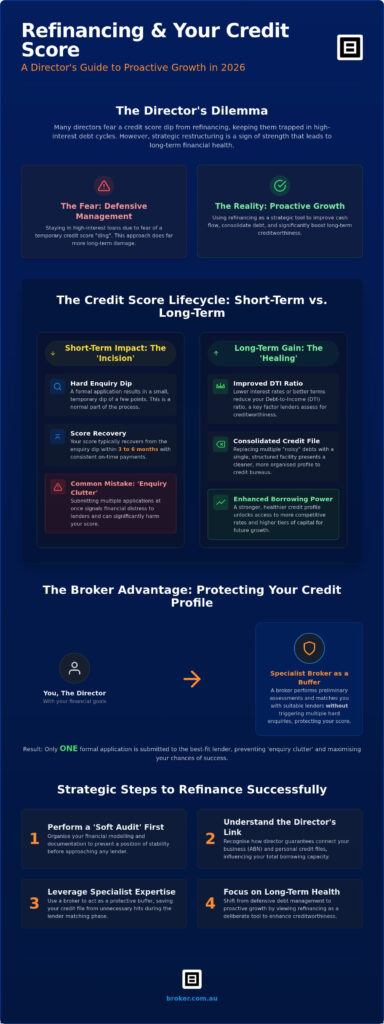
The journey of restructuring debt follows a predictable trajectory of short-term adjustments followed by long-term strengthening. When you look at how refinancing a business loan affects credit score, you have to view it through the lens of a 12-month cycle rather than a 30-day snapshot. While the initial application creates a minor ripple on your file, the eventual reduction in monthly liabilities often leads to a significantly more robust credit profile.
Immediate Impacts of a New Application
The moment a lender reviews your application, they perform a hard enquiry. This is a formal request to view your credit history, and it typically results in a small, temporary reduction in your score. In the 2026 Australian lending environment, these dips are generally minor, often only a few points, provided your file isn’t already crowded with recent searches. Most directors see their scores recover from this specific hit within three to six months of consistent activity.
A common mistake is “shopping around” by submitting multiple formal applications to different banks simultaneously. This creates “enquiry clutter,” which signals to credit bureaus that your business might be in financial distress or struggling to secure funding. To avoid this, it’s often wiser to consult with a specialist broker who can perform preliminary assessments before a formal “hard” check is ever recorded. Additionally, closing your old loan account can slightly lower the average age of your credit history, another factor that might cause a brief, secondary dip in your score.
Long-Term Credit Improvements
The real value of refinancing lies in the “healing” phase that begins after the first few months. By moving into a loan with a lower interest rate or a more appropriate term, you improve your Debt-to-Income (DTI) ratio. Lenders in 2026 place immense weight on this ratio. When your repayments represent a smaller percentage of your monthly revenue, your risk rating improves automatically. This increased cash flow acts as a safety net, drastically reducing the likelihood of missed payments or late fees that would otherwise devastate your standing.
Over a 12-month period, a consolidated repayment structure does more than just simplify your bookkeeping. It builds a “prime” credit profile by demonstrating a consistent, manageable repayment history. This disciplined track record is exactly what’s required for future business acquisitions or large-scale commercial property investments. By enduring the minor, short-term “incision” of an application, you’re effectively clearing the path for a much healthier financial future. Understanding how refinancing a business loan affects credit score over this full lifecycle allows you to make decisions based on strategy rather than fear.
Business Credit vs. Personal Credit: The Director’s Dilemma
Directors often operate under the illusion that their company’s debt exists in a vacuum. In the Australian lending landscape, the reality is far more interconnected. Most lenders require a Director Guarantee for business facilities, meaning your personal credit profile is often the primary security for the loan. This is where understanding how refinancing a business loan affects credit score becomes personal. When you restructure debt, you aren’t just moving numbers on a company balance sheet; you’re often triggering a review of your own financial standing.
Separating these liabilities is a strategic move that requires professional foresight. While an ABN identifies your business, your personal file is what most non-bank lenders use to gauge character and reliability. If your business debt is poorly structured, it can “bleed” into your personal life, limiting your ability to secure private finance for things like a family home or a new vehicle. By organising your debt correctly, you ensure that your business growth doesn’t come at the expense of your personal financial freedom.
The Impact on Personal Borrowing Power
A common question we hear is whether a business restructure will stop a director from getting a home loan. The answer depends on how you manage cross-collateralisation. If your business debt is tied directly to your personal residence, any new application for a business refinance will involve a deep dive into your home equity. Maintaining a clean personal repayment history is non-negotiable. Lenders in 2026 are increasingly sensitive to directors who use personal credit cards to fund business cash flow gaps, as this creates a high-risk profile on both files. To protect your borrowing power, it’s essential to keep business and personal expenses strictly separate.
Protecting the Company Credit File
Your company has its own reputation to protect. Platforms like Equifax and Illion provide the data that lenders use to decide your fate. In 2026, commercial credit reporting is more transparent than ever. This means that tax defaults or Australian Taxation Office (ATO) payment plans are visible to potential lenders. If your business has a history of late BAS payments, it will directly impact your refinance odds. Monitoring your business credit score allows you to see what the banks see before you apply. By addressing “red flags” like outdated defaults or incorrect enquiry data, you can improve the narrative of your business health. This proactive approach ensures that when you do move forward, the question of how refinancing a business loan affects credit score results in a story of growth rather than a warning sign of distress.
Strategic Steps to Refinance Without Tanking Your Score
Executing a successful restructure requires a tactical approach that prioritises your credit file’s integrity. Refinancing isn’t a shot in the dark; it’s a calculated move that begins long before you submit a formal application. By performing a “soft audit” of your current credit file, you can identify potential red flags or inaccuracies that might hinder your progress. This preliminary step allows you to understand how refinancing a business loan affects credit score in your specific circumstances, giving you the chance to clean up your profile before a lender ever sees it.
The most critical rule during this transition is to maintain every single one of your current repayments. Even a single late payment on an account you intend to close can derail your application and cause lasting damage to your standing. Lenders in 2026 are looking for stability and reliability, not just a good debt-to-income ratio.
Preparation and Financial Modelling
In the current lending climate, your historical BAS records and P&L statements are only half the story. The 2026 Australian standard now places a heavy emphasis on “Forward-Looking” financial projections. You need to prove that the restructure isn’t just a band-aid solution, but a strategic move that will fuel future growth. Organising a comprehensive Letter of Facilities and detailed financial modelling can often offset a slightly lower credit score. By showing a clear path to increased profitability, you present a narrative of strength. It’s also vital to consult your accountant to ensure the new structure is tax-effective, as a poorly planned restructure can lead to unexpected liabilities that further strain your cash flow.
Choosing the Path of Least Resistance
One of the greatest risks to your credit health is “mass-applying” through digital aggregators that blast your data to dozens of lenders at once. This scattergun approach creates a flurry of hard enquiries that can make even the healthiest business look desperate. Instead, you should utilise AI-driven pre-qualification tools that match your risk profile with specific lenders before a hard check is ever recorded. Non-bank lenders often have a higher appetite for “outside the box” scenarios, particularly for fit-out finance or complex working capital needs, making them a safer bet for directors with unique requirements.
To ensure you’re matched with the right facility without unnecessary credit hits, get started with our expert team for a tailored assessment. By targeting the right lenders from the outset and timing your refinance to coincide with peak business performance, you can secure the funding you need while keeping your credit profile pristine. This strategic alignment is the most effective way to manage how refinancing a business loan affects credit score while positioning your enterprise for long-term success.
The Broker Advantage: Protecting Your Credit Profile
Navigating the Australian lending market alone often leads to a trail of “hard” enquiries that can unintentionally damage your standing. When you approach a bank directly, they have a singular focus on their own products, and their mandatory credit checks are recorded regardless of the outcome. A specialist broker acts as a critical buffer in this process. By serving as an intermediary, an expert guide manages the initial stages of the search without exposing your file to unnecessary risk. This proactive management is the most effective way to control how refinancing a business loan affects credit score, ensuring your profile remains pristine while you seek a more efficient debt structure.
Beyond simple protection, a boutique brokerage provides “inside access” to the best rates and tailored facilities that aren’t advertised to the general public. Many non-bank lenders and private credit funds operate exclusively through the broker channel, offering flexible terms for complex commercial restructures or business acquisitions. Having a high-level fixer in your corner means you can leverage these exclusive relationships to secure a “best in class” solution that aligns with your specific growth targets for 2026.
Proprietary AI and Accurate Matching
The traditional “paperwork mountain” is often a major source of anxiety for directors. We use proprietary AI to streamline this process, identifying the “Path to Yes” by matching your financial modelling with lender appetites before a formal application is ever lodged. This technology allows us to pinpoint which of our 50+ bank and non-bank lenders is most likely to approve your facility based on current RBA sentiment and ASIC requirements. Speed of approval is a key factor here. By reducing the time between the initial enquiry and the final settlement, we protect your credit momentum and allow you to stay focused on your daily operations rather than getting bogged down in administrative delays.
A Stress-Free Path to a Better Rate
Our approach is designed to move you from a state of uncertainty toward streamlined confidence. We understand that high-stakes financial decisions require both technical expertise and personal attention. By personifying the service through a dedicated team of specialists, we ensure you always feel like you’re in good hands. This isn’t just about finding a cheaper loan; it’s about a holistic strategy that considers your long-term financial health and borrowing capacity. Our “I’m interested” philosophy starts a low-pressure conversation where we can explore your needs without the heavy-handed tactics of traditional lenders. We manage the logistics and the credit risk, providing you with the clarity needed to make an informed choice. If you’re ready to see how a professional restructure can heal your balance sheet, the next step is simple: I’m interested in a credit-safe loan review. Understanding how refinancing a business loan affects credit score is the first step toward a more profitable and secure future for your enterprise.
Restructuring for Long-Term Growth and Credit Health
Refinancing in 2026 is a deliberate exercise in credit management rather than a simple search for a lower rate. By moving from high-interest, short-term debt to structured facilities, you heal your debt-to-income ratio and build a “prime” profile for future growth. While the initial application creates a minor ripple on your file, the long-term benefits of improved cash flow far outweigh the temporary dip. Understanding exactly how refinancing a business loan affects credit score empowers you to stop reacting to debt and start using it as a tool for success.
As an award-winning business loan broker, we specialise in complex finance and national restructures. Our proprietary AI ensures accurate lender matching before any hard checks occur, protecting your standing from unnecessary enquiry clutter. You don’t have to manage these high-stakes transitions alone. Our expert guides are ready to help you find the “Path to Yes” while keeping your personal and business credit files secure. Take the first step toward a more efficient balance sheet today.
I’m interested in exploring my refinancing options
Frequently Asked Questions
Does refinancing a business loan count as a ‘hard enquiry’ in Australia?
Yes, a formal application for refinancing almost always results in a hard enquiry on your credit file. This occurs when a lender requests your full credit history to assess your risk profile before approval. While this causes a minor, temporary dip in your standing, it’s a standard part of the Australian lending process. To protect your file, you can use our proprietary AI to pre-qualify before a formal check is ever recorded.
How many points will my credit score drop when I refinance?
Most Australian directors see a minor reduction of five to ten points following a single hard enquiry. The exact impact depends on your current score and the “thickness” of your credit history. If you have a long track record of on-time repayments, your score will likely recover within three to six months. Avoiding multiple applications in a short window is the best way to manage how refinancing a business loan affects credit score long-term.
Can I refinance my business loan if I have a low credit score?
You can certainly refinance with a lower score, but your choice of lenders will likely shift toward specialist non-bank providers. These institutions often look beyond the raw number, focusing instead on your current cash flow and the quality of your business assets. While major banks might decline a “below prime” file, non-bank lenders frequently offer tailored facilities for directors working through a credit recovery phase or a complex business restructure.
What is the ‘Loyalty Tax’ and how does it affect SME owners?
The “Loyalty Tax” refers to the higher interest rates and fees often charged to long-term customers compared to the competitive rates offered to new borrowers. In the 2026 market, many SME owners find they are paying significantly more than the current market rate simply because they haven’t reviewed their facility in years. Refinancing allows you to escape this trap, immediately improving your debt-to-income ratio and your company’s overall creditworthiness.
Will my personal credit score be affected by a business loan refinance?
Yes, your personal credit score is often affected because most Australian business loans require a Director Guarantee. Lenders typically run a check on your personal file as part of the business application process. This is why it’s vital to maintain clean personal repayments while restructuring company debt. Separating your liabilities where possible can help protect your personal borrowing power for future needs like a family home or private vehicle finance.
How long should I wait between loan applications to protect my score?
Waiting at least six months between formal credit applications is a prudent strategy for protecting your profile. Rapid-fire enquiries signal financial distress to credit bureaus, which can lead to a steeper drop in your score. By spacing out your applications, you allow your score to stabilise and demonstrate a pattern of controlled, strategic borrowing. This disciplined approach is essential for maintaining a “prime” standing in the eyes of major lenders.
What documents do I need for a 2026 business loan refinance?
For a 2026 refinance, you’ll generally need your latest Business Activity Statements (BAS), updated Profit and Loss (P&L) statements, and a current Letter of Facilities. Australian lenders now also look for “forward-looking” financial modelling that demonstrates your future repayment capacity. Having these documents organised and verified by your accountant ensures a seamless application process and reduces the likelihood of multiple enquiries being made while seeking an accurate lender match.
Is it better to consolidate multiple business debts into one loan?
Consolidating multiple debts into a single facility is often the most effective way to clean up a “noisy” credit file. Instead of managing several small repayments with different lenders, a single structured loan improves your cash flow and simplifies your financial management. This strategic move directly influences how refinancing a business loan affects credit score by lowering your total number of active credit accounts and improving your debt-to-income ratio over time.