
Did you know that over 11,000 Australian companies entered external administration last financial year, often because they waited too long to address a mounting debt pile? A business loan restructuring agreement shouldn’t be viewed as a white flag of surrender, but rather as a high-level strategic tool to reclaim your company’s future. It is a proactive way to pivot when the weight of the current economy feels like too much to carry alone.
It’s exhausting to wake up every morning with the pressure of crushing monthly repayments and the constant fear that a director guarantee might put your family home at risk. With the ATO resuming aggressive recovery actions and the RBA cash rate sitting at 4.35 percent, the strain on your cash flow is undeniably real. We understand that you’ve worked too hard to let everything slip away due to temporary liquidity issues.
This guide will show you how to turn that toxic debt into a manageable runway. You’ll learn how to secure lowered repayments and extended terms while keeping the tax office satisfied. We will explore the critical differences between formal Small Business Restructuring and informal private negotiations, giving you the inside access needed to protect your assets and restore your peace of mind.
Key Takeaways
- Discover how a tailored business loan restructuring agreement can transform toxic debt into a manageable runway while shielding your personal assets from seizure.
- Learn the specific 2026 eligibility criteria for the Small Business Restructuring (SBR) process, including the $1 million liability cap and mandatory tax lodgement rules.
- Understand how to leverage strategic refinancing or debt consolidation to merge multiple equipment and vehicle loans into one efficient facility.
- Identify the “pain points” of your current creditors to negotiate extended terms and lower repayments that satisfy the ATO and improve your daily cash flow.
- Gain inside access to specialised non-bank lenders who offer more flexible terms than the “Big Four” through our proprietary AI-driven market scanning.
Table of Contents
- What is a Business Loan Restructuring Agreement in Australia?
- The Small Business Restructuring (SBR) Process: A 2026 Roadmap
- Strategic Refinancing vs. Formal Debt Consolidation
- Negotiating the Agreement: How to Secure Favourable Terms
- How Broker.com.au Facilitates Seamless Debt Restructuring
What is a Business Loan Restructuring Agreement in Australia?
A business loan restructuring agreement is a binding contract between your company and its creditors. It serves as a strategic reset button. In the 2026 Australian market, where business insolvencies reached a decade high, this agreement has evolved into a sophisticated tool for proactive directors. Its primary goal is to fix immediate cash flow leaks while ensuring the business remains solvent for the long haul.
You generally have two paths: a private workout or a formal Small Business Restructuring (SBR) plan. A private workout is an informal negotiation with your bank or lender to change your loan terms. In contrast, a formal SBR plan falls under the Corporations Act and involves a legal process to settle debts. With 61 percent of SMEs abandoning bank applications due to rigid documentation requirements in 2026, many are now turning to a debt restructuring to find flexibility outside traditional banking structures.
The Legal vs. Commercial Framework
The formal SBR framework is unique because it allows you, as the director, to stay in the driver’s seat. Unlike traditional voluntary administration, you continue to run the daily operations while a Small Business Restructuring Practitioner (SBRP) helps you draft a plan for creditors to vote on. It’s a streamlined process designed specifically for companies with liabilities under $1 million. This path is often the best way to deal with the ATO if you’ve fallen behind on tax lodgements or superannuation payments.
If your situation isn’t at the level of a formal SBR, commercial refinancing acts as a “soft” restructuring alternative. This involves moving your debt to a more flexible lender, often a non-bank entity, who understands your specific industry pressures. This shift allows you to bypass the “Big Four” and access terms that actually fit your current revenue cycle without the stigma of a formal insolvency appointment.
Key Clauses Every Director Must Understand
When negotiating your business loan restructuring agreement, the fine print determines your recovery speed. You should focus on three critical areas to ensure the deal is sustainable:
- Repayment holidays: These provide a temporary pause on principal payments, or a shift to interest-only periods, giving you breathing room to reinvest in operations.
- Haircuts: This is a negotiated reduction of the total principal owed. Creditors may accept a percentage of the debt now rather than risking a total loss if the company liquidates.
- Covenant waivers: These prevent your lender from calling in the loan if you fail to meet certain financial ratios, such as debt-service coverage, during your transition phase.
The Small Business Restructuring (SBR) Process: A 2026 Roadmap
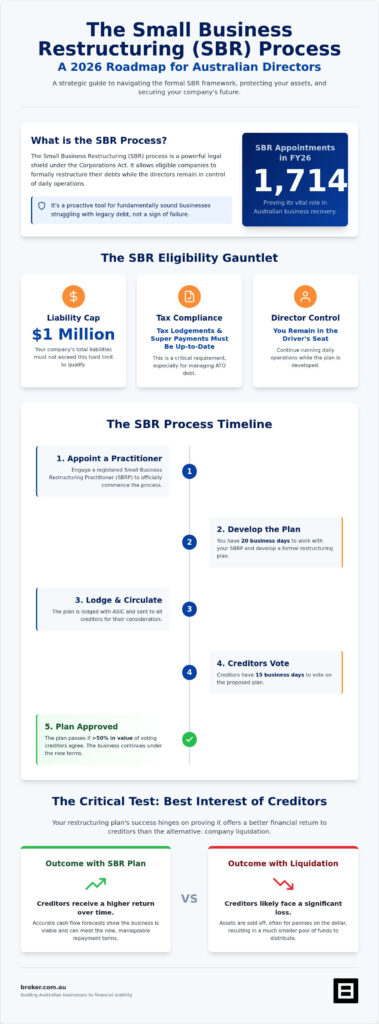
The formal SBR process is a powerful legal shield designed for businesses that are fundamentally sound but struggling with legacy debt. In FY26, there were 1,714 SBR appointments across Australia, proving it remains a vital path for recovery. To qualify, your company’s total liabilities must not exceed $1 million. This threshold is a hard limit. Once you’ve confirmed eligibility, you must appoint a Small Business Restructuring Practitioner (SBRP). This expert works with you to turn your vision into a formal business loan restructuring agreement that creditors can actually support.
The clock starts ticking immediately. You have exactly 20 business days to develop your restructuring plan. During this period, you remain in control of your business, which is a massive advantage compared to traditional voluntary administration. After the plan is lodged, creditors have 15 business days to vote. For the plan to pass, it needs a majority in value (more than 50 percent) of the creditors who choose to vote. If you’re feeling overwhelmed by these tight timelines, you can explore tailored finance solutions to help bridge the gap during the negotiation phase.
Preparing Your Financial Modelling
Success hinges on your ability to prove that creditors will get a better return through your plan than they would if the company was liquidated. This is known as the “Best Interest of Creditors” test. Accurate financial modelling is non-negotiable. You need to provide clear cash flow forecasts that show how the restructured debt will be serviced over time. Many directors are now using AI-driven stress-testing tools to simulate different economic scenarios, ensuring their proposal is robust enough to survive future market volatility.
Dealing with the ATO and Excluded Creditors
The ATO is often the largest creditor in an SBR. In 2026, their stance remains firm: they generally support plans that offer a superior return to liquidation, provided your compliance history is clean. However, you must have all tax lodgements up to date before the process begins. Crucially, following the “Payday Super” legislation that commenced on 1 July 2026, all employee entitlements and superannuation must be paid in full before you can even propose a plan. According to ASIC’s guide to the restructuring process, related-party creditors, such as directors or family members, are often excluded from voting. This means you can’t rely on “friendly” debt to push a business loan restructuring agreement through the finish line.
Strategic Refinancing vs. Formal Debt Consolidation
While a formal SBR is a powerful legal shield, many Aussie SMEs find that a private business loan restructuring agreement through refinancing or consolidation is a more discreet way to fix cash flow. Refinancing involves moving your current debt to a new lender to secure a lower interest rate or more favourable terms. It’s an ideal move if your business performance has improved since you first took out the loan. Consolidation, however, is about simplicity. It merges multiple equipment, vehicle, and unsecured loans into a single facility, replacing a chaotic calendar of repayments with one predictable monthly figure.
A sophisticated strategy we often employ is “Debt Recycling.” This involves leveraging equity in commercial property to clear expensive, high-interest working capital debt. It effectively turns “bad” short-term debt into “good” long-term debt. Directors must be wary of “quick fix” unsecured loans. While they offer fast cash, they often carry high daily or weekly repayments that can worsen a debt spiral. In 2026, with 31 percent of SMEs now preferring non-bank lenders over the “Big Four,” there are more options than ever to restructure without falling into the trap of predatory lending.
The Impact on Your Credit File
Privacy is a major factor when choosing your path. A formal SBR is a matter of public record and appears on the ASIC register, which can stay on your credit file for years. A private refinance or consolidation agreement, however, is a standard commercial transaction. It protects your reputation and keeps your ability to borrow for future business acquisition intact. After a successful restructure, your business enters a “Credit Healing” period. During this time, consistent repayments on your new facility demonstrate to future lenders that you’ve successfully navigated a period of stress and emerged stronger.
Unlocking Working Capital via Asset Finance
Your existing assets are often a hidden source of liquidity. A “Sale and Leaseback” arrangement allows you to sell machinery or vehicles you already own to a lender and lease them back. This provides an immediate injection of cash to clear ATO debts or fund growth. Alternatively, you can refinance existing equipment loans to extend the “balloon” payment term, significantly lowering your monthly overheads. By using a broker’s inside access to specialised asset lenders, you can find flexible terms that traditional banks simply won’t offer to businesses in a transition phase.
Negotiating the Agreement: How to Secure Favourable Terms
Securing a business loan restructuring agreement is as much about psychology as it is about finance. To win at the negotiating table, you must first identify your lender’s “pain points.” Banks and private lenders generally loathe uncertainty. They also know that liquidation is a costly, drawn-out process that often results in a poor recovery of funds. By presenting a solution that offers a higher return than a fire sale, you shift the leverage back into your favour. This is your strongest bargaining chip.
We always recommend a “No-Surprises” policy. You should initiate contact with your creditors well before a default occurs. When you approach them early, you aren’t a problem to be managed; you’re a partner seeking a solution. Your proposal must include a robust “Turnaround Strategy” that proves the business is viable. This involves showing exactly how you’ve cut costs, improved margins, or pivoted your model to ensure future solvency. The process typically moves through three distinct stages:
- Letter of Intent: A formal document outlining your desire to restructure and the broad terms you’re proposing.
- Active Negotiation: The back-and-forth where specific interest rates, terms, and “haircuts” are hammered out.
- Deed of Agreement: The final, legally binding document that replaces your old loan contracts.
If you’re feeling the pressure of an impending deadline, you can get in touch with our expert team to help manage these high-stakes conversations on your behalf.
Managing Director Guarantees and Cross-Collateralisation
The most significant source of stress for Aussie business owners is the danger of the family home being tied to business performance. This often happens through cross-collateralisation, where a single guarantee covers multiple loans. During a restructure, you have a unique window to negotiate the “de-linking” of personal assets. If a total release isn’t possible, we often aim for “capping” a guarantee to a specific dollar amount. This prevents an unlimited claim on your personal wealth and ensures your family’s future isn’t entirely dependent on a single business facility.
What Lenders Look for in a 2026 Restructure
In the 2026 lending environment, we’ve seen a clear shift toward “Character-Based” lending in the mid-market. Lenders are looking beyond the balance sheet to assess your “Management Capability.” They want to know if the leadership team has the grit and skill to execute the turnaround. Providing a professional corporate advisory report can significantly increase your approval odds. It shows the lender that you’ve sought expert guidance and that your financial modelling has been stress-tested by specialists. They want to see that you’re proactive, transparent, and fully committed to the new path.
How Broker.com.au Facilitates Seamless Debt Restructuring
Broker.com.au acts as your seasoned partner in managing the complexities of the Australian lending landscape. We use proprietary AI technology to scan the market, identifying “restructure-friendly” lenders in minutes rather than weeks. This speed is critical because, as we’ve seen throughout 2026, 61 percent of SMEs abandon traditional bank applications due to documentation hurdles. Our AI-driven assessment bridges this gap, allowing us to build a robust business loan restructuring agreement that aligns with your specific cash flow needs while others are still stuck in the paperwork phase.
We provide inside access to a network of specialised non-bank and private lenders who look beyond a simple balance sheet. These institutions are often more flexible with terms, especially for businesses in the construction or hospitality sectors that have been hit hard by recent economic shifts. We don’t just find you a loan; we structure a comprehensive solution that protects your personal assets and organises your debt into a manageable facility. Our role is that of a “High-Level Fixer,” ensuring every piece of the puzzle fits your long-term vision for the company.
The Expert Guide Advantage
One of the biggest mistakes a director can make is going directly to their current bank when they’re under financial stress. Traditional banks often have rigid, automated risk profiles that may trigger an immediate “no” or, worse, a reduction in your existing credit limits. Our team, led by experts like Matt, Kylie, and Flavio, provides a human-led advisory service that prioritises your specific needs. We handle the heavy lifting of negotiation, allowing you to focus on running your business. We’ve successfully helped clients restructure toxic debt to the point where they were eventually able to qualify for business acquisition funding to expand their operations and buy out competitors.
Getting Started: The “I’m Interested” Conversation
Reclaiming your financial momentum starts with a simple, confidential review of your current debt profile. We understand the anxiety that comes with ATO pressure or looming interest charges, and our goal is to move you toward a state of streamlined confidence. This is a low-pressure process designed to give you clarity on your options without the stress of a traditional bank interview. We take a “can-do” approach to situations that fall outside the norm, ensuring you’re in good hands from day one. Our bespoke corporate advisory ensures we don’t just find a loan; we structure the solution that works for your unique circumstances.
If you’re ready to protect your family home and reclaim your business cash flow, we’re here to help. I’m interested in a confidential debt restructure review.
Secure Your Business Future Today
The weight of business debt doesn’t have to define your company’s legacy. As we’ve explored, whether you choose a formal SBR process or a private refinance, the goal is to protect your family home and reclaim your cash flow. By acting early and using sophisticated financial modelling, you can turn a stressful situation into a manageable path forward. You’ve worked too hard to let temporary liquidity issues derail your long-term goals.
Implementing a strategic business loan restructuring agreement is about more than just survival; it’s about setting the stage for future growth. Our award-winning corporate advisory team provides inside access to over 50 Australian lenders, ensuring you find a partner who understands your specific industry pressures. With our AI-powered debt analysis, we can rapidly identify the best path to satisfy the ATO and secure your assets without the typical bank delays.
You don’t have to navigate these complex negotiations alone. Our experts are ready to guide you through every step with a tailored approach that puts your needs first. I’m interested in a bespoke debt restructuring strategy. Take the first step toward relief today; your business’s best days are still ahead of it.
Frequently Asked Questions
Can I restructure my business loan if I am already in arrears with the ATO?
Yes, you can restructure while in arrears with the ATO, and they are often the most common creditor involved in these negotiations. However, to be eligible for a formal Small Business Restructuring process, all your tax lodgements must be current. The ATO generally supports a business loan restructuring agreement if it offers a better return than liquidation. It’s a proactive way to manage General Interest Charges and establish a sustainable repayment plan.
How does a formal restructuring plan affect my personal credit score?
A formal restructuring plan under the Corporations Act will appear on the ASIC register, which can impact your business and personal credit files for several years. In contrast, an informal or private restructure via refinancing is usually treated as a standard commercial transaction. While a formal process may temporarily lower your score, successfully completing the agreement demonstrates financial responsibility to future lenders, allowing for a credit healing period once the debt is resolved.
What is the difference between debt restructuring and debt consolidation?
Debt restructuring involves changing the terms of your existing contracts, such as negotiating haircuts on the principal or extending the loan term. Debt consolidation is the process of taking out one new loan to pay off multiple smaller debts, such as equipment and vehicle finance. While consolidation simplifies your monthly repayments into a single facility, a business loan restructuring agreement is a deeper strategic reset that addresses the underlying viability and solvency of the company.
Will I lose control of my company during a Small Business Restructuring (SBR)?
No, you do not lose control of your company during a Small Business Restructuring. Unlike voluntary administration, where an external party takes over, the SBR framework is a debtor-in-possession model. This means you and your fellow directors continue to manage the day-to-day operations while the Restructuring Practitioner focuses on the creditor plan. It allows you to maintain your brand’s momentum and staff relationships while the legacy debt is being formally addressed.
Can a business loan restructuring agreement protect my family home?
Yes, a restructure is one of the most effective ways to protect your family home from cross-collateralisation. By negotiating a release or capping of director guarantees during the process, you can separate your personal assets from the business’s liabilities. This prevents the bank from seizing your home if the business faces future hurdles. Securing these protections is a primary objective for many directors who choose to formalise a new agreement with their lenders.
How much does it cost to appoint a restructuring practitioner in Australia?
The cost of appointing a Small Business Restructuring Practitioner is typically split into two phases: a fixed fee for the initial 20-day planning period and a percentage-based fee for managing the plan once creditors approve it. While we don’t set these statutory fees, we help you find practitioners who offer transparent pricing. Investing in professional guidance early often saves the business significantly more by securing principal reductions and avoiding the total loss of liquidation.
Is it possible to restructure a secured business loan without losing the collateral?
It is entirely possible to restructure a secured business loan without losing your collateral. Lenders generally prefer to keep a performing loan on their books rather than going through the hassle of seizing and selling machinery or property. By negotiating an extension of the balloon payment or moving to an interest-only period, you can reduce the immediate cash flow pressure. This allows you to keep the essential equipment you need to generate revenue and trade back to health.
How long does a typical debt restructuring process take from start to finish?
A formal SBR process is designed for speed, typically taking about 35 business days from the appointment of a practitioner to the final creditor vote. This includes 20 days to draft the plan and 15 days for creditors to cast their ballots. Informal private restructures can vary depending on the lender’s internal approval times, but using AI-powered analysis can significantly accelerate the initial assessment. Most businesses find they can achieve a signed agreement and reclaimed momentum within two months.