
What if the very tax strategies you use to grow your company are secretly sabotaging your mortgage approval? It’s a bitter pill to swallow when a bank looks at your thriving enterprise and sees a high-risk applicant because your taxable income has been expertly minimised. You’ve built something substantial, yet the traditional lending system often fails to recognise the true strength of your cash flow. If you’re tired of being penalised for your success, these business owner home loan application tips will help you bridge the gap between your tax returns and your actual borrowing power.
We know the frustration of dealing with lenders who don’t understand complex structures or the value of depreciation. This guide promises to simplify the process, helping you secure the same competitive rates as PAYE earners. We’ll explore how to manage the 2026 APRA debt-to-income caps and which lenders have reduced their ABN registration requirements to just 18 months. By the end, you’ll have a clear, stress-free strategy to organise your financials and gain inside access to the best deals on the market. It’s time to ensure your lender sees the full picture of your professional success.
Key Takeaways
- Understand why traditional banks often struggle with business income and how to reframe your financials to overcome the 2026 serviceability hurdles.
- Learn the difference between “Standard” and “Streamlined” packs to decide if you should provide two years of tax returns or use recent BAS statements for a faster approval.
- Master essential business owner home loan application tips like timing your lodgement for the “Golden Quarter” to maximise your borrowing capacity.
- Discover how to choose between the lowest possible variable rates and the flexibility of an Alt-Doc loan based on your specific documentation availability.
- Gain inside access to lenders who understand add-backs and complex company structures by leveraging proprietary AI technology and specialist broker insights.
Table of Contents
- Why Home Loans for Business Owners are Different in 2026
- Proving Your Worth: The Documentation Checklist
- Full Doc vs. Low Doc: Choosing Your Path
- 5 Strategic Tips to Maximise Your Borrowing Capacity
- The Broker Advantage: Navigating the 2026 Landscape
Why Home Loans for Business Owners are Different in 2026
Banks love simplicity. A PAYE earner with a single payslip represents a clean, low-touch file. For a sole trader, partner, or company director, the file is often a complex stack of tax returns, profit and loss statements, and trust deeds. This PAYE bias often leads to unnecessary frustration, yet your business structure should be seen as a strategic asset, not a hurdle. By 2026, the RBA cash rate of 4.35% and APRA’s strict debt-to-income (DTI) caps have made serviceability much tighter for everyone. For SMEs, this means your real income needs to be articulated with precision to avoid an automated rejection. We believe in the “Fair Go” principle: business owners deserve the same competitive rates as everyone else, provided their story is told correctly.
The Gap Between Taxable Income and Borrowing Power
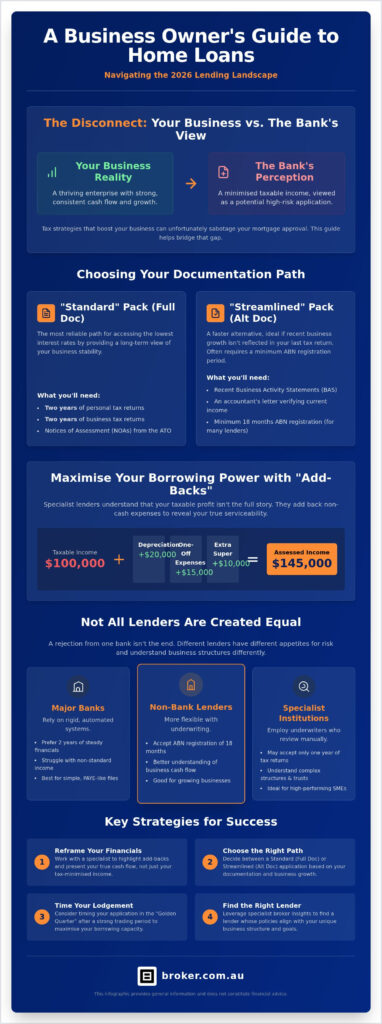
Most accountants work hard to minimise your tax. While this is great for your bottom line, it can be a hurdle when understanding mortgage loans from a bank’s perspective. Lenders often focus on the taxable income figure, but that number rarely reflects the actual cash flow available to service a loan. We look for “add-backs” like depreciation, one-off capital expenses, and voluntary superannuation contributions. These adjustments can significantly boost your assessed income. Whether you’re a partner or a director, your retained earnings and dividends are vital pieces of the puzzle. Using these business owner home loan application tips allows you to show the bank your true financial strength rather than just a tax-optimised figure.
Lender Appetites: Not All Banks are Created Equal
Don’t assume your current bank is the best fit for your next home. Major banks often rely on rigid, automated systems that struggle with non-standard income streams. In contrast, certain non-bank lenders employ specialist business underwriters who manually review your application. They understand that a temporary dip in profit during a business growth phase isn’t a sign of instability. The 2026 environment has seen a shift in how different institutions view risk:
- Major Banks: Typically prefer two years of steady financials and ABN registration.
- Non-Bank Lenders: More likely to accept 18 months of ABN registration as of July 2026.
- Specialist Institutions: Often accept one year of tax returns for high-performing SMEs.
A rejection from your current bank is rarely the final answer. It usually just means their internal policy doesn’t align with your specific corporate structure. Finding a lender whose appetite matches your business model is the key to a stress-free approval.
Proving Your Worth: The Documentation Checklist
Banks view documentation as the definitive “truth” of your enterprise. While a payslip is a simple snapshot, your business financials are a complex narrative. To secure a competitive rate, you must present this narrative clearly. Most traditional lenders require a “Standard Pack,” which consists of two years of personal and business tax returns. This is the most reliable way to access the lowest interest rates, as it provides a long term view of your stability. Always organise your Notices of Assessment (NOAs) from the ATO early. Lenders use these to verify that the figures on your tax returns match what was officially lodged, and missing NOAs are a common cause of avoidable delays.
For those needing a faster path, the “Streamlined Pack” is an excellent alternative. This approach uses your recent Business Activity Statements (BAS) and an accountant’s letter to verify current income. It is particularly useful if your business has seen significant growth that isn’t yet reflected in your last tax return. Keep in mind that your ABN and GST registration history are critical here. Many lenders now require a minimum of 18 months of active ABN registration to consider these streamlined options. If you’re unsure which documentation path fits your current situation, our expert team can help you determine the most efficient strategy for your specific structure.
Mastering the Art of “Add-Backs”
The real secret to maximizing your borrowing power lies in “add-backs.” These are expenses that reduce your taxable income but don’t actually cost you cash on a day to day basis. A specialist lender will add these back to your profit to get a truer sense of your serviceability. Key add-backs include:
- Depreciation: This is a paper loss on assets like vehicles or equipment. It reduces your tax but doesn’t lower the cash in your bank account.
- One-off expenses: A major equipment upgrade or a unique legal fee shouldn’t permanently hurt your borrowing capacity. We can often argue these are non-recurring.
- Superannuation: Voluntary super contributions are discretionary. Lenders view these as usable income because you could choose to stop making them if needed to pay a mortgage.
Applying these business owner home loan application tips ensures the bank sees your actual disposable income rather than just a tax-minimised figure.
The Importance of a “Clean” Business Financial Statement
Assessors look for “noise” in your financials that suggests risk. Director Loan Accounts are a prime example. If you’ve been drawing funds from the business as a loan rather than a salary, it needs to be clearly documented to avoid confusion. Similarly, separating your personal and business expenses is vital for a stress-free review. In 2026, lenders are scrutinising Profit and Loss (P&L) statements for consistency. A “clean” set of books tells the lender that you are a disciplined manager of your own capital, which builds the trust necessary for a high-stakes approval.
Full Doc vs. Low Doc: Choosing Your Path
Choosing between a Full Doc and a Low Doc loan is a strategic decision that balances cost against convenience. A Full Doc application is the gold standard for securing the lowest possible interest rates in Australia. As of August 2026, 49 lenders are offering variable rates below 6%, providing a significant advantage for those with up to date financials. One of the most effective business owner home loan application tips is to leverage recent policy shifts. Major banks like ANZ and Westpac now accept one year of income documentation for certain applicants, rather than the traditional two. This evolution allows many owners to qualify for “Prime” rates even if their older tax returns don’t reflect their current success.
Low Doc loans, often rebranded as “Alt-Doc,” serve as a vital tool for entrepreneurs whose paperwork isn’t quite ready for a standard review. While these products typically carry higher interest rates, starting around 6.99% p.a., they provide the flexibility to move quickly in a competitive property market. You should be aware that most Low Doc products are capped at an 80% Loan-to-Value Ratio (LVR). This means you’ll need a 20% deposit to avoid the higher risk fees often associated with these specialist products. By maintaining a lower LVR, you can often negotiate better terms even within the Alt-Doc space.
When to Consider a Low Doc Loan
There are specific scenarios where an Alt-Doc path is the most logical choice. If your most recent tax returns haven’t been lodged with the ATO yet, but your business bank statements show consistent, healthy cash flow, a Low Doc loan can bridge the gap. Lenders in this space often rely on an “Accountant Declaration.” This is a formal document where your advisor confirms your estimated annual income, providing the lender with the confidence to proceed without full tax assessments. It’s a streamlined way to prove your serviceability when your formal lodgements are lagging behind your actual performance.
The 2026 “Alt-Doc” Evolution
The old stigma surrounding Low Doc loans is rapidly disappearing. In the 2026 lending environment, AI technology and open banking allow lenders to verify business health in real time through digital bank feeds. This has made Alt-Doc loans far more competitive and transparent than they were a decade ago. Successful entrepreneurs often use these loans as a short term solution, with the intention of refinancing to a lower Full Doc rate once their next tax return is finalised. When comparing costs, consider whether the slightly higher interest rate is a fair price for the opportunity to secure your dream home today rather than waiting another year for the tax man to catch up.
5 Strategic Tips to Maximise Your Borrowing Capacity
Maximising your borrowing power in 2026 requires a proactive approach to your personal and commercial ledger. Since APRA’s 2026 restrictions limit lenders to having no more than 20% of new mortgages with a debt to income (DTI) ratio above six, every dollar of liability counts. These business owner home loan application tips are designed to help you trim the fat and present a robust profile to the assessor. Small adjustments made three to six months before you apply can be the difference between a “yes” and a frustrating rejection. Our goal is to ensure you move through the process with streamlined confidence.
- Reduce personal liabilities: Banks assess credit cards based on their total limit, not the balance you actually owe. Close unused cards and consider paying out car loans to lower your DTI.
- Time your application: The first quarter after your tax lodgement is the “Golden” window. This ensures your most recent, and hopefully strongest, figures are the basis for the bank’s decision.
- Consolidate business debt: Restructuring your commercial finance can reduce your monthly commitments, freeing up personal cash flow for mortgage serviceability.
- The “Company Wage” strategy: Paying yourself a regular, consistent salary via bank transfer creates a “PAYE-like” history that simplifies the lender’s verification process.
- Utilise an offset account: Maintaining liquidity in an offset account rather than leaving it in a business account can reduce your interest while keeping funds accessible for tax or growth.
Managing Your Business Debt Profile
Your business credit lines and overdrafts are often viewed as personal liabilities by many traditional banks. To protect your personal borrowing power, aim to separate your business and personal security to avoid cross-collateralisation. This ensures your family home isn’t tied directly to your commercial performance. Debt recycling allows you to convert non-deductible home loan debt into tax-deductible investment debt, effectively lowering your long term interest burden while you build wealth. If you’re ready to see how these adjustments affect your specific numbers, I’m interested in a borrowing power assessment with a specialist today.
The Power of the “Clean” Application
Lenders in 2026 use sophisticated technology to scan the three months of bank statements leading up to your application. Avoid “red flag” transactions like erratic large cash withdrawals or excessive discretionary spending during this period. You must also ensure all ATO obligations, specifically your Integrated Client Account, are fully up to date with no outstanding debts. Maintaining a small, consistent cash buffer in your business account builds immense confidence with the assessor. It proves your enterprise is resilient enough to handle both business expenses and a new mortgage commitment without stress.
The Broker Advantage: Navigating the 2026 Landscape
A bank manager is essentially paid to say “no” if your application doesn’t fit a very specific, pre-defined box. In contrast, a specialist broker sees the entire Australian lending market, allowing us to look past the “walls” of any single institution. By 2026, the lending environment has become increasingly fragmented. While one major bank might tighten its belt on SMEs, a boutique lender might be aggressively seeking new business. We operate as your Expert Guide, using proprietary AI technology to filter through hundreds of loan products to find the “needle in the haystack” that matches your unique profile. This level of insight provides you with inside access to competitive rates and tailored terms that are often withheld from the general public.
From Business Loans to Home Loans
We don’t view your home loan in isolation. Our team analyses your total financial picture, ensuring your personal mortgage works in harmony with your secured business loans, vehicle finance, and commercial property holdings. This “High-Level Fixer” approach is essential for entrepreneurs involved in M&A activity or those with complex asset finance requirements. We understand that your business and personal lives are intrinsically linked. One of the most important business owner home loan application tips is to ensure your personal debt doesn’t stifle your company’s ability to access working capital. We’ve successfully navigated cases where “outside of the norm” financials, such as large one-off capital injections or intricate trust distributions, would have triggered an immediate rejection from a standard bank assessor.
A Seamless, Stress-Free Process
The true broker advantage lies in the relief of knowing your application is in professional hands. We take on the heavy lifting, from managing the mountains of paperwork to negotiating directly with specialist underwriters. Our process is designed to be seamless and efficient, allowing you to remain focused on your daily operations. You’ll benefit from the expertise of team members like Matt, Kylie, and Flavio, who provide proactive updates and ensure there are no surprises along the way. We move you from a state of uncertainty toward a feeling of streamlined confidence and relief. Ready for a better way to borrow? I’m interested in starting a low-pressure conversation about your goals.
Your Path to a Seamless Approval in 2026
Securing a mortgage as a self-employed professional in 2026 doesn’t have to be a source of anxiety. By focusing on the strength of your “real” income through add-backs and timing your application for the first quarter after tax lodgement, you can overcome traditional bank bias. These business owner home loan application tips are your roadmap to moving from uncertainty to streamlined confidence. You’ve built a successful enterprise; now it’s time to ensure your home loan reflects that achievement.
At Broker.com.au, we act as your expert guide and high-level fixer. As an award-winning Australian brokerage, we use proprietary AI-driven technology to simplify the most complex lending scenarios. We provide inside access to the best rates from over 40 lenders, ensuring you aren’t limited by the rigid policies of a single bank. Our team manages the heavy lifting so you can stay focused on what you do best. Let’s turn your property goals into a reality with a process that is professional, efficient, and tailored to you.
I’m interested – Let’s discuss your home loan goals
You’re in good hands, and we’re ready to help you secure your dream home with total confidence.
Frequently Asked Questions
Can I get a home loan if I’ve only been in business for 1 year?
Yes, it is certainly possible to secure a home loan with only one year of trading. While traditional lenders usually prefer two years of financials, several major Australian banks reduced their requirements in 2026 to accept just 12 months of income documentation for eligible applicants. You may need to provide a slightly larger deposit or use an Alt-Doc product if your ABN registration is under 18 months. We help you identify which lenders currently have an appetite for newer enterprises.
Do I need a bigger deposit as a business owner compared to a PAYE employee?
You don’t always need a larger deposit than a PAYE earner. If you provide full documentation, such as two years of tax returns, you can often access loans with a 5% or 10% deposit, though Lenders Mortgage Insurance will apply. However, for Low Doc or Alt-Doc loans, most lenders in 2026 cap the Loan-to-Value Ratio at 80%. This means a 20% deposit is typically required to access these more flexible, streamlined application paths without extra risk fees.
How much can I actually borrow if my business shows a loss but has high cash flow?
Your borrowing capacity is determined by your “add-back” adjusted income rather than just your bottom line profit. Lenders can add back non-cash expenses like depreciation and one-off capital purchases to your taxable income. This often significantly increases the amount you can borrow. By using these business owner home loan application tips, we can present a truer picture of your cash flow to the bank, ensuring your actual ability to service the loan is recognised by the assessor.
What is an “Accountant Letter” and is it enough to get a home loan approved?
An Accountant Letter is a formal declaration where your tax professional confirms your estimated annual earnings. It is a core component of an Alt-Doc application but is rarely enough on its own. Most lenders will also require recent Business Activity Statements or business bank statements to verify the figures. It provides a professional layer of confidence for the lender, especially when your most recent tax returns haven’t been finalised or lodged with the ATO yet.
Will my business equipment finance affect my personal home loan application?
Yes, your business equipment finance is typically viewed as a liability that affects your personal debt to income ratio. Under the 2026 APRA guidelines, lenders are very sensitive to your total monthly commitments. If the equipment is financed in your personal name or carries a personal guarantee, the repayments will reduce your borrowing capacity. We often recommend reviewing your commercial debt structure before applying for a mortgage to ensure your personal serviceability remains as high as possible.
Is it better to apply as an individual or through my company/trust structure?
Most business owners apply as individuals to access standard residential interest rates and avoid the complexities of corporate lending. While buying through a trust or company can offer asset protection benefits, it often involves higher set-up costs and more stringent lending criteria. The best choice depends on your long term investment strategy and tax advice. We work closely with your accountant to ensure the loan structure aligns with both your home ownership dreams and your business goals.
What happens if I haven’t finished my 2025-2026 tax returns yet?
If your 2025-2026 returns aren’t finished, you can still apply using an Alt-Doc loan product. These loans rely on alternative proofs of income like BAS and bank statements rather than finalised tax assessments. This is a common situation for successful entrepreneurs who prefer to wait until the end of the lodgement period. Once your returns are eventually lodged and show a strong result, we can often help you refinance back to a lower Full Doc rate to reduce your interest costs.
Can I use my business equity as a deposit for a personal home loan?
You cannot directly use business equity as a deposit, but you can certainly unlock the value within your company to fund a purchase. This is often done by refinancing an existing commercial property or taking out a business loan for a legitimate purpose like a dividend payment or director’s loan. These business owner home loan application tips help you navigate the tax implications of such a move. It’s a proactive way to use your commercial success to secure your personal residential future.