
Why should your accountant’s success in minimising your tax bill be the very thing that stops you from buying your dream home? For many business owners, the traditional lending path is a dead end because mainstream banks often struggle to look past a complex company structure. If you’ve been told you need two years of pristine, up-to-date tax returns just to get a foot in the door, you’re likely feeling the same frustration as many other directors. The good news is that low doc home loans for company directors are designed to bridge this exact gap, allowing your business success to be recognised as legitimate lending power.
We understand that your income often comes from a sophisticated mix of dividends, director fees, and retained profits. This guide explores how you can bypass the rigid requirements of the major banks by using alternative proof of income, such as a Business Activity Statement (BAS) or a simple Accountant’s Letter. You’ll discover how to access competitive interest rates and streamlined application processes that respect your time. By the end of this 2026 guide, you’ll have a clear roadmap to securing a residential mortgage that reflects your true financial position, not just what appears on a tax summary.
Key Takeaways
- Understand how modern “Alt-Doc” solutions provide a flexible path for directors whose tax returns don’t reflect their true cash flow.
- Learn how to use alternative proof of income, such as Business Activity Statements (BAS) or an Accountant’s Letter, to replace traditional tax documentation.
- Discover why low doc home loans for company directors remain a strategic choice for those with complex trust or corporate structures in the 2026 market.
- Compare the long-term value of alt-doc versus full-doc lending to find a solution that respects both your time and your business structure.
- Identify the essential eligibility criteria you need to meet to ensure your application is “lender-ready” and positioned for a stress-free approval.
Table of Contents
- What Are Low Doc Home Loans for Company Directors?
- Alternative Documentation: Proving Income as a Director
- Low Doc vs. Full Doc: Comparing the Director’s Options
- Eligibility Checklist: Preparing for Your Application
- Why Broker.com.au is the Expert Partner for Directors
What Are Low Doc Home Loans for Company Directors?
A low-documentation loan, or “alt-doc” loan, provides a streamlined path to property ownership for those who don’t have traditional income evidence. In 2026, these products have evolved far beyond the unregulated “no doc” era. They are now sophisticated financial tools that comply with strict Australian lending standards while offering the flexibility you need. For a director, this means your eligibility is based on a holistic view of your business health rather than just a personal tax summary.
Why does this matter? Many directors keep significant profits within their company for growth or tax efficiency. Standard bank algorithms see a low personal salary and trigger an automatic rejection. Low doc home loans for company directors look at the bigger picture. They recognise that retained earnings and business cash flow are valid indicators of your financial strength. These loans cater specifically to those who have the means to pay but lack the conventional paperwork to prove it.
Why Directors Often Struggle with Standard Loans
Standard lenders crave simplicity. They want a PAYG slip or two years of identical tax returns. If you use a family trust to distribute funds or have recently changed your company structure, you don’t fit their rigid mould. A frequent hurdle for directors is a recent ABN registration or a change from a sole trader to a company. While a big bank might restart your “two-year clock,” specialist lenders look at your industry experience and consistent cash flow. This mismatch between taxable income and actual cash flow is the primary reason many directors feel locked out of the residential market.
The Role of Non-Bank Lenders in 2026
Specialist non-bank lenders fill this gap by offering manual underwriting. This means a real person, not an algorithm, reviews your application. They take the time to understand why your profits are distributed in a certain way or why your Business Activity Statements show a sudden spike in growth. Broker.com.au provides inside access to these director-friendly panels, using our award-winning expertise to present your case in the best possible light. We focus on your business’s potential, ensuring your low doc home loans for company directors application feels like a professional conversation rather than a stressful interrogation. Our proprietary AI technology helps us match your specific corporate structure with lenders who value your entrepreneurial success.
Alternative Documentation: Proving Income as a Director
Proving your income doesn’t always require a mountain of tax returns. For savvy directors, the “Alt-Doc” toolkit is about demonstrating cash flow and stability through different lenses. Lenders in 2026 have shifted toward a holistic view of business health. This ensures they meet their responsible lending obligations while still providing the flexibility you need to grow your personal assets. Consistency across your documents is vital. If your bank statements don’t align with your reported turnover, it raises red flags that can stall an application.
When applying for low doc home loans for company directors, the goal is to present a clean, logical narrative of your financial strength. Specialist lenders look for patterns of trade that prove you can comfortably manage repayments without traditional PAYG evidence. By choosing the right combination of documents, you can often secure an approval faster than a standard full-doc loan.
BAS and Bank Statement Loans
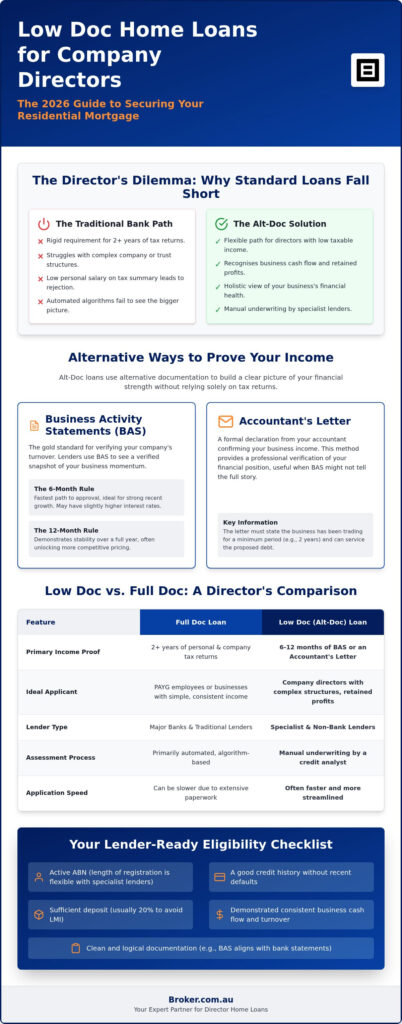
Business Activity Statements (BAS) are the gold standard for verifying turnover in the 2026 market. Lenders use these to see GST-registered income over a set period. Most low doc home loans for company directors require at least two recent BAS to establish a pattern of trade. This provides a verified snapshot of your business’s momentum.
- The 6-month rule: This is the fastest path to approval but often carries slightly higher rates due to the shorter data set.
- The 12-month rule: This demonstrates seasonal stability and often unlocks better pricing from specialist lenders.
- Notional income: Lenders don’t just look at gross revenue. They apply an expense ratio, often around 50% for service-based businesses, to estimate your net servicing capacity.
The Accountant’s Letter Method
Sometimes, a professional declaration is the most efficient path. A “best in class” accountant’s letter is more than just a signature on a page. It must confirm your business’s ability to service the specific loan amount without financial hardship. Lenders carefully check your accountant’s professional indemnity insurance. This ensures the declaration is backed by professional accountability and rigorous standards.
The specific wording can make or break your application. Phrases like “I am aware of the director’s financial position” are standard, but they must be supported by a clear statement that the loan is affordable. If you’re unsure which document best represents your true earning power, you can get started with a quick assessment to see which path fits your specific company structure.
Low Doc vs. Full Doc: Comparing the Director’s Options
Choosing between a standard full doc loan and a low doc alternative is a strategic business decision. While a full doc loan offers the lowest possible interest rates, it requires you to have two years of up-to-date, finalised tax returns. For many directors, waiting for these documents means missing out on a property opportunity. This is the “opportunity cost” that generic comparison sites often ignore. Paying a “Low Doc Premium” for a year or two is often a small price to pay compared to the potential capital growth of a well-timed property purchase.
The flexibility of low doc home loans for company directors allows you to act when the market is right. You aren’t beholden to your accountant’s filing schedule or the complexity of your latest corporate restructure. By using current cash flow data instead of historical tax returns, you can secure a mortgage that reflects your present-day success. This proactive approach ensures you’re building personal wealth at the same pace as your business.
Borrowing Power and LVR Limits
Most low doc home loans for company directors cap the Loan to Value Ratio (LVR) at 80%. This means you’ll generally need a 20% deposit plus costs. Data from early 2026 indicates that self-employed borrowers often bring larger deposits to the table, averaging over $489,000, which results in lower average LVRs compared to PAYG earners. Your personal credit score is a major factor here. A “clean” credit history allows you to access higher LVRs and better terms. If your credit is pristine, some specialist lenders may consider applications slightly above the standard 80% limit, provided your business cash flow is robust.
Interest Rate Structures and Costs
Lenders use risk-based pricing to determine your rate. This isn’t a one-size-fits-all approach. If your business has been established for several years and your BAS shows consistent growth, you’ll fall into the “clean” low doc category. Conversely, those with recent credit hiccups or shorter business histories might be categorised as “sub-prime,” which carries a higher cost. You should also be aware of “risk fees.” Unlike standard Lenders Mortgage Insurance (LMI) used by big banks, many non-bank lenders charge a one-off risk fee to protect against the lack of traditional documentation. These loans aren’t permanent; you can always refinance to a full doc loan once your financials are finalised and your tax returns reflect your true earning power.
Eligibility Checklist: Preparing for Your Application
Lenders in 2026 aren’t looking for perfection, but they do demand transparency. Before you apply for low doc home loans for company directors, you need to ensure your business affairs are tidy. This starts with the clear separation of your personal lifestyle costs from your business’s operational expenses. While it sounds basic, lenders scrutinise bank statements for “leakage” between personal and business accounts. A clean separation demonstrates that you’re a disciplined director who maintains a professional handle on your cash flow.
The timeline for a low doc approval has improved significantly thanks to modern digital verification tools. You can often expect a conditional approval within 48 to 72 hours, provided your alternative documentation is ready for review. Organising your affairs early ensures you can act quickly when the right property becomes available.
ABN and GST Requirements
Lenders generally require your ABN to be active for at least 12 months, though 24 months remains the industry benchmark for accessing the most competitive rates. If you’ve recently transitioned from a sole trader to a Pty Ltd company structure, it doesn’t necessarily reset your eligibility. Many specialist lenders will “bridge” the history of your previous ABN if you’re operating in the same industry with the same client base. You’ll also need to prove your GST registration status, as this allows lenders to verify the turnover figures reported in your Business Activity Statements.
Financial Health and Credit Integrity
Your personal credit score remains a cornerstone of your application. Under the Comprehensive Credit Reporting (CCR) system, lenders see a detailed history of your repayment habits. Ensure your credit card repayments and any existing vehicle finance instalments are paid on time for at least six months prior to your application. This builds a profile of reliability that offsets the lack of traditional tax returns.
- ATO Tax Debt: Having a debt with the ATO isn’t an automatic deal-breaker. If you have a formal payment plan in place and a history of meeting those instalments, specialist lenders are often willing to consider your application.
- Equity and Savings: Substantial equity in other property or a genuine savings history acts as a powerful “mitigant.” It proves you have a financial buffer, which reduces the lender’s perceived risk.
- Credit CCR Data: Regularly check your credit report to ensure there are no errors that could stall your approval process.
If you’re ready to see how your current business structure stacks up against 2026 lending standards, you can check your eligibility today and speak with one of our expert guides.
Why Broker.com.au is the Expert Partner for Directors
Securing a mortgage when you run a company shouldn’t feel like a second job. At Broker.com.au, we act as your high-level fixer, translating the complexities of your business success into a language that lenders understand. We specialise in “outside of the norm” situations where traditional banks often stumble. Whether you’re dealing with intricate trust distributions or tax-effective income structures, our award-winning team ensures you aren’t penalised for being a successful entrepreneur. Our goal is to move you from a state of uncertainty toward a feeling of streamlined confidence.
We leverage proprietary AI technology to scan our extensive panel of lenders, instantly matching your specific profile with the most competitive alt-doc rates available. This tech-driven approach removes the guesswork, ensuring you get inside access to the best rates without the typical back-and-forth. We handle the heavy lifting of the application process, allowing you to stay focused on running your company while we secure your personal wealth. Our “I’m interested” approach replaces high-pressure sales tactics with low-pressure, high-insight consultations that respect your time and your goals.
Access to Specialist Lender Panels
Many of the most flexible solutions for low doc home loans for company directors aren’t available on the high street. We provide inside access to specialist non-bank lenders that don’t deal with the general public. These lenders value the manual underwriting process, allowing us to customise your loan structure to account for retained earnings or complex dividend schedules. Our track record in delivering best-in-class finance solutions means we know exactly which lender will view your corporate structure as an asset rather than a liability.
Streamlined Process for Busy Professionals
Time is your most valuable resource. Our digital portal makes document submission seamless, allowing you to upload your BAS or Accountant’s Letter with ease. You won’t be dealing with a faceless call centre; you’ll have dedicated support from seasoned experts like Matt, Kylie, and Flavio. They understand the nuances of the Australian lending market and work proactively to ensure your application is lender-ready from day one. This human-led advisory approach transforms a traditionally stressful experience into a professional, efficient transaction. If you’re ready to explore your options without the usual bank hurdles, simply let us know I’m interested to start a conversation that prioritises your needs.
Secure Your Property Future Today
Your company structure should be a strategic gateway to property wealth, not a frustrating barrier. By leveraging modern alt-doc solutions, you can finally move past the rigid limitations of traditional bank assessments. We’ve explored how a simple Accountant’s Letter or recent BAS can unlock the borrowing power you need without waiting for years of finalised tax returns. Low doc home loans for company directors provide the flexibility to act when the market is right, ensuring your personal assets grow alongside your business success.
Broker.com.au is here to simplify this journey. As an award-winning Australian brokerage, we use proprietary AI technology to navigate complex trust and corporate profiles, ensuring you get inside access to the best rates available for business owners. We handle the heavy lifting and documentation hurdles so you can keep your focus on leading your company. Don’t let outdated bank algorithms stall your personal dreams or investment goals. If you’re ready to see what’s possible for your unique situation, simply let us know I’m interested in a low doc loan for my next property. You’re in good hands, and we’re ready to help you turn your hard-earned business success into a residential reality.
Frequently Asked Questions
Can I get a low doc loan if I have been a director for less than a year?
Most lenders require at least 12 months of ABN registration and director experience to consider an application. However, if you’ve recently transitioned from a sole trader to a company structure within the same industry, specialist lenders often recognise your total time in business. They’ll look at your combined history to ensure you have the stability needed to service the debt, even if your current Pty Ltd is relatively new.
Do I need to pay Lenders Mortgage Insurance (LMI) on a low doc home loan?
You generally don’t pay traditional LMI on these products; instead, lenders often apply a “Risk Fee” or “Lender Protection Fee.” This is because many non-bank lenders manage their own risk internally rather than using external insurers like Helia or QBE. This fee is typically capitalised into your total loan amount, so you don’t need to find the extra cash upfront at the time of settlement.
Is an Accountant’s Letter enough to prove my income for a mortgage?
An Accountant’s Letter is a vital document, but it’s rarely accepted as the sole piece of evidence in 2026. Lenders usually require it to be supported by at least six months of business bank statements or a recent Business Activity Statement (BAS). This multi-layered approach helps the lender verify that the income declared in the letter aligns with the actual cash flow passing through your company accounts.
Are interest rates significantly higher for low doc loans in 2026?
Interest rates for low doc home loans for company directors are typically higher than standard full-doc loans, but the gap is manageable. You can expect to pay a premium of roughly 0.5% to 1.5% above standard market rates. This reflects the lender’s increased risk in the absence of traditional tax returns. Many directors view this as a temporary cost, refinancing to a lower rate once their financials are finalised.
Can I use a low doc home loan to purchase an investment property?
Yes, these loans are frequently used by directors to expand their investment portfolios quickly. Lenders are often happy to support investment purchases provided the property is in a high-demand area. You’ll find that the assessment process includes a review of the projected rental income alongside your business cash flow, ensuring the investment is sustainable without relying solely on your company’s retained earnings for repayments.
What is the maximum LVR available for company directors on low doc terms?
The standard maximum Loan to Value Ratio (LVR) is 80%, meaning you’ll need a 20% deposit. While some niche lenders might consider an LVR of up to 85% for applicants with pristine credit, these cases are less common. Maintaining a lower LVR often helps you secure a more competitive interest rate, as it reduces the lender’s exposure and demonstrates that you have significant equity in the deal from day one.
Can I refinance from a low doc loan to a standard loan later?
Refinancing is a common exit strategy for many business owners. Once you have two years of finalised tax returns that show a strong taxable income, you can apply to switch to a full-doc product. This allows you to move to a lower interest rate and potentially access more features. It’s a great way to use a low doc loan as a stepping stone to long-term financial stability.
How does the ATO tax debt affect my low doc loan eligibility?
Having a tax debt isn’t an automatic rejection, provided you have a formal payment plan in place. Lenders will want to see that you’ve been meeting your ATO instalments on time for at least six months. If the debt is undisclosed or you don’t have a structured plan to clear it, most lenders will decline the application. Transparency is key to moving from uncertainty toward a successful loan approval.