
Private credit in Australia has surged by 160% since 2014, reaching over A$148 billion in 2026. Yet, even with this massive shift, many investors still find themselves stuck in a six-week queue at a major bank while prime opportunities slip away; deciding between private lenders vs big four banks for commercial property has never been more critical for your bottom line. It’s frustrating to have a rock-solid project stalled by rigid serviceability requirements or the 3.0% APRA buffer that doesn’t always reflect your business potential. You likely want the security of institutional capital, but you need the agility of a modern lender to stay competitive as asset values diverge.
This guide will help you master the strategic differences between these funding sources so you can secure the fast access to capital and flexible terms your project demands. We’ll break down the latest 2026 RBA trends, compare current variable rates across the market, and show you how to use a hybrid funding approach to lock in the best possible deal for your next acquisition. Whether you are looking for the lowest possible rate or the most flexible covenants, understanding these institutional shifts is the first step toward a stress-free settlement.
Key Takeaways
- Understand how the 4.35% RBA cash rate and current market sentiment dictate lender appetite for different commercial asset classes in 2026.
- Discover the strategic trade-offs between private lenders vs big four banks for commercial property, balancing institutional stability against the need for rapid execution.
- Learn how to bypass rigid bank serviceability requirements by leveraging asset-based lending for settlements that take days rather than months.
- Master the “Total Cost of Capital” calculation to accurately compare interest rates, setup fees, and exit costs across a national network of lenders.
- Explore how proprietary AI technology and expert guidance can identify the ideal policy fit to ensure your next property acquisition is seamless and stress-free.
Table of Contents
- The 2026 Australian Commercial Lending Landscape
- Major Banks: The Gold Standard for Cost of Capital
- Private Lenders: Speed, Flexibility, and Asset-Based Lending
- Choosing Your Lender: A Direct Comparison Framework
- The Broker.com.au Advantage: Inside Access to Best Rates
The 2026 Australian Commercial Lending Landscape
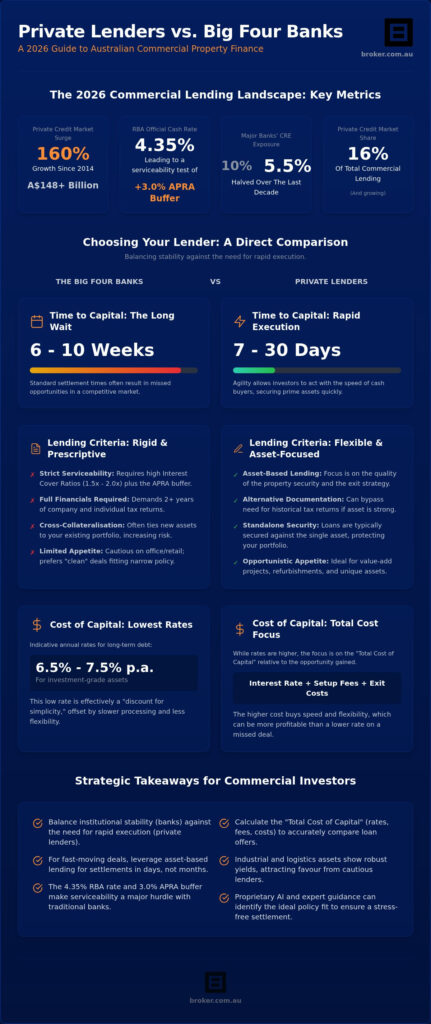
The Reserve Bank of Australia (RBA) has held the cash rate at 4.35% as of August 2026, creating a market sentiment best described as a “pause, not a turning point.” While rates have stabilised after the fluctuations earlier this year, the criteria for securing funding have shifted dramatically. Commercial property investors now face a stark choice when weighing up private lenders vs big four banks for commercial property. Institutional lenders have significantly reduced their appetite, halving their commercial real estate exposure from 10% to just 5.5% of total assets over the last decade. This retreat has opened the door for private credit to become a mainstream solution, now accounting for approximately 16% of the total commercial lending market in Australia.
For many developers and business owners, the most critical metric in 2026 isn’t just the interest rate; it’s the “time to capital.” In a market where prime assets are highly contested, waiting 6 to 10 weeks for a major bank to tick every box often means missing the deal entirely. Private lenders have filled this void by offering settlements in as little as 7 to 30 days. This agility allows investors to act with the same speed as cash buyers, providing a distinct advantage in a landscape where asset quality is diverging between prime industrial spaces and secondary retail assets.
The RBA Factor and Commercial Yields
Monetary policy continues to exert pressure on commercial valuations through the mandatory APRA serviceability buffer. Lenders are required to assess your ability to repay at 3.0% above the actual loan rate. When you combine a 4.35% cash rate with this buffer, many “gold-plated” borrowers are finding their serviceability restricted by institutional models. This has led to a noticeable shift toward industrial and specialised commercial assets, such as warehouses and logistics hubs, which offer the robust yields necessary to satisfy these strict assessments. Major banks are tightening their grip on traditional office and retail sectors, making it harder for even established investors to secure funding without significant capital reserves.
Institutional Caution vs. Private Opportunism
The Big Four are currently navigating the complexities of Basel III regulations, which has increased the cost of holding large commercial property portfolios. This institutional caution has created a “funding gap” for mid-market deals. Private syndicates and non-bank lenders are stepping into this space with a “can-do attitude,” focusing more on the quality of the security and the exit strategy rather than just historical tax returns. The sweet spot for acquisitions this year lies in properties where value can be added through refurbishment or repositioning, projects that often fall “outside of the norm” for traditional bank policy but are perfectly suited for flexible private funding.
Major Banks: The Gold Standard for Cost of Capital
For many established investors, the Big Four remain the primary target for long-term debt. The logic is simple; they offer the lowest cost of capital. Indicative pricing for investment-grade assets currently sits between 6.5% and 7.5% p.a., while strong owner-occupiers can sometimes secure rates starting from 6%. This pricing advantage, combined with the perceived stability of a major institution, makes them the gold standard for many. However, when evaluating private lenders vs big four banks for commercial property, it’s vital to recognise that these low rates are effectively a discount for simplicity. Banks want clean, easy deals that fit their narrow risk parameters; they charge a premium in the form of time and flexibility.
The Rigid Criteria for Major Bank Approval
Approval from a major bank requires clearing significant hurdles. The most prominent is the Interest Cover Ratio (ICR), which assesses if the property’s net income can comfortably cover interest payments, often with a 1.5x to 2.0x safety margin. Unlike more flexible non-bank options, major lenders are increasingly moving away from “Lease Doc” loans, where the lease alone supports the debt. They now demand full transparency, including two years of company tax returns and individual tax assessments. There is also the persistent issue of cross-collateralisation. Banks often seek to tie your new acquisition to your existing portfolio, which can limit your future borrowing capacity and increase your overall risk profile if one asset underperforms.
Covenants and Reporting Requirements
The relationship with a major bank doesn’t end at settlement. It’s a continuous cycle of reporting and reviews. You’ll likely face annual financial reporting obligations and strict covenants, such as maintaining a specific Loan-to-Value Ratio (LVR) throughout the term. If the bank decides to re-value your asset and the market has dipped, you might be required to pay down a portion of the loan immediately to restore the LVR. This level of oversight has significant implications for financial stability within your own portfolio. While Westpac offers various business options with rates starting from 7.91% p.a. for small business loans, the administrative burden remains high. If these institutional hurdles feel too restrictive for your current project, you might find it helpful to explore more flexible commercial property loans that align with your specific cash flow needs.
Private Lenders: Speed, Flexibility, and Asset-Based Lending
While the major banks are preoccupied with historical data, private lenders operate with an “Asset-First” philosophy. This means your commercial property’s value and your planned exit strategy carry more weight than two years of tax returns. When choosing between private lenders vs big four banks for commercial property, investors often find that private capital is a tactical tool for growth rather than a last resort. It allows for creative structures like capitalised interest, where monthly repayments are added to the loan balance to preserve cash flow during a project’s critical phases.
Approval speeds are the true differentiator. While a bank might take 10 weeks to process a complex file, a private lender can move from application to settlement in 7 to 30 days. This speed is supported by a Reserve Bank of Australia analysis on non-bank lending, which highlights how this sector provides essential liquidity when traditional institutions retreat. For 2026, indicative rates for a commercial first mortgage range from 9.50% to 13.0% p.a., a premium paid for certainty and pace.
Non-Bank vs. Pure Private Lending
Distinguishing between institutional non-banks and pure private family offices is vital for choosing the right partner. Institutional non-banks often offer “Low Doc” options that still require some financial evidence, whereas family offices provide the most flexible “No Doc” funding based solely on the property. These lenders often provide second mortgage funding, with rates between 1.45% and 1.95% per month, allowing you to unlock equity without refinancing your existing low-rate bank debt. This tiered approach ensures that even situations falling outside of the norm can find a tailored solution.
When Speed is More Valuable than the Interest Rate
Consider a scenario where a distressed industrial warehouse goes to auction. A major bank cannot meet the 28-day settlement period, but a private lender can secure the asset in 14 days. Even at a higher rate, the acquisition profit far outweighs the interest cost. Bridging the gap for development projects with “pre-sale” hurdles is another common use case, allowing construction to start while the final sales are finalised. In these high-stakes moments, the agility of the lender becomes your greatest competitive advantage.
Asset-based lending in 2026 is a streamlined finance model where loan approval is secured by the intrinsic value and future liquidity of the commercial property itself, rather than the borrower’s traditional income history.
Choosing Your Lender: A Direct Comparison Framework
Deciding between private lenders vs big four banks for commercial property requires looking beyond the headline interest rate. You need to calculate the “Total Cost of Capital.” This includes setup fees, which are often 1% to 2% for private debt, compared to lower bank establishment fees. However, you must also weigh the risk of rigid bank policy against the flexibility of private terms. In 2026, major banks might offer 65% to 70% LVR on prime industrial assets, while private lenders can often stretch to 75% or 80% for high-quality security. If your project relies on higher leverage to preserve cash, the private route may actually be the more cost-effective choice when opportunity costs are considered.
The 5-Point Commercial Lending Checklist
To find the path of least resistance for your deal, run your scenario through this essential checklist:
- Urgency of Settlement: If you need to settle in under 30 days to secure a discount or beat a competitor, private capital is your only realistic option.
- Strength of Financials: Banks require two years of clean tax returns. If your recent financials are complex or show a temporary dip, a “Low Doc” private loan provides a necessary workaround.
- Asset Quality: Standard warehouses are bankable. Specialised properties, like cold storage or medical suites, often face lower LVRs at major banks but are welcomed by private syndicates.
- Loan Duration: Are you looking for a 15-year term or a 12-month bridge? Private debt is designed for short-term tactical moves, not long-term holds.
- Exit Certainty: You must have a clear plan to either sell the asset or refinance. Private lenders will scrutinise your exit strategy more than your historical income.
Structuring the Exit Strategy
The most sophisticated investors use private debt as a “bridge” to reach a bankable position. This is particularly effective for assets with high vacancy rates or those requiring significant refurbishment. By using private funding to “stabilise” the property, you can secure tenants and improve the building’s valuation. Once the property generates a stable yield that meets the major banks’ Interest Cover Ratio (ICR) requirements, you can transition the debt to a Big Four lender at a much lower rate. This strategy allows you to build a track record that institutional lenders respect.
It’s vital to avoid the “trap” of expensive private rollovers. If your loan term is ending and you haven’t secured a refinance, you could be forced into high penalty rates. Our expert team can help you map out this transition from day one, ensuring your move from private to institutional debt is seamless. If you want to see how these options stack up for your specific deal, I’m interested in a tailored commercial comparison.
The Broker.com.au Advantage: Inside Access to Best Rates
The decision between private lenders vs big four banks for commercial property shouldn’t be a source of anxiety. Our role as your Expert Guide is to simplify this choice by providing inside access to a national network of over 100 lenders. We don’t just look at the Big Four; we look at the specific policy fit for your unique deal, whether it’s a commercial property loan for a new warehouse or complex development finance. Our award-winning team acts as your High-Level Fixer, ensuring that even situations falling outside of the norm are handled with professional authority and a can-do attitude. We believe that you should feel in good hands from the first consultation to the final settlement.
AI-Driven Accuracy in Commercial Applications
Traditional applications often fail because they’re sent to the wrong lender at the wrong time. We use proprietary AI technology to identify the path of least resistance for your loan, matching your financial profile to current lender appetite before the application is even submitted. This significantly reduces your rejection risk and streamlines the data collection process, allowing for faster credit decisions. By utilising proprietary AI to cross-reference real-time lender appetites with individual borrower profiles, we provide Aussie developers with an exclusive advantage in securing the most competitive terms available in 2026. This seamless approach ensures your application is efficient and tailored to the market’s current reality, moving you toward a feeling of streamlined confidence.
Start the Conversation: “I’m Interested”
We believe in a low-pressure advisory approach. You won’t find aggressive “Apply Now” buttons here. Instead, we use the “I’m interested” philosophy to start a conversation about your specific needs. When you speak with one of our commercial specialists, such as Matt, Kylie, or Flavio, you’re engaging with a human-led advisory that prioritises your specific goals over a mere process. This personification of our service transforms a generic digital portal into a partner who understands the Australian lending landscape intimately.
Your first discovery session is designed to be a stress-free exploration of your options. We provide the local insights you need to move from uncertainty to relief. If you’re ready to secure a better deal for your next acquisition, I’m interested in exploring my commercial property options. We’ll manage the complex financial modelling and the heavy lift of paperwork, so you can stay focused on managing your business and growing your portfolio.
Secure Your Competitive Edge in the 2026 Market
The 2026 commercial landscape rewards investors who can balance the institutional stability of the Big Four with the tactical agility of private credit. Whether you are navigating the 4.35% RBA environment or targeting industrial assets with higher yields, the choice between private lenders vs big four banks for commercial property is no longer a binary one. It’s about matching the right capital to the right stage of your project. By using private debt to bridge the gap and institutional funding to lock in long-term value, you can build a portfolio that is both resilient and responsive.
As an award-winning national brokerage, we provide the inside access you need to stay ahead. Our proprietary AI-matching technology removes the guesswork, while our senior commercial advisors act as your high-level fixers to ensure a seamless, stress-free settlement. You don’t have to navigate these complexities alone; you’re in good hands with a team that prioritises your specific goals. I’m interested in a tailored commercial finance solution. Let’s turn your next property acquisition into a streamlined success.
Frequently Asked Questions
Can I get a commercial property loan from a private lender if the bank said no?
Yes, you certainly can. Private lenders specialise in situations that fall outside the rigid box-ticking of major banks. While the Big Four focus heavily on historical tax returns and serviceability, a private lender looks primarily at the property’s value and your exit strategy. This makes them a perfect fit if your financials are complex or if you need to bypass the standard 3.0% APRA serviceability buffer to secure an asset.
What are the typical interest rates for private commercial lenders in Australia for 2026?
For 2026, indicative rates for a commercial first mortgage generally range between 9.50% and 13.0% p.a. If you require a second mortgage, you can expect rates between 1.45% and 1.95% per month. These rates represent the premium paid for the speed and flexibility that private capital provides. When comparing private lenders vs big four banks for commercial property, remember that private pricing is bespoke and depends heavily on the asset type and LVR.
How much deposit do I need for a commercial property loan with a Big Four bank?
Typically, you will need a deposit of 30% to 35% for a commercial investment property, as major banks usually cap LVRs at 65% to 70%. If you are a strong owner-occupier business, some Big Four lenders may offer up to 80% LVR, requiring only a 20% deposit. These requirements are much stricter than residential lending because banks view commercial assets as higher risk, especially in the current fluctuating interest rate environment.
What is an “exit strategy” in private lending and why is it crucial?
An exit strategy is your clearly defined plan to repay the loan at the end of its term. This usually involves selling the property or refinancing into long-term debt with a major bank. Because private funding is designed as a short-term tactical bridge, lenders prioritise the viability of your exit over your current income. Without a rock-solid exit plan, securing private capital is difficult, as it protects both your equity and the lender’s security.
Can I use my Self-Managed Super Fund (SMSF) with a private lender?
You can definitely use an SMSF with private and non-bank lenders. While many major banks have scaled back their SMSF commercial lending, the private sector has stepped in with tailored solutions. These loans are often used to purchase industrial warehouses or retail spaces directly through your super fund. Our team can help you navigate the specific compliance and liquidity requirements to ensure the process is seamless and meets all legal obligations.
How long does it take to settle a commercial property loan through Broker.com.au?
Settlement through Broker.com.au typically takes between 7 and 30 days for private funding. This is significantly faster than the 6 to 10 weeks often required by major banks. Our proprietary AI technology identifies the path of least resistance for your loan, allowing us to match your profile with the right lender appetite instantly. This streamlined approach ensures that you can act quickly on time-sensitive opportunities without the stress of institutional delays.
Are private lenders regulated the same way as the Big Four banks?
Private lenders are not regulated by the Australian Prudential Regulation Authority (APRA), which governs the Big Four. Instead, they operate under the Australian Securities and Investments Commission (ASIC) guidelines. This lack of APRA oversight is exactly what allows them to be more flexible with serviceability and LVRs. However, they must still act within the law and follow the terms of their loan contracts, providing a professional and secure alternative for commercial borrowers.
What happens if I cannot refinance out of a private loan at the end of the term?
If you cannot refinance, you may face expensive loan extensions or penalty interest rates. This high-stakes scenario underscores why having a High-Level Fixer is essential. When evaluating private lenders vs big four banks for commercial property, our advisors ensure your exit strategy is realistic from the start. We help you build a strong track record so you are in a bankable position well before your private loan term reaches its end.