
What if the biggest threat to your business purchase isn’t the interest rate, but how you’ve structured your debt for day two? With the RBA holding the cash rate at 4.35% as of August 2026, many Australian SMEs are finding that even a slight miscalculation in their funding model can turn a dream acquisition into a cash flow nightmare. It’s easy to feel overwhelmed by the common mistakes in business acquisition loans, especially when the fear of overpaying for goodwill or getting tangled in complex loan structures looms large.
We understand that securing the right capital is about more than just getting a “yes” from a lender. It’s about ensuring your new venture can comfortably service its debt while protecting your personal assets from unnecessary exposure. This guide provides a clear path to structuring finance for long-term success. You’ll learn how to navigate the 2026 lending landscape, leverage inside access to competitive rates, and organise your working capital to ensure the business thrives from the moment you take over.
Key Takeaways
- Understand how the 2026 RBA landscape influences lender appetite and why acquisition funding requires a bespoke structure compared to standard business loans.
- Discover why underestimating “Day One” working capital is a critical oversight and how to budget for a seamless ownership transition.
- Learn to identify common mistakes in business acquisition loans, specifically the risk of exposing personal assets by selecting the wrong security structure.
- Gain insights into the “Big Three” documents lenders scrutinise and how proper add-back analysis can validate the true value of business goodwill.
- See how leveraging “inside access” to over 40 lenders and AI-driven matching technology can help you secure competitive rates and flexible terms.
Table of Contents
- Navigating the Complexity of Business Acquisition Loans in 2026
- Underestimating Working Capital: The #1 Post-Acquisition Mistake
- Structural Flaws: Choosing the Wrong Loan Type for Your Industry
- The Documentation Trap: Why Your Application Might Be Rejected
- Partnering for Success: How an Expert Broker Streamlines Your Purchase
Navigating the Complexity of Business Acquisition Loans in 2026
Buying a business is one of the most significant financial moves you’ll ever make. Unlike a standard expansion loan, where you’re growing an entity you already control, acquisition funding requires the lender to back a total stranger to the business: you. One of the common mistakes in business acquisition loans is treating the application like a simple top-up of existing credit. It’s a completely different beast. The stakes are higher because you’re often borrowing against “goodwill,” the intangible value of the brand and customer base, which traditional banks often find difficult to quantify. If you get the structure wrong, you aren’t just risking the new business; you could be putting your own family home or personal assets on the line.
Acquisition vs. Expansion: Understanding the Risk Profile
Lenders view a change of ownership as a primary risk factor. When the person who built the business leaves, will the customers stay? This uncertainty is why buying a “going concern” is priced differently than buying physical assets like machinery. In an acquisition, your personal credit history and professional track record carry immense weight. Banks aren’t just looking at the business’s P&L; they’re looking at your ability to step in and lead. This is why many applications fail. The buyer hasn’t demonstrated they can manage the transition, leading to a “goodwill gap” that stalls the deal before it even starts.
The 2026 Australian Lending Environment
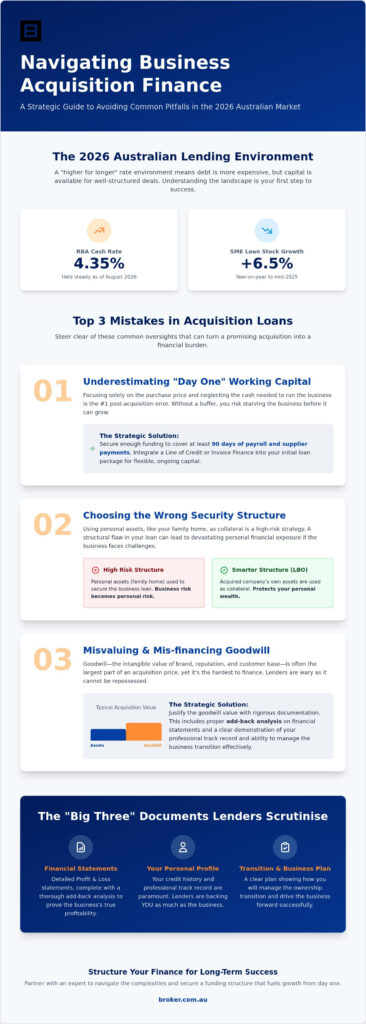
As of August 2026, the RBA has held the cash rate at 4.35%. This “higher for longer” environment has cooled valuation multiples, meaning you might get more business for your buck, but debt servicing is more expensive. While the “Big Four” remain cautious, digital lenders and private credit pools are stepping up to fund SME acquisitions. Total SME loan stock grew by 6.5% year-on-year to mid-2025, showing that capital is available if you know where to look. Having “inside access” to these non-bank lenders is crucial for specialised industries where traditional lending criteria don’t fit.
In many cases, sophisticated buyers use a Leveraged Buyout (LBO) approach. This involves using the acquired company’s assets as collateral to secure the debt. It’s a powerful tool, but it requires precise financial modelling to ensure you don’t overstretch your cash flow from day one. Partnering with a specialist who understands these nuances ensures you aren’t just getting a loan, but a structure that supports long-term growth.
Underestimating Working Capital: The #1 Post-Acquisition Mistake
Settlement day isn’t the finish line; it’s the starting gun. One of the most common mistakes in business acquisition loans is focusing solely on the purchase price while ignoring the liquidity needed to actually run the shop from day one. If you tip every cent of your savings into the deposit to lower your interest rate, you risk “starving the beast” before you’ve even changed the signage. You need a war chest, not just a keys-in-hand payment.
Transitioning a business involves significant hidden costs. You might face immediate stock replenishment needs, staff training expenses, or software licence renewals the previous owner neglected to mention. Without a tailored Business Acquisition Funding strategy that includes a pre-approved buffer, you could find yourself seeking emergency finance within weeks. This often leads to taking on expensive, short-term debt that eats into your profit margins before you’ve found your feet.
The Working Capital Gap in Australia
You should ideally secure enough funding to cover at least the first 90 days of payroll and supplier payments. In Australian industries like construction or retail, seasonal fluctuations can be brutal. A retailer taking over in February might face a post-Christmas slump, while a trade business might wait 60 days for a major invoice to be settled. Integrating a Line of Credit or Invoice Finance into your initial loan package ensures you have “always-on” capital to bridge these gaps. This proactive approach moves you from a state of uncertainty to streamlined confidence.
Financing Goodwill: The Intangible Asset Trap
Most Australian acquisitions involve a significant “goodwill” component, which is often the hardest part to finance. In 2026, goodwill is the premium paid over the fair market value of a business’s tangible assets, reflecting its brand reputation, established customer base, and projected earnings. Because banks can’t repossess a reputation, they are notoriously hesitant to lend against it, often requiring significant collateral to bridge the gap.
While traditional lenders might only fund a small portion of the goodwill value, specialist non-bank lenders can often push this higher by scrutinising the business’s cash flow consistency. Recent 2026 data shows that 28.4% of business loan applications are specifically for day-to-day capital, highlighting how vital it is to secure a structure that acknowledges the “blue sky” value of your purchase. By working with an expert, you can access tailored solutions that fund the full reality of the business, not just its physical equipment.
Structural Flaws: Choosing the Wrong Loan Type for Your Industry
Many buyers hunt for the lowest interest rate like it’s the only metric that matters. This is one of the most frequent common mistakes in business acquisition loans because a low rate often comes with rigid terms that can strangle a growing company. If your loan doesn’t allow for early repayments or requires you to pledge every asset you own, that small saving on interest becomes very expensive in the long run. You need a structure that breathes with your business, not one that suffocates it.
One strategy to bridge the gap between a bank’s valuation and the purchase price is vendor finance. This involves the seller leaving a portion of the sale price in the business as a loan to you, usually paid back over one to three years. It reduces your initial debt burden and ensures the seller remains invested in a smooth transition. Competitors often overlook this, but it’s a vital tool in the 2026 market where traditional valuations are more conservative.
Secured Business Loans: Leveraging Assets for Lower Rates
Secured funding typically offers the most competitive rates because the lender has a safety net. You might use commercial property or the business’s existing plant and equipment as collateral. However, you must be wary of cross-collateralisation. Many traditional banks will try to link your personal mortgage and your business loan together. This puts your family home at risk if the business hits a rough patch. Keeping these assets separate is vital for your financial security. You can also use tailored equipment finance to fund machinery or vehicles separately, which often carries lower rates than a general business loan.
The Rise of Unsecured Acquisition Funding
For service-based businesses like accounting firms or digital agencies, there aren’t many physical assets to secure a loan against. This is where unsecured options shine. While the interest rates are naturally higher, the speed of execution is unmatched. In a competitive 2026 market, being able to move quickly on a deal can be the difference between winning the acquisition and losing it to a rival. Our proprietary AI technology identifies the best unsecured options by matching your specific industry risk profile with lenders who have a genuine appetite for your sector.
Finally, you must consider the impact of balloon payments on your five-year exit strategy. A large lump sum due at the end of your term can ruin your plans if you haven’t organised a refinance or a sale well in advance. Structuring your debt to match your long-term goals ensures you aren’t forced into a fire sale just because a loan term expired. By getting the structure right from day one, you move from a state of uncertainty toward streamlined confidence in your new venture.
The Documentation Trap: Why Your Application Might Be Rejected
Lenders in 2026 have sharpened their focus on credit quality. They’re no longer satisfied with a cursory glance at a Balance Sheet. A frequent entry in the list of common mistakes in business acquisition loans is presenting “raw” vendor data without context. If your application lacks a narrative that explains the numbers, you’re likely to face a swift rejection. Lenders need to see the “Big Three”: three years of certified tax returns, current interim financials no more than 45 days old, and a robust 12-month cash flow forecast.
You must also watch for the ATO red flag. In the current 2026 enforcement environment, ASIC and the ATO are cracking down on hidden tax debts and unpaid superannuation. If the target business has an outstanding Integrated Client Account debt, it can derail your funding immediately. Always insist on an up-to-date ATO portal printout as part of your due diligence to ensure you aren’t inheriting a tax nightmare.
Preparing a Lender-Ready Business Plan
A generic business plan won’t cut it. Your plan must include a detailed Transition Plan that specifies how you’ll retain key staff and clients after the vendor departs. Follow this with a SWOT analysis tailored to your industry’s 2026 challenges, such as digital disruption or rising labour costs. Finally, provide a clear Sources and Uses of Funds statement. This shows exactly where every dollar of the loan is going, from the purchase price to the working capital buffer required for a seamless takeover.
The Importance of Accurate Financial Modelling
Lenders want to see the “normalised” profit of the business. This involves identifying “Add-backs,” which are expenses the current owner runs through the business that you won’t necessarily have. These might include a personal vehicle, one-off legal fees for the sale, or discretionary travel. By adding these back, you show the true debt-servicing capacity of the entity. Our proprietary AI technology streamlines the verification process by automatically categorising financial data to meet strict lender criteria.
If you’re ready to present a professional, lender-ready application, get started with our expert team for a tailored assessment of your acquisition goals.
Partnering for Success: How an Expert Broker Streamlines Your Purchase
Walking into your local bank branch is a common starting point, but it’s often where the journey ends for complex purchases. A local manager is limited to a single set of products and rigid lending criteria that might not suit a “going concern” purchase. By contrast, a specialist broker provides “inside access” to over 40 lenders, including non-bank institutions that have a specific appetite for SME acquisitions. Navigating the lending landscape alone is one of the common mistakes in business acquisition loans that can lead to missed opportunities or unfavourable terms. We ensure you’re in good hands from the first enquiry.
We use proprietary AI technology to scan the market and match your specific profile with the most competitive rates in Australia. This isn’t just about finding the lowest number. It’s about identifying the lenders who understand your industry and offer the most flexible terms for goodwill and working capital. Our role as a “High-Level Fixer” means we handle the tedious back-and-forth with credit departments. This allows you to focus on the operational handover while we ensure the finance is seamless and professional.
Tailored Solutions for Complex Deals
Consider a situation where a client sought to buy a highly profitable digital agency. The business had significant goodwill but almost zero physical assets, making traditional banks recoil. We structured a solution using a mix of unsecured funding and a tailored line of credit, ensuring the buyer could meet the purchase price without pledging their family home. Our “I’m interested” approach starts a low-pressure conversation about your specific goals. We manage the entire process, moving you from a state of uncertainty to streamlined confidence.
Your Next Steps to Acquisition
Before you sign a Heads of Agreement, it’s vital to get a pre-assessment. This gives you the confidence to negotiate from a position of strength, knowing exactly what your borrowing capacity looks like in the current 2026 landscape. You can use our repayment calculators to stress-test your serviceability against various interest rate scenarios. Taking this proactive step ensures you don’t fall into the trap of over-committing to a deal you can’t fund. It’s the most effective way to avoid the common mistakes in business acquisition loans that derail so many promising deals.
Ready to turn your acquisition dream into a reality? Start your stress-free acquisition journey with Broker.com.au today and see how our award-winning team can secure the future of your business.
Securing Your Future with Strategic Acquisition Funding
Acquiring a business is a high-stakes move that requires precision, foresight, and the right financial architecture. By prioritising “Day One” working capital and ensuring your loan structure doesn’t unnecessarily risk your personal assets, you set the foundation for a seamless transition. Avoiding the common mistakes in business acquisition loans isn’t just about saving on interest; it’s about protecting the long-term health of your investment and ensuring you can service your debt from the moment you take the keys.
As an award-winning Australian brokerage, we provide the “inside access” you need to navigate this journey with confidence. Our proprietary AI matching technology connects you with over 40 bank and non-bank lenders, ensuring you get a tailored solution that fits your specific industry needs. Whether you’re navigating complex goodwill valuations or organising a line of credit for operational stability, our team is here to handle the heavy lifting and the back-and-forth with lenders.
Your dream of business ownership is within reach, and with the right partner, the process can be entirely stress-free. I’m interested in exploring acquisition funding options to help you take the next step. Let’s work together to turn your vision into a successful, streamlined reality.
Frequently Asked Questions
Can I get a business acquisition loan without using my home as security?
Yes, you can secure funding without pledging your family home by opting for an Unsecured Business Loan or leveraging the target business’s own assets. While traditional banks often prefer property as collateral, many non-bank lenders in our network focus on the business’s cash flow and “going concern” value. This helps you avoid one of the most stressful common mistakes in business acquisition loans: cross-collateralising your personal residence with your new commercial venture.
How much deposit do I typically need for a business purchase in Australia?
Most Australian lenders require a deposit between 20% and 50% of the total purchase price, depending on the industry and the strength of the business’s financials. If the purchase is heavily weighted toward goodwill rather than tangible assets, the deposit requirement is typically higher. However, having a strong professional track record or using a portion of equity from an existing business can sometimes reduce the cash contribution needed at settlement.
What is the difference between goodwill and asset-based lending?
Asset-based lending uses physical items like machinery or vehicles as security, whereas goodwill lending focuses on the intangible value of a company’s brand and future earnings. Because you can’t repossess a reputation, lenders view goodwill as higher risk. In the 2026 lending environment, we often use a mix of both to ensure you get the most competitive rates while still covering the full “blue sky” value of the acquisition.
How long does the business loan application process usually take?
The timeframe for approval usually ranges from two to six weeks, though digital lenders can often provide a “yes” much faster. The speed of the process depends heavily on the quality of your documentation and the complexity of the deal structure. Having your “Big Three” financial documents organised and ready for our AI matching technology is the best way to ensure a seamless and efficient path to settlement.
Can I include working capital in my acquisition loan?
Yes, and we strongly recommend including a working capital buffer to cover your first 90 days of operations. Many new owners focus only on the purchase price, which is a significant oversight. By integrating a Line of Credit or Working Capital Finance into your initial funding package, you ensure the business has the liquidity to handle payroll and supplier payments without stress from day one.
What happens if the business I buy has existing ATO debt?
Existing ATO debt is a major red flag that must be addressed during the due diligence phase and cleared at the point of settlement. In 2026, ASIC and the ATO are prioritising the collection of unpaid taxes and superannuation from small businesses. We work with you to ensure the vendor’s tax obligations are fully disclosed and settled so you don’t inherit a liability that jeopardises your loan serviceability.
Is it possible to get a loan for a franchise acquisition?
Yes, franchise acquisitions are often viewed favourably by lenders because they come with a proven business model and established systems. Some banks have “pre-approved” lists for major Australian franchise groups, which can lead to more competitive rates and streamlined approvals. Whether you are buying an existing franchise or a new territory, we can match you with lenders who specialise in the franchise sector.
Why should I use a broker instead of going directly to my bank?
Using a broker gives you inside access to over 40 bank and non-bank lenders, rather than being restricted to a single bank’s narrow criteria. We use proprietary AI technology to find the best fit for your specific industry and financial goals. Beyond just finding a loan, we act as a “High-Level Fixer,” managing the complex back-and-forth with credit departments to ensure your acquisition journey is professional and stress-free.