
The era of the ‘Big Four or nothing’ approach to Australian business acquisitions is officially over. With M&A activity involving Australian companies surging to US$58.4 billion in the first half of 2026, securing leveraged buyout financing australia has become a game of sophisticated strategy rather than just bank loyalty. You’ve likely felt the pressure of managing complex debt layers or feared that over-leveraging a target company could jeopardise its future. It’s a common concern, especially with the ACCC’s new mandatory merger control regime now in full swing, adding significant regulatory hurdles to your acquisition timeline.
We understand that finding the right capital is often the most stressful part of a deal. This guide will help you master the intricacies of M&A debt, moving you from a state of uncertainty to streamlined confidence. You’ll gain a clear roadmap to funding that balances senior and mezzanine debt while unlocking competitive rates from private credit providers that traditional banks often miss. We’re going to break down the shift toward unitranche facilities and show you how to structure a deal that’s both aggressive and sustainable for the long term.
Key Takeaways
- Identify the core differences between LBO and MBO structures to choose the right path for your specific leadership or acquisition goals.
- Master the Australian debt stack by learning how to balance senior debt and mezzanine finance to secure competitive leveraged buyout financing australia.
- Understand why lenders prioritise the Debt Service Coverage Ratio (DSCR) and how to prepare your financial modelling to meet strict 2026 eligibility criteria.
- Explore the rise of unitranche loans as a streamlined alternative for combining multiple debt layers into a single, efficient facility.
- Gain inside access to private credit and institutional lenders through AI-driven matching to avoid the pitfalls of shopping your deal directly to major banks.
Table of Contents
- Understanding Leveraged Buyout (LBO) and Management Buyout (MBO) Financing
- Core Financing Structures for Australian Acquisitions
- Assessing Eligibility: Is the Acquisition Financeable?
- The Roadmap to Securing LBO Financing in 2026
- Why Expert Brokerage is Essential for Complex Acquisitions
Understanding Leveraged Buyout (LBO) and Management Buyout (MBO) Financing
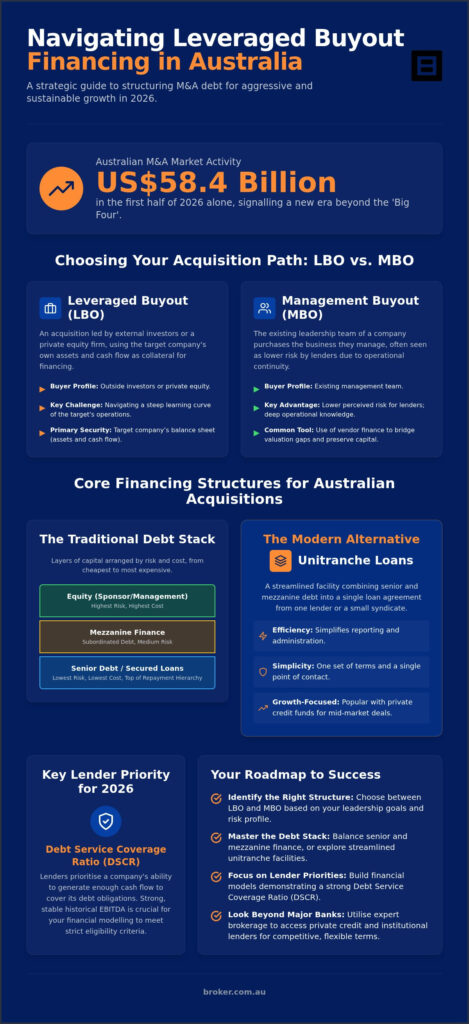
2026 has arrived as a watershed moment for Australian business owners looking to exit and ambitious teams ready to step up. With M&A activity involving Australian companies hitting US$58.4 billion in the first half of the year, the demand for structured leveraged buyout financing australia is at an all-time high. Understanding Leveraged Buyouts (LBO) is the first step toward realising these transitions. At its core, an LBO involves using the target company’s own balance sheet, specifically its assets and cash flow, as the primary collateral to secure the acquisition loan.
A Management Buyout (MBO) occurs when the existing leadership team decides to purchase the business they already run. Lenders often view these deals favourably because the risk of the unknown is significantly lower when the people at the helm stay in place. However, a major hurdle in the Australian market is “Goodwill”. While traditional lenders might shy away from high levels of intangible assets, modern private credit providers take a more holistic view of historical EBITDA stability to fund the gap.
LBO vs MBO: Key Differences for Australian Buyers
The primary distinction for Australian buyers lies in the risk profile and familiarity. Outside investors in an LBO face a steep learning curve, whereas management teams in an MBO already understand the operational skeletons in the closet. To bridge the valuation gap, many Australian MBOs utilise vendor finance, where the seller agrees to receive a portion of the sale price over time from future earnings. This preserves your personal capital, allowing you to reinvest in post-acquisition growth rather than tipping every cent into the purchase price.
The Evolving Australian Debt Landscape
The days of the Big Four banks holding a monopoly on acquisition funding are gone. While APRA and ASIC regulations have tightened the screws on traditional bank lending, the private credit market has stepped in to offer the flexibility that modern M&A requires. LBO financing is a strategic tool for scaling without equity dilution. Today, having inside access to non-bank lenders is what separates a successful deal from a rejected application. This shift has decentralised the market, making leveraged buyout financing australia accessible to mid-market firms that were previously ignored by institutional debt providers.
Core Financing Structures for Australian Acquisitions
Structuring leveraged buyout financing australia effectively requires a sophisticated understanding of the “debt stack”. This stack represents different layers of capital, each with its own risk profile and cost. By layering these components, you can minimise the amount of personal equity required while ensuring the business has enough breathing room to meet its repayment obligations. In the 2026 market, we’ve seen a significant shift toward unitranche loans. These facilities are incredibly efficient because they combine senior and subordinated debt into a single package, simplifying the reporting process for the borrower.
The choice between asset-based and cash-flow lending depends entirely on the target business. If you’re acquiring a manufacturing firm with heavy machinery, asset-based lending uses those tangible items as security. Conversely, for service-based or tech companies, cash-flow lending is the standard, where the loan is sized against historical EBITDA. For larger deals, “Term Loan B” (TLB) structures have become a staple. These offer a “bullet” repayment at the end of the term, which frees up cash flow in the early years to fund growth or integration costs. When designing these structures, it’s vital to consider the ATO’s view on LBO tax source to ensure your interest deductions and legal framework remain compliant with current Australian standards.
Senior Debt and Secured Business Loans
Senior debt is the foundation of most acquisitions. It’s generally the cheapest capital available because it sits at the top of the repayment hierarchy. However, it’s also the most restrictive. Australian lenders in 2026 typically look for conservative Loan-to-Value Ratios (LVR) on commercial assets, often requiring substantial security. To maintain operational freedom, many buyers now push for “Covenant Lite” terms. These agreements have fewer financial hurdles, allowing management to run the business without constant fear of a technical default. If you’re looking for a stress-free way to navigate these options, exploring Business Acquisition Funding tailored to your industry is a smart first step.
Mezzanine and Subordinated Debt
Mezzanine finance acts as the bridge between your senior debt and your own equity. It’s a powerful tool for buyers who want to preserve their cash reserves for post-acquisition projects. Because mezzanine lenders have a lower priority claim on assets, they charge higher interest rates to compensate for the increased risk. A critical part of this arrangement is the inter-creditor agreement. This legal document manages the relationship between the senior and mezzanine lenders, clearly defining who gets paid first if the business faces financial distress. This structure is essential for high-leverage deals where traditional bank limits aren’t enough to cross the finish line.
Assessing Eligibility: Is the Acquisition Financeable?
Determining if a deal is financeable requires looking beyond the purchase price to the target company’s ability to live with its new debt. The primary metric lenders scrutinise is the Debt Service Coverage Ratio (DSCR). This figure measures the business’s operating cash flow against its total debt obligations. In the current 2026 lending climate, a strong DSCR provides the reassurance that the company can comfortably meet interest and principal repayments without choking its day-to-day operations. If the ratio is too tight, the deal is likely to be rejected or require a significant equity injection to lower the leverage.
Historical EBITDA stability is another non-negotiable factor. Lenders look for consistent, predictable earnings over a three to five-year period. “Lumpy” cash flow, characterised by wild swings or one-off windfall profits, is a major red flag for those providing leveraged buyout financing australia. Debt requires regular, rhythmic servicing, and volatile earnings make that impossible to guarantee. Additionally, the quality of tangible assets like plant, equipment, and real estate remains vital. These assets act as a safety net, allowing lenders to collateralise the loan and potentially offer more favourable terms than a pure cash-flow based facility.
Financial Modelling and Due Diligence
Your financial model is more than just a spreadsheet; it’s a survival plan. To secure high-leverage debt, your model must survive a rigorous stress test involving fluctuating interest rates and potential market downturns. Professional lenders now expect a Quality of Earnings (QofE) report to validate that the reported profits are sustainable and not inflated by accounting tricks. This due diligence process also uncovers “hidden” liabilities that could sink a deal post-completion. These often include underfunded employee entitlements, looming lease renewals, or deferred maintenance on critical equipment that will require immediate capital expenditure.
Management Experience and Track Record
Lenders don’t just fund spreadsheets; they fund people. “Management Alpha” is the tangible value that a skilled leadership team brings to a business, and it’s a core component of the credit assessment. You need to prove that the new leadership can maintain or, ideally, improve existing margins. A clear, actionable “100-Day Plan” is essential for showing how you’ll manage the transition and hit growth targets immediately after the keys change hands. Our corporate advisory team at Broker.com.au specialises in polishing these management presentations, ensuring your track record and strategic vision are presented with the professional authority that institutional lenders demand.
The Roadmap to Securing LBO Financing in 2026
Securing leveraged buyout financing australia requires a disciplined, multi-stage approach to ensure the deal remains viable from the first handshake to the final settlement. The process begins with a preliminary assessment where we use proprietary AI technology to match your deal with the most compatible lenders. This proactive step avoids the common mistake of “shopping the deal” and damaging your credit profile before you’ve even started. Once a match is identified, the focus shifts to preparing a robust Information Memorandum (IM) and detailed financial projections. These documents must clearly articulate the “Management Alpha” and the target’s cash-flow resilience to stand up to intense institutional scrutiny.
Comparing competing offers is the next critical milestone in your journey. We issue term sheets from multiple lenders, allowing you to weigh up interest rates, repayment structures, and overall flexibility. The formal due diligence phase in 2026 now demands extra attention to the ACCC’s mandatory merger control regime, which became effective on 1 January 2026. This regulatory shift means transactions meeting specific revenue thresholds must receive approval before completion, making it vital to factor these notification periods into your settlement date. Finally, once credit approval is secured, we manage the transition and settlement to ensure a seamless handover of the business operations.
Navigating Term Sheets and Covenants
Understanding the fine print in Australian loan contracts is what protects your operational freedom post-acquisition. Negative pledges and financial covenants are standard, but the real skill lies in negotiating for “headroom”. This buffer ensures you don’t breach terms during a quiet quarter or a seasonal dip in revenue. We focus on securing covenants that are realistic and tailored to your specific industry cycles. We also distinguish between committed funding lines, which the lender is legally bound to provide, and uncommitted lines that offer less certainty. If you’re ready to start this process with an expert guide, I’m interested in Business Acquisition Funding to see how we can streamline your application.
The Role of Private Credit and Non-Bank Lenders
Non-bank lenders have become the preferred choice for many Australian mid-market acquisitions because of their flexibility with “goodwill” and intangible assets. Unlike the Big Four banks, these institutional lenders are often more concerned with future cash flow than historical real estate security. By leveraging our institutional relationships, you can gain inside access to rates and structures that aren’t available to the general public. Private credit often provides higher leverage for a slightly higher price. This trade-off is frequently worth it for buyers who want to maximise their growth potential without diluting their equity stake through expensive capital raises.
Why Expert Brokerage is Essential for Complex Acquisitions
Approaching multiple banks directly to secure leveraged buyout financing australia often backfires. Each formal enquiry or rejection leaves a mark on your corporate credit profile, potentially signaling desperation to the very lenders you need to impress. Our award-winning team acts as a strategic buffer. We use proprietary AI technology to identify niche lenders perfectly suited to specific Australian industries, ensuring your application lands on the desk of a credit officer who already understands your sector’s nuances. This precision protects your reputation and significantly increases the likelihood of a seamless, professional approval process.
Protecting your personal assets is another critical layer of our service. We specialise in structuring debt so that your family home and personal wealth remain insulated from the business’s liabilities. By focusing on the target company’s cash flow and assets as the primary security for leveraged buyout financing australia, we help you achieve your acquisition goals without exposing your private life to unnecessary risk. Our signature ‘I’m interested’ approach allows you to start this high-stakes conversation in a low-pressure environment, far removed from the cold, impersonal feel of a traditional bank branch.
Beyond Traditional Broking: Corporate Advisory
Our role extends deep into corporate advisory, where we help you translate complex ‘M&A speak’ into actionable financial strategies. We assist with debt restructuring to optimise your balance sheet, ensuring the cost of capital remains as low as possible. Whether we are facilitating a multi-million dollar transition for a professional services firm or a large-scale manufacturing plant, having an advocate who understands the intricacies of financial modelling is invaluable. We’ve seen firsthand how a well-structured deal, supported by local insights, can turn a challenging acquisition into a stress-free success story.
Securing Your Future Growth
An acquisition is just the beginning of your journey. It’s vital that your debt structure doesn’t stifle your future working capital needs or limit your operational agility. We look ahead to ensure you have enough liquidity to fund day-to-day operations and upcoming growth projects. This often involves integrating asset finance or invoice finance into your post-acquisition structure to maintain a healthy, fluid cash flow. By planning for these requirements upfront, you ensure the business remains resilient in any economic climate. If you’re ready to explore these tailored options with a partner who prioritises your specific dreams, I’m interested in acquisition funding and ready to help you take the next step.
Take the Next Step Toward Your Acquisition Goals
The Australian M&A landscape in 2026 demands more than just a standard loan application. Success now hinges on your ability to navigate complex debt stacks and the ACCC’s mandatory merger regime with precision. By mastering the balance between senior debt and mezzanine layers, you can secure leveraged buyout financing australia that empowers growth rather than stifling it. You’ve worked hard to identify the right target; now it’s time to ensure the funding matches your ambition.
Partnering with an award-winning brokerage provides you with inside access to over 80 institutional and private lenders, ensuring you aren’t limited by the Big Four’s rigid criteria. Our proprietary AI matching technology streamlines the process, generating rapid term sheets that align with your specific industry needs. This expert guidance transforms a high-stakes financial hurdle into a stress-free transition, keeping your personal assets protected while you focus on your post-acquisition strategy. We’re ready to help you navigate the complexities and secure the best possible rates for your deal.
I’m interested in exploring acquisition finance options
Your next major business milestone is within reach, and with the right debt structure in place, you can lead your new venture with absolute confidence.
Frequently Asked Questions
What is the typical interest rate for LBO financing in Australia?
Typical interest rates for leveraged buyout financing australia are tiered based on the deal’s risk profile and the specific lender involved. For high-quality credits using Term Loan B structures, margins in 2026 usually sit in the 3% to 4% range above the benchmark rate. Private credit and mezzanine options often carry higher rates to compensate for their subordinated position in the debt stack. We use AI matching to find the most competitive market rates for your specific industry.
Can I use my family home as collateral for a management buyout?
You can use residential equity to support a management buyout, but it is rarely the most efficient strategy for high-level acquisitions. Most sophisticated M&A debt structures prioritise the target company’s assets and cash flow as security instead. Using your family home can provide a lower interest rate; however, it exposes your personal life to business risks. We focus on asset-based and cash-flow lending to insulate your personal wealth while still securing the necessary capital.
What is the maximum leverage (LVR) available for business acquisitions?
Maximum leverage for Australian business acquisitions typically ranges between 60% and 80% for senior debt, depending on the asset quality and EBITDA stability. When mezzanine finance or unitranche facilities are integrated, total leverage can occasionally reach higher levels. Lenders scrutinise the Debt Service Coverage Ratio (DSCR) to ensure the business can comfortably service the debt. Our role is to help you structure these layers to maximise your acquisition power without over-leveraging the company.
How long does it take to secure leveraged buyout financing?
Securing leveraged buyout financing in Australia generally takes between four and twelve weeks from the initial assessment to settlement. This timeline depends heavily on the complexity of the due diligence process and the speed of financial modelling. AI-driven lender matching can accelerate the early stages by identifying the right partners quickly. You should also account for the ACCC’s mandatory merger control regime notification periods if your transaction meets the specific revenue thresholds for 2026.
Do Australian banks fund management buyouts for small businesses?
Australian banks do fund management buyouts for small businesses, though they often apply conservative lending criteria and require substantial security. Traditional banks typically prefer businesses with long histories of stable cash flow and tangible assets. If a small business lacks significant collateral, non-bank lenders and private credit funds are often more flexible. These alternative providers specialise in “Goodwill” lending, making them a viable option for leadership teams ready to purchase a service-based or tech-focused business.
What is the difference between senior debt and unitranche debt?
Senior debt sits at the top of the repayment hierarchy and offers the lowest interest rates because it is the most secure layer. Unitranche debt is a hybrid product that combines senior and subordinated debt into a single loan facility with one blended interest rate. Unitranche loans have become popular in Australia because they simplify the debt stack and reduce the need for complex inter-creditor agreements. This structure provides a streamlined path for buyers who need speed and operational flexibility.
Will I need to provide a personal guarantee for an LBO loan?
Personal guarantees are commonly requested by Australian lenders for mid-market LBO loans, though they are often negotiable depending on the strength of the deal. In larger institutional transactions, lenders may rely solely on the company’s assets and a “negative pledge” rather than personal recourse. Providing a guarantee can sometimes unlock better rates or higher leverage. We work to structure your debt in a way that minimises personal exposure while still satisfying the lender’s security requirements.
How does thin capitalisation affect LBO structures in Australia?
Thin capitalisation rules limit the amount of interest that Australian companies can deduct for tax purposes if their debt-to-equity ratio exceeds certain thresholds. For 2026, these regulations are a critical consideration when structuring leveraged buyout financing australia to ensure tax efficiency. If your debt levels are too high relative to the company’s assets, you might lose valuable tax deductions. It’s essential to consult with corporate advisory experts to balance high leverage with compliance to these complex ATO regulations.