
Your complex business structure is a testament to your success, not a reason for a mortgage rejection. Yet, many entrepreneurs find themselves stuck in a cycle of frustration when junior bank staff fail to grasp the nuances of a balance sheet or unnecessarily discount income by 20%. If you have been searching for home loans for business owners with complex structures, you likely know that the standard retail banking model simply isn’t built for your needs. It’s exhausting to have your tax-effective distributions ignored or your borrowing capacity stifled because a lender can’t see the true strength of your entire business group.
We understand that your financial world involves far more than a simple payslip. This 2026 guide will show you how to bypass typical bank hurdles by partnering with lenders who actually understand “add-backs” and sophisticated tax setups. You’ll learn how to maximise your borrowing capacity using the full power of your companies and trusts, ensuring a streamlined application process that respects your professional time. We are diving into the latest APRA debt-to-income regulations and specific lender policies to help you move from uncertainty to total confidence in your next property purchase.
Key Takeaways
- Understand why Australian lenders categorise discretionary trusts and Pty Ltd entities as complex and how to position your structure as a financial strength.
- Discover how to navigate home loans for business owners with complex structures by shifting the credit focus from taxable net profit to serviceable cash flow.
- Learn to maximise your borrowing capacity through a strategic “add-back” analysis that converts non-cash expenses like depreciation into usable income.
- Prepare for a seamless application with a tailored checklist of consolidated group financials and essential trust deed documentation.
- Find out why a commercial-minded broker using proprietary AI technology can access sophisticated lending solutions that standard retail bank managers often overlook.
Table of Contents
- What Defines a Complex Business Structure for Home Loans?
- How Lenders Assess Sophisticated Income Streams in 2026
- The Add-Back Strategy: Maximising Your Borrowing Capacity
- Checklist: Preparing for a Complex Structure Home Loan
- Why a Specialist Broker is Vital for Sophisticated Owners
What Defines a Complex Business Structure for Home Loans?
Banks love simplicity. A PAYG employee with a single payslip is their ideal borrower because the risk is easy to quantify. When you move beyond common business structures like sole proprietorships into the world of multi-layered entities, traditional retail banking systems often trigger a red flag. Lenders categorise setups as “complex” when income is diverted through trusts, shared across multiple Pty Ltd companies, or involves intricate inter-company loans. While these arrangements are excellent for tax efficiency and asset protection, they look like a maze of risk to a junior bank officer. Securing home loans for business owners with complex structures requires a lender that can read a full group tax return rather than just a personal notice of assessment.
The Trust Factor: Discretionary vs. Unit Trusts
Trusts are a cornerstone of Australian wealth management, but they often complicate serviceability in the eyes of a standard lender. Banks distinguish between discretionary trusts, where distributions can fluctuate at the trustee’s whim, and unit trusts, which have fixed entitlements. A common hurdle is how the bank views the borrower. Are you applying as an individual, or is a corporate trustee the applicant? The Trust Deed is the most vital document here. Lenders will scrutinise it to ensure the trust has the power to borrow and to identify the actual beneficiaries. If your distributions vary significantly year to year, a standard bank might “shade” or ignore that income entirely. We look for lenders who see the historical consistency of those distributions to give you the credit you deserve.
Multiple Entity Groups and Inter-company Lending
If you operate several Pty Ltd entities, a lender won’t just look at the company paying your salary. They’ll demand consolidated group financials to ensure one profitable arm isn’t propping up a failing one. Inter-company loans and director’s loans also come under the microscope. If you’ve taken a loan from your company, often referred to as a Division 7A loan, it can drastically reduce your personal borrowing power. Banks may treat the repayment as a personal debt, even if it’s a tax-effective internal transfer. Managing loss-making entities within a larger, profitable group is another challenge. A retail banker might see a single loss and decline the whole file. An expert broker identifies if that loss was a one-off capital expense, ensuring your true group strength is recognised. This is where our proprietary AI technology provides an edge, mapping your specific entity web against the precise appetite of Australian lenders who specialise in sophisticated setups.
How Lenders Assess Sophisticated Income Streams in 2026
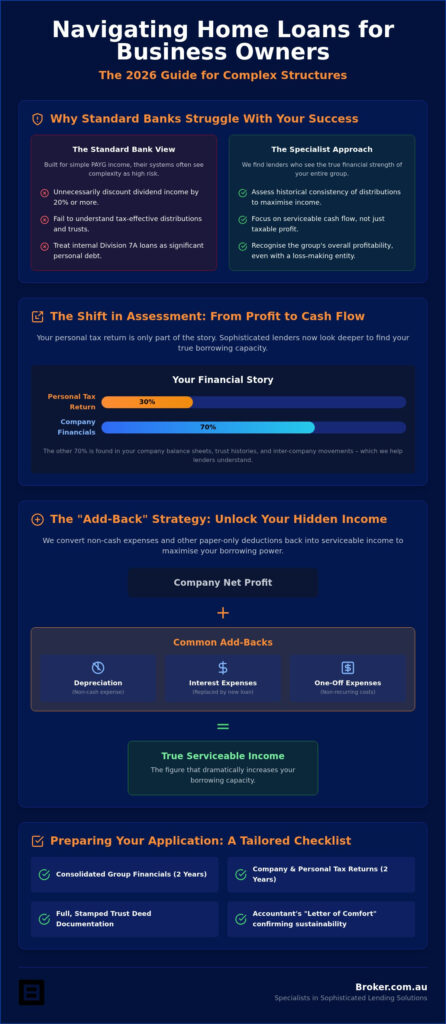
Credit models have evolved significantly over the last few years. In the past, a bank might look at the bottom line of your personal tax return and make a snap decision. In 2026, sophisticated lenders have shifted toward a “Serviceable Cash Flow” model. This approach looks past the accounting profit to identify the actual liquidity available to service a debt. If you are seeking home loans for business owners with complex structures, your personal tax return usually only tells about 30% of your financial story. The remaining 70% is hidden within company balance sheets, trust distribution histories, and inter-company movements that a standard retail banker often lacks the training to interpret.
A major point of friction is how banks “shade” or discount dividend income. It’s common for major lenders to automatically reduce your dividend income by 20% to account for perceived volatility. They also struggle to differentiate between “drawings,” which are capital reductions, and a regular “salary.” Proving that your drawings are consistent and sustainable is the key to unlocking higher borrowing limits. With the RBA cash rate sitting at 4.35% as of mid-2026, every dollar of assessed income is vital for meeting tightened serviceability buffers.
Dividends and Director Fees: Proving Consistency
Most lenders cling to a strict two-year average for dividends and director fees. However, if your business has seen a material shift in scale or a successful acquisition, we can often negotiate a waiver of this rule. A “Letter of Comfort” from your accountant is a powerful tool here. It confirms that distributions are sustainable and won’t impact the business’s operational viability. Following international lender assessment guidelines, we focus on documenting a clear history of these payments to satisfy even the most conservative credit teams. The goal is to move the conversation from “volatility” to “intentional tax planning.”
Retained Earnings: The Hidden Borrowing Power
One of the biggest advantages for business owners is “Retained Earnings.” Some specialist lenders will now consider the profit you’ve chosen to leave inside the company as part of your personal borrowing power. This is a game changer for those who keep money in the business for tax efficiency rather than paying it out as taxable income. There’s a vital distinction between “Paper Profit,” such as asset revaluations, and “Available Cash.” Our role is to show the credit manager that your business has the liquid strength to support your lifestyle and the new loan. If your current bank isn’t looking at the whole picture, it might be time to explore more tailored finance options that recognise your true group strength and financial expertise.
The Add-Back Strategy: Maximising Your Borrowing Capacity
Your tax return is designed to minimise your liability to the ATO, not to showcase your true wealth to a bank. While your accountant works hard to reduce your taxable income through clever deductions, those same deductions can inadvertently sabotage your borrowing power. This is where the “Add-Back” strategy becomes essential. By identifying non-cash expenses and one-off costs, we can effectively turn tax deductions back into usable income for your serviceability assessment. For those seeking home loans for business owners with complex structures, this process often makes the difference between a decline and a high-limit approval.
A common hurdle in 2026 is the impact of “Instant Asset Write-offs.” If your business purchased significant equipment or vehicles and claimed the full deduction immediately, your profit on paper might look dangerously low. However, a specialist lender understands that this was a strategic choice rather than a sign of financial distress. Similarly, inter-company interest payments within a group should be presented as a neutral wash. If Company A is paying interest to Company B within your same structure, we ensure the lender views this as an internal movement of funds rather than an external debt burden. Understanding How Lenders Assess Sophisticated Income Streams on a global scale allows us to apply these high-level fixer techniques to your Australian application.
Depreciation and Amortisation: The Non-Cash Advantage
Depreciation is perhaps the most powerful add-back available to business owners. Because it’s a non-cash expense, it doesn’t actually reduce the liquid funds you have available to meet mortgage repayments. Depreciation is added back to net profit because it represents an accounting entry for asset wear and tear rather than an actual cash outflow from the business. We also look closely at equipment finance. If a loan for a specific asset is nearly paid off, we can often argue for that commitment to be excluded from your long-term serviceability calculations, further boosting your capacity.
Superannuation and One-Off Costs
Many successful directors choose to pay themselves voluntary superannuation contributions well above the compulsory 11.5% guarantee. Conservative banks might treat this as a mandatory expense, but we prove these are discretionary distributions. If you can stop these payments at any time without legal penalty, they should be counted as income. We also identify “Extraordinary Items” that shouldn’t penalise your future borrowing. These might include:
- One-off legal fees from a specific dispute or acquisition.
- Redundancy payments during a business restructure.
- Initial setup costs for a new entity or branch.
- Temporary “lumpy” expenditure identified in your accountant’s notes.
By isolating these items, we ensure your application for home loans for business owners with complex structures reflects your ongoing earning potential rather than a single point in time.
Checklist: Preparing for a Complex Structure Home Loan
Most major banks suggest that two years of personal tax returns are enough to secure a mortgage. For an entrepreneur with a sophisticated setup, this advice is dangerously simplistic. When you are applying for home loans for business owners with complex structures, the documentation required is far more extensive. Lenders in 2026 are increasingly risk-averse, meaning any missing schedule or unverified tax debt can lead to an immediate “no.” To ensure a stress-free approval, your application must be presented with the precision of a corporate merger.
Your preparation should focus on four key pillars. First, provide consolidated group financials for the last two financial years. This allows the lender to see the performance of the entire ecosystem rather than just one entity. Second, include full Trust Deeds for every trust in the structure. It is vital to include all amendments and variations, as banks will check these for “power to borrow” clauses. Third, provide complete company tax returns and associated schedules for every trading entity. Finally, include clear screenshots from your ATO Portals. Lenders will not proceed if there is any outstanding tax debt or an undisclosed payment plan for any entity in the group.
The ‘Corporate Map’: Helping the Lender Understand
Credit managers are often overwhelmed by complex files. We recommend creating a visual “Corporate Map” or diagram that outlines every entity, trust, and shareholding percentage. This visual aid clarifies the flow of funds between your business and personal accounts, making the “High-Level Fixer” job easier for the credit team. Accompany this with a brief Executive Summary of your business model. This narrative explains why your structure exists, whether for asset protection or tax efficiency, and proves that your income is stable and sustainable. If you want to see how your specific structure matches current lender appetite, you can get started with our AI mapping tool here.
Financial Statements: Beyond the Basics
Accuracy is your best ally. Ensure your Profit and Loss statements for the current year align perfectly with your lodged Business Activity Statements (BAS). Any discrepancy here triggers a “serviceability red flag” that can stall an application for weeks. If you are applying mid-way through the financial year, “Interim Financials” are essential. These provide a real-time view of your business’s health, which is vital in the 2026 economic environment. We also look closely at your Director Loan Accounts. As discussed earlier regarding Division 7A, these must be managed carefully to ensure they are viewed as internal transfers rather than personal liabilities that could reduce your borrowing capacity.
Why a Specialist Broker is Vital for Sophisticated Owners
A standard retail bank manager is usually trained to handle simple, high-volume applications. They often lack the technical depth required to interpret the multi-layered financial reports common in successful enterprises, such as trust deeds or consolidated balance sheets. In contrast, a commercial-minded broker operates as a high-level fixer who understands the whole picture of your personal and business assets. This specialist expertise is essential for securing home loans for business owners with complex structures, as it ensures your application is presented to a credit manager who speaks the same financial language as your accountant.
AI-Driven Accuracy for Complex Maps
Our proprietary AI technology accurately maps your entire business structure against the specific credit policies of dozens of Australian lenders to find home loans for business owners with complex structures that standard algorithms miss. This isn’t just about finding a generic rate; it’s about identifying which specific lenders have an appetite for your particular trust setup or industry. By automating the calculation of complicated add-backs, we reduce human error and deliver lender-ready packs that move through the system much faster. This precision allows us to provide inside access to the best rates for complex profiles that might otherwise be deemed too difficult by high-street banks.
Bridging the Gap Between Business and Personal Finance
We offer a unique perspective because we are specialists in both business loans and residential finance. We don’t look at your home loan in isolation. Instead, we structure your debt to ensure it supports your future business growth and doesn’t limit your ability to secure asset finance or equipment finance later. This holistic strategy moves you from a state of uncertainty toward streamlined confidence and relief.
Many of the most effective solutions for sophisticated owners exist within boutique or private banking channels. These exclusive pathways are generally not available to the public. We act as your influential intermediary to unlock these doors, providing local insights and a can-do attitude for situations that fall outside of the norm. Our “I’m interested” approach starts a low-pressure conversation about your dreams, ensuring you feel informed rather than rushed. Ready for a sophisticated approach? I’m interested in a tailored home loan solution
Secure the Home Your Success Deserves
Navigating the Australian lending landscape in 2026 doesn’t have to be a source of anxiety. By focusing on serviceable cash flow rather than just taxable income, you can unlock borrowing capacity that traditional banks often overlook. Your complex structure is a sign of financial sophistication; you simply need a partner who knows how to translate that strength into a successful mortgage application. Whether it’s utilising strategic add-backs or providing a visual corporate map to clear credit hurdles, the right preparation changes everything.
Securing home loans for business owners with complex structures requires more than a standard application. It demands the award-winning expertise and proprietary AI technology that we bring to every file. Our specialists understand corporate tax as well as your accountant does, ensuring you get personalised service and access to private banking channels. You’ve worked hard to build a successful enterprise, and your personal property goals should reflect that achievement. We’re here to help you move from uncertainty to relief with a tailored finance solution.
I’m interested in exploring home loan options for my business structure
Frequently Asked Questions
Can I get a home loan if my business is held in a family trust?
Yes, you can absolutely secure a mortgage when your business operates within a family trust. Lenders typically require the corporate trustee to act as the borrower or guarantor. We ensure your trust deed is “lender-ready” by verifying it contains the necessary powers to borrow and provide security. This setup is common for asset protection and doesn’t hinder your application if presented correctly to a commercial-minded credit team.
How do lenders view income distributed to a corporate beneficiary?
Lenders often view income distributed to a corporate beneficiary with caution because it’s not “paid out” to you personally. However, we work with specialist credit managers who recognise these distributions as part of the wider group’s strength. By showing that this capital is accessible and not tied up in long-term business liabilities, we can often include it in your serviceability calculations for home loans for business owners with complex structures.
Why does my bank say I can’t afford a loan despite my business making a high profit?
Your bank likely focuses on your “taxable income” after all your accountant’s clever deductions. While this reduces your tax bill, it also shrinks your perceived borrowing capacity on paper. Standard retail systems often fail to account for non-cash expenses like depreciation or one-off capital purchases. We bridge this gap by identifying these items and presenting your “true serviceable cash flow” to the lender instead.
Is it possible to use a 1-year tax return assessment for complex structures?
Yes, it’s possible to secure an approval using only your most recent year’s tax returns. While the major banks usually demand a two-year average, certain specialist lenders will assess a single year if you’ve been in business for at least two years. This is a vital strategy if your business has recently scaled significantly or if your previous year’s figures don’t reflect your current financial success.
What are ‘add-backs’ and how do they help my mortgage application?
Add-backs are specific business expenses that lenders “add back” to your net profit to increase your borrowing power. These include non-cash items like depreciation and amortisation, or discretionary costs like one-off legal fees and excess superannuation contributions. By correctly identifying these, we can often increase a borrower’s assessed income by tens of thousands of dollars, making a significant difference in your final loan amount.
Do I need to be a guarantor for my company if it’s part of the loan structure?
Yes, personal guarantees from directors are a standard requirement when company or trust income is used to service a personal home loan. This provides the lender with additional security, ensuring you are personally responsible for the debt even if the income flows through a corporate entity. It’s a routine part of the process for sophisticated owners and doesn’t usually change the loan’s competitive terms or interest rates.
How does a Division 7A loan affect my ability to borrow for a home?
A Division 7A loan can complicate your application because lenders typically treat the required annual repayments as a personal debt commitment. This reduces your “disposable income” in the bank’s serviceability calculator. We manage this by working with your accountant to clarify the nature of these loans. In some cases, we can restructure how these are viewed to ensure they don’t unnecessarily penalise your home loans for business owners with complex structures.
Can I use business assets as security for a personal home loan?
You can use business assets, such as commercial property, as security for a personal home loan, though it requires a more technical application. This is often done through a “cross-collateralised” structure or by using a specific equity release from the business entity. It’s an efficient way to avoid Lenders Mortgage Insurance (LMI) if you have significant equity tied up in your trading entities or commercial premises.