
What if the very tax strategies that help your business grow are the same ones standing between you and your next property investment? For many of the 1.6 million self-employed Australians, the disconnect between a taxable profit and actual cash flow is a constant source of anxiety. You have worked hard to build a successful enterprise, yet traditional banks often struggle to understand the nuances of business reinvestment or complex company structures. It is a common frustration, but it doesn’t have to be your reality.
In this 2026 guide, we unlock the secrets of how lenders assess self-employed income to help you secure the competitive rates you deserve. You will discover how to position your financials for a streamlined, stress-free approval while maximising your borrowing capacity through strategic add-backs. We will preview the latest shifts in lending policy, including why the old two-year rule is no longer the industry standard for many major banks, and how you can gain inside access to tailored finance solutions that respect your entrepreneurial journey.
Key Takeaways
- Understand why banks “shade” your earnings and learn to bridge the gap between your taxable profit and true borrowing power.
- Identify the most efficient documentation pathway for your business, whether you require a traditional Full Doc approach or a flexible Alt Doc solution.
- Master how lenders assess self-employed income by uncovering the “add-backs,” such as depreciation, that can substantially increase your eligible loan amount.
- Recognise how your specific business structure influences lender requirements, allowing you to organise your financials for a faster, more certain approval.
- Discover how professional insights and proprietary technology can streamline complex applications, moving you from uncertainty to a stress-free lending outcome.
Table of Contents
- Why Lenders View Self-Employed Income Differently in 2026
- Full Doc vs Alt Doc: Choosing Your Documentation Pathway
- Calculating Borrowing Power: The Secret of Add-backs
- How Your Business Structure Influences Loan Approval
- Take Control of Your Borrowing Power Today
Why Lenders View Self-Employed Income Differently in 2026
Lenders treat self-employed applicants with a level of scrutiny that many business owners find frustrating. If you’re a PAYG employee, your income is predictable; the bank sees a payslip and moves on. For the 1.6 million self-employed individuals in Australia, income is often variable, tied to market shifts, and influenced by seasonal cycles. Banks manage this perceived risk by looking through a very specific lens. Statistically, 90% of new Australian businesses are projected to cease trading within their first five years, which explains why lenders are so focused on stability and trading history.
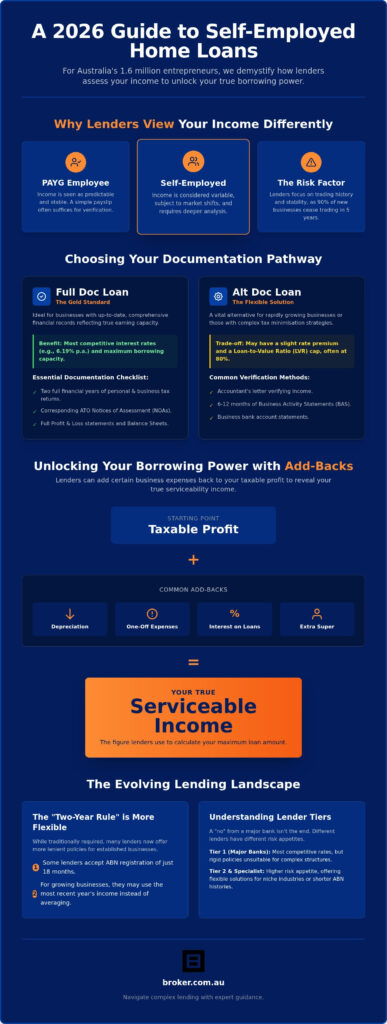
Understanding how lenders assess self-employed income is the first step toward a successful application. Traditionally, banks required two full years of tax returns to prove your earnings. In 2026, this landscape has shifted. While some major lenders still prefer the two-year average, others like Bankwest and ME Bank now accept an ABN registration of just 18 months. They might even use your most recent year’s income rather than averaging it with a lower previous year, provided your LVR is 80% or less. This flexibility is a game-changer for growing businesses that have seen a recent spike in profitability.
It is vital to remember that your taxable income is rarely the final figure a lender uses. Most business owners work with their accountants to legally minimise their tax obligations. While this is great for your bottom line, it can look like a lack of “income” to a standard bank algorithm. This is where the expert guidance of a broker becomes invaluable; we look beyond the base profit to find the true cash flow of your enterprise.
The Concept of Serviceability
Serviceability is the bank’s way of asking: “Can you actually afford this loan?” To find the answer, they calculate your Net Serviceable Income (NSI). This isn’t just your profit; it’s your income minus business expenses, tax, and personal living costs. In 2026, with the RBA cash rate at 4.35%, lenders apply a “buffer” interest rate during stress-testing. This means they assess your ability to pay at a rate significantly higher than the actual product rate to ensure you can handle future market fluctuations without financial distress.
Lender Tiers and Risk Appetites
Not all lenders are created equal. Tier 1 banks offer competitive rates but have rigid policies that often don’t suit complex business structures. If a major bank says “no,” it isn’t the end of the road. Tier 2 and specialist lenders often have a higher risk appetite for niche industries or shorter ABN histories. While some applicants opt for low-documentation loans when traditional records aren’t available, these often come with higher interest rates. Our role is to find the right tier that matches your specific financials, ensuring you don’t pay more than necessary for the credit you need.
Full Doc vs Alt Doc: Choosing Your Documentation Pathway
The path you choose to verify your earnings is one of the most critical decisions in the application process. While the “Two-Year Rule” was once the immovable standard, 2026 has introduced a welcome degree of flexibility. Today, how lenders assess self-employed income depends largely on the clarity of your paper trail and the maturity of your business. If your tax returns are up to date and reflect your true earning capacity, a “Full Doc” loan remains the most cost-effective route. However, for those with rapidly growing enterprises or complex tax minimisation strategies, “Alt Doc” solutions provide a vital alternative to traditional assessment methods.
There is always a trade-off to consider. Full Doc loans generally offer the lowest interest rates, such as the 6.19% p.a. fixed rates currently seen for low LVR tiers. In contrast, Alt Doc loans often carry a slight interest rate premium and may limit your Loan-to-Value Ratio (LVR) to 80% or less. Despite the higher cost, the ability to secure funding without two years of perfect tax history is often the catalyst business owners need to secure a property before the market moves.
The Essential Full Doc Checklist
This is the gold standard for Australian lending. It requires a comprehensive look at your financial history to provide the lender with absolute certainty. To meet the standard documentation requirements of a major bank, you typically need to prepare:
- Personal and Business Tax Returns for the last two full financial years.
- Notice of Assessments (NOAs) from the ATO to verify the returns were lodged and processed.
- Full Profit and Loss statements along with Balance Sheets prepared by a qualified accountant.
- Evidence that your ABN and GST registration have been active for at least 24 months, though some lenders now consider 18 months.
When to Use Alt Doc Solutions
If your most recent tax return doesn’t tell the whole story, an Alt Doc (Alternative Documentation) pathway might be the right fit. This is particularly useful if you have recently pivoted your business model or seen a significant revenue spike that isn’t yet reflected in a yearly tax summary. Instead of tax returns, lenders may accept:
- The last six months of Business Activity Statements (BAS) to demonstrate current turnover.
- Six months of business bank statements to prove consistent cash flow and expense management.
- A signed Accountant’s Letter. This document confirms your income is sufficient to meet repayments, but it must be worded carefully to meet lender compliance without making unrealistic future guarantees.
Choosing between these two paths requires a strategic look at your long-term goals. If you are unsure which documentation style fits your current business structure, you can always start a low-pressure conversation with our team to explore your options.
Calculating Borrowing Power: The Secret of Add-backs
Your tax return is designed to show the Australian Taxation Office as little profit as legally possible. While this strategy is excellent for tax efficiency, it can be a significant hurdle when you are trying to prove your serviceability to a bank. This is where add-backs become your most powerful tool. Understanding how lenders assess self-employed income requires a shift in perspective; you aren’t just looking at the bottom line, but at the actual cash available to meet loan repayments.
Lenders will “add back” certain expenses that appear on your profit and loss statement but don’t represent a true ongoing cash drain on your business. By identifying these items, we can often increase your assessed income by tens of thousands of dollars. We provide inside access to specialist credit teams who understand these nuances and look for reasons to say “yes” rather than looking for excuses to decline. Common add-backs include:
- Depreciation: Writing off the value of assets like vehicles or equipment is a non-cash expense. Lenders recognise that this money is still in your pocket.
- One-off expenses: If you spent $15,000 on a major website redesign or legal fees for a specific business acquisition, lenders often treat these as non-recurring.
- Interest expenses: Interest paid on debts you are currently refinancing is added back because those specific payments will cease once the new loan is in place.
- Extra Superannuation: Any contributions made above the mandatory Super Guarantee (11.5% for the 2025-26 financial year) are viewed as discretionary income.
Maximising Your Net Profit Before Tax (NPBT)
To get a true sense of your borrowing power, we look for “paper losses” that standard algorithms might miss. For example, if you are a company director, your salary and any drawings are often added back to the business profit to determine a global income figure. A unique advantage for business owners buying their own commercial premises is the “rent-saved” add-back. If the business is currently paying rent to a third party, that expense is added back to your profit because the new loan repayment will replace that outgoing cost.
The “Averaging” Trap
Most lenders will take the average of your last two years of income to smooth out any volatility. If your most recent year shows a significant jump in profit, some banks might cap the increase at 20% above the previous year to manage their risk. This is a common point of friction for successful, scaling businesses that have recently reached a new level of performance. Income shading is a risk-mitigation policy where Australian banks reduce your assessed income by a certain percentage, often 20%, to account for potential business fluctuations or unforeseen expenses.
How Your Business Structure Influences Loan Approval
The way you organise your enterprise is just as important as the numbers on your balance sheet. Whether you operate as a sole trader, through a family trust, or as a company director, each structure triggers a different set of rules for how lenders assess self-employed income. A sole trader application is generally the most straightforward, as the bank simply looks at your individual tax return. However, this simplicity comes with a catch; your personal and business liabilities are completely intertwined, meaning any business debt is viewed as a personal obligation that can directly impact your borrowing capacity for a home loan.
Partnerships and trusts require a “look through” assessment. Lenders will examine the trust deed and financial statements to see how profit is distributed to beneficiaries or partners. If you are a company director, the assessment becomes even more nuanced. Banks don’t just look at the PAYG salary you pay yourself; they also consider dividends and, crucially, the retained profits left within the company. This allows for a more holistic view of your wealth, but it requires a broker who can articulate the strength of your corporate structure to a credit assessor.
One non-negotiable factor in 2026 is a clean record with the ATO. Lenders now frequently request a copy of your Integrated Client Account or “Business Portal” statement. Any significant outstanding tax debt or a history of late BAS lodgements can stall an application instantly. Maintaining a transparent, debt-free relationship with the tax office is the foundation of a stress-free approval, as it signals to the lender that your business is managed with professional rigour.
Retained Profits and Company Performance
Many business owners ask if they can use profit left in the company to service a personal home loan. The answer is often yes, provided you have a controlling interest. However, this requires a sophisticated corporate advisory approach to prove that taking those funds won’t jeopardise the business’s operational health. We also keep a close eye on “Director Loans” on your balance sheet. If the records show you owe the company a significant sum, lenders may treat this as an undeclared liability rather than an asset, which can quickly diminish your borrowing power.
Special Considerations for Business Acquisition
If you are seeking Business Acquisition Funding, the assessment shifts from your historical personal income to the future potential of the target entity. In this M&A context, add-backs are even more vital than in a standard mortgage application. We help you identify “synergies” and redundant owner costs in the target business to bridge the gap between historical performance and your future projections. This level of complex loan restructuring is what separates a standard broker from a high-level fixer. If you are planning a complex move or need to restructure for an upcoming purchase, get started with a tailored assessment today.
Navigating the complexities of how lenders assess self-employed income doesn’t have to be a solo mission. While the technical details of add-backs and company structures can feel overwhelming, they are simply the variables we use to solve your financial puzzle. At Broker.com.au, we move you from a state of uncertainty toward streamlined confidence. Our proprietary AI technology is a core part of this process, accurately matching your specific business profile with the lenders most likely to offer an approval. This best in class technology allows us to bypass the generic “no” of a standard bank algorithm and find the boutique or major lender that actually understands your industry.
We pride ourselves on being high-level fixers. This means we don’t just look at a single home loan in isolation. If you need to restructure existing debt, secure Equipment Finance for a new contract, or find Working Capital Finance to manage seasonal shifts, we handle the entire ecosystem of your business and personal finances. Our inside access to the best rates across the Australian market ensures that your complexity doesn’t result in a “complexity premium” on your interest rate. You are in good hands with a team that views your entrepreneurial journey as an asset, not a risk.
The Broker.com.au Advantage
The real difference lies in the human-led advisory behind the digital portal. When you work with experts like Matt, Kylie, and Flavio, you aren’t just a file number. We take a proactive, can-do attitude toward every application, especially those that fall outside of the norm. We understand that your business financials are a narrative of your hard work. Our role is to organise those financials into a compelling story that highlights your strengths, justifies your reinvestments, and clearly demonstrates your serviceability to the credit assessor. This tailored approach is why our award-winning finance solutions continue to set the industry standard.
Your Next Steps to Funding
We believe the path to your financial goals should be as stress-free as possible. That is why we use a low-pressure “I’m interested” approach. It’s the start of a conversation, not a high-pressure sales pitch. To prepare for your first chat, simply have your ABN details and your most recent Business Activity Statements ready. We’ll take it from there, providing the local insights and technical expertise needed to unlock your next opportunity. We’re ready to go above and beyond to ensure your business structure works for you, not against you.
Ready to see your true borrowing power? I’m interested
Take Control of Your Borrowing Power Today
You now have the strategic framework to transform your business financials from a complex hurdle into a powerful asset. By identifying eligible add-backs and selecting the documentation pathway that reflects your current growth, you can navigate the nuances of how lenders assess self-employed income with total confidence. Understanding these 2026 lending shifts is the first step toward moving from financial uncertainty to a streamlined, stress-free approval.
As an award-winning business loan broker, Broker.com.au is uniquely positioned to act as your high-level fixer. We combine proprietary AI technology for accurate application matching with deep expertise in both personal home loans and large-scale business acquisition funding. Our team is ready to go above and beyond to ensure your business structure is presented in the best possible light to major and specialist lenders alike.
I’m interested in exploring my loan options
Your entrepreneurial success deserves a lending solution that is just as ambitious as you are. We look forward to helping you unlock your true borrowing capacity and securing the competitive rates you need to fund your next big dream.
Frequently Asked Questions
Can I get a home loan if I have been self-employed for less than two years?
Yes, you can certainly secure a home loan with less than two years of trading history. While major banks often prefer a 24-month track record, several Tier 2 and specialist lenders in 2026 accept an ABN registration of just 12 to 18 months. You will typically need to provide alternative evidence of stable earnings, such as Business Activity Statements or an accountant’s letter, to satisfy their specific credit criteria.
What is an Accountant’s Letter and will it help my loan application?
An Accountant’s Letter is a formal document where your qualified accountant confirms your current income and the business’s ability to meet loan repayments. It’s particularly helpful for Alt Doc applications where your most recent tax return doesn’t reflect your current financial strength. This letter provides lenders with professional assurance that your business is performing well and can sustain the proposed debt without financial hardship.
How do lenders treat depreciation when assessing my business income?
Lenders generally treat depreciation as a non-cash expense and will add it back to your net profit to increase your borrowing power. Because depreciation is an accounting entry rather than a physical drain on your bank account, banks recognise that this money is available for servicing debt. This is a crucial component of how lenders assess self-employed income to find your true serviceable cash flow.
Does a large tax refund help or hurt my chances of getting a loan?
A tax refund itself rarely impacts your loan chances as lenders focus on your gross and net profit before tax rather than your final tax position. While a large refund might boost your personal savings for a deposit, credit assessors are more interested in the consistency of your business revenue. They’ll scrutinise your tax returns to ensure your income is sustainable regardless of your ATO refund status.
What is the difference between taxable income and “add-back” income?
Taxable income is the profit remaining after all legal deductions, whereas add-back income is the figure lenders use after adding back non-cash or one-off expenses. By including items like depreciation, one-off legal fees, or voluntary superannuation, lenders get a clearer picture of your actual disposable income. This adjusted figure often results in a significantly higher borrowing capacity than your tax return alone suggests.
Can I use my Business Activity Statements (BAS) instead of tax returns?
Yes, you can use your Business Activity Statements (BAS) as primary evidence of income through an Alt Doc loan pathway. This is an efficient solution if your business has seen rapid growth in the current financial year that isn’t yet captured in a formal tax return. Lenders typically require the last six months of BAS to verify your turnover and calculate a deemed profit margin for serviceability.
How does a Self-Managed Super Fund (SMSF) loan differ for the self-employed?
SMSF loans for self-employed individuals often involve purchasing business real property where your business pays rent directly to your super fund. The assessment focuses on the fund’s ability to service the debt through rental income and member contributions rather than your personal drawings. It’s a sophisticated strategy that requires specialised advice to ensure the structure meets strict Australian compliance requirements and stays within LVR limits.
What happens if my business made a loss last year but is profitable now?
If your business is currently profitable despite a previous loss, lenders will require a clear, documented explanation for the turnaround. This is a key scenario in how lenders assess self-employed income; they may look at your interim profit and loss statements or bank turnover to prove the loss was a one-off event. Providing evidence of a new contract or a reduction in legacy expenses can help bridge this gap.