
Your accountant’s favourite tax deductions are often the biggest hurdle standing between you and your new home. While minimising your tax bill is a smart move for annual cash flow, declaring business income for a mortgage requires a completely different strategy. It’s a common frustration for Australian business owners; you know your enterprise is thriving, yet on paper, your borrowing capacity looks lower than it should. You might even worry that your company structure is too complex for a standard lender to understand, or that the 2026 APRA debt-to-income limits will hold you back.
We understand that the traditional “two years of tax returns” rule feels rigid when your business is evolving and growing. You deserve a process that recognises your true earning potential, not just the bottom line of a tax summary. This guide promises to show you how to strategically present your financials to maximise your borrowing power and secure a loan with confidence. We’ll explore how to use “add-backs” like one-off equipment purchases to your advantage, navigate the current 4.35% cash rate environment, and build a documentation plan that moves you from uncertainty to a stress-free approval.
Key Takeaways
- Discover the strategic difference between declaring business income for a mortgage and filing your annual tax return to significantly boost your borrowing capacity.
- Learn how to identify and apply “add-backs,” such as depreciation and one-off capital expenses, to present a more accurate picture of your financial health to lenders.
- Understand the critical distinctions between Full Doc and Low Doc loans to choose the most efficient application method for your current business situation.
- Access a streamlined checklist for organising your Australian Notice of Assessments (NOA) and tax returns to ensure a professional and stress-free submission.
- Find out how expert guidance and proprietary AI can navigate complex trust and company structures to secure inside access to the best available rates.
Table of Contents
- Understanding the Self-Employed Mortgage Landscape in Australia
- The Art of the ‘Add-Back’: Maximising Your Borrowing Power
- Full Doc vs. Low Doc: Which Declaration Method Suits Your Business?
- Preparing Your Paperwork: A Checklist for a Stress-Free Application
- How Broker.com.au Streamlines the Self-Employed Home Loan Process
Understanding the Self-Employed Mortgage Landscape in Australia
Australian lenders categorise anyone who doesn’t receive a standard PAYG salary as a self-employed borrower. While a regular employee simply provides a few recent payslips, your path involves a more granular review of your financial history. Banks often view business owners through a lens of caution because they perceive business income as more volatile than a fixed salary. This fundamental difference in risk assessment is a crucial first step in understanding mortgage loans from a lender’s perspective. It isn’t just about how much you earn; it’s about the consistency and structure of those earnings over time.
Your Australian Business Number (ABN) acts as the foundation of your application. Lenders use your ABN registration date to verify the longevity of your enterprise. In the current 2026 market, with the RBA cash rate sitting at 4.35%, credit policies have become more precise. Banks want to see that your business can thrive across different economic cycles. This is why declaring business income for a mortgage requires a strategic approach that goes beyond simply handing over a pile of receipts. You need to show that your business is a stable vehicle capable of servicing long term debt.
Sole Traders vs. Company Directors
The way you’ve structured your business significantly changes how a lender calculates your borrowing power. If you’re a sole trader, your business income and personal income are essentially one and the same. Lenders typically look at your net profit after all expenses are deducted. However, if you operate as a director of a proprietary limited company, the situation is more complex. Banks will look at the salary you pay yourself and any dividends distributed, but they may also consider the company’s retained profits. Your individual tax return (ITR) is only half the story here. To get a full picture, lenders must scrutinise the company’s financial statements to ensure the business is healthy enough to sustain your drawings.
The “Two-Year Rule” and Exceptions
The traditional benchmark for self-employed applicants is providing two full years of consistent Australian tax returns and Notices of Assessment. This provides lenders with a clear trend of your performance. However, as of July 2026, the landscape is becoming more flexible for high performing businesses. Some major lenders now accept 18 months of ABN registration, and in specific cases, they may even assess applications based on a single year of financials. These exceptions are often “inside access” policies that aren’t always advertised to the general public. If your business has seen rapid growth or you’ve recently transitioned from a similar PAYG role into your own consultancy, these shorter trading period options can be a game changer for your approval chances.
The Art of the ‘Add-Back’: Maximising Your Borrowing Power
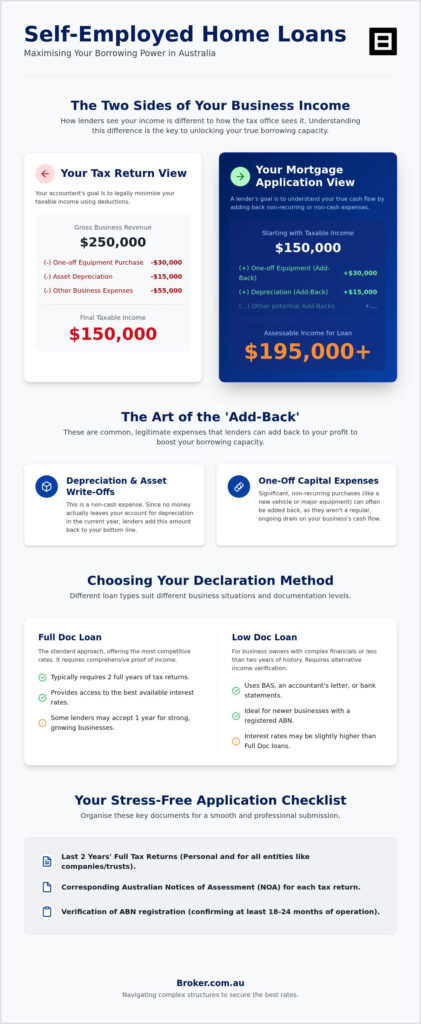
Your tax return is a masterpiece of efficiency designed to minimise what you owe the government, but it can be a double-edged sword when you’re declaring business income for a mortgage. While your accountant works hard to reduce your taxable profit through legitimate deductions, a mortgage lender’s credit assessor is looking for the exact opposite: a robust, high-income figure that proves you can comfortably service a loan. This is where the concept of “add-backs” becomes your most powerful tool. Add-backs are specific business expenses that lenders are willing to add back to your net profit because they don’t represent a true loss of cash or a recurring obligation.
Lenders allow these adjustments because they want to see your “true” disposable income. In the 2026 lending environment, where APRA’s debt-to-income (DTI) ratio rules often cap borrowing at six times your gross income, every dollar added back to your profit significantly moves the needle on your borrowing capacity. By correctly calculating your business income with these adjustments in mind, you transform a modest tax figure into a strong financial profile that inspires lender confidence.
Depreciation and Instant Asset Write-Offs
Depreciation is the king of add-backs. It’s an accounting entry that reflects the wearing out of an asset, like a delivery van or a piece of machinery, but it doesn’t involve any actual cash leaving your bank account this year. An add-back for depreciation involves restoring a non-cash accounting expense to your profit to demonstrate the actual liquid funds available for mortgage repayments. Under the 2026 tax rules, many businesses still benefit from accelerated depreciation or instant asset write-offs. Lenders recognise that while these deductions are great for your tax bill, they shouldn’t penalise your mortgage application because the money is still physically available to pay for your home.
Superannuation and Interest Expenses
Lenders also look closely at discretionary spending and non-recurring costs. If you’ve made voluntary superannuation contributions above the legal minimum, most Australian banks will treat that extra amount as income. They view it as money you could have easily kept if you needed to meet a mortgage payment. Similarly, if your business has paid interest on a loan that will be closed or refinanced as part of your new home loan, that interest can often be added back. One-off legal fees, professional advice for a specific merger, or even a temporary fit-out cost that won’t happen again next year are all eligible for review. If you’re unsure which of your expenses qualify, you might find it helpful to explore our tailored finance solutions to see how we can restructure your presentation for the best result.
Full Doc vs. Low Doc: Which Declaration Method Suits Your Business?
Choosing the right verification method is a pivotal moment in your application. It’s not just about what you have; it’s about how you present it. While most borrowers aim for the lowest possible interest rate, the reality of running a business means your most recent tax return might not reflect your current success. This is where the choice between a Full Doc and a Low Doc loan becomes a strategic decision rather than a simple paperwork preference. When declaring business income for a mortgage in 2026, you need to balance the cost of the loan against the speed and likelihood of approval.
The Australian lending market has evolved significantly recently. With the RBA cash rate at 4.35% and 30 lenders having reduced their variable rates since June 1, 2026, there’s a clear appetite for new business. However, APRA’s debt-to-income (DTI) limits mean that your method of declaration must be airtight. Whether you choose a standard path or a more flexible alternative, the goal is to move from uncertainty toward a feeling of streamlined confidence.
The Full Doc Pathway
The Full Doc pathway remains the gold standard for securing “Best in class” rates. It requires a comprehensive disclosure of your financial position, typically involving two years of full financial statements and tax returns. This method is ideal for established businesses with stable or growing profits and clear documentation. By providing a complete picture of your understanding assessable income, you give lenders the highest level of trust. This transparency allows you to access the most competitive products on the market, ensuring your long-term interest costs remain as low as possible.
When to Consider a Low Doc Loan
Tax returns can sometimes be outdated by the time you’re ready to buy, especially if your business has seen a surge in performance. If your latest tax return doesn’t reflect your current cash flow, a Low Doc loan offers a more agile alternative. Instead of waiting for the next financial year, you can use Business Activity Statements (BAS) or an accountant’s letter to verify your earnings. While these loans often carry a “rate premium,” they provide the flexibility needed when declaring business income for a mortgage during an expansion phase. You’ll generally need a clean credit history and a larger deposit, as most lenders cap the Loan-to-Value Ratio (LVR) at 80% for these products to offset the reduced documentation.
Preparing Your Paperwork: A Checklist for a Stress-Free Application
Approaching a lender with a disorganised folder of receipts is the fastest way to invite scrutiny and delays. In the current lending climate, where total residential mortgage debt has reached $2.51 trillion as of June 2026, banks are more focused than ever on precise documentation. Moving from uncertainty to approval requires a methodical approach to declaring business income for a mortgage. By treating your application like a professional business case, you demonstrate the competence and stability that credit assessors value most.
To ensure your journey remains seamless, follow this essential documentation checklist:
- Step 1: Gather your personal and business tax returns for the last two financial years. Consistency between these years is key to proving income stability.
- Step 2: Secure your official Australian Notice of Assessments (NOA) from the ATO. These documents confirm that your lodged returns have been processed and verified by the government.
- Step 3: Prepare a professional Year-to-Date (YTD) Profit and Loss statement. This bridges the gap between your last tax return and today.
- Step 4: Review your business bank statements for the last six months. Look for “discretionary” spending that could be misinterpreted as a recurring business liability.
The Importance of the Notice of Assessment
For Australian lenders, the Notice of Assessment is the ultimate verification tool. It provides a level of certainty that an unaudited tax return simply cannot match. When declaring business income for a mortgage, any discrepancy between your individual tax return figures and your NOA will trigger immediate red flags. It’s also vital to ensure your tax obligations are up to date. If you have an outstanding debt with the ATO, you’ll generally need to prove that a formal payment plan is in place and being met before a lender will proceed. Clearing these hurdles early ensures you stay in good hands throughout the approval process.
Year-to-Date Financials
Lenders care deeply about how your business has performed since your last tax lodgement. If you operate a seasonal business, such as in tourism or retail, a YTD statement allows you to explain fluctuations and show that your current cash flow is sufficient to meet the 6.0% p.a. average mortgage rates seen in April 2026. Lenders require your Year-to-Date Profit and Loss statement to be current within 90 days of your application to ensure they are assessing your business’s most recent financial health. If you’re ready to present your business in its best light, get started with our expert team today for a tailored assessment of your borrowing power.
How Broker.com.au Streamlines the Self-Employed Home Loan Process
The Australian lending landscape is a complex web of shifting credit policies and rigorous assessment criteria. For a business owner, trying to find the right path alone can feel like a full time job. Broker.com.au was built to remove that burden. We combine high level financial expertise with cutting edge technology to ensure that declaring business income for a mortgage is a process of streamlined confidence rather than a source of anxiety. Our role is to act as your expert guide, providing the inside access and local insights you need to secure a best in class result.
We provide access to a diverse panel of over 30 lenders, ranging from the big four banks to boutique specialist business lenders. This broad reach is vital because no two banks view self-employed income in exactly the same way. While one lender might be conservative regarding your company’s retained earnings, another may have a specific appetite for your industry or structure. We identify these nuances early, ensuring your application is positioned for success from the very first submission.
AI-Driven Accuracy for Business Owners
Our proprietary AI technology is a cornerstone of our award winning finance solutions. It doesn’t just match you with a rate; it models your specific financial profile against thousands of data points within lender credit policies. For those declaring business income for a mortgage, this tech is invaluable. It identifies which lenders are most likely to accept your specific add-backs, such as one-off capital expenses or voluntary superannuation. This precision significantly reduces the risk of multiple credit enquiries, which can damage your credit score. By getting it right the first time, we provide faster pre-approvals so you can bid at auction with the certainty of an elite buyer.
Your Partner in Growth
We believe your home loan should be a catalyst for your overall financial health, not a drain on your business’s resources. Our team, led by experts like Matt, Kylie, and Flavio, looks beyond the immediate transaction. We help you structure your personal and business debt to maximise your ROI and protect your cash flow. Whether you are navigating a complex family trust or a multi-layered proprietary limited company, we handle the heavy lifting of the documentation process. You’ve worked hard to build your enterprise; we work just as hard to ensure the lending market recognises its true value. Ready to see what you can borrow? I’m interested
Secure Your Future with Strategic Financial Presentation
Securing a home loan as a business owner in 2026 doesn’t have to be an uphill battle. By mastering the art of the add-back and selecting the right documentation pathway, you can present a financial profile that reflects your true success. Your taxable income is just a starting point. Your actual borrowing power lies in the strategic details of your cash flow. Whether you’re navigating complex trusts or simply need to bridge the gap with a Low Doc solution, the right preparation ensures you’re ready for the current 4.35% cash rate environment.
Declaring business income for a mortgage is ultimately about telling your financial story in a language that lenders understand. As an award-winning Australian brokerage, Broker.com.au uses proprietary AI loan matching technology to connect you with the right credit policies for your specific situation. We specialise in complex business structures, ensuring you have an expert guide to handle the heavy lifting and provide inside access to the best rates. If you’re ready to move from uncertainty to streamlined confidence, we’re here to help.
I’m interested in a tailored home loan solution
You’ve done the hard work of building your enterprise. Now it’s time to enjoy the rewards of your ambition and secure the property you’ve earned.
Frequently Asked Questions
Can I get a mortgage if I have only been self-employed for one year?
Yes, you can certainly secure a home loan with only one year of trading history. While many major banks prefer two years of financials, several specialist lenders now accept one year of tax returns or 18 months of ABN registration. This is especially true if you’ve moved from a similar PAYG role into your own business, as lenders recognise your industry expertise and earning stability.
How do lenders calculate my income if I have a large tax deduction?
Lenders calculate your “true” income by using a process called an add-back. They take your net profit and add back non-cash expenses like depreciation or one-off capital purchases that your accountant used to reduce your tax. This ensures that declaring business income for a mortgage reflects the actual cash you have available to service a loan rather than just your taxable profit.
What is a “Low Doc” loan and do I need one in 2026?
A Low Doc loan is a flexible product that allows you to verify your income using alternative documents like Business Activity Statements (BAS) or an accountant’s letter. You might need one in 2026 if your business is currently in a rapid growth phase. If your 2025 tax return doesn’t show your current 2026 earning capacity, these loans provide a way to prove your modern cash flow.
Do I need to have my 2025 tax returns lodged to apply for a mortgage in 2026?
Lenders generally require the most recent financial data available, so you’ll usually need your 2025 returns if you’re applying after the standard lodgement deadlines. If you haven’t lodged yet, some lenders may accept your 2024 returns supported by 2025 BAS and a Year-to-Date profit and loss statement. This ensures they are assessing your business based on its current health in the 2026 market.
Can I use business dividends as my primary source of declared income?
Yes, dividends are a standard way for company directors to declare income for a mortgage. Lenders will review your personal tax return to see the dividends paid, but they’ll also scrutinise the company’s financial statements. They need to be sure the business is generating enough profit to sustain those dividends without impacting its operational stability or future growth.
How does a business loss in one year affect my borrowing power?
A business loss can significantly reduce your borrowing capacity because most lenders average your income over the last two years. If one year shows a loss, it brings that average down. However, if the loss was due to a one-off, non-recurring event or a major capital investment, we can often explain this to the credit assessor to prevent it from derailing your application.
What happens if I have an outstanding tax debt with the ATO?
An outstanding tax debt is a hurdle, but it isn’t always a deal-breaker. Lenders will typically require you to have a formal payment plan in place with the ATO and a record of consistent, on-time payments. Alternatively, some lenders may allow you to use the equity in your new home loan to clear the tax debt as part of the settlement process.
Will the bank look at my business bank statements or just my tax returns?
Most banks will review your business bank statements alongside your tax returns to get a complete picture of your financial habits. They use these statements to verify your current cash flow and look for discretionary spending patterns. This allows them to see how your business is performing right now, rather than just looking at a historical snapshot from a previous financial year.