
Why should your hard-earned company cash sit idle in a business account when it could be the key to your new front door? Using business profits for home loan deposit purposes is one of the most effective ways for self-employed Australians to break into the property market, yet many fear the taxman’s shadow. You’ve built a successful enterprise, and it’s only natural to want those retained earnings to work for your personal goals. We understand that the complexity of Division 7A and the anxiety over high tax hits on unfranked dividends often bring the dream of home ownership to a grinding halt.
You’re in good hands. This article provides a clear path to legally and strategically leveraging your company’s earnings to secure a deposit without falling foul of the ATO. We’ll explore how to maximise your borrowing power while minimising tax leakage during the transfer. You’ll gain insight into structuring complying loans at the 2026-27 benchmark interest rate of 8.77% and learn how to present your financials so lenders see the true strength of your business.
Key Takeaways
- Discover how using business profits for home loan deposit purposes is a legitimate strategy when you know how to navigate the transition from company cash to personal assets.
- Learn the essential rules of Division 7A to ensure your deposit funds don’t trigger unexpected tax penalties or unfranked dividends.
- Understand how specialist lenders “add back” specific business expenses to reflect your real income, often unlocking significantly more borrowing power than a standard tax return suggests.
- Follow a structured two-step process to organise your financials and coordinate with your accountant for a stress-free application.
- See why an expert guide is vital to accessing tailored solutions from lenders who specialise in complex self-employed and trust structures.
Table of Contents
- Can I Use My Business Profits for a Home Loan Deposit in Australia?
- Understanding the ATO Rules: Division 7A and Personal Use of Company Funds
- How Lenders Evaluate Your Business Profits for Mortgage Applications
- Proven Strategies to Organise Your Deposit Using Business Earnings
- Navigating the Application: Why Specialist Brokerage is Essential
Can I Use My Business Profits for a Home Loan Deposit in Australia?
The short answer is a resounding yes. Using business profits for home loan deposit purposes is a common and legitimate strategy for successful Australian entrepreneurs, provided the funds are extracted legally and strategically. You’ve worked hard to build a profitable enterprise, and it’s only natural to want that capital to work for your personal property goals. However, the path isn’t always a straight line. While the cash is physically sitting in your business account, lenders need to see a clear, compliant transition of those funds into your personal name before they’ll count it as a genuine contribution.
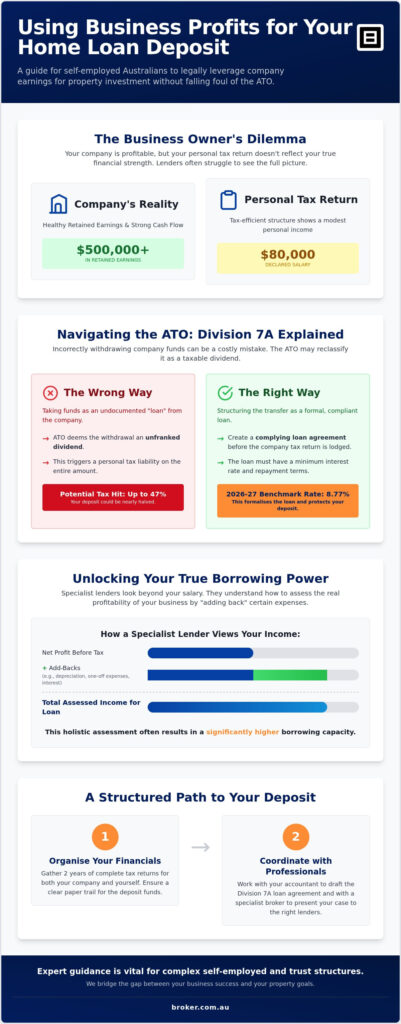
Many founders struggle with the “Business Owner’s Dilemma”. On paper, your company is thriving with healthy retained earnings and strong cash flow. On your personal tax return, however, you might appear “income-poor” because you’ve prioritised tax efficiency by taking a modest salary. This creates a disconnect. You know you have the wealth, but a standard bank algorithm only sees the lean personal income. We specialise in bridging this gap, helping you present a holistic view of your financial strength that looks beyond a simple PAYG slip.
Lending standards in 2026 require significantly more transparency than in previous years. Following the 2024 updates to APRA’s responsible lending guidelines, banks now scrutinise the sustainability of your business cash flow more than ever. They aren’t just looking at the cash you have at the bank today; they want to ensure that withdrawing a large lump sum for a deposit won’t cripple your company’s ability to trade or meet its future tax obligations. Having a clear audit trail is no longer optional, it’s the baseline for approval.
Sole Traders vs. Proprietary Limited Companies
Your business structure dictates your entire strategy. As a sole trader, your business profit is technically your personal income from day one, making the transition of funds relatively simple. However, if you operate a Proprietary Limited company, your business is a separate legal entity. This creates a hurdle because the money belongs to the company, not you personally. To use these funds, you must navigate Division 7A rules to avoid the ATO treating the withdrawal as an unfranked dividend, which could result in a massive, unexpected tax bill that eats into your deposit.
The Concept of ‘Retained Earnings’
Retained earnings are the cumulative net profit after dividends are paid. These funds often sit in your business account as a safety net or for future expansion. Lenders view these as a “surplus” that proves your business is more than just a job; it’s a wealth-generating asset. When we present your application, we highlight these earnings to demonstrate that your business has the “fat” required to support your home ownership dreams without risking its operational health. It’s about showing the lender that your company is a robust engine, not just a source of a weekly wage.
Understanding the ATO Rules: Division 7A and Personal Use of Company Funds
The ATO views your private company as a distinct legal entity, not a personal savings account. Division 7A exists specifically to prevent shareholders from taking tax-free distributions of profit under the guise of “loans.” If you’re using business profits for home loan deposit purposes, failing to structure the transfer correctly can lead to the ATO reclassifying the funds as an unfranked dividend. This means you lose the benefit of any tax the company has already paid, potentially triggering a tax bill of up to 47% on the entire amount. Such an oversight can instantly slash your available capital and derail your settlement.
A complying loan agreement is your primary defence in 2026. This legal document outlines the interest rate and repayment schedule, ensuring the ATO recognises the money as a genuine loan rather than a hidden profit distribution. By formalising this arrangement before the company’s tax return is lodged, you protect your deposit from being treated as taxable income. It’s about maintaining a clear paper trail that satisfies both the tax office and your bank’s credit department.
Dividends vs. Salary: The Tax Efficiency Battle
Taking a lump-sum dividend is a popular way to fund a deposit because it allows you to utilise franking credits. Since most small businesses pay a 25% company tax rate, a franked dividend essentially “pre-pays” a portion of your personal tax liability. However, taking a large dividend in a single year can push you into a higher tax bracket. Alternatively, increasing your salary can help meet strict lender serviceability requirements, but it often results in higher immediate tax leakage. Timing your extraction is vital; successful borrowers often spread distributions across two financial years to manage their tax thresholds more effectively.
Director’s Loans for Home Deposits
If you prefer not to take a permanent dividend, a Director’s Loan under Division 7A guidelines offers a flexible alternative for using business profits for home loan deposit funds. For the income year ending 30 June 2027, the benchmark interest rate is set at 8.77%. These loans must be structured with specific terms: seven years for unsecured loans or up to 25 years if the loan is secured by a registered mortgage over real estate. Setting up these structures requires precision. If you’re unsure how these rules apply to your specific company structure, you can discover more about how we coordinate with accountants to streamline this process.
How Lenders Evaluate Your Business Profits for Mortgage Applications
Lenders don’t see your business the same way the ATO does. While the tax office focuses on what you owe, a mortgage credit assessor focuses on what you can afford. When you’re using business profits for home loan deposit funds, the bank’s primary concern is whether extracting that capital will leave your company “cash poor.” They’ll scrutinise your Net Profit After Tax (NPAT) to ensure the business remains a viable, ongoing concern after the deposit is paid. This assessment often involves looking at your “working capital,” the money needed for day-to-day operations, to confirm that your personal dream won’t compromise your professional stability.
The traditional “Two-Year Rule” still dominates the big four banks, where they’ll average your last two years of tax returns to determine your income. However, the market has shifted significantly. As of July 2026, several major lenders, including ANZ, Bankwest, and ME Bank, have updated their policies to accept just 18 months of ABN registration for certain applications. This flexibility is essential when using business profits for home loan deposit strategies, as it allows successful entrepreneurs to act on property opportunities without waiting years for a historical paper trail to catch up to their current success.
Common ‘Add-Backs’ That Boost Your Borrowing Power
Your true borrowing power is often hidden beneath your taxable income. Lenders use “add-backs” to adjust your profit, essentially adding non-cash or one-off expenses back into your income pool. If you’ve utilised the permanent $20,000 instant asset write-off for equipment, a savvy lender will recognise this as a one-time deduction rather than an ongoing cost. Other common add-backs include:
- Additional superannuation: Voluntary contributions above the 2025-26 concessional cap of $30,000.
- Depreciation: Non-cash expenses for vehicles or equipment that don’t affect your actual cash flow.
- One-off expenses: Large, non-recurring costs like a website rebrand or legal fees for a specific project.
- Interest expenses: Interest on business loans or equipment finance that will be finalised before your property purchase.
LVR and Risk Assessment for Business Owners
Risk assessment is often stricter for entrepreneurs because business income is perceived as more volatile than a PAYG salary. You might find that some lenders cap your Loan to Value Ratio (LVR) at 80% to avoid Lenders Mortgage Insurance, or they might apply a higher serviceability buffer than the standard APRA-mandated 3%. It’s also worth being cautious about having both your business and home loan with the same “Big Four” bank; this can lead to cross-collateralisation, giving the bank more control over your assets than is ideal. For profit-heavy businesses that don’t fit the standard mould, “Alt Doc” loans provide a streamlined path by using business activity statements or accountant letters instead of full tax returns.
Proven Strategies to Organise Your Deposit Using Business Earnings
Moving from the theory of lender evaluation to the practical execution of a purchase requires a disciplined approach. You’ve seen how banks scrutinise your figures; now it’s time to prepare those figures for a successful application. Organising your funds isn’t just about moving money between accounts. It’s about creating a narrative of financial stability that satisfies both the ATO and a credit assessor’s risk profile. By following a structured path, you can ensure that using business profits for home loan deposit purposes becomes a seamless part of your wealth-building journey.
We recommend a five-step process to ensure you’re in good hands throughout the transaction:
- Step 1: Conduct a pre-lending audit. Review your company balance sheet for “lazy” cash or messy director loan accounts that might complicate your “source of funds” story.
- Step 2: Consult with your accountant and broker simultaneously. This alignment is vital. Your accountant focuses on tax minimisation, while we focus on lender policy. We work together to find the “sweet spot” that satisfies both.
- Step 3: Determine the extraction method. Based on your tax bracket and the 2026-27 benchmark rates, decide whether a franked dividend or a complying Division 7A loan serves you best.
- Step 4: Secure structure-specific pre-approval. Don’t settle for a generic pre-approval. You need a commitment from a lender who has reviewed and accepted your specific company or trust tax structure.
- Step 5: Execute and document. When you transfer the funds, keep every receipt and minute of the director’s meeting. Lenders require a clear paper trail to satisfy anti-money laundering regulations.
If you’re ready to see how these steps apply to your unique situation, get started with a tailored assessment of your borrowing power today.
Debt Recycling for Business Owners
For established entrepreneurs, debt recycling offers a sophisticated way to optimise your balance sheet. This involves using the equity within your business or existing commercial assets to fund a personal property deposit. Debt recycling is a strategy to improve tax efficiency while building wealth. By carefully structuring your loans, you can potentially convert non-deductible personal debt into deductible business debt, providing a dual benefit of home ownership and ongoing tax relief.
Interim Dividends and Real-Time Reporting
You no longer have to wait for the end of the financial year to prove your success. With 2026 digital accounting software like Xero or MYOB, we can provide lenders with real-time profit and loss statements. This allows you to declare an interim dividend based on current-year earnings, which is a game-changer if your business has seen a significant spike in growth recently. Managing your company’s “Statement of Position” through real-time data ensures that your application reflects your business’s true, current capacity rather than outdated historical returns.
Navigating the Application: Why Specialist Brokerage is Essential
Most local bank branches are set up for simple PAYG employees. When you walk in with company tax returns and complex trust deeds, the average lender often defaults to a conservative “no” because they don’t understand the nuances of your business. Using business profits for home loan deposit purposes requires a credit assessor who can read a balance sheet as well as they read a payslip. We act as your expert guide, ensuring your application lands on the desk of someone who understands that your retained earnings are a sign of strength, not a liability.
Our proprietary AI technology scans over 30 lenders in real-time, specifically filtering for those with “business-friendly” policies. This isn’t just about finding a low rate; it’s about identifying which banks allow for the specific add-backs and Division 7A loan structures discussed earlier in this guide. By using this technology, we remove the guesswork and provide you with streamlined confidence that your chosen lender is the right fit for your complex needs. We’ve seen many cases where a standard bank rejected an application that a specialist lender approved in 48 hours.
We also take the lead on managing the communication between your accountant and the bank’s credit department. This reduces the stress-factor significantly. You won’t be stuck in the middle of technical arguments about depreciation, franking credits, or the 2026-27 benchmark interest rates. You’re in good hands, allowing you to focus on running your business while we handle the heavy lifting of the mortgage approval process.
Inside Access to Custom Lending Tiers
Some of the best solutions for entrepreneurs aren’t found on a public website. We provide inside access to private banking tiers and boutique lenders that specialise in high-net-worth business owners. These institutions often look at your total “wallet share.” They consider your business loans, equipment finance, and personal home loan as a single, valuable relationship. This holistic view often leads to negotiated interest rate discounts and more flexible terms that a standard retail bank simply cannot match. Broker.com.au streamlines this entire process, ensuring busy directors don’t waste time on paperwork that doesn’t move the needle.
Next Steps: Get Your Deposit Strategy Sorted
Don’t wait until you’ve found the perfect property to start this conversation. The most successful applications begin months in advance. Lenders generally want to see a “clean” six-month period across both your business and personal bank statements. This means avoiding excessive director drawings or irregular transfers that haven’t been properly documented by your bookkeeper. By starting now, we can ensure your serviceability is peak-ready before you ever set foot in an open home. If you are ready to move from uncertainty to a clear path forward, I’m interested in a home loan strategy session.
Turning Your Business Success into Personal Property Wealth
Navigating the transition from company profits to a personal deposit requires more than just a simple bank transfer. It demands a precise understanding of Division 7A compliance and the ability to present your true profitability through strategic add-backs that standard lenders often overlook. By aligning your accountant’s tax advice with a specialist’s lending insight, you can bypass the rigid barriers of traditional banks and access tailored finance solutions that respect your entrepreneurial journey. You’ve built a robust engine for wealth; now it’s time to direct that power toward your home ownership goals.
Successfully using business profits for home loan deposit purposes is a sophisticated move that sets the foundation for your personal future. Our award-winning expertise and proprietary AI matching ensure your complex financials are paired with the most business-friendly lenders in the Australian market. We provide stress-free management of your application from start to finish, ensuring you remain in good hands throughout the process. If you’re ready to move from uncertainty to a clear path forward, I’m interested in a tailored home loan strategy. Your business has already proven its value; let those earnings open the door to your next home today.
Frequently Asked Questions
Can I just transfer money from my business account to my personal account for a deposit?
No, you cannot simply move funds without a formal tax classification. Doing so triggers immediate ATO scrutiny and can lead to the funds being treated as taxable income at your highest marginal rate. You must record the transfer as a salary payment, a formal dividend, or a complying loan. Properly categorising this transfer is the first step in using business profits for home loan deposit purposes without creating a tax disaster.
What is Division 7A and why should I care when buying a home?
Division 7A is a tax integrity rule designed to stop private companies from making tax-free profit distributions to shareholders. It’s vital because any money taken from your company for a home deposit must be structured as a complying loan or a dividend. If you fail to do this, the ATO treats the entire amount as an unfranked dividend, which could cost you nearly half your deposit in unexpected tax. This makes compliance a non-negotiable part of using business profits for home loan deposit strategies.
Do I need to pay myself a higher salary for two years before I can get a mortgage?
You don’t always need a long history of high personal drawings. While traditional banks prefer two years of personal tax returns, our specialist lenders focus on your company’s net profit and specific “add-backs.” Many of our lenders now accept just 18 months of ABN registration. This allows us to use your business’s actual earnings to prove serviceability rather than relying solely on the salary you’ve historically paid yourself.
Can my business act as a guarantor for my personal home loan?
Generally, Australian lenders won’t allow a company to act as a guarantor for a standard residential mortgage. Banks prefer individuals as guarantors to ensure there is clear, personal liability. However, you can often use the equity within your business or commercial property as security for a separate business loan to fund the deposit. This is a complex structure that requires an expert guide to ensure it meets both bank policy and tax law.
Will the bank look at my company’s debt when I apply for a personal mortgage?
Yes, lenders will scrutinise your company’s liabilities as part of your personal application. Business debts, such as vehicle leases, equipment finance, or a company line of credit, are factored into your total debt-to-income ratio. We help you present these liabilities clearly, ensuring the credit assessor understands which debts are self-servicing through business revenue rather than being a drain on your personal cash flow.
How much tax will I pay if I take a $200,000 dividend for a house deposit?
The tax you’ll pay depends on your existing income and available franking credits. If your company has already paid the 25% corporate tax rate, you’ll receive a credit for that amount. You then pay the difference between that 25% and your personal marginal tax rate on the “grossed-up” dividend. It’s often more tax-efficient to spread this dividend across two financial years if your settlement timing allows for it.
What is an ‘add-back’ in a self-employed home loan application?
An add-back is a non-cash or one-off business expense that a lender adds back to your net profit to show your true income. This increases your assessable borrowing power. Common examples include depreciation on equipment, voluntary superannuation contributions up to the $30,000 concessional cap, and non-recurring expenses like a major website rebrand. These adjustments often reveal significantly more borrowing power than your tax return initially suggests.
Can I use my business’s ‘Line of Credit’ to fund my home deposit?
Using a business line of credit for a personal deposit is possible but requires a formal loan agreement between you and the company. This loan must meet all Division 7A requirements, including the 2026-27 benchmark interest rate of 8.77%. It’s a sophisticated path that requires careful coordination between your accountant and our team to ensure the bank accepts the funds as a legitimate and sustainable source for your deposit.