
Most business buyers walk into a bank conversation thinking the deal sells itself. It doesn’t. Understanding what banks look for in a business acquisition loan is the difference between a conditional approval letter and a politely worded rejection, and far too many capable buyers learn that lesson the hard way.
If you’ve found a business worth buying and you’re now staring down a mountain of financial paperwork, wondering how on earth a lender will view “goodwill” on the balance sheet or whether your serviceability will stack up, you’re not alone. These are the exact questions that keep acquisition finance feeling complicated, even for experienced operators.
Here’s the reassuring truth: banks aren’t trying to catch you out. They’re looking for a specific story, one where your experience aligns with the business’s proven cash flow and the risk of transition is clearly managed. This article breaks down the precise criteria Australian lenders use in 2026, gives you a practical checklist to package a compelling application, and explains where a specialist broker can give you a genuine edge before you ever sit across the table from a credit assessor.
Key Takeaways
- Understanding what banks look for in a business acquisition loan goes beyond the numbers — lenders assess your character, experience, and industry fit just as closely as the target business’s cash flow.
- Goodwill is one of the most misunderstood elements of acquisition finance; knowing how Australian lenders value it in 2026 can make or break your borrowing capacity.
- The “Five Cs” of credit form the unofficial scorecard every credit assessor uses — and structuring your application around them dramatically improves your chances of approval.
- Asset-backed components of the business, such as equipment and stock, can be leveraged to bridge funding gaps that goodwill alone won’t cover.
- A specialist broker’s inside access to lender appetite — including AI-matched deal placement — can secure terms and approval pathways that aren’t available through a direct bank conversation.
Table of Contents
- The Fundamentals: What is an Acquisition Loan?
- The “Five Cs” of Credit: The Bank’s Secret Scorecard
- Character and Experience: You Matter as Much as the Numbers
- The Acquisition Specifics: Goodwill, Assets, and Transition
- How a Broker Organises a “Stress-Free” Approval
The Fundamentals: What is an Acquisition Loans?
A business acquisition loans is a specific form of commercial finance designed to fund the purchase of an existing business, whether that’s buying out a sole trader, acquiring a competitor, or stepping into a franchise. In the Australian market, this type of funding sits in its own category, and understanding that distinction is the first step toward a successful application.
Unlike a standard working capital loan, which supports the day-to-day cash needs of a business you already operate, acquisition finance is funding a transition. You’re not borrowing against something you own yet. That single fact changes everything about how a lender assesses the deal.
Acquisition Funding vs. Traditional Business Loans
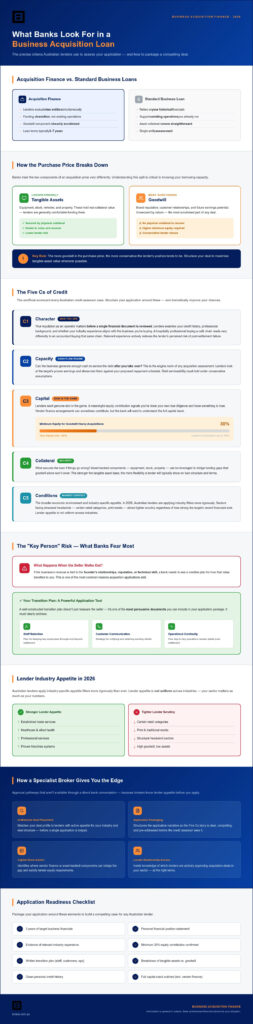
Standard business loans lean heavily on your historical financials. Acquisition finance is different because lenders must evaluate two entities simultaneously: your personal capacity to service the debt and the target business’s ability to generate the cash flow that will repay it. The purchase price is rarely a clean figure either. It typically breaks down into two components that banks treat very differently:
- Tangible assets: Equipment, stock, vehicles, and property. These hold real collateral value and lenders are generally comfortable funding them.
- Goodwill: The premium paid for brand reputation, customer relationships, and future earnings potential. This is unsecured by nature, which is why it’s the most scrutinised part of any acquisition deal.
Loan terms for Australian acquisitions typically range from three to seven years, with structures varying based on asset composition, industry type, and the borrower’s equity contribution. The more goodwill in the purchase price, the more conservative the lender’s position tends to be.
Why Banks Are Extra Cautious with Business Purchases
The core concern for any lender is what happens the moment the seller walks out the door. This is the “key person” risk, and it’s one of the most common reasons acquisition applications stall. If the business’s revenue is tied to the founder’s relationships, reputation, or technical skill, a bank needs to see a credible plan for how that value transfers to you.
In 2026, Australian lenders are also applying industry-specific appetite filters more rigorously. Sectors facing structural headwinds, such as certain retail categories and print media, attract tighter scrutiny regardless of how strong the target’s recent financials look. Understanding what banks look for in a business acquisition loan means recognising that the lending landscape shifts with economic conditions, and lender appetite is not uniform across industries.
A well-constructed transition plan, one that addresses staff retention, customer communication, and operational continuity, doesn’t just reassure the seller. It’s one of the most persuasive documents you can include in your application package.
The “Five Cs” of Credit: The Bank’s Secret Scorecard
Every credit assessor in Australia, whether they’re sitting at a major bank or a specialist commercial lender, runs your application through the same mental framework. It’s called the Five Cs of Credit, and understanding it is fundamental to knowing what banks look for in a business acquisition loan. Most applicants focus almost entirely on the numbers. The assessors are looking at something far more layered.
- Character: Your reputation as an operator matters before a single financial document is reviewed. Lenders examine your credit history, your professional background, and whether your industry experience aligns with the business you’re buying. A hospitality professional buying a café chain reads very differently to an accountant buying that same chain. Relevant experience doesn’t just reassure the lender; it actively reduces their perceived risk of post-settlement failure.
- Capacity: Can the business generate enough cash to service the debt after you take over? This is the engine room of any acquisition assessment, and it’s covered in detail below.
- Capital: Lenders want genuine skin in the game. A meaningful equity contribution, typically a minimum of 30% for goodwill-heavy acquisitions, signals that you’ve done your own due diligence and have something to lose. Vendor finance arrangements can sometimes form part of this contribution, but a bank will want to understand the full capital stack before approving the deal.
- Collateral: What’s securing the loan if things go wrong? This is explored in the section below, but the short version is that tangible assets always carry more weight than intangible ones.
- Conditions: The external environment matters. Lenders assess the purpose of the loan, the industry’s current trajectory, and broader economic conditions. A business acquisition in a sector facing structural disruption will attract tighter scrutiny regardless of how clean the financials look.
Proving Your Capacity to Repay
EBITDA (Earnings Before Interest, Tax, Depreciation and Amortisation) is the figure lenders use as a proxy for the cash a business generates to service debt before financing costs are factored in. The key metric built around it is the Debt Service Cover Ratio (DSCR), calculated by dividing the business’s annual EBITDA by its total annual debt repayment obligations. Most Australian lenders want to see a DSCR of at least 1.25x, meaning the business generates $1.25 for every $1.00 of debt it needs to repay. Anything tighter than that and you’re in negotiation territory.
What trips up many buyers is the normalisation process. Before a lender accepts the seller’s profit and loss statement at face value, their credit team will adjust it. They’ll add back one-off expenses, remove discretionary owner costs, and scrutinise any revenue that may not survive the ownership transition. The normalised EBITDA figure they arrive at is often lower than what the vendor’s accountant presented, which is precisely why understanding this process in advance lets you stress-test your own serviceability before the bank does it for you.
The Importance of Collateral and LVRs
Loan-to-Value Ratio benchmarks vary significantly by asset type. For commercial property securing a business loan, Australian lenders typically lend up to 65-70% LVR. Equipment and plant can attract higher advance rates depending on the asset’s liquidity. Goodwill, being unsecured, is the component that stretches lender comfort the most.
Many buyers use residential property as additional security to unlock lower interest rates and higher approval confidence. It’s an effective strategy, but it comes with a trade-off worth understanding clearly: cross-collateralisation ties your personal assets to the business loan, which limits your flexibility to refinance or sell that property independently in the future. It’s not inherently a bad structure, but it deserves careful consideration before you agree to it.
Structuring collateral intelligently is one of the areas where specialist guidance genuinely pays for itself. If you’d like to understand how your specific asset position maps to current lender appetite, speaking with a business acquisition finance specialist is a practical first step before you formalise anything with a bank.
Character and Experience: You Matter as Much as the Numbers
Here’s something most buyers don’t realise until it’s too late: a credit assessor has formed a preliminary view of your application before they’ve finished reading the executive summary. They’re not just processing a spreadsheet. They’re building a mental picture of you as an operator, and that picture either instils confidence or raises quiet doubts that no amount of clean financials will fully resolve.
Understanding what banks look for in a business acquisition loan means accepting that your professional history is a core part of the credit assessment, not a footnote. The business’s numbers tell the lender what the asset is worth. Your background tells them whether you’re the right person to protect it.
Demonstrating Industry Competence
Direct experience in the target industry carries the most weight, but it’s not the only currency. Transferable skills, such as operational management, P&L accountability, or staff leadership, can bridge a gap when they’re presented deliberately. What a bank won’t accept is a high-income earner with no operational context buying into a complex trade business simply because the numbers look attractive. The concern isn’t your intelligence; it’s the execution risk that follows when a new owner is learning the industry at the same time they’re learning the business.
If your background doesn’t map neatly to the target sector, the most effective strategy is to build a management team that does. A documented plan showing that you’ve already engaged an experienced operations manager or industry-specific GM can shift a lender’s risk assessment meaningfully. It signals that you’ve identified the gap and already moved to close it.
The Narrative: Telling the Story of the Acquisition
Numbers validate your story. They don’t replace it. A compelling executive summary does three things well: it explains why this business, why you, and why now. Lenders respond to buyers who’ve clearly done their homework, not just on the financials, but on the market position, the competitive landscape, and the growth opportunities the current owner hasn’t pursued.
That last point deserves emphasis. Identifying what the seller left on the table, whether that’s an untapped client segment, underutilised equipment, or a pricing structure that hasn’t been reviewed in years, demonstrates commercial acumen. It also reframes the acquisition as a value-creation opportunity rather than a simple change of hands.
Equally important is addressing weaknesses head-on. If the business has a customer concentration issue or relies on one key supplier, acknowledge it in your application and explain your mitigation plan. Credit managers are experienced at spotting problems. A buyer who surfaces them proactively builds far more trust than one who hopes they go unnoticed.
Your personal credit score matters too. A strong commercial case can be undermined by a history of defaults or court judgements, so it’s worth reviewing your credit position before lodging anything formal. If there are blemishes, a specialist broker can help you contextualise them in a way that a direct bank application simply doesn’t allow for.
The Acquisition Specifics: Goodwill, Assets, and Transition
The purchase price of most businesses splits into two very different conversations with a lender. Tangible assets are relatively straightforward. Goodwill is where deals slow down, get restructured, or quietly fall apart. Understanding what banks look for in a business acquisition loan means getting clear on how these two components are treated separately, and how the transition period between ownership creates a third layer of risk that most applicants never think to address.
Managing the Goodwill Challenge
From a bank’s perspective, intangible assets are simply promises about future earnings that carry no recoverable value if the business fails. That’s not cynicism; it’s the fundamental problem with lending against something you can’t repossess and resell. Australian lenders typically cap goodwill funding at a percentage of the total purchase price, with the remainder expected to come from your equity contribution or supplementary structures like vendor finance.
For service-based businesses where goodwill makes up the majority of the purchase price, the most effective strategies include:
- Vendor finance as a bridging component: A seller who agrees to carry a portion of the purchase price as a loan signals confidence in the business’s ongoing performance, which lenders read as meaningful validation.
- Residential security cross-collateralisation: As covered earlier, this unlocks additional funding capacity, though it carries trade-offs worth weighing carefully.
- Demonstrating earnings sustainability: Three years of normalised financials showing consistent EBITDA growth gives a lender far more comfort than a single strong year.
If the business you’re buying is heavily relationship-driven, such as a professional services firm or a trade business with long-term contracts, your application needs to show explicitly how those relationships transfer. Documented client agreements, supplier contracts, and staff continuity plans all reduce the perceived evaporation risk on the goodwill component.
Transition Risk Mitigation
The transition period is the single most underestimated element of what banks look for in a business acquisition loan. The first six to twelve months post-settlement carry the highest risk of revenue disruption, and lenders know it. A vendor who commits to a structured handover period, whether through a formal consulting arrangement or a staged earn-out tied to performance milestones, dramatically reduces that risk in the credit assessor’s mind.
Key staff retention is equally persuasive. Employment agreements locked in before settlement, retention bonuses tied to a twelve-month tenure, and a clearly communicated internal transition plan all tell the bank that the people who actually run the business aren’t walking out the door on Day 1.
Don’t overlook working capital either. Post-settlement cash flow is frequently tighter than buyers anticipate, particularly while clients and suppliers are still forming their view of the new owner. Building a working capital buffer into your funding structure from the outset is far cleaner than returning to the lender six months later for a separate facility.
Structuring a deal with high intangible value takes experience and lender-specific knowledge that most buyers simply don’t have. Talk to a business acquisition funding specialist who can map your deal structure to the lenders most likely to back it.
How a Broker Organises a “Stress-Free” Approval
By the time you’ve worked through the Five Cs, normalised EBITDA, goodwill limitations, and transition risk, one thing becomes clear: understanding what banks look for in a business acquisition loan is genuinely complex. Knowing the theory is one thing. Translating it into a submission that a credit assessor reads favourably is another skill entirely, and it’s precisely where a specialist broker earns their place in the process.
The most common misconception buyers have is that a broker simply submits your application to a few lenders and waits. The reality is far more strategic. A broker’s value sits in three distinct areas: access, intelligence, and packaging.
Access matters because lenders don’t publish their full appetite publicly. Banks adjust their credit settings regularly based on portfolio exposure, internal risk targets, and economic conditions. A broker with an active panel relationship sees those shifts in real time. That means they know which lender is actively writing acquisition deals in your industry right now, not six months ago, and which ones have quietly tightened their position. That inside access to lender appetite is something a direct bank conversation simply can’t replicate.
Intelligence means knowing how to structure a deal before it’s submitted. Presenting a high-goodwill acquisition to a lender that caps intangible funding at a conservative threshold isn’t just inefficient; it can damage your position if a formal decline goes on record. The right broker matches your deal structure to the lender most likely to back it, which protects your credit profile and accelerates the path to approval.
The Power of Proprietary Tech
Broker.com.au uses proprietary AI technology to streamline the data collection process and improve the accuracy of financial modelling before anything reaches a lender’s desk. Rather than submitting a static application and waiting weeks for a response, the platform identifies the most suitable lenders from a broad panel of Australian financiers based on your specific deal profile. For acquisitions that sit outside conventional parameters, whether that’s an unusual industry, a high-goodwill component, or a complex capital stack, this capability is particularly valuable. It surfaces lenders with genuine appetite for non-standard deals that a borrower approaching banks directly would never find on their own.
Your Expert Guide Through the Lending Maze
Packaging is where the work becomes visible. A well-prepared application speaks the bank’s language from page one: normalised financials, a clear transition narrative, documented serviceability, and collateral mapped to lender-specific LVR benchmarks. For larger acquisitions involving complex debt structures or M&A considerations, Broker.com.au’s corporate advisory capability adds another layer, ensuring the deal is structured to satisfy both the credit team and the commercial realities of the transaction.
The process starts with a low-pressure conversation, no hard sell, no obligation. If you’re ready to explore what’s possible, I’m interested in an acquisition loan is the right place to begin.
Your Next Step Toward a Successful Acquisition
Knowing what banks look for in a business acquisition loan gives you a genuine advantage before you ever sit across from a credit assessor. The businesses that secure funding aren’t necessarily the ones with the cleanest numbers; they’re the ones that tell a coherent story, address risk proactively, and arrive at the right lender with the right structure already in place.
The key threads running through everything covered here are straightforward: your experience and character carry real weight, the goodwill component needs deliberate management, and transition risk is far easier to address before submission than after a decline.
Broker.com.au is an award-winning business finance broker with proprietary AI technology that matches your deal to the most suitable lenders across a broad panel of 30+ Australian financiers. That means faster results, smarter deal placement, and access to lenders you won’t find through a direct bank conversation.
The first conversation is low-pressure and obligation-free. I’m interested in exploring acquisition finance and getting the right team behind your deal from day one.
Frequently Asked Questions
How much deposit do I need for a business acquisition loan in Australia?
Most Australian lenders require a minimum deposit of 30% for acquisitions with a significant goodwill component, though this figure can shift depending on the deal structure and industry. Businesses with a higher proportion of tangible assets, such as equipment or property, may attract a lower equity requirement because those assets provide recoverable collateral. Your deposit can sometimes include vendor finance, but the lender will want to understand the full capital stack before confirming their position.
Can I get a business loan with no collateral?
Unsecured business loans do exist in the Australian market, but they come with tighter lending criteria, shorter terms, and higher interest rates to compensate for the lender’s increased risk. For acquisition finance specifically, a fully unsecured structure is uncommon because the amounts involved are typically substantial. Most buyers end up with a blended structure, using tangible business assets and sometimes residential property to partially secure the facility, which improves both approval confidence and the rate offered.
Will the bank fund 100% of the goodwill in a business purchase?
No. Understanding what banks look for in a business acquisition loan includes accepting that lenders cap their exposure to goodwill, which is an intangible asset they can’t repossess or resell if the business fails. The exact cap varies by lender and deal profile, but buyers are generally expected to contribute meaningful equity against the intangible component. Vendor finance, where the seller carries part of the purchase price as a loan, is one of the most effective tools for bridging the gap between the bank’s goodwill limit and the total purchase price.
How long does the business loan approval process typically take?
Timelines vary considerably depending on deal complexity, the lender’s internal workload, and how completely your application is packaged from the outset. A straightforward acquisition with clean financials and strong collateral might move through credit assessment in two to four weeks. Complex deals involving high goodwill, unusual industries, or layered capital structures can take longer. Submitting a well-prepared application to the right lender from day one is the single most effective way to avoid unnecessary delays.
Does the bank look at my personal tax returns for a business loan?
Yes, personal tax returns are a standard part of the documentation package for most business acquisition loans in Australia. Lenders use them to verify your personal income, assess your existing financial commitments, and confirm that your overall position supports the debt you’re taking on. If you’re a director or significant shareholder of other entities, those financials may be requested as well. Having two to three years of personal and business tax returns ready to go significantly smooths the assessment process.
What is the difference between a secured and unsecured acquisition loan?
A secured acquisition loan is backed by assets, whether that’s commercial property, equipment, or residential real estate, giving the lender a recoverable position if repayments fail. An unsecured loan carries no such backing, which means the lender takes on more risk and prices the facility accordingly with higher rates and stricter criteria. For most business acquisitions, a fully unsecured structure is rarely practical at the loan sizes involved. The more common outcome is a secured or partially secured facility, with the structure tailored to the asset composition of the specific deal.
Can I use vendor finance alongside a bank loan?
Yes, and it’s often an effective strategy. Vendor finance, where the seller agrees to carry a portion of the purchase price as a deferred loan, can work alongside a primary bank facility to bridge funding gaps, particularly on the goodwill component. Lenders generally view vendor finance positively because it signals that the seller has confidence in the business’s ongoing performance. The key is full transparency: the bank needs to understand the complete debt structure, including repayment terms on the vendor component, before they’ll confirm their own position.
What happens if my credit score isn’t perfect?
A less-than-perfect credit history doesn’t automatically disqualify you, but it does require careful management of how your application is presented. Lenders distinguish between isolated blemishes, such as a single late payment during a difficult period, and a pattern of defaults or court judgements, which raise more serious concerns. Context matters enormously here. A specialist broker can help you frame your credit history accurately and match your application to lenders whose current appetite aligns with your profile, which protects your credit file from unnecessary formal declines while still exploring the options available to you.