
Did you know that major Australian banks currently knock back nearly 70% of business loan applications under $1 million? While the headlines focus on the RBA cash rate of 4.35%, the actual business purchase loan interest rates australia entrepreneurs face are often a complex mix of base rates and risk margins that can feel like a moving target. It’s completely normal to feel a sense of anxiety when your dream acquisition is on the line, especially when the gap between a headline rate and your actual quote remains unclear. You want to move forward, but the fear of high-stakes debt and slow bank approvals can be paralysing.
We understand that you need more than just a number; you need a financing structure that preserves your cash flow and provides a stress-free path to settlement. This 2026 guide will show you how to navigate the current lending environment to secure the most competitive funding available. We’ll explore the latest benchmarks for secured and unsecured loans, explain how lenders calculate your specific risk margin, and provide the inside access you need to bypass traditional hurdles and close your deal with confidence.
Key Takeaways
- Understand how the current RBA cash rate influences commercial lending and what this means for your 2026 acquisition strategy.
- Decode the ‘Base + Margin’ formula to gain a clear picture of how lenders price your specific industry risk and experience.
- Evaluate the trade-offs between secured and unsecured funding to find a solution that protects your cash flow and assets.
- Learn actionable strategies to lower your business purchase loan interest rates australia by optimising your Debt Service Cover Ratio before you apply.
- Discover why gaining inside access to a broad lender panel through proprietary AI matching offers a significant advantage over a direct bank application.
Table of Contents
- Understanding Business Purchase Loan Interest Rates in Australia (2026)
- How Lenders Calculate Your Interest Rate: The ‘Base + Margin’ Formula
- Secured vs Unsecured Rates for Business Acquisitions
- Strategies to Lower Your Business Purchase Loan Rate
- Why Inside Access Beats a Direct Bank Application
Understanding Business Purchase Loan Interest Rates in Australia (2026)
Acquiring an existing business is a high-stakes manoeuvre that requires more than just a vision; it demands a precise understanding of Business loan fundamentals. Unlike a standard commercial loan for equipment, a business purchase loan is specifically designed to finance the acquisition of an entire entity. This includes its tangible assets, its existing contracts, and the often-elusive value of its goodwill. In the current 2026 market, business purchase loan interest rates australia are heavily influenced by broader economic shifts, yet they remain distinct from the consumer lending space. While a residential mortgage is secured by a liquid property market, an acquisition loan is often tied to the future cash flow of the business itself, which lenders perceive as a higher-risk venture.
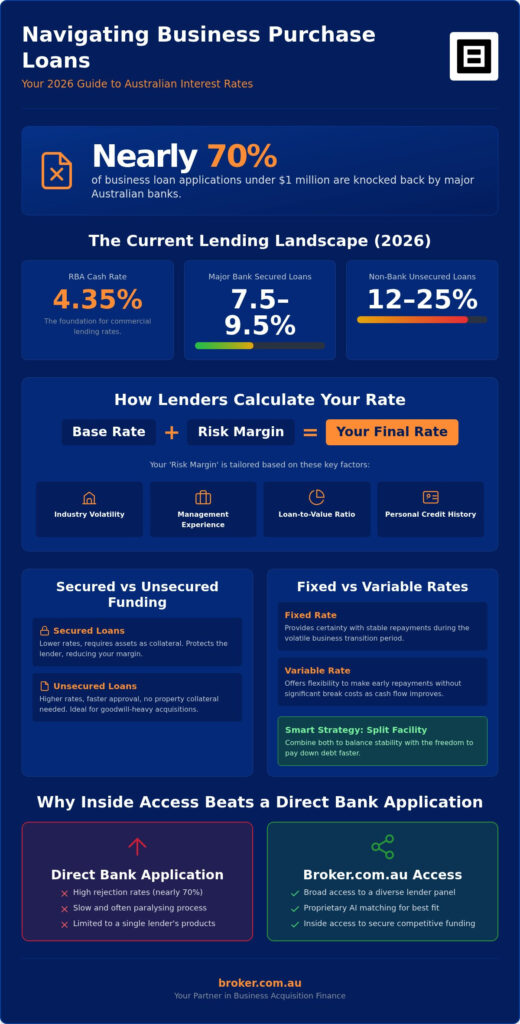
As of July 2026, the Reserve Bank of Australia (RBA) maintains a cash rate target of 4.35%. This serves as the foundation for commercial lending, but the business purchase loan interest rates australia entrepreneurs actually pay are significantly higher. For instance, while the average rate for new small business loans sat at approximately 7.26% earlier this year, major bank secured loans typically range from 7.5% to 9.5%. If you’re looking at non-bank unsecured options for speed, those rates can climb between 12% and 25%. This premium exists because “goodwill” cannot be easily repossessed and sold like a three-bedroom house in the suburbs. Banks often publish ‘indicator’ rates, but your final quote will include a risk margin tailored to your specific financial modelling and industry profile.
Fixed vs Variable Rates for Acquisitions
Choosing between a fixed or variable rate is a strategic decision during an acquisition. Locking in a fixed rate provides certainty during the volatile transition period, ensuring your repayments don’t budge while you’re busy bed-down operations. Conversely, variable rates offer the flexibility to restructure or make early repayments without heavy break costs. In 2026, we’re seeing more savvy buyers opt for split facilities to balance stability with the freedom to pay down debt faster as the business scales and cash flow improves.
The Role of the RBA and Market Indicators
The official cash rate flows directly into commercial ‘base rates’, but larger acquisition loans often look toward the Bank Bill Swap Rate (BBSW) as a more accurate benchmark for the cost of wholesale funds. Lenders use these indicators to set their own internal pricing before adding their margin. Generally, every move the RBA makes triggers a corresponding shift in business loan margins as banks adjust their risk appetite to match the broader economic climate.
How Lenders Calculate Your Interest Rate: The ‘Base + Margin’ Formula
When you receive a quote for a business acquisition, the number you see isn’t pulled from thin air. It’s the result of a precise calculation: Base Rate + Risk Margin. While the base rate is tied to market indicators like the RBA cash rate or the BBSW, the margin is where the lender’s true assessment of your deal lives. This margin is the primary variable in business purchase loan interest rates australia, and it reflects the level of risk the bank thinks it’s taking on by backing your venture.
Several factors can push your risk margin higher. Industry volatility is a major lever. If you’re buying a boutique medical clinic with stable patient records, your margin will be slimmer than if you’re acquiring a seasonal hospitality business. Lenders also scrutinise your management experience. If you’ve never run a business in that sector, expect the margin to widen. Loan-to-Value Ratio (LVR) is another critical component. If you’re asking the bank to fund 80% of the purchase price, they’ll want a higher return for that exposure compared to a 50% LVR deal. Your personal credit history also plays a role, as many lenders still view the individual behind the entity as the ultimate guarantor of debt.
Risk Profiling: What Australian Banks Look For
Banks typically evaluate your application using the ‘Five Cs’ of credit: Character, Capacity, Capital, Collateral, and Conditions. The biggest hurdle in acquisitions is ‘Goodwill’. Lenders are often wary of goodwill because it’s an intangible asset that can evaporate if the transition is botched. This is why historical government-backed loan schemes were so vital; they provided the security banks needed to lend against these less tangible business values. A robust business plan that details your transition strategy can help compress this risk margin significantly.
Hidden Fees and the ‘Comparison Rate’ Trap
The headline rate is often a distraction. You must look at the ‘Effective Interest Rate’ to understand the true cost. Under Australian commercial lending standards, the effective interest rate is the total cost of credit expressed as an annual percentage, incorporating the nominal interest rate plus all mandatory fees and charges amortised over the life of the loan. You should look out for application and establishment fees, valuation fees for the business assets, and ongoing monthly facility fees. If you’re feeling overwhelmed by these calculations, speaking with an expert guide can help you cut through the bank jargon and find a deal that actually preserves your cash flow.
Secured vs Unsecured Rates for Business Acquisitions
When you’re ready to finalise a deal, the structure of your debt often dictates the long-term health of your cash flow. The choice between secured and unsecured funding is the most significant lever you can pull to influence business purchase loan interest rates australia. While secured loans offer the comfort of lower interest rates, they require you to tie up valuable assets as collateral. Unsecured loans, on the other hand, provide the agility needed for fast-moving acquisitions but carry a premium to compensate the lender for their increased exposure. Choosing the right path requires a clear-eyed look at your balance sheet and your appetite for risk.
According to recent Reserve Bank of Australia analysis on small business finance, the availability of collateral remains a primary determinant of both loan approval and pricing. For many Australian entrepreneurs, this often leads to the question of cross-collateralisation. While using your family home to secure a business loan can drop your rate significantly, it places your personal sanctuary directly in the line of fire if the business faces a downturn. It’s a high-stakes trade-off that requires professional guidance to ensure you aren’t over-leveraging your personal life for a professional gain.
Secured Acquisition Finance: Leveraging Assets
Secured finance is the gold standard for buyers who want to minimise their interest expense. By using commercial property or residential equity, you can often access rates that sit between 6.5% and 8.5% in the current 2026 market. For acquisitions involving significant physical assets, such as a transport company or a manufacturing plant, Asset Finance and Chattel Mortgages allow you to secure the loan against the equipment itself. Typical Loan-to-Value Ratios (LVR) for these secured facilities usually cap out at 70% for commercial property, though some niche lenders may stretch further for high-quality applicants.
Unsecured Funding: Speed Over Cost
There are times when waiting six weeks for a bank valuation isn’t an option. In competitive M&A scenarios, unsecured funding provides the “speed to lead” that can close a deal in as little as 24 to 72 hours. These lenders focus on your ‘Capacity’—your demonstrated cash flow and Debt Service Cover Ratio—rather than your ‘Collateral’. Because the lender has no physical asset to seize, business purchase loan interest rates australia for unsecured products typically range from 12% to 25%. This is often the strategic choice for service-based businesses, such as digital agencies or consulting firms, where the primary value lies in contracts and people rather than bricks and mortar.
Strategies to Lower Your Business Purchase Loan Rate
Securing the most competitive business purchase loan interest rates australia has to offer isn’t a matter of luck. It’s the result of deliberate preparation. Lenders reward borrowers who present a low-risk profile, and you can influence this perception before you ever sit down for an interview. One of the most effective levers is your Debt Service Cover Ratio (DSCR). By demonstrating that the business generates significantly more cash flow than is required to meet debt obligations, you provide the lender with a safety buffer. Aiming for a DSCR of 1.5x or higher often signals to a bank that their capital is in safe hands, which can lead to a direct reduction in the risk margin they apply to your quote.
Negotiation is another critical tool. Many borrowers mistakenly focus on the base rate, which is largely dictated by market forces. Instead, you should focus your energy on negotiating the bank’s margin. Providing more ‘skin in the game’ through a larger deposit is a proven way to achieve this. A 30% deposit compared to a 10% deposit changes the lender’s Loan-to-Value Ratio (LVR) and drastically reduces their exposure. Couple this with a clean financial history and up-to-date Business Activity Statements (BAS), and you create a compelling case for a rate discount. Using an expert broker to create competitive tension between multiple lenders ensures you aren’t just taking the first offer your current bank puts on the table.
Professional Documentation and Financial Modelling
High-quality, ‘M&A’ style reporting can transform how a credit team views your application. Detailed financial modelling that includes various ‘what-if’ scenarios shows a level of sophistication that ‘Low Doc’ applications simply cannot match. While Low Doc options might offer speed, they always come with a premium on the interest rate. Professional corporate advisory and structured debt reporting make you look like a lower-risk borrower, allowing you to access the sharpest business purchase loan interest rates australia currently provides.
Optimising Your Security Mix
You don’t have to fund your entire acquisition through a single, high-interest facility. Splitting your loan can be a much more efficient strategy. For example, you might use asset finance for the business’s equipment and vehicles while using a secured commercial loan for the property. You could even integrate invoice finance to manage working capital, which often carries a lower overall interest burden than a traditional overdraft. To start planning your structure, you can use Broker.com.au’s business loan calculator to see how different loan amounts and terms impact your repayments.
If you’re ready to see how these strategies apply to your specific acquisition, I’m interested in exploring my finance options with a specialist who can provide inside access to the best available rates.
Why Inside Access Beats a Direct Bank Application
Walking into your local branch might feel like the logical first step, but it often leads straight into the ‘Single Bank’ trap. Your current bank is limited by its own risk appetite and current product suite; they simply cannot offer you a deal they don’t have. If their internal policy has cooled on your specific industry, the business purchase loan interest rates australia they quote you will reflect that lack of enthusiasm. They won’t tell you that a non-bank lender across town is currently aggressive in your sector and offering a margin two points lower. This is where inside access becomes your greatest asset in a high-stakes acquisition.
At Broker.com.au, we use proprietary AI technology to scan the entire lending landscape in seconds. This isn’t just about speed; it’s about accuracy. Our system matches the nuances of your acquisition, such as your industry, your LVR, and your projected cash flow, to the specific lender niches where you’re most likely to secure a ‘best in class’ offer. We provide a bridge to private funds and non-bank lenders that the general public simply can’t reach. This ensures your application lands on the desk of someone who actually understands the value of your deal rather than a generic credit officer following a rigid checklist.
The Broker Advantage: Competitive Tension
An award-winning broker does more than just fill out paperwork. We create competitive tension by forcing multiple lenders to bid for your business. When banks know they’re in a shootout, they’re much more likely to sharpen their pencils on the risk margin to win the deal. This ‘Expert Guide’ approach removes the inherent anxiety of the process, moving you from uncertainty toward streamlined confidence. You gain inside access to unpublished rates and tailored structures that aren’t available through a standard retail application. We know which lenders are hungry for M&A deals right now and which ones are quietly tightening their belts.
Getting Started with Broker.com.au
We believe finance should be a conversation, not a confrontation. That’s why we use an ‘I’m interested’ approach. It’s a low-pressure way to start discussing your goals without the weight of a formal application hanging over you. Our team, including specialists like Matt, Kylie, and Flavio, provides a human touch to our digital-first process. We manage the complexity so you can focus on the business you’re about to own. From your initial enquiry through to the moment the deal is funded, we ensure the process is seamless, professional, and entirely stress-free. If you’re ready to see what the market really has to offer for business purchase loan interest rates australia, let’s start that conversation today.
Secure Your Business Future Today
Stepping into business ownership is a bold move, but the right finance structure makes it a sustainable one. You now have the tools to look beyond headline numbers and understand how the ‘Base + Margin’ formula impacts your bottom line. Whether you decide to leverage property for lower costs or prioritise the speed of unsecured funding, the key is to ensure your choice supports your long-term cash flow. Navigating business purchase loan interest rates australia doesn’t have to be a source of stress when you have the right insights at your disposal.
We’re here to help you move from uncertainty to a position of strength. As an award-winning broker, we use proprietary AI matching technology and a national panel of bank and non-bank lenders to find a tailored solution for your specific needs. Our team is ready to manage the heavy lifting, providing a seamless path to settlement so you can focus on leading your new acquisition. You’re in good hands with experts who prioritise your success.
I’m interested: let’s find your best rate
Your acquisition journey is just beginning, and we look forward to helping you turn your vision into a reality with confidence and ease.
Frequently Asked Questions
What is a typical interest rate for a business purchase loan in Australia in 2026?
Typical rates in the current market depend heavily on the security you provide. For secured loans through major banks, you can expect rates to range between 7.5% and 9.5% p.a. as of July 2026. If you’re looking at unsecured options from non-bank lenders, rates generally sit between 12% and 25% p.a. to account for the increased lender risk. Your specific business purchase loan interest rates australia quote will be determined by your risk margin, which is influenced by your experience and the business’s cash flow.
Can I get a loan to buy a business without any collateral?
Yes, it’s possible to secure an Unsecured Business Loan for an acquisition. In these cases, lenders don’t require physical assets like property or equipment as security; instead, they focus on your ‘Capacity’ to repay. They’ll scrutinise your projected cash flow and the historical performance of the target business. While these loans offer greater flexibility and speed, they do carry higher interest rates and shorter terms than secured facilities because the lender has no assets to claim if the loan defaults.
How does the RBA cash rate affect my existing business loan?
If your loan is on a variable rate, it’ll typically move in tandem with the RBA cash rate, which currently sits at 4.35%. When the RBA adjusts this target, banks usually update their internal ‘base rates’ accordingly. This means your monthly repayments will increase or decrease shortly after an RBA announcement. If you’ve locked in a fixed rate, your repayments remain unchanged regardless of RBA moves until your fixed term expires, providing you with a buffer against market volatility.
Is it better to choose a fixed or variable rate when buying a business?
The right choice depends on whether you value repayment certainty or financial flexibility. A fixed rate is often reassuring during the high-stakes transition period of an acquisition because it protects your cash flow from sudden rate hikes. However, variable rates offer the freedom to make extra repayments or refinance your debt without facing expensive break costs. Many savvy buyers opt to split their facility, fixing a portion for stability while keeping the rest variable for flexibility.
What documents do I need to secure the best interest rate?
To access the most competitive rates, you need to present a professional, low-risk profile. This requires two years of personal and business tax returns, up-to-date BAS statements, and a robust business plan for the acquisition. Lenders also want to see detailed financial modelling and profit and loss statements for the target entity. Providing high-quality documentation shows the lender you’re in control, which helps compress the risk margin they apply to your business purchase loan interest rates australia quote.
How long does it take to get a business purchase loan approved?
Approval timelines vary drastically depending on the lender you choose. Traditional banks have rigorous processes that can take several weeks or even months to reach a final decision. Conversely, fintech and non-bank lenders specialise in speed, often providing approvals within 24 to 72 hours. Using a broker with proprietary AI technology can accelerate this process further by ensuring your application is matched with the right lender niche from the very beginning, avoiding unnecessary delays.
What is the difference between a secured and unsecured business loan?
A secured loan is backed by collateral, such as commercial property, residential equity, or the business’s physical assets. Because the lender has an asset to sell if things go wrong, they offer much lower interest rates. An unsecured loan doesn’t require collateral but relies entirely on your creditworthiness and the business’s ability to generate cash. While unsecured loans are faster to arrange and protect your assets, they come with higher interest costs and more stringent repayment schedules.
Can I use my home as security for a business acquisition loan?
Yes, using your residential equity is a common strategy to secure a lower interest rate for a business purchase. By providing your home as collateral, you offer the lender a high level of security, which typically unlocks the most competitive rates on the market. It’s important to remember that this involves cross-collateralisation. While it reduces your interest burden, it also means your personal property is directly at risk if the business encounters financial difficulties and cannot meet its debt obligations.