
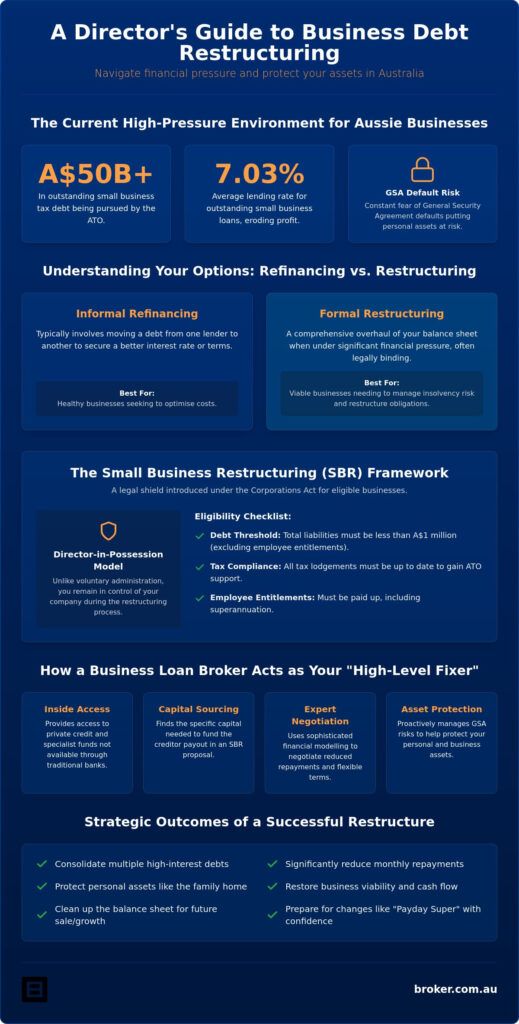
Did you know the ATO is currently pursuing more than A$50 billion in outstanding small business tax debt? If your profit margins are being eroded by interest rates hovering around 7.03% and the constant fear of a General Security Agreement (GSA) default, you aren’t alone. It’s a high-pressure environment, but understanding how a business loan broker can help with debt restructuring is often the first step toward reclaiming control. Many directors feel trapped by rigid repayment schedules, yet the right expert brokerage provides the inside access needed to turn a complex debt burden into a manageable strategic pivot.
You’ve worked too hard to let a temporary cash flow crunch put your family home or business assets at risk. This article will show you how to navigate the complexities of debt restructuring agreements to protect what you’ve built and restore vital liquidity. We’ll explore how to consolidate multiple high-interest facilities into a single loan, reduce your monthly repayments, and prepare your balance sheet for the July 2026 “Payday Super” transition with streamlined confidence.
Key Takeaways
- Identify the critical distinctions between informal refinancing and a formal Small Business Restructuring (SBR) agreement to remain compliant with the A$1 million liability threshold.
- Discover exactly how a business loan broker can help with debt restructuring by providing inside access to private credit and specialist funds beyond the reach of traditional banks.
- Learn how to use sophisticated financial modelling as your primary weapon to negotiate reduced monthly repayments and more flexible loan terms.
- Explore strategic consolidation techniques to merge fragmented high-interest facilities, such as equipment finance and unsecured loans, into one streamlined facility.
- Gain insights into protecting your personal assets, like the family home, by proactively managing General Security Agreement (GSA) risks with an expert guide.
Table of Contents
- What is a Business Loan Restructuring Agreement in Australia?
- The Small Business Restructuring (SBR) Framework
- Strategic Debt Restructuring: Refinance vs Consolidation
- Negotiating Terms: How to Secure a Favourable Agreement
- How Broker.com.au Facilitates Seamless Debt Restructuring
What is a Business Loan Restructuring Agreement in Australia?
A business loan restructuring agreement is a formal contract between your company and its creditors to modify the terms of existing debt. It isn’t just a simple extension of a deadline. It’s a sophisticated financial pivot designed to restore your company’s viability. Unlike a standard loan application, Debt restructuring involves a comprehensive overhaul of your balance sheet to ensure your business can meet its obligations without collapsing under the weight of rigid repayment schedules. In 2026, with average small business lending rates for outstanding loans sitting at 7.03%, these agreements have become essential tools for survival.
Understanding how a business loan broker can help with debt restructuring starts with distinguishing between informal refinancing and a formal agreement. Refinancing typically involves moving a debt from one lender to another to secure a better rate. A formal restructuring agreement, however, often occurs when the business is under significant pressure. It may involve partial debt forgiveness, altered security arrangements on the Personal Property Securities Register (PPSR), or a total stay of payments. While a Restructuring Practitioner handles the legal administration of a Small Business Restructuring (SBR) plan, a commercial finance broker acts as the “High-Level Fixer.” We find the specific capital or alternative lenders needed to fund the proposal and keep the doors open.
Key Components of a Standard Agreement
A well-crafted agreement usually includes revised repayment schedules that align with your actual cash flow cycles rather than a bank’s arbitrary calendar. You might see interest rate adjustments or “covenant holidays,” which provide temporary relief from strict financial performance requirements. In more complex scenarios, the agreement could include debt-for-equity swaps or modifications to security arrangements. These changes are designed to protect your assets while giving the business the breathing room it needs to return to profitability.
When Should You Consider a Formal Agreement?
You don’t need to wait for a total collapse to act. If your business is facing technical insolvency, where liabilities outweigh assets, or if the ATO is aggressively pursuing a portion of that A$50 billion in outstanding small business debt, it’s time to move. We often apply the “Fair Go” test: is the underlying business model still profitable if the debt burden was lighter? If the answer is yes, restructuring can be a powerful way to clean up the balance sheet before a business acquisition or a future sale. It’s about moving from a state of constant anxiety to a position of streamlined confidence.
The Small Business Restructuring (SBR) Framework
The Small Business Restructuring (SBR) framework, introduced under Part 5.3B of the Corporations Act, represents a significant shift in Australian insolvency law. Unlike voluntary administration, which often sees directors lose control to an external party, the SBR process operates on a “Director-in-Possession” model. This means you remain at the helm of your company while working with a professional to compromise debts. In a 2026 environment where the ATO is pursuing over A$50 billion in small business debt, this framework provides a legal shield to propose a Strategic Debt Restructuring plan that creditors can vote on. Understanding how a business loan broker can help with debt restructuring is vital here, as the success of your plan often hinges on securing new capital to fund the creditor payout.
Once the process begins, you have a 20-business-day window to develop a restructuring plan. This plan is then put to creditors for a vote. For the plan to be accepted, a majority in value of the creditors who vote must agree to the terms. If successful, the business is freed from the old debt burden and can continue trading. If you’re currently feeling the pressure of rigid repayment schedules, you might want to discover more about how fresh finance can support an SBR proposal.
Eligibility Criteria for the SBR Process
- Debt Threshold: Your total liabilities must be less than A$1 million. This figure excludes employee entitlements but includes all secured and unsecured debts.
- Compliance: All tax lodgements must be up to date. The ATO is unlikely to support a plan if your reporting isn’t current.
- Employee Entitlements: All due employee entitlements, including superannuation, must be paid in full before the plan is proposed to creditors.
- Exclusivity: The company, and its current or former directors, must not have used the SBR process or simplified liquidation in the previous seven years.
The Role of the Restructuring Practitioner
The Restructuring Practitioner acts as a neutral intermediary. Their job is to assess your company’s viability and certify to creditors that the proposed plan is achievable. They don’t run your business; they supervise the restructuring process. In 2026, regulatory standards have increased practitioner accountability, ensuring they provide a high level of scrutiny to every application. While they manage the legalities, a broker works in the background to ensure you have the Working Capital Finance or Secured Business Loans necessary to make the plan’s “cents in the dollar” offer attractive to your lenders.
Strategic Debt Restructuring: Refinance vs Consolidation
Restructuring isn’t always a desperate move for survival. For many high-performing Australian SMEs, it’s a strategic choice to unlock growth and improve operational efficiency. While the previous section focused on the legal framework of insolvency, most businesses thrive by simply recalibrating their debt before things reach a breaking point. This is how a business loan broker can help with debt restructuring; we identify whether your situation requires a simple refinance to a more flexible lender or a comprehensive consolidation of multiple high-interest facilities.
With RBA data from February 2026 showing average small business lending rates for outstanding loans at 7.03%, even a minor adjustment in your debt structure can yield significant savings. For businesses with strong property backing, asset-backed restructuring allows you to use commercial property to secure lower-cost, long-term debt. If you’re facing a temporary gap during this pivot, unsecured bridge funding can provide the necessary liquidity to keep operations seamless while the new, permanent facility is being finalised.
Refinancing for Better Terms
Moving your debt from a Tier 1 bank to a specialist lender is often the most efficient way to gain flexibility. Major banks frequently impose rigid covenants and restrictive balloon payments that can suddenly drain your cash reserves. We look for lenders who offer tailored repayment structures that better match your seasonal cash flow. When considering this path, we help you identify and account for hidden costs that banks don’t always highlight, such as:
- Break fees: Costs associated with exiting a fixed-rate contract early.
- Valuation charges: Fees for updated appraisals on security assets.
- Discharge fees: Administrative costs to release existing mortgages or GSAs.
Debt Consolidation Strategies
Consolidation is the process of merging fragmented debts into a single, manageable facility. This is particularly effective if you’ve accumulated various short-term working capital loans, equipment finance, and lines of credit with different expiry dates. By rolling these into one term loan, you reduce administrative overhead and often lower your total interest expense.
One sophisticated approach involves debt recycling, where business owners use residential property equity to secure business funding at lower residential rates. Alternatively, you might use Invoice Finance to pay down high-interest supplier debt, effectively using your accounts receivable to replace more expensive forms of credit. This streamlined approach moves you away from the anxiety of multiple repayment dates toward a state of organised financial control.
Negotiating Terms: How to Secure a Favourable Agreement
Securing a favourable debt restructuring agreement is rarely about asking for a favour; it’s about presenting a compelling business case that makes a lender feel secure. In the high-stakes environment of 2026, where the ATO is actively pursuing outstanding debts and interest rates remain a primary concern for SMEs, your approach to negotiation must be clinical. This is exactly how a business loan broker can help with debt restructuring. We move the conversation away from your current distress and toward a structured, data-backed recovery. By acting as your corporate advisory partner, we bridge the gap between your immediate cash flow pressure and a lender’s need for risk mitigation.
Your strongest weapon in these negotiations is sophisticated financial modelling. Lenders need to see more than just a balance sheet; they want to see a “Problem-Solution” pitch that clearly demonstrates how the restructure ensures they get their money back. We help you build these models to prove that once the debt is consolidated or refinanced, the business has the liquidity to thrive. This process often includes negotiating the removal of restrictive financial covenants. If your current loan has “maintenance covenants” that trigger a default if your profit dips for a single quarter, we work to replace them with “incurrence covenants” that only apply when you take on new debt. This gives you the essential room to breathe and grow post-restructure.
What Lenders Look for in a Restructure
Lenders look at your historical performance, but they’re far more interested in your future cash flow projections and the quality of your management team. They want to see a proactive, can-do attitude rather than a reactive one. Proprietary AI-driven data analysis in 2026 allows lenders to see beyond surface-level risks, providing a granular view of future cash flow that significantly boosts their confidence in a proposed restructure. Showing that you’ve identified market trends and adjusted your model accordingly is often the difference between a rejection and an approval.
Common Pitfalls to Avoid
One of the most dangerous traps for Australian business owners is cross-collateralisation. You should never allow your family home to be “all-in” for business debt if it can be avoided. We focus on untangling these arrangements to preserve your personal assets. Another fatal mistake is the “Ostrich Effect”-waiting too long to start the conversation. By the time you’re facing a GSA default, your leverage is gone. Finally, avoid the urge to over-promise on repayments just to get a deal over the line. Triggering a second default is often the end of the road for an SME. To avoid these traps and secure a tailored solution, I’m interested in starting a low-pressure conversation about your options.
How Broker.com.au Facilitates Seamless Debt Restructuring
At Broker.com.au, we don’t just facilitate loans; we architect financial recoveries. Understanding how a business loan broker can help with debt restructuring is the first step, but successful execution requires a partner who moves with speed and precision. As an award-winning national broker, we specialise in navigating the complex Australian lending landscape to protect your assets and restore your cash flow. We act as your high-level fixer, untangling complicated debt structures so you can focus on running your business with streamlined confidence.
Our competitive edge lies in our inside access to over 50 lenders. This network includes traditional banks, but more importantly, it provides access to private credit and specialist funds that often remain invisible to the average business owner. These lenders are frequently more restructure-friendly, offering the flexibility required to consolidate high-interest facilities or provide Secured Business Loans that traditional institutions might decline. With our team by your side, you’re in good hands throughout the entire process.
The Broker.com.au Advantage
We utilise a sophisticated Problem-Solution approach to resolve complex commercial and asset debt. While other firms might rely on manual spreadsheets, our proprietary AI technology matches your business to the most suitable lenders in a fraction of the time. This AI doesn’t replace our human expertise; it enhances it. It ensures that your application is accurate, tailored, and sent to the specific funder most likely to approve your unique scenario. Our team members, including Matt, Kylie, and Flavio, then take over to lead the high-stakes negotiations with lenders on your behalf.
Our results speak for themselves. We’ve helped countless Australian SMEs turn the corner, moving them from the brink of a GSA default to a position of sustainable growth. By providing the corporate advisory and financial modelling lenders demand, we ensure your restructure isn’t just a temporary fix, but a permanent resolution. This proactive approach is exactly how a business loan broker can help with debt restructuring when traditional avenues have closed.
Get Started with a Specialist Advisory
We believe that high-stakes financial decisions should be as stress-free as possible. That’s why we use a low-pressure “I’m interested” approach. It isn’t a heavy commitment; it’s the start of a professional conversation about your options. Whether you’re in a major capital city or a regional centre, our national coverage ensures you receive specialised advice tailored to your specific market conditions.
Discover how our award-winning team can organise your business debt today.
Restore Your Financial Momentum
The Australian financial landscape in 2026 demands more than just hard work; it requires a sophisticated strategy to handle the A$50 billion in outstanding SME tax debt and rising interest pressures. You’ve seen how the Small Business Restructuring framework and strategic consolidation can protect your assets and restore vital liquidity. Understanding how a business loan broker can help with debt restructuring is the difference between struggling under rigid bank terms and pivoting toward a sustainable, profitable future. By untangling cross-collateralised debts and negotiating better covenants, you ensure your family home and business assets remain secure.
Our Expert Corporate Advisory Team is ready to guide you through this transition with Proprietary AI-Driven Accuracy. We provide Award-Winning Finance Solutions that move you from a state of uncertainty toward streamlined confidence. You don’t have to navigate these complexities alone. If you’re ready to explore a tailored path forward with our high-level fixers, we’re here to help.
I’m interested in restructuring my business debt
It’s time to stop worrying about repayment schedules and start focusing on your next phase of growth. Your business is in good hands with us.
Frequently Asked Questions
What is the difference between a business loan restructure and refinancing?
Refinancing is primarily about moving debt to a new lender for a better rate or term, while restructuring involves changing the fundamental structure of your debt to ensure business viability. A restructure often occurs when a business is under pressure and may include debt forgiveness or altered security arrangements. Understanding how a business loan broker can help with debt restructuring is vital here, as they identify whether a simple refinance or a more complex legal framework like the SBR is the most efficient path for your cash flow.
Can I restructure my business loans if I have an ATO debt?
You can absolutely restructure with ATO debt; the Small Business Restructuring (SBR) framework was specifically designed to address this scenario. With the ATO pursuing over A$50 billion in small business debt in 2026, many SMEs use this process to propose a compromise. We help you secure the capital needed to make a “cents in the dollar” offer that creditors, including the tax office, are more likely to accept, moving you from uncertainty toward a state of relief.
Will a restructuring agreement affect my credit score as a director?
A formal restructuring appointment does not appear on your personal credit file, though any payment defaults recorded before the process began will remain for up to five years. While the company’s restructure is noted on public ASIC registers, your personal credit score is generally protected unless a personal guarantee is called upon. Our expert guide approach aims to manage the process so you can restore your business without compromising your long-term personal borrowing capacity.
How long does it typically take to finalise a restructuring agreement in Australia?
A formal SBR process typically takes about seven weeks from the appointment of a practitioner to the final creditor vote. This timeline includes a strict 20-business-day period to develop the proposal and a subsequent 15-business-day window for creditors to cast their votes. Informal restructures handled through a broker can vary in length depending on the complexity of the lenders involved and the speed of your financial modelling, though we aim for a seamless and efficient transition.
Do I need to provide a personal guarantee for a restructured loan?
Lenders often request a personal guarantee for a restructured loan, but this is a key area where sophisticated negotiation is essential. We work to ensure your personal assets, such as the family home, are not cross-collateralised with business debt. By utilizing Secured Business Loans backed by commercial equity, we can often limit the scope of personal liability and provide you with a more secure, stress-free financial foundation for future growth.
What happens if my creditors reject the proposed restructuring plan?
If creditors reject a formal restructuring plan, the company may face voluntary administration or liquidation unless an alternative arrangement is secured. However, a broker can often prevent this outcome by identifying “Plan B” funding from private credit or specialist funds that traditional banks don’t advertise. This proactive strategy demonstrates how a business loan broker can help with debt restructuring by providing a safety net when mainstream lending avenues have closed.
Is a restructuring agreement public knowledge?
Formal restructuring processes under the Corporations Act, such as SBR or voluntary administration, are matters of public record and are listed on the ASIC insolvency notices website. In contrast, informal debt negotiations and private refinancing agreements remain confidential between you and your lenders. We help you weigh the benefits of a formal legal shield against the privacy of an informal turnaround to ensure the process aligns with your company’s reputation and goals.
Can I still get a business loan if I have previously restructured?
You can still obtain business finance after a restructure, although your choice of lenders may change in the short term. While Tier 1 banks often require 18 to 24 months of clean trading history post-restructure, second-tier and specialist lenders frequently consider applications after only 6 to 12 months. We use our inside access to find these flexible lenders who prioritise your current cash flow consistency over past technical insolvency, helping you stay in good hands as you grow.