
Why does a traditional lender look at your thriving company’s complex tax structure and see a “risk” instead of a success story? It’s incredibly frustrating when your accountant works hard to legalise your tax position, only for a bank to tell you that your serviceability doesn’t meet their rigid PAYG boxes. With the RBA cash rate sitting at 4.35% in July 2026 and lenders applying a strict 3% serviceability buffer, the hurdle for self-employed Australians has never felt higher.
You shouldn’t be penalised for your entrepreneurial success. We’ve designed this guide to flip the script, offering you the essential business owner home loan application tips you need to secure a competitive rate without the usual paperwork headaches. Our expert strategies focus on presenting a clear financial narrative that lenders can’t ignore, even with trusts or companies in the mix.
We’ll show you exactly which documents actually matter to credit assessors, how to manage the current 20% cap on high debt-to-income lending, and the most efficient way to move from application anxiety to a stress-free approval.
Key Takeaways
- Discover why specialist lenders are becoming the primary choice for business owners in 2026 as traditional banks tighten their criteria.
- Learn how to use legal “add-backs” to boost your borrowing power and implement our top business owner home loan application tips for a seamless approval.
- Understand the difference between Full Doc and Alt Doc structures to choose the path that best fits your current financial reporting.
- Organise your ATO paperwork and Notice of Assessments early to avoid the common delays that cause application anxiety.
- Gain inside access to hidden credit policies through expert brokerage and AI technology to find a tailored lender match.
Table of Contents
- Understanding the Self-Employed Lending Landscape in 2026
- Optimising Your Financials: Beyond the Net Profit Figure
- Choosing the Right Loan Structure: Full Doc, Low Doc, and Alt Doc
- Your Pre-Application Checklist: Organising Documents Like a Pro
- How a Specialist Broker Streamlines Your Path to Settlement
Understanding the Self-Employed Lending Landscape in 2026
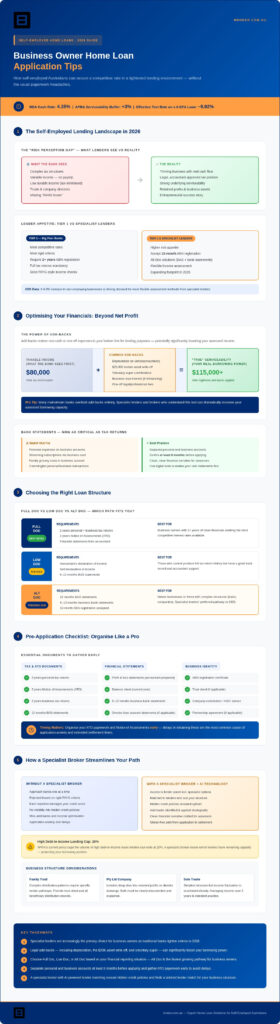
Being your own boss is the Australian dream, but for a bank’s credit assessor, it often looks like a puzzle with missing pieces. Whether you are a sole trader, a partner in a professional firm, or a company director, your income isn’t a simple figure on a weekly payslip. It’s a reflection of your business’s health, tax strategy, and cash flow. This complexity often creates a “risk perception gap” where a lender might see uncertainty in your financials, even if your business is thriving.
In 2026, the lending environment has shifted significantly. While traditional banks have tightened their criteria to manage risk, specialist lenders are expanding their footprint. Recent ABS data shows a 4.9% increase in non-employing businesses, and this growing segment of self-employed Australians is driving a need for more flexible assessment methods. Understanding the mortgage origination process is vital because it reveals how different lenders vet your business stability. One of the most effective business owner home loan application tips we can offer is to identify whether your structure, such as a family trust or a proprietary limited company, dictates a specific lending path. A trust often involves complex distribution patterns, while a company structure requires a deep dive into retained profits versus director drawings.
The Impact of Current Interest Rate Predictions
The RBA cash rate sits at 4.35% as of July 2026, and this has a direct impact on how much you can borrow. APRA still requires lenders to apply a 3% serviceability buffer. This means if you’re applying for a loan at 6.92%, the lender tests your ability to pay at nearly 10%. Inflation also plays a role. Lenders are scrutinising business expenses more closely to ensure your “net profit” isn’t being eroded by rising costs. You’ve got to stress-test your own cash flow before the bank does it for you.
Lender Appetite: Tier 1 vs Tier 2 Lenders
The “Big Four” banks still offer some of the most competitive rates, but they’re often the most rigid. If your ABN has been registered for less than two years, you might find their doors closed. Tier 2 and specialist lenders have a higher appetite for risk and often accept a 12-month ABN registration if the business narrative is strong. These specialists focus on “Alt-Doc” solutions, looking at your Business Activity Statements (BAS) and bank statements rather than just your final tax returns. Choosing between them depends on how you’ve organised your financials and how quickly you need to move.
Optimising Your Financials: Beyond the Net Profit Figure
Your accountant’s primary goal is to minimise your tax bill. While this is great for your cash flow, it often creates a hurdle when you’re seeking a home loan. Traditional lenders typically look at your taxable income and assume that’s all you have to live on. This is where many applications fail. One of the most critical business owner home loan application tips is to look beyond that final figure on your tax return and focus on your “true” serviceability. You need to show the bank that your business is more profitable than your tax return suggests.
Bank statements have become as important as tax returns in 2026. Lenders now use sophisticated digital tools to scrape your transactions, searching for personal lifestyle costs hidden within business accounts. If your business account is paying for your streaming subscriptions or the family’s weekly groceries, it muddies the water. Separating these accounts at least six months before you apply makes your financial narrative much cleaner. Exploring different mortgage lender options will show that some are far more adept at calculating these adjustments than others.
The Magic of Add-backs Explained
Add-backs are the process of restoring non-cash or one-off expenses to your bottom line for lending purposes. This is a powerful tool that many mainstream banks overlook. If you’ve utilised the $20,000 instant asset write-off for a new piece of equipment, that’s a one-off cost that won’t repeat next year. Other common add-backs include:
- Depreciation on assets like vehicles or machinery.
- Voluntary superannuation contributions above the mandated “Payday Super” levels.
- Interest expenses on business loans that you’re planning to refinance.
- One-off legal or professional fees that aren’t part of daily operations.
Director Loans and Dividends
How you take money out of the business matters as much as how much you take. Lenders prefer consistency. If you pay yourself a regular wage or dividend, it’s easier for them to map your lifestyle. Sporadic lump sums or relying on a shareholder loan can raise red flags. It suggests the business is being used as a personal ATM, which makes credit assessors nervous. Cleaning up these entries before you apply is essential to presenting a narrative of stability and professional financial management. Our team can help you identify these hidden figures to ensure you’re in the best position before you get started.
Choosing the Right Loan Structure: Full Doc, Low Doc, and Alt Doc
Not every entrepreneur’s journey follows a straight line. If your company is in a high-growth phase, your tax returns from two years ago probably don’t reflect your current success. This is why choosing the right loan structure is one of the most vital business owner home loan application tips for 2026. You need to match the product to your business’s current life cycle rather than forcing your financials into a box that no longer fits. The lending market has evolved to recognise that a “snapshot” of the past isn’t always an accurate predictor of the future.
Full Doc loans remain the gold standard for securing the lowest possible interest rates. These require two years of full tax returns and matching Notices of Assessment from the ATO. However, for those with more complex setups or recent scaling, “Alt Doc” has become a mainstream solution. Recent industry reports show a 195% surge in application volumes for alt-doc residential products. This shift highlights a growing lender confidence in using Business Activity Statements (BAS) and bank statements to verify income in real-time. It allows you to prove your current serviceability based on what you are earning today, not what you earned eighteen months ago.
When to Consider a Low Doc Loan
Low Doc loans are specifically designed for borrowers with substantial equity but limited recent paperwork. If you have a 20% deposit or significant existing property equity, you can often secure a loan by declaring your own income. The trade-off is usually a slightly higher interest rate compared to Full Doc products. For a rapidly growing business, the speed and flexibility of this path can outweigh the higher cost. Most lenders cap the Loan-to-Value Ratio (LVR) at 80% for these products, though some specialist lenders may require a larger deposit depending on the industry.
The Accountant Letter Strategy
A professional declaration from your accountant can bridge the gap between what the ATO sees and what a lender needs. This letter isn’t just a simple note; it’s a formal verification of your business’s ability to service the debt without hardship. It’s essential that your accountant and broker are aligned before any documents are submitted. They need to agree on the narrative of your income and ensure that any dividends or drawings mentioned in the letter match the bank statements provided. This level of professional coordination is what moves an application from a “maybe” to a “yes”.
Your Pre-Application Checklist: Organising Documents Like a Pro
Preparation is the antidote to rejection. While a PAYG employee might only need two recent payslips, your application requires a comprehensive financial autobiography. Lenders in 2026 are increasingly reliant on digital data matching with the ATO, making the accuracy of your paperwork non-negotiable. Applying these business owner home loan application tips starts with a meticulously organised folder that pre-empts every question a credit assessor might ask. If you can provide a clear, transparent view of your financial health from the outset, you significantly reduce the “back-and-forth” that often leads to application fatigue.
For a standard Full Doc application, you’ll need your personal and business tax returns for the last two financial years. Crucially, these must be accompanied by the matching Notices of Assessment (NOA) from the ATO. Lenders use the NOA to verify that the figures you’ve provided are the final versions accepted by the tax office. You should also prepare:
- Profit and Loss (P&L) statements and Balance Sheets, ideally current within the last six months.
- A detailed business debt schedule covering equipment finance, vehicle finance, and any lines of credit.
- Evidence of your “Payday Super” compliance, as real-time reporting is now a standard check for business health.
- A current Statement of Position that highlights your true net worth, including equity in other properties or business assets.
The “Clean Bank Statement” Rule
Lenders typically scrutinise the last three to six months of your business and personal bank statements. They aren’t just looking at the balance; they’re looking at your habits. One major red flag is “round-robin” transfers, where money moves between business and personal accounts in a way that looks like income inflation. It’s vital to keep your transactions transparent. Clearly distinguish between essential business costs and discretionary personal spending. If you’ve been using your business account for family holidays or high-end retail, stop at least six months before applying to ensure your statements present a professional, disciplined narrative.
Liability and Asset Management
Honesty is the only policy when it comes to business liabilities. Even if a loan is in the company name, it will almost certainly impact your personal borrowing capacity. Lenders look at your total exposure, including unsecured business loans or working capital finance. If you have significant asset finance for trucks or machinery, prepare to explain how the business services these debts independently of your personal income. A well-prepared Statement of Position should clearly link assets to their corresponding liabilities, showing the lender that your business is a self-sustaining entity. To ensure your documentation meets the highest standard of accuracy, discover our tailored approach today.
How a Specialist Broker Streamlines Your Path to Settlement
Approaching a major bank directly as a self-employed borrower is often a frustrating exercise in trial and error. While a bank’s internal staff are trained to sell their own limited range of products, they rarely have the authority or the insight to look past a rigid credit box. A specialist broker provides what we call “inside access” to the actual credit policies that lenders hide from the general public. We know which banks have an appetite for 12-month ABN registrations and which ones will penalise you for a single year of lower profits. This level of insight is what transforms a complex application into a seamless approval.
One of the most effective business owner home loan application tips we can offer is to let an expert translate your financials into a narrative that credit assessors value. We don’t just hand over a pile of tax returns; we explain the story behind the numbers. If you had a one-off equipment purchase or a temporary dip due to business expansion, we ensure the lender understands these as signs of growth rather than instability. By leveraging our corporate advisory background, we ensure that complex trust distributions and company retained profits are presented as strengths that support your serviceability.
The Broker.com.au AI-Driven Process
In 2026, speed and accuracy are the benchmarks of a professional application. We utilize proprietary AI technology to scan complex business bank statements and tax structures, identifying potential serviceability gaps before they ever reach a lender’s desk. This proactive approach significantly reduces the time-consuming paperwork and the “back-and-forth” that often causes application anxiety. Our technology allows us to compare your unique profile against a panel of over 30 lenders instantly, finding the most competitive interest rates and tailored terms for your specific situation. This digital advantage ensures your application is “bank-ready” from day one.
Taking the Next Step
The ultimate strategy for success is to start your preparation early. We recommend starting the conversation at least six months before you plan to purchase. This window allows us to work with you and your accountant to clean up bank statements, manage director loans, and ensure your “payday super” lodgements are perfect. Our team, led by experts like Matt, Kylie, and Flavio, takes a low-pressure, professional approach to every enquiry. We move you from a state of uncertainty toward a feeling of streamlined confidence, managing every detail from the initial conversation to the final key handover. Ready to secure your home? I’m interested in a business owner home loan.
Secure Your Property Future with Confidence
Owning a business shouldn’t be a barrier to homeownership. By focusing on “add-backs” to reveal your true serviceability and maintaining clean bank statements, you shift the lender’s focus from risk to opportunity. These business owner home loan application tips are designed to help you navigate a 2026 lending environment where traditional banks often overlook the nuances of your success. Whether you are opting for a traditional Full Doc path or a flexible Alt Doc structure, the key is presenting a well-prepared financial narrative that reflects your current growth.
As an award-winning Australian brokerage, we combine specialist expertise in complex business structures with proprietary AI-driven technology to find your perfect lender match. We bridge the gap between your tax strategy and the bank’s criteria, ensuring a seamless path to settlement that respects your time and your achievements. Our team understands both the business and personal sides of your balance sheet, providing the “inside access” needed for a stress-free approval.
Ready to turn your hard work into property equity? I’m interested in a tailored home loan solution. You’ve built a successful business; now it’s time to secure the home you deserve. We’re here to make that transition as smooth and efficient as possible.
Frequently Asked Questions
Can I get a home loan with only one year of business tax returns?
Yes, you can secure a home loan with only one year of tax returns by using specialist lenders who offer Alt-Doc products. While the major banks typically demand two years of history, many non-bank lenders now accept 12 months of ABN registration if supported by Business Activity Statements or an accountant’s letter. This flexibility is vital for rapidly scaling businesses that haven’t yet reached the traditional two-year milestone.
How do lenders treat business debts when I apply for a personal mortgage?
Lenders view business debts as ongoing liabilities that directly reduce your personal borrowing capacity. Even if a loan for equipment or a vehicle is in your company’s name, the monthly repayments are factored into your total debt-to-income ratio. It is essential to provide a clear debt schedule showing how the business services these obligations independently of your personal drawings to minimise the impact on your mortgage application.
What is the minimum ABN registration time required for a home loan?
The minimum ABN registration time is generally 12 months for specialist lenders, whereas traditional banks usually require a full 24 months. If your business has been active for at least one year and you can demonstrate consistent GST lodgements, you have a strong chance of approval. Our team uses proprietary AI technology to match your specific ABN history with lenders who have the highest appetite for newer businesses.
Does having a “Low Doc” loan mean I will pay a significantly higher interest rate?
Not necessarily, as the interest rate gap between Low Doc and Full Doc products has narrowed significantly in 2026. While you might pay a small premium for the added flexibility, increased competition among non-bank lenders has made these options very price-competitive. The trade-off for a slightly higher rate is often a much faster approval process and the ability to secure a home without providing years of complex tax returns.
How can I increase my borrowing power as a self-employed borrower?
One of the most effective business owner home loan application tips to increase borrowing power is to identify all legitimate “add-backs” such as depreciation and one-off equipment write-offs. By restoring these non-cash expenses to your bottom line, you present a higher net profit to the lender. Additionally, ensuring your personal and business expenses are strictly separated at least six months prior to applying will significantly clean up your serviceability profile.
What are “add-backs” and how do they help my application?
Add-backs are specific business expenses that lenders are willing to add back to your net profit to give a truer reflection of your actual income. Common examples include one-off capital purchases, voluntary superannuation contributions, and non-cash items like depreciation. By using add-backs, you can legally increase your reported income for lending purposes, which often makes the difference between a rejection and a stress-free approval.
Can I use my business equity as a deposit for a personal home loan?
You cannot use business equity directly as a deposit, but you can access those funds through director drawings, dividends, or by refinancing business assets to release cash. This requires careful coordination with your accountant to ensure the transaction is tax-compliant and doesn’t negatively impact the business’s balance sheet. We specialise in complex structures and can help you navigate the best way to extract equity for your property goals.
Why was my home loan rejected by a major bank despite my business being profitable?
Major banks often reject profitable business owners because their rigid credit models fail to account for tax-minimisation strategies or complex trust structures. If your taxable income is low due to high legal deductions, a bank’s automated system may flag you as unable to service the debt. In 2026, the 3% serviceability buffer and strict debt-to-income caps mean that even small inconsistencies in your paperwork can lead to an immediate “no” from traditional institutions.