
Why does a major bank treat a successful company director like a credit risk just because their tax returns are optimised for business growth? It’s an exhausting reality for many directors who find their complex trust or company structures are misunderstood by rigid lending algorithms. When you’re time-poor and focused on scaling your enterprise, you need a finance partner who speaks your language. Specialist low doc home loans for company directors provide a tailored path to property ownership by using your business bank statements or BAS as proof of income, rather than relying on outdated tax assessments.
We agree that your true wealth shouldn’t be hidden behind clever accounting or complex corporate shells. This 2026 guide promises to show you exactly how to secure a competitive mortgage rate using alternative documentation that reflects your actual cash flow. We will preview the latest market shifts, including how to navigate the current 4.35% cash rate and APRA’s 3% serviceability buffer, ensuring your application process is both efficient and stress-free. It’s time to move past the paperwork hurdles and gain the inside access you deserve.
Key Takeaways
- Understand why traditional lenders often struggle with director wealth and how to pivot to solutions that value actual cash flow over paper profits.
- Learn the specific criteria for low doc home loans for company directors, including how to leverage BAS and bank statements for a faster approval.
- Discover the 2026 LVR benchmarks and how to use risk-based pricing to secure a mortgage that aligns with your business’s performance.
- Access our essential checklist for ABN and GST registration to ensure your company structure meets specialist lending standards from day one.
- Explore how high-level fixers use proprietary technology to streamline complex applications, turning a frustrating process into a seamless experience.
Table of Contents
- Why Company Directors Struggle with Standard Home Loans
- How Alt Doc Home Loans Work for Directors
- Comparing Rates and LVRs for Director Home Loans
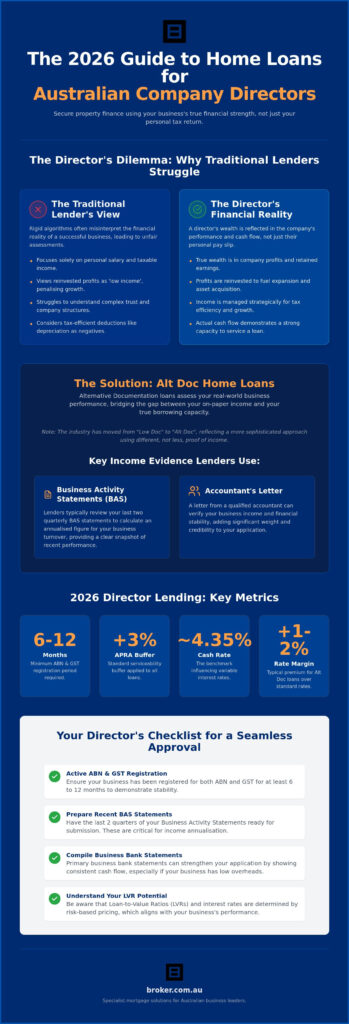
- The Director’s Checklist for a Seamless Approval
- Why Broker.com.au is the Choice for Australian Directors
Why Company Directors Struggle with Standard Home Loans
Banks prefer simple. If you’re a PAYG employee with a single income stream and a standard tax slip, the application process is a breeze. But for those at the helm of a proprietary limited company, the conversation changes. Traditional lenders often fail to interpret the nuances of complex company tax returns and trust structures. They see a web of inter-entity transfers and assume risk, rather than seeing the strategic asset management of a successful professional. It’s a disconnect that leaves many directors feeling like their success is being held against them.
Directors frequently reinvest profits back into the business to fuel expansion or purchase new assets. While this is sound business sense, it reduces your taxable income on paper. In a standard assessment, a bank might only look at your personal salary, completely ignoring the substantial retained earnings sitting within the company. This creates a massive gap between your actual wealth and your borrowing power in the eyes of a Big Four bank. You shouldn’t be penalised for being a smart operator who knows how to manage cash flow.
One-off business expenses and non-cash items like depreciation further complicate the picture. These deductions are perfect for tax efficiency but can unfairly reduce your “serviceable income” in a traditional lending environment. This is why a low-documentation loan, now more accurately referred to as an Alt Doc loan, is the strategic choice for savvy directors. It allows for a more holistic view of your financial health that traditional algorithms simply can’t process. Using low doc home loans for company directors means your mortgage is assessed on your real-world capacity, not just a bottom-line figure on a tax return.
The Problem with Personal Drawings vs. Company Profit
Standard bank assessments focus heavily on personal drawings or director fees. If you’ve chosen to keep a modest salary for tax purposes while the company accumulates wealth, you’ll likely hit a brick wall with traditional lenders. Alt Doc lenders operate with more insight. They understand that dividends and company profits are a more accurate reflection of your financial reality. By focusing on your business’s actual turnover and trading activity, these specialist lenders provide a path for low doc home loans for company directors that acknowledges your true ability to service a loan.
The Move from Low Doc to Alt Doc in 2026
The Australian lending landscape has matured. By 2026, the term “Low Doc” has largely transitioned to “Alternative Documentation.” This shift isn’t just about semantics; it reflects a more sophisticated approach to income verification. It’s about providing different proof points, such as BAS or bank statements, that suit a director’s unique situation rather than providing less information. This ensures you remain compliant with current Australian credit law while enjoying the flexibility you need to secure your dream home without the stress of a full tax audit.
How Alt Doc Home Loans Work for Directors
Alt Doc finance is a solution verified by business performance rather than personal tax returns. While traditional institutions demand years of historical data, specialist lenders focus on your current trading reality. To access these products, most lenders require your Australian Business Number (ABN) and GST registration to be active for a minimum of 6 to 12 months. This timeframe demonstrates business stability without requiring you to wait for the next tax season to roll around. It’s a proactive way to secure low doc home loans for company directors who are ready to buy now.
Interest rates in this space remain competitive, though they typically sit slightly higher than standard “Full Doc” loans. According to the Australian government definition, these loans are designed for borrowers who have the income to repay a loan but lack the traditional paperwork to prove it. Because the lender takes on a perceived higher risk by not seeing a full tax history, you might see a margin of 1% to 2% above standard variable rates. However, for many directors, the cost of the slightly higher rate is far outweighed by the opportunity to secure a property that would otherwise be out of reach.
Key Income Evidence: BAS and Bank Statements
Your Business Activity Statements (BAS) are the heavy lifters in an Alt Doc application. Lenders typically look at your last two quarters of BAS to annualise your business income. They apply a standard expense ratio to your total turnover to estimate your net profit. If your business has low overheads, providing primary business bank statements can further strengthen your case. These statements prove consistent cash flow and trading activity, giving the lender confidence in your daily liquidity. If you’re unsure which documents will best showcase your business’s strength, you can always let us know I’m interested to start a low-pressure conversation about your options.
The Accountant’s Declaration
Your accountant is often your most valuable ally when applying for low doc home loans for company directors. Many lenders will accept an Accountant’s Letter as a primary form of income verification. This document isn’t just a simple note; it’s a formal declaration confirming that your business is trading profitably and that the proposed loan repayments are within your financial capacity. To carry weight, this letter must usually come from an “eligible” accountant who holds CPA or CA status. This professional oversight provides the “Expert Guide” assurance that lenders need to bypass traditional tax return requirements. It’s a streamlined, professional way to bridge the gap between business success and personal property goals.
Comparing Rates and LVRs for Director Home Loans
Securing a mortgage as a director often involves balancing deposit size with rate sensitivity. For low doc home loans for company directors, Loan-to-Value Ratio (LVR) caps typically peak between 80% and 85%. This means you’ll generally need a 15% to 20% deposit to access the most competitive specialist products. While some niche lenders may stretch slightly further, higher LVRs often trigger additional risk fees or stricter income verification requirements. It’s a trade-off that requires a clear understanding of your business’s current liquidity.
Lenders in 2026 operate on a model of risk-based pricing. Essentially, the more documentation you can provide, such as multiple quarters of BAS or comprehensive bank statements, the lower your interest rate will be. This approach is mirrored in many global markets, as noted in this Forbes Advisor guide regarding business-focused credit. In the Australian market, current benchmarks show rates starting from 6.39% p.a. for lower LVRs, while higher-risk applications might see rates closer to 6.99% p.a. with lenders like Liberty Financial.
The 2026 financial climate adds another layer of complexity. With the RBA cash rate at 4.35% as of May 2026, and APRA maintaining a 3% serviceability buffer, your application will be assessed at an interest rate of approximately 7.35%. This makes the “cost of money” a vital consideration. However, many directors realise that the “opportunity cost” of waiting two years for a full tax history often exceeds the slightly higher interest paid on an Alt Doc loan today. Property prices don’t wait for your accountant to finish the books.
Standard vs. Alt Doc Comparison
When comparing products, you’ll typically find an interest rate spread of 0.5% to 1.5% between a standard full-doc loan and an Alt Doc alternative. You should also account for application fees and risk fees, which are more common in the specialist space. Despite the higher nominal rate, these loans can be highly tax-effective. If the property is used for investment purposes, the interest remains deductible, potentially offsetting the higher cost. It’s about looking at the net result rather than just the headline figure.
Maximising Your Borrowing Power
To boost your serviceability, we focus on “add-backs.” These are legitimate business expenses, like one-off equipment purchases or non-cash depreciation, that a specialist lender can add back to your profit to show a truer picture of your income. We also look at restructuring business liabilities. For example, using asset finance to consolidate high-interest business debt can significantly improve your home loan capacity. For those with existing equity, the strategic use of debt recycling can further accelerate wealth building while keeping your personal mortgage manageable. It’s about making your business structure work for your personal goals.
The Director’s Checklist for a Seamless Approval
Preparing for a mortgage shouldn’t feel like a second job. For low doc home loans for company directors, the secret to a stress-free approval lies in the quality of your alternative documentation. Lenders in the 2026 market aren’t looking for less information; they’re looking for different, more relevant proof points that reflect your current trading reality. To keep your application moving at pace and ensure you’re in good hands from the start, you should have the following essentials ready:
- An active ABN registered for a minimum of 6 to 12 months.
- Current and active GST registration status.
- Your two most recently lodged Business Activity Statements (BAS).
- Six months of primary business bank statements showing clear, consistent trading activity.
- A signed “Self-Declaration of Income” form provided by the lender to confirm your repayment capacity.
Preparing Your Business Finances
Before hitting the “submit” button, a little housecleaning goes a long way. Lenders look for clear separation between your personal life and your corporate entity. If your personal expenses are frequently showing up on the company card, it creates “noise” that can slow down your approval process. It’s also vital to clean up any “Director Loans” that might appear as liabilities. With the ATO intensifying its efforts to ensure compliance with Division 7A, having a clean ledger is essential. Ensure all your ATO obligations are fully up to date. It’s worth noting that from July 1, 2025, the General Interest Charge (GIC) applied to unpaid tax debts is no longer tax-deductible, so clearing any arrears is both a smart tax move and a boost to your mortgage eligibility.
Engaging a Specialist Broker
A generalist broker might understand a standard PAYG wage slip, but they often lack the technical expertise to navigate complex trust structures or the nuances of corporate tax. This is where “High-Level Fixers” provide the most value. We offer inside access to a boutique network of non-bank lenders who specialise in the “outside the norm” scenarios that company directors live every day. Our proprietary AI technology facilitates a streamlined application process, matching your specific business profile to the best available rates in minutes. This moves you from a state of uncertainty to one of organised efficiency. If you are ready to secure your next property without the traditional tax return headache, get started with our expert team today to see what’s possible.
Why Broker.com.au is the Choice for Australian Directors
We aren’t just brokers; we’re award-winning finance strategists who specialise in “outside the norm” scenarios. Since our founding in 2018, we’ve built a reputation for a “Can-Do” attitude that thrives where traditional banks falter. We understand that a director’s wealth is often found in the strength of their company rather than a simple payslip. Our team acts as your High-Level Fixer, handling the heavy lifting of low doc home loans for company directors so you can focus on scaling your business without the administrative burden.
What truly sets us apart is our proprietary AI technology, which addresses a major gap in the traditional brokerage model. While other firms might spend days manually wading through complex business bank statements, our AI facilitates a near-instant, sophisticated assessment of your cash flow. It identifies “add-backs” and trading patterns that human eyes might miss, ensuring your application is “On the Money” from day one. This technological edge allows us to present a bulletproof case to a bespoke panel of lenders—many of whom traditional banks simply won’t talk to.
The Broker.com.au Advantage
We believe in a sophisticated blend of professional authority and reassuring accessibility. Our “Expert Guides” have the local insights needed to navigate the Australian lending landscape, regardless of where your business is based. We provide inside access to the best rates through our “I’m interested” approach. This is a low-pressure, professional conversation designed to move you from uncertainty to organised efficiency. We serve directors nationwide, offering a boutique level of personal attention that large-scale banks can’t match.
Getting Started is Stress-Free
Our streamlined process is designed to be efficient from the very first chat through to settlement. We take the time to ensure your home loan is perfectly integrated with your broader business goals and tax strategy. We don’t just look for a mortgage; we look for a solution that supports your long-term wealth building. If you’re ready to bypass the rigid criteria of traditional lenders and secure a competitive rate tailored to your unique situation, I’m interested — let’s chat about my options today and see how we can make your property goals a reality.
Secure Your Property Future with Alternative Documentation
The Australian lending landscape in 2026 requires a more nuanced approach to income verification. Your company’s true value often lies far beyond the bottom line of a standard tax return. By utilising alternative documentation like BAS and business bank statements, you can bypass the rigid constraints of traditional banks and secure a mortgage that reflects your actual trading performance. Specialist low doc home loans for company directors provide the strategic flexibility needed to act quickly in a competitive property market, ensuring your personal goals keep pace with your business growth.
As an award-winning business loan broker, we specialise in navigating complex company and trust structures that generalist lenders often misunderstand. Our proprietary AI-powered matching technology ensures you are connected with the right specialist lender in minutes, moving you from a state of uncertainty to streamlined confidence. We handle the heavy lifting, providing the inside access you need to secure competitive rates while you remain focused on leading your enterprise.
I’m interested — let’s see what your borrowing power looks like
You have worked hard to build a successful business. Now, let us help you secure the home you deserve with a process that is professional, efficient, and tailored to your unique needs.
Frequently Asked Questions
Can I get a home loan as a company director with only 6 months of ABN?
Yes, it is possible to secure a loan with 6 months of ABN history, provided you are also GST registered for that same period. While traditional banks typically demand a full two-year trading history, our “High-Level Fixers” have inside access to specialist lenders who prioritise current trading performance over historical data. You will generally need to provide strong Business Activity Statements (BAS) or primary business bank statements to demonstrate your business’s stability in these scenarios.
What is the maximum LVR for an Alt Doc home loan in 2026?
In the 2026 lending environment, the maximum Loan-to-Value Ratio (LVR) for Alt Doc products generally peaks at 80% to 85%. This means you’ll typically require a deposit of at least 15% to 20% to satisfy specialist lending criteria. Higher LVRs are occasionally available through boutique lenders, but these often attract a risk fee or a slightly higher interest rate to account for the alternative documentation provided during the assessment.
Do Alt Doc loans have higher interest rates for directors?
Yes, interest rates for low doc home loans for company directors are typically 1% to 2% higher than standard full-doc variable rates. This margin reflects the lender’s perceived risk when traditional tax returns aren’t available to verify income. However, many directors find this a strategic trade-off, as it allows them to enter the property market immediately rather than waiting years for their tax returns to perfectly reflect their actual borrowing power.
Will I need to provide an Accountant’s Letter for my application?
An Accountant’s Letter is frequently used as a primary form of income verification in an Alt Doc application. This formal declaration confirms that your business is trading profitably and that you have the financial capacity to service the proposed mortgage repayments. To carry the necessary authority, this letter must usually be signed by a qualified professional with CPA or CA status who understands the complexities of your company or trust structures.
Can I use an Alt Doc loan to buy an investment property?
Absolutely, and it is a common strategy for savvy directors looking to build wealth. Given that investors accounted for approximately 40% of all new home loans in the September 2025 quarter, lenders are well-versed in providing low doc home loans for company directors for investment purposes. This approach allows you to leverage your business cash flow to expand your portfolio while potentially benefiting from the tax deductibility of the interest paid on the loan.
How long does the approval process take with Broker.com.au?
Our process is designed to be streamlined and efficient, often moving much faster than a traditional bank. Thanks to our proprietary AI technology, we can facilitate a sophisticated matching process that identifies the right lender for your specific profile in minutes. While the final settlement depends on the complexity of your corporate structure, our goal is to move you from the initial “I’m interested” conversation to a formal approval with minimal stress and administrative delay.
What happens if I have outstanding tax debt with the ATO?
Outstanding tax debt does not necessarily lead to an automatic decline, but it does require expert handling. Some specialist lenders are willing to provide a loan that includes a payout of your ATO debt at settlement, effectively consolidating your liabilities. It is vital to address this proactively, especially since the General Interest Charge on unpaid tax debts became non-deductible in July 2025, making it more cost-effective to clear these debts via your mortgage.
Can I switch from an Alt Doc loan to a standard loan later?
Yes, you can certainly refinance to a standard “Full Doc” loan once your circumstances change. Many directors use Alt Doc as a strategic bridge to secure a property now, then refinance to a lower interest rate once they have two years of clean tax returns that reflect their true income. We can help you monitor your situation and manage the transition to a standard product as soon as your documentation allows for a traditional bank assessment.