
What if the success of your next venture depends less on the purchase price and more on the strategic structure of your debt? With business lending in Australia growing by 9.9% in the last year, many entrepreneurs are stepping into deals without a clear map of their serviceability. It’s natural to feel a sense of anxiety when faced with complex valuations or the fear of a bank rejection, especially when you’re trying to weigh up the value of goodwill against tangible assets.
We’re here to help you move from uncertainty toward a feeling of streamlined confidence. This guide will show you how to master the art of acquisition finance and use a business acquisition loan calculator australia to model your way to a successful purchase. You’ll learn how to navigate the 2026 lending landscape, where typical LVRs range from 60% to 80%, and understand how the ATO’s firmer stance on debt affects your cash flow. We provide the tailored insights you need to ensure the business you buy today is positioned for long-term growth.
Key Takeaways
- Learn the critical distinction between funding tangible assets and intangible goodwill to ensure your loan structure correctly reflects the business’s true value.
- Discover how to use a business acquisition loan calculator australia to stress-test your repayments against realistic 2026 market rates before you commit to a purchase.
- Master the “universal language” of EBITDA and learn how to identify add-backs that can legitimately increase your borrowing power.
- Follow a proven chronological roadmap from initial discovery to settlement day, including why a pre-assessment is vital before signing any contracts.
- Understand how a market-wide broker approach and proprietary AI technology provide inside access to more efficient, professional finance solutions than traditional banks.
Table of Contents
- Understanding Business Acquisition Loans in the Australian Market
- How to Use a Business Acquisition Loan Calculator Strategically
- Assessing Serviceability: The Metrics That Matter to Lenders
- Step-by-Step Guide to Securing Your Acquisition Funding
- Why Partnering with an Expert Broker Maximises Your Borrowing Power
Understanding Business Acquisition Loans in the Australian Market
Business acquisition funding is a specialised financial solution designed to help you purchase an established entity. Unlike a startup loan, where you’re financing a vision, acquisition finance allows you to leverage a proven track record. This process is a key component of Mergers and acquisitions (M&A), where the primary focus shifts from your personal credit history to the historical performance of the target company. In the 2026 Australian market, lenders have sharpened their focus on consistent cash flow, making it vital to present a professional, data driven case from the outset.
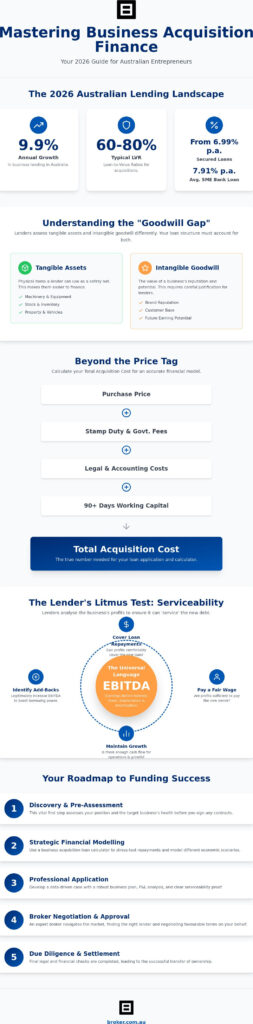
The core challenge for many buyers is the “Goodwill Gap.” When you buy a business, you’re usually paying for tangible assets like machinery or stock, plus an intangible value called goodwill. Lenders feel comfortable with assets because they provide a safety net. They’re more cautious about goodwill, which represents the business’s reputation and future earning potential. This is where a business acquisition loan calculator australia becomes your most valuable asset. It allows you to model how much of that goodwill you can afford to finance based on the business’s actual earnings, ensuring you don’t overstretch your capital before you’ve even taken the keys.
Secured vs. Unsecured Acquisition Funding
Choosing the right structure is about balancing cost against risk. Many Australian buyers choose to use residential equity to secure their business loan. This approach often unlocks the most competitive rates, which can start from approximately 6.99% p.a. for secured products in 2026. However, if you’re buying a professional services firm with few physical assets, unsecured cash flow lending might be the better path. While interest rates are higher for unsecured options, they provide a seamless way to fund the purchase without putting your family home on the line. Each approach has its place, and the right choice depends on your specific risk appetite and the asset profile of the business you’re buying.
Why Acquisition Loans Differ from Standard Business Loans
A standard business loan usually relies on your own financial history. Acquisition loans are different because the lender scrutinises the target business’s Profit and Loss (P&L) statements for the last two to three years. They want to see “serviceability,” which is a fancy way of asking if the business’s profits can comfortably cover the new loan repayments while still paying you a fair wage. Your application must include a robust business plan that explains how you’ll maintain or grow those profits after the handover. Without this strategic roadmap, even a profitable business might face a rejection from traditional bank credit departments. We help you bridge this gap by providing the inside access and professional modelling required to prove serviceability from day one.
How to Use a Business Acquisition Loan Calculator Strategically
A repayment estimate is only the starting point. To truly master acquisition finance, you must treat your business acquisition loan calculator australia as a sophisticated stress-testing tool. It allows you to move beyond simple arithmetic and into the realm of financial modelling, where you can predict how the business will perform under various economic pressures. By inputting current 2026 data, such as the 7.91% p.a. average for small business bank loans, you can build a preliminary Debt Service Coverage model that satisfies both your own risk appetite and a lender’s strict credit criteria.
Step 1: Determining Your Total Purchase Price
Many first-time buyers make the mistake of only inputting the headline sale price into their calculator. To get an accurate picture, you must account for “Total Acquisition Cost.” This includes the purchase price, stamp duty, legal fees, and accounting costs for due diligence. You also need to factor in at least 90 days of working capital to ensure a seamless transition. When calculating these extras, consulting ASIC’s small business resources can provide clarity on your regulatory and financial obligations as a new owner. Total Acquisition Cost is the sum of the purchase price, all professional fees, and initial working capital.
Step 2: Modelling Different Loan Terms
The length of your loan significantly impacts your monthly cash flow. While a 5-year term is standard for equipment finance, business acquisition loans often benefit from a 10-year term. A longer term reduces your monthly commitment, which preserves vital cash flow during the critical first year of ownership. You should also model the difference between Principal and Interest (P&I) repayments and a short interest-only period. Interest-only periods can be a lifesaver during a handover, though they will increase the total interest paid over the life of the loan. If you’re unsure which structure fits your vision, you can get started with an expert to explore tailored options.
Step 3: Sensitivity Analysis for Rate Hikes
Lenders don’t just look at whether you can afford today’s rates; they test your “buffer.” You should perform a sensitivity analysis by running your business acquisition loan calculator australia at 2% higher than the current market offer. If the target business can’t remain profitable at a 9.5% or 10% interest rate, the deal carries a high level of risk. This proactive approach mirrors the bank’s own internal stress testing. By doing this work early, you move from a state of uncertainty to one of streamlined confidence, knowing your deal can withstand the fluctuating economic environment of 2026.
Assessing Serviceability: The Metrics That Matter to Lenders
While your business acquisition loan calculator australia provides the raw repayment figures, lenders are looking for a deeper level of insight before they approve your application. They don’t just look at the bottom line of a tax return. Instead, they speak the universal language of EBITDA: Earnings Before Interest, Taxes, Depreciation, and Amortisation. This metric allows a credit department to see the core operational profitability of the business, stripped of any specific accounting or tax structures used by the previous owner. It provides a level playing field for assessing whether the entity can actually pay for itself.
One of the biggest hurdles buyers face is the fear that a business’s profit looks too low on paper. This is often because small business owners naturally look for ways to minimise their tax obligations. To solve this, we use a process called “normalisation.” We identify “Add-backs” which are expenses currently running through the business that won’t necessarily continue under your ownership. By identifying these costs, we can prove to the lender that the true earning capacity of the business is much higher than the reported net profit suggests.
The Debt Service Coverage Ratio (DSCR) Explained
The Debt Service Coverage Ratio (DSCR) is the litmus test for any acquisition. It’s a simple formula: your annual EBITDA divided by your total annual debt service (principal and interest). Most Australian banks typically look for a DSCR between 1.2x and 1.5x. This means for every dollar of loan repayment, they want to see at least $1.20 to $1.50 in profit. You can use the results from your business acquisition loan calculator australia to find your projected debt service and compare it against the target business’s adjusted EBITDA to see if the deal passes the bank’s initial sniff test.
Common “Add-backs” That Boost Your Borrowing Power
Identifying the right add-backs is where a professional broker adds significant value to your application. Lenders will often accept several types of adjustments to the P&L to show the true profitability of the entity. Common add-backs include:
- One-off legal or professional fees that won’t recur.
- Personal expenses run through the business, such as private vehicle leases or travel.
- Non-cash items like depreciation and amortisation.
- The “Owner-Operator” salary adjustment. If the current owner takes a $250,000 salary but the market rate for a manager to do that job is $120,000, the $130,000 difference can often be added back to the profit.
By carefully documenting these items, we help you move from a state of uncertainty to a feeling of streamlined confidence. We ensure the lender sees the same potential in the business that you do, maximising your borrowing power and securing the best possible terms for your acquisition.
Step-by-Step Guide to Securing Your Acquisition Funding
Securing the capital for your purchase is a chronological journey that requires precision at every turn. While you’ve likely used a business acquisition loan calculator australia to gauge your repayments, the path from an initial enquiry to the final settlement day involves several critical milestones. One of the most important steps is the pre-assessment. You should never sign a Sale of Business Agreement without a clear understanding of your borrowing capacity. This proactive approach ensures you’re not left stranded if the bank’s valuation doesn’t match the purchase price, moving you from a state of uncertainty to one of streamlined confidence.
To make a deal more “bankable,” consider the structure of the purchase itself. Incorporating vendor finance, where the seller provides a portion of the funding, can be a powerful signal to a primary lender. It shows that the previous owner has “skin in the game” and is confident in the business’s future performance. During this phase, you must also manage the valuation process carefully. Lenders will often require an independent valuation of both the business assets and any property you’re using as security. We help you navigate these complexities, providing the expert guidance needed to keep the deal on track.
Preparation: The Document Checklist
Lenders in 2026 require a comprehensive data pack to assess your application. At a minimum, you will need the last three years of Profit and Loss (P&L) statements and Balance Sheets for the target business. You also need to provide a personal Statement of Position (SOP) to show your own financial backing. Perhaps most importantly, you must present a clear business plan. This document should outline how you intend to maintain or grow the revenue once the keys are handed over, proving to the credit department that the transition will be seamless and professional.
Submission and Negotiation
A common mistake is “shotgunning” applications to multiple lenders simultaneously. This can lead to multiple credit enquiries that negatively impact your credit score and signal desperation to banks. Instead, a broker manages the “credit conversation” on your behalf, using inside access to identify the lenders most likely to approve your specific deal. We negotiate more than just the interest rate; we focus on the covenants and security requirements that can affect your long term operational freedom. If you’re ready to see how we can tailor a solution for you, I’m interested in a pre-assessment.
Settlement and Post-Acquisition Cash Flow
Settlement day is the final hurdle where funds are disbursed to the vendor and legal titles are transferred. However, your financial planning shouldn’t end there. It’s vital to ensure your working capital finance or line of credit is ready for day one operations. This ensures you can cover stock purchases or payroll while you’re still finding your feet in the new entity. A final checklist for a smooth transition includes verifying all bank accounts are active, merchant facilities are transferred, and your first month’s repayments are accounted for in your cash flow forecast.
Why Partnering with an Expert Broker Maximises Your Borrowing Power
Approaching a single bank for your business purchase is like looking at the world through a straw. You only see one set of products, one specific credit appetite, and one rigid interest rate. If that specific lender has reached its quota for your industry or feels uncomfortable with the “Goodwill Gap,” your acquisition could stall before it even begins. When you partner with us, you gain a market-wide perspective. We move you from the limited options of a traditional branch toward a feeling of streamlined confidence by accessing over 30 lenders across the Australian landscape. Our proprietary AI technology scans the market to match your specific deal with the lender most likely to say yes, ensuring your business acquisition loan calculator australia results are backed by actual, fundable offers.
This “inside access” is particularly vital when a Big Four bank issues a rejection. In the 2026 environment, major lenders have increased their scrutiny on consistent cash flow and up-to-date ATO positions. A “no” from a major bank is often just a sign that your deal doesn’t fit their current algorithm. We act as your high-level fixer, maintaining deep relationships with non-bank and private lenders who specialise in business acquisition funding. These lenders often have a more nuanced understanding of EBITDA and add-backs, allowing them to approve deals that traditional institutions might deem too complex. We don’t just act as a middleman; we serve as your professional advocate throughout the entire credit conversation.
Navigating the 2026 Australian Lending Landscape
The Australian lending market has shifted significantly, with a 9.9% growth in business lending driven largely by “Tier 2” and private institutions. These lenders have become the backbone of SME acquisitions because they offer the flexibility that centralised bank credit departments lack. Your local bank manager, while well-meaning, often lacks the authority to approve deals involving significant goodwill or complex corporate structures. We organise the entire process to be stress-free, handling the heavy lifting of document preparation and lender negotiations. This allows you to focus on the operational handover while we ensure the financial foundation is secure and professional.
Tailored Solutions for Business Owners
Our role is to provide tailored solutions that look at your entire financial ecosystem. This might include specialised SMSF loans if you intend to purchase the commercial property as part of the acquisition, or restructuring your existing vehicle and equipment finance to free up vital working capital. We can also look at your residential equity to see if a secured loan structure can unlock those lower 6.99% p.a. rates we discussed earlier. You aren’t just getting a loan; you’re gaining a long-term corporate advisor dedicated to your dream. Ready to run the numbers? Speak with a Broker.com.au acquisition expert today.
Secure Your Future with a Strategic Acquisition
Success in the 2026 Australian market requires more than just a great business idea; it demands a sophisticated approach to finance. You now understand how to move from a state of uncertainty to streamlined confidence by using a business acquisition loan calculator australia to model your repayments and stress-test your serviceability. By focusing on normalised EBITDA and identifying key add-backs, you’ve learned how to present a “bankable” deal that satisfies even the most rigorous credit departments.
As an award-winning business loan broker, we offer inside access to over 30+ Australian lenders and use proprietary AI technology to ensure your application is fast, accurate, and professional. We’re here to act as your expert guide, providing the tailored insights needed to navigate the goodwill gap and secure the best possible rates. You don’t have to manage this high-stakes transition on your own. Our team is ready to help you move forward with a plan that prioritises your long-term success.
I’m interested in an acquisition loan
Your next venture is waiting, and we’re here to ensure you have the financial backing to make it a resounding success. Let’s get started today.
Frequently Asked Questions
How much deposit do I need for a business acquisition loan in Australia?
You typically need a deposit of 20% to 40% of the total purchase price for a business acquisition loan. Most lenders operate within a Loan-to-Value Ratio (LVR) of 60% to 80%, depending on the industry and the strength of the target business’s cash flow. If you’re using residential property as additional security, you might be able to reduce the cash deposit required significantly.
Can I get an unsecured loan to buy a business?
Yes, you can obtain an unsecured loan to buy a business, though these are generally reserved for firms with high cash flow and low physical assets. Interest rates for unsecured acquisition funding are higher, starting from approximately 12.74% p.a. in 2026. These products are ideal if you want to avoid using personal assets like the family home as security for the transaction.
What is the typical interest rate for a business acquisition loan in 2026?
In July 2026, typical interest rates for secured business acquisition loans start from approximately 6.99% p.a. for variable rates and 7.35% p.a. for fixed terms. If you’re looking at unsecured options, rates can range from 12.74% p.a. to over 20% p.a. depending on your risk profile. Using a business acquisition loan calculator australia can help you model these different scenarios to see how they impact your monthly serviceability.
Does the bank look at my personal income or the business income?
Lenders focus primarily on the target business’s ability to service the debt, but they will also scrutinise your personal financial position. While the business’s historical P&L is the main driver for approval, you’ll need to provide a personal Statement of Position. This ensures you have the personal buffer required to manage the business through its initial transition period without financial distress.
What are “add-backs” and how do they affect my loan application?
Add-backs are expenses currently in the business’s accounts that won’t continue under your ownership, such as one-off legal fees or personal travel. By adding these back to the net profit, you normalise the earnings to show the lender the true cash flow available for debt servicing. This process is critical for maximising your borrowing power and ensuring your application reflects the entity’s actual earning potential.
How long does it take to get a business acquisition loan approved?
The approval process generally takes between four to eight weeks from the initial application to settlement. While our proprietary AI technology can provide a fast pre-assessment, the full credit approval involves deep due diligence and independent valuations. Having all your documentation, such as three years of financial statements and a robust business plan, ready from day one will help move the process along more efficiently.
Can I use my home as security for a business purchase?
You can certainly use your home as security, and doing so is one of the most effective ways to access lower interest rates. By securing the loan against residential equity, you move into a lower risk category for the bank. This often allows you to access the best market rates, which are significantly lower than unsecured cash flow lending products available in the 2026 Australian market.
What happens if the business valuation comes in lower than the purchase price?
If the valuation is lower than the purchase price, it creates a goodwill gap that you must cover with additional equity or alternative funding. You might choose to negotiate a lower price with the vendor or request vendor finance to bridge the difference. Our role is to help you model these scenarios using a business acquisition loan calculator australia so you can find a professional solution that keeps the deal alive.