
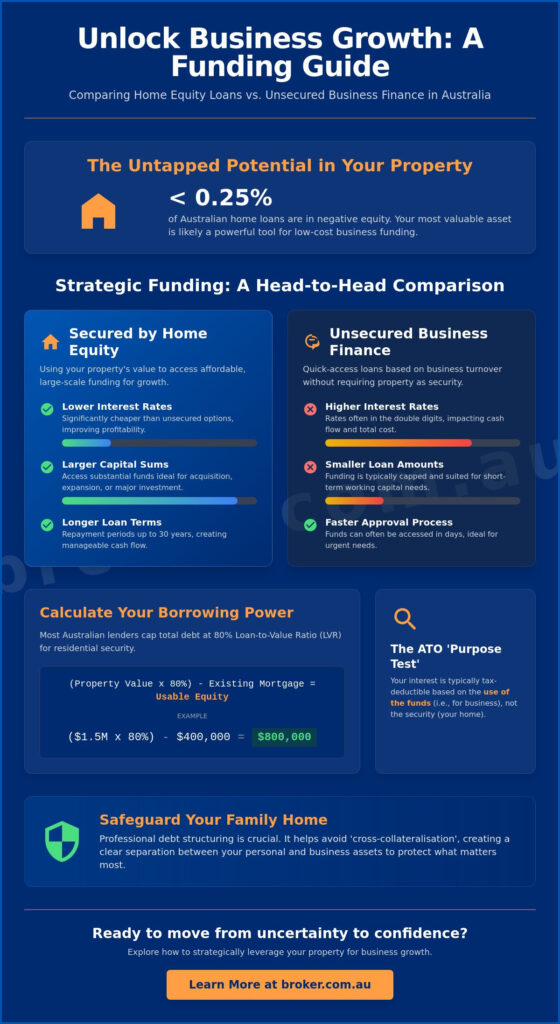
Did you know that less than 0.25% of Australian home loans are currently in negative equity? This means your most valuable asset is likely sitting on a mountain of untapped potential while you struggle with double-digit interest rates on unsecured finance. Using home equity for business loan purposes is often the most efficient way to fuel growth, yet many founders hesitate because they fear the complexity of bank requirements or the risk of losing the family home.
It’s natural to feel protective of your property, especially with APRA’s new debt-to-income limits introduced in February 2026. You want the capital to expand, but you don’t want to risk everything you’ve worked for on a poorly structured deal. We understand that high-stakes financial decisions can be daunting, which is why we’re here to help you move from uncertainty to streamlined confidence.
You’ll learn how to strategically leverage your residential property to secure lower-interest business funding while keeping your personal assets shielded. This guide provides a clear look at the latest LVR limits, the tax benefits of separating your debt, and how to access larger capital sums for business acquisition without the stress of traditional bank hurdles.
Key Takeaways
- Understand the ATO ‘Purpose Test’ to ensure your interest remains tax-deductible based on how you use the capital, not just what secures it.
- Calculate your true borrowing capacity by navigating 2026 LVR limits and the specific serviceability requirements for self-employed applicants.
- Learn why using home equity for business loan purposes usually secures much lower interest rates than unsecured commercial finance while providing access to larger capital sums.
- Protect your family home by understanding how to structure your debt to avoid cross-collateralisation and maintain a clear boundary between personal and business assets.
- Explore debt recycling strategies that can help you convert non-deductible residential debt into a tax-efficient engine for business growth.
Table of Contents
- What Does Using Home Equity for a Business Loan Actually Mean?
- Calculating Your Borrowing Power: LVR and Serviceability
- Home Equity vs. Unsecured Business Loans: A Strategic Comparison
- The Step-by-Step Process to Accessing Equity for Business
- Protecting Your Assets: Why Professional Debt Structuring Matters
What Does Using Home Equity for a Business Loan Actually Mean?
Home equity isn’t just a number on a bank statement; it’s the untapped value of your hard work. In the Australian commercial landscape, What Does Using Home Equity for a Business Loan Actually Mean? refers to the process of pledging your residential property as security to access lower-interest capital. While a traditional mortgage is a personal liability, using home equity for business loan purposes transforms that equity into a strategic investment. This shift allows you to move away from high-interest unsecured finance and toward a structured, cost-effective funding model.
The Australian Taxation Office (ATO) focuses heavily on the “purpose test.” They look at the use of funds rather than the security behind the loan. If you use the capital to generate business income, the interest is generally tax-deductible. It’s a powerful way to reduce your tax bill while growing your enterprise. However, it’s vital to distinguish between a mortgage “top-up” and a dedicated business facility. A top-up often muddies the waters between personal and professional debt, whereas a specific business loan keeps your accounting clean and your tax accountant happy.
The Mechanics of Usable Equity
Calculating what you can actually borrow involves the 80% Loan-to-Value Ratio (LVR) rule. Most Australian lenders will cap your total debt at 80% of your property’s current value. In 2026, current market appraisals are more important than ever. If your property has increased in value since you purchased it, your borrowing power has grown with it. While some lenders allow you to exceed the 80% mark, this usually involves Lenders Mortgage Insurance (LMI), which adds to your setup costs. We typically recommend staying within the 80% threshold to keep your interest rates at their most competitive levels.
Common Business Use Cases for Home Equity
Business owners often leverage their homes for three primary reasons. First, it’s a popular choice for Business Acquisition Funding or purchasing a franchise, as it provides the large capital sums required. Second, it serves as a reliable source of Working Capital Finance to manage growth spurts or seasonal cash flow gaps. Finally, many savvy operators use equity to refinance expensive short-term debt. By moving high-interest liabilities into a secured property loan, you can significantly reduce your monthly repayments and improve your business’s overall profitability. This approach moves you from a state of financial complexity toward a feeling of streamlined confidence.
Calculating Your Borrowing Power: LVR and Serviceability
Understanding how much capital you can access involves more than just looking at your property value. Lenders look at two distinct pillars: the value of your security and your ability to meet repayments. When using home equity for business loan purposes, the assessment process is often more nuanced than a standard residential mortgage. Banks don’t just want to know what your house is worth; they need to see that your business cash flow can support the debt without causing financial strain. This is particularly relevant given the RBA on small business finance insights, which highlight how residential property remains the primary engine for securing affordable commercial credit in Australia.
Your ABN registration length and GST status play a pivotal role in 2026. Most Tier 1 lenders prefer an ABN that has been active for at least two years, though specialist lenders can often assist with shorter timeframes. If you’re GST registered, it signals a level of business maturity that can open doors to more competitive rates. In contrast, the current RBA cash rate trends have forced lenders to apply a “serviceability floor” or buffer, typically 3% above the actual interest rate, to ensure you can still manage repayments if rates rise further. This makes accurate financial modelling essential before you submit an application.
Loan-to-Value Ratio (LVR) Explained
Loan-to-Value Ratio is the primary risk metric for Australian banks and non-bank lenders. For residential security, the standard LVR threshold is 80%. If you use a commercial property as security, this cap usually drops to between 65% and 75%. Maximising your LVR requires a delicate balance. Pushing for the absolute limit can lead to aggressive lender oversight or the requirement for additional reporting. We often find that keeping your total debt slightly below the 80% mark allows for a more seamless approval process and keeps you in the “best in class” pricing category.
The Self-Employed Serviceability Challenge
Traditional banks often struggle with the complexity of business tax returns. They might see a low “taxable income” and decline the loan, ignoring the fact that your business is highly profitable. This is where “Add-backs” become vital. We look for non-cash expenses like depreciation, one-off interest costs, or excess superannuation contributions to prove your real earning capacity. If your tax returns don’t tell the full story, a “Low Doc” equity loan might be the solution, using BAS statements or accountant letters to verify income. If you’re unsure where you stand, you can check your current borrowing power with our specialised calculators to get a clearer picture of your options.
Home Equity vs. Unsecured Business Loans: A Strategic Comparison
Choosing between these two paths often feels like a trade-off between speed and cost. When you’re using home equity for business loan purposes, you’re playing the long game. You’re leveraging a stable asset to secure some of the most competitive rates in the Australian market, often starting from around 5.89% p.a. as of June 2026. In contrast, Unsecured Business Loans are the “sprint” of the finance world. They offer rapid access to capital, sometimes within 24 hours, but this speed comes at a premium. Interest rates for unsecured facilities are significantly higher, frequently reaching into the double digits because the lender carries more risk without a tangible asset to fall back on.
The total cost of credit is where the distinction becomes most apparent. A secured loan can be structured over a traditional 30-year residential term, which keeps your monthly repayments low and manageable. Unsecured finance typically requires full repayment within one to five years. While the lower monthly commitment of an equity-backed loan is attractive, you must be mindful of the long-term interest. Paying off a business expense over 30 years can result in a higher total interest bill than a short-term unsecured loan, unless you’re proactive with additional repayments. We help you model these scenarios so you can move forward with streamlined confidence.
When to Choose Equity
This strategy is ideal for long-term growth projects, such as Business Acquisition Funding or major equipment upgrades. If you have significant “lazy equity” sitting in your primary residence, it’s often the most efficient way to fund a dream without the heavy burden of high-interest repayments. The longer application process, which includes formal property valuations and mortgage registrations, is a small price to pay for the substantial interest savings over time. It’s about using your existing wealth to build future value.
When Unsecured Finance is the Smarter Play
There are times when the “red tape” of a property-secured loan isn’t worth the effort. For short-term cash flow gaps, such as managing a seasonal stock build-up or a brief delay in client payments, Unsecured Business Loans or a Line of Credit are often superior. These products don’t require you to risk the family home for a temporary need. They’re also the go-to solution for high-turnover businesses that haven’t yet built up significant property assets but need an efficient injection of capital to keep momentum. You get the funds you need without the complexity of a full bank valuation.
The Step-by-Step Process to Accessing Equity for Business
Getting started doesn’t mean walking into a bank branch. In fact, that’s often the quickest way to damage your credit file with unnecessary “hard pulls” that signal desperation to other lenders. The modern path to using home equity for business loan capital begins with a soft pre-qualification. This stage involves a high-level review of your credit score and a preliminary check of your equity position without leaving a footprint on your file. Once we establish that the numbers stack up, we move into the heavy lifting of 2026 market appraisals and documentation. By using AI-driven brokerage tools, we can match your specific profile with lenders who have a high appetite for your industry, ensuring the submission process is both efficient and targeted.
The final hurdle is settlement. This is the legal phase where the mortgage is registered against your title and the funds are disbursed. While it might sound complex, our team handles the coordination between solicitors and lenders to ensure a seamless transition. Once settled, you’ll have the capital ready to deploy, moving your business from a state of planning toward active growth. This structured approach ensures you remain in control of your financial destiny without the inherent anxiety of traditional bank hurdles.
Organising Your Financial “Story”
Lenders don’t just buy into numbers; they buy into a narrative. If you’re using home equity for business loan funds to fuel a business acquisition or an M&A deal, your business plan must be bulletproof. You need to justify exactly how the equity release will generate a return that covers the new debt. A clean six-month history of both mortgage and existing business repayments is non-negotiable. It signals to credit teams that you’re a reliable operator who is “in good hands.” Our role as your Expert Guide is to provide “inside access” to lender credit teams, presenting your story in a way that highlights your strengths and mitigates their perceived risks.
Valuations: Desktop vs. Full Physical Inspections
In the current Australian property market, the valuation is the ultimate gatekeeper. Depending on your LVR and the location of your security, a lender might accept an automated valuation model (AVM). These are fast and “stress-free,” but they can sometimes be conservative. For more complex scenarios or larger loan amounts, a full physical inspection is required. To prepare, ensure your property is presented in its best light, similar to an open-home inspection. If a valuation shortfall occurs, don’t panic. We have the local insights to challenge results or pivot to alternative lenders who may see the value differently. If you’re ready to see where your property stands, get started with a property valuation check today to understand your true borrowing capacity.
Protecting Your Assets: Why Professional Debt Structuring Matters
The fear of “losing the house” is a common theme on Australian business forums, and it’s a valid concern for any founder who hasn’t been given the right structural advice. Using home equity for business loan capital is a powerful growth lever, but it must be pulled with precision. Protecting your assets isn’t about avoiding risk; it’s about isolating it. By using separate legal entities, such as corporate trust structures, you can create a clear boundary between your business liabilities and your family’s security. This professional approach moves you from a state of caution toward a feeling of streamlined confidence.
Debt recycling is another sophisticated strategy we use to turn a passive asset into an active financial engine. This involves paying down your non-deductible residential mortgage and then re-borrowing those funds for a specific business purpose. Because the ATO focuses on the “use of funds,” the interest on the new business portion becomes tax-deductible. It’s an efficient way to reduce your total interest cost while building a more professional debt profile. We act as a “High-Level Fixer” in these scenarios, ensuring that your accounting and lending structures are perfectly aligned for maximum tax efficiency and asset protection.
Avoiding the Cross-Collateralisation Trap
Cross-collateralisation occurs when a lender uses one security to back multiple loans, effectively tangling your home and business together in a single legal web. Banks love this because it gives them maximum leverage over your entire asset portfolio, but it’s rarely in your best interest. If your business hits a rough patch, a cross-collateralised loan could put your family home at immediate risk even if your mortgage payments are up to date. Using separate lenders for your home and business loans can significantly increase your financial safety by ensuring one default doesn’t automatically trigger a total asset liquidation. We prefer to use “standalone” facilities or second mortgages to keep your risks isolated and your assets protected.
The Broker Advantage: Accessing the Non-Bank Market
The “Big Four” banks often have rigid policies that don’t cater well to complex business equity scenarios. They might offer a “one size fits all” product that forces you into cross-collateralisation just to get the deal done. As specialists, we provide inside access to a vast network of non-bank lenders who have a higher appetite for using home equity for business loan purposes. These lenders are often more flexible with LVR limits and understand the nuances of self-employed income. We leverage proprietary AI to scan the market and find the most efficient, tailored solution for your specific needs. Ready to see your options? I’m interested
Secure Your Growth with Strategic Capital
Using home equity for business loan purposes is more than just a finance transaction; it’s a calculated move to lower your overheads while accessing the capital needed for genuine expansion. By navigating the 2026 lending landscape with professional debt structuring, you can effectively separate your personal and business liabilities. This ensures your family home remains a sanctuary rather than a security risk. You’ve seen how the right LVR strategy and a clear purpose test can transform your property into a powerful engine for business acquisition or working capital.
As an award-winning Australian brokerage, we specialise in high-level corporate advisory and business acquisition funding. We use proprietary AI for faster loan matching, giving you inside access to the best rates and most flexible non-bank lenders in the market. If you’re ready to move from uncertainty toward streamlined confidence, our team is here to act as your expert guide. I’m interested in exploring my equity options
Your business goals are within reach, and with the right structure, your path to growth is clearer and safer than ever before.
Frequently Asked Questions
Can I use my home equity to start a brand new business in Australia?
Yes, you can use your home equity to start a new business, though lenders typically require a robust business plan and evidence of industry experience. Unlike established businesses with two years of tax returns, startups are assessed on their projected cash flow and the borrower’s personal credit history. Specialist non-bank lenders are often more flexible than major banks for these “new-to-business” scenarios, providing a tailored path for entrepreneurs.
What is the maximum LVR for a business loan secured by residential property?
The maximum LVR for a business loan secured by residential property is typically 80% of the property’s current market value. While some lenders may consider up to 85% with Lenders Mortgage Insurance (LMI), most commercial facilities are capped at 80% to maintain competitive interest rates. If you’re using commercial property as security instead, the limit generally drops to between 65% and 75% depending on the lender’s risk appetite.
Is the interest on a home equity loan tax-deductible if used for business?
Yes, the interest is generally tax-deductible if the funds are used for income-producing business purposes. The ATO applies the “purpose test,” which looks at how you spend the capital rather than what property secures the loan. It’s essential to keep the business portion of the debt separate from your personal mortgage to ensure clean accounting and maximise your deductions during tax season.
How long does it take to get a business loan using home equity?
Accessing equity for a business purpose usually takes between two and six weeks from application to settlement. The timeline depends heavily on the speed of the property valuation and how quickly you can provide your financial documentation. While using home equity for business loan capital takes longer than an unsecured loan, the lower interest rate and longer repayment terms usually justify the additional processing time.
Do I need my spouse’s consent to use our joint home equity for my business?
Yes, you’ll almost certainly need your spouse’s consent if they are a joint owner or have a legal interest in the property. Lenders require all owners on the title to sign the mortgage documents and acknowledge the risk to the security. Even if the property is in your name only, some lenders may require a spousal waiver to ensure the loan doesn’t cause undue financial hardship to the household.
What happens to my home if the business fails and I cannot repay the loan?
If your business fails and the loan isn’t repaid, the lender has the legal right to sell the property to recover the outstanding debt. This is why professional debt structuring is vital to isolate risks where possible. We work with you to ensure your serviceability is sustainable even during market fluctuations, helping to move you from a state of uncertainty toward a feeling of streamlined confidence.
Can I use an investment property instead of my primary place of residence?
Yes, you can use an investment property as security, and this is often a preferred strategy for asset protection and tax tracking. Using an investment property makes it easier to isolate tax-deductible interest and avoids putting your primary place of residence at direct risk. Lenders assess investment security similarly to owner-occupied homes, though the interest rates and LVR limits may vary slightly between different financial institutions.
Will using equity for a business loan affect my ability to refinance my home loan later?
Using equity for a business loan will impact your future refinancing options because it increases your total debt and debt-to-income (DTI) ratio. Under APRA regulations effective from February 2026, lenders are restricted in how much they can lend to borrowers with high DTI ratios. It’s important to model your future borrowing needs to ensure your business debt doesn’t prevent you from accessing competitive residential rates later.