Your family home shouldn’t be the collateral for a business that’s currently suffocating under high monthly repayments. With 12,819 Australian companies entering external administration in the 2026 financial year, recognising the signs you need to restructure business debt early is the difference between a total collapse and a successful turnaround. You likely feel the weight of BAS arrears or the constant pressure of superannuation deadlines, and it’s exhausting to watch your hard-earned cash flow disappear into interest charges before it can fund growth.
We understand that behind every balance sheet is a person who just wants to get back to business without the looming shadow of the ATO. This guide will help you reorganise your company liabilities, protect your personal assets, and restore the liquidity you need to thrive. We’ll explore the current 2026 landscape, including the $1 million Small Business Restructuring liability threshold and how to access tailored finance that moves you from uncertainty to streamlined confidence. From non-bank lending insights to formal restructuring pathways, here is your roadmap to financial relief.
Key Takeaways
- Learn how to recognise the critical signs you need to restructure business debt before temporary cash flow gaps evolve into systemic insolvency risks.
- Understand the strategic differences between informal refinancing and the formal ASIC Small Business Restructuring (SBR) framework to protect your personal assets.
- Discover how proprietary AI and advanced financial modelling can remove the guesswork and accurately predict your likelihood of loan approval.
- Follow a proven five-step roadmap to audit your company liabilities and engage expert advisory for a streamlined path to recovery.
- Gain inside access to non-bank lenders and private capital solutions that provide the flexibility required for complex debt scenarios.
Table of Contents
- Identifying the Tipping Point: When Your Business Debt Needs Restructuring
- Formal vs Informal: Choosing the Right Path for Your Restructure
- Financial Modelling: Assessing Your Position for a Successful Outcome
- The 5-Step Roadmap to Restructuring Business Debt Successfully
- Why a Specialist Broker is Your Best Asset in a Restructure
Identifying the Tipping Point: When Your Business Debt Needs Restructuring
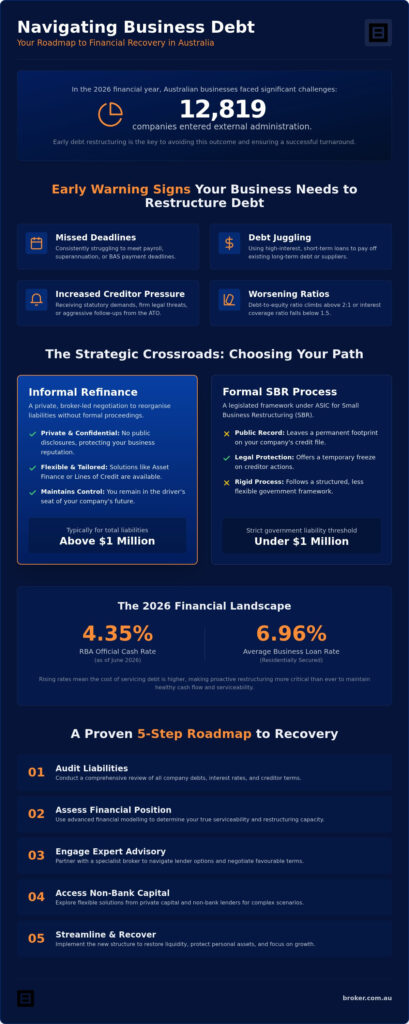
For many Australian business owners, the concept of What is debt restructuring? often feels like a last resort. In the 2026 Australian market, it’s actually a sophisticated tool for survival and growth. It involves reorganising your company’s liabilities to improve liquidity and ensure you can meet your obligations. While some view it as a sign of failure, proactive SMEs use it to pivot before the “Red Zone” hits. This zone is typically reached when your debt-to-equity ratio climbs beyond 2:1, or more critically, when your interest coverage ratio falls below 1.5. At this point, your business isn’t just carrying debt; the debt is carrying you.
Identifying the signs you need to restructure business debt early is the difference between a controlled turnaround and a forced liquidation. It’s rarely a sudden event. Usually, it’s a slow creep of systemic cash flow gaps. You might find that while your revenue looks healthy on paper, your bank account is perpetually empty because every dollar is earmarked for high-interest repayments. If you’re consistently delaying one supplier to pay another, you’ve moved past a temporary hitch and into a cycle that requires a structural fix. Common indicators include:
- Difficulty meeting payroll or superannuation deadlines consistently.
- Relying on high-interest unsecured loans to pay down existing long-term debt.
- Receiving statutory demands or increasingly firm legal threats from creditors.
- Your debt-to-equity ratio exceeding safe industry benchmarks.
The Difference Between Stressed and Normal Debt
Debt is a powerful tool for expansion when used correctly. However, with the RBA official cash rate sitting at 4.35% as of June 2026, the cost of servicing that tool has risen. Normal debt is manageable and planned. Stressed debt feels like a burden that stifles operations. If your residentially secured business loan is creeping toward the 6.96% average seen in early 2026, and your margins haven’t grown to match, your serviceability is under threat. A temporary hitch is a one-off late payment; deep-seated distress is when your business cannot survive without constant external injections of capital.
Recognising Creditor Pressure and ATO Liabilities
The shift from friendly reminders to formal demands is a major red flag. The ATO has become increasingly aggressive in 2026, specifically targeting unpaid Superannuation Guarantee and BAS arrears. These aren’t just business debts; they carry personal liability risks for directors. Under the Corporations Act 2001, the insolvency threshold is defined as the point where a company is no longer able to pay all its debts as and when they become due and payable. Acting while you are still “stressed but solvent” allows for informal refinancing and private capital solutions that aren’t available once formal administration begins. Proactive restructuring today ensures you stay in the driver’s seat of your company’s future.
Formal vs Informal: Choosing the Right Path for Your Restructure
Once you’ve identified the signs you need to restructure business debt, you face a strategic crossroads. You must choose between a private, informal reorganisation or a formal, legislated process. This choice isn’t just about preference. It’s often dictated by your balance sheet. The Australian government sets a $1 million liability threshold for its streamlined small business rescue process. If your total debts sit above this figure, your path forward will almost certainly be an informal, broker-led negotiation. Recognising the signs you need to restructure business debt early gives you the luxury of choice between these two frameworks.
Choosing between these paths affects more than just your interest rates. It impacts your credit reputation and your future borrowing capacity. A formal process offers legal protection but leaves a public footprint. An informal restructure remains behind closed doors, allowing you to maintain the “business as usual” image that is vital for customer and supplier confidence.
The Informal Refinance: A Broker-Led Solution
An informal restructure is a sophisticated, private negotiation led by a specialist. We help you reorganise your debt without the need for court intervention or public disclosures. This often involves refinancing existing high-cost debt into more sustainable structures, such as Asset Finance or a Line of Credit. By using your existing machinery or property as leverage, you can often secure lower rates and extended terms. This keeps your financial affairs private. It ensures your relationships with suppliers and customers remain untarnished. If you want to maintain total control while fixing your cash flow, you can explore tailored finance options that provide a discreet way forward.
Formal SBR: When You Need Legal Protection
The formal path utilises the ASIC Small Business Restructuring (SBR) framework. To be eligible, your company must have total liabilities of less than $1 million and be up to date with tax lodgements. You appoint a Small Business Restructuring Practitioner who takes control of the proposal process. For many, the greatest advantage is the “stay on proceedings.” This legal shield stops creditors from pursuing you or winding up the company while you formulate a plan. It’s a powerful tool if you’re facing aggressive legal action. However, be aware that an SBR is recorded on public ASIC databases. This can make securing traditional finance more difficult for several years after the process concludes.
Financial Modelling: Assessing Your Position for a Successful Outcome
Relying on intuition is a high-stakes gamble when your business’s future is on the line. In the 2026 Australian lending environment, “gut feel” has been replaced by granular data. Lenders now demand a level of transparency that goes far beyond a basic profit and loss statement. One of the clearest signs you need to restructure business debt is when your internal financial projections consistently fail to match your actual bank balance. To secure a successful outcome, you must move from reactive bookkeeping to proactive financial modelling.
At Broker.com.au, we use proprietary AI technology to facilitate this transition. Our systems allow us to stress-test your business plan against current RBA trends and non-bank lending criteria. This technology predicts loan approval success by simulating how different debt structures-such as Invoice Finance or Secured Business Loans-will impact your future liquidity. By assessing your asset pool and separating secured from unsecured liabilities, we can build a case for lenders that emphasizes your business’s resilience rather than its current distress.
Calculating Your Debt Service Cover Ratio (DSCR)
In 2026, Australian lenders prioritise free cash flow over historical profit. They want to know if your business generates enough cash to cover its debt obligations after all operating expenses are met. This is measured through the Debt Service Cover Ratio (DSCR). To calculate this, take your Net Operating Income and divide it by your total annual debt service. A 1.25x DSCR is the “gold standard” for approval, signalling to lenders that you have a 25% buffer to handle unexpected market shifts. If your ratio is currently sitting at 1.0x or lower, it’s a definitive sign that your debt structure requires immediate professional attention.
The Danger of Cross-Collateralisation
Many SME owners unknowingly put their personal lives at risk through cross-collateralisation. This occurs when a lender uses a single asset, like your family home, to secure multiple loans, such as your Commercial Property Loan and your Vehicle Finance. It’s a common trap that gives banks excessive leverage over your personal assets. Part of a sophisticated restructure involves “untangling” these ties. We specialise in identifying hidden risks in your current loan contracts and moving business debt toward standalone security. This ensures that even if the business faces headwinds, your family home remains protected. This strategic separation is essential for restoring your peace of mind and creating a professional boundary between your personal wealth and your corporate liabilities.
The 5-Step Roadmap to Restructuring Business Debt Successfully
Moving from the recognition of signs you need to restructure business debt to active resolution requires a disciplined framework. It’s not enough to simply want a better rate. You need a structured programme that lenders and creditors can trust. This roadmap transitions your business from a state of financial anxiety to one of streamlined confidence.
- Step 1: Comprehensive Financial Audit. You must account for every cent. This goes beyond your current balance sheet to include contingent liabilities, director loans, and any personal guarantees that could be triggered.
- Step 2: Professional Advisory. Engaging a broker or corporate advisor early is vital. We act as your expert guide, navigating the complexities of the 2026 lending landscape so you don’t have to face it alone.
- Step 3: Strategy Selection. Based on your audit, we decide whether a private refinance, a Line of Credit for consolidation, or a formal SBR is the most efficient path forward.
- Step 4: Negotiation and Application. This is where we leverage our inside access to non-bank lenders and private capital. We present your stress-tested business plan to those most likely to provide competitive terms.
- Step 5: Implementation and Monitoring. Once the new structure is in place, adhering to a strict cash flow budget is essential. Success is measured by your ability to maintain the new repayment schedule without fresh arrears.
If you’re ready to move past the stress of unmanageable repayments, you can get started with a confidential assessment today.
Negotiating with the ATO: A Critical Component
The Australian Taxation Office has significantly increased its enforcement activity in 2026. They’re less patient with informal “drip-feed” arrangements than in previous years. To negotiate effectively, you must be lodgement-compliant before the first conversation begins. The ATO is often more willing to accept a lump-sum settlement or a structured payment plan if it’s bundled into a broader business loan restructure. We help you present a professional case that shows the tax debt is being cleared through a sustainable, funded strategy rather than just being kicked down the road.
Engaging Creditors Without Damaging Relationships
Maintaining supplier trust is essential for your ongoing operations. When debt levels become a burden, communication should shift from reactive excuses to proactive proposals. A professional intermediary removes the high-stakes emotion from the negotiation table, allowing for a more objective discussion about repayment terms. We focus on creating a “Fair Go” proposal. This is a plan that demonstrates to creditors that they’ll receive a better outcome through your continued trade and a structured repayment plan than they would through a forced liquidation. This approach preserves your reputation while securing the breathing space your business needs to recover.
Why a Specialist Broker is Your Best Asset in a Restructure
Recognising the signs you need to restructure business debt is just the first step toward recovery. The real challenge lies in finding a lender willing to back a business that’s currently under pressure. While traditional institutions often tighten their criteria during economic headwinds, an award-winning broker acts as your high-level fixer. We don’t just find a loan; we provide corporate advisory that transforms your balance sheet. By using proprietary AI to facilitate accurate financial modelling, we can demonstrate your future serviceability to the right partners, moving you from survival mode to streamlined confidence. In 2026, speed is the new currency. Our AI-powered applications reduce approval times from weeks to days, ensuring you get the liquidity you need before a crisis deepens.
Beyond the Big Four: Exploring the 2026 Lending Landscape
If you’ve noticed the signs you need to restructure business debt, you’ve likely already found that traditional banks are restricted by rigid risk appetites. These institutions often don’t account for the nuances of a business turnaround or the value of a seasoned director’s experience. In 2026, we’ve seen a significant rise in specialist debt consolidation lenders across Australia. These non-bank entities look beyond historical arrears to focus on the underlying value of your enterprise. Broker.com.au provides you with inside access to these private capital markets, offering terms that are often outside of the norm. Whether it’s through Asset Finance to unlock equity in machinery or a tailored Working Capital Finance facility, we ensure you aren’t limited by the automated “no” of a retail bank.
A Stress-Free Process from Start to Finish
We believe that financial restructuring should alleviate anxiety, not add to it. Our “I’m interested” approach is designed to start a low-pressure conversation rather than a cold interrogation. You won’t be dealing with a faceless digital portal. Instead, our seasoned partners like Matt, Kylie, and Flavio provide personal attention to every complex debt scenario. This human-led advisory ensures your specific needs remain the priority throughout the restructure. We handle the technical heavy lifting, from complex creditor negotiations to detailed financial modelling, so you can focus on running your business. You’re in good hands with a team that understands the Australian lending landscape inside out.
Ready to breathe again? Discover how we can restructure your debt and restore your cash flow today.
Restoring Cash Flow and Protecting Your Future
Navigating the 2026 economic landscape requires more than just resilience; it demands a strategic approach to your balance sheet. Identifying the early signs you need to restructure business debt allows you to choose a discreet, informal path over public insolvency frameworks. By utilising advanced financial modelling and separating your personal assets from corporate liabilities, you can move from a state of constant pressure to one of streamlined confidence.
As an award-winning Australian brokerage, we provide the inside access to non-bank lenders and private capital that traditional banks simply cannot match. Our 5-star client testimonials reflect our commitment to stress-free transitions. Our proprietary AI-driven financial modelling ensures your new debt structure is built for the specific challenges of 2026. You don’t have to navigate these complexities alone. Our team is here to handle the technical heavy lifting so you can focus on growth.
I’m interested; let’s discuss my business debt options
Take the first step toward financial relief today. Your business has a future, and with the right guide, you can restore your cash flow and protect the legacy you’ve worked so hard to build.
Frequently Asked Questions
Will restructuring my business debt affect my personal credit score?
Restructuring your business debt won’t necessarily damage your personal credit score if you choose the informal path. Private refinancing or consolidation through a broker is a confidential arrangement between you and the lender that doesn’t trigger a public insolvency marker. However, if you enter a formal Small Business Restructuring (SBR) plan, this becomes a public record on ASIC databases and will likely impact your credit file for several years.
How long does the business debt restructuring process typically take in Australia?
The timeline for a restructure depends on the complexity of your liabilities and the chosen path. Under the formal SBR framework, a company has 20 business days to develop a plan and creditors have 15 business days to vote. Informal restructures through private lenders can often be finalised faster; our AI-driven financial modelling helps streamline the application process to secure approvals in a matter of days rather than months.
What is the difference between debt restructuring and refinancing?
Refinancing is the straightforward process of replacing an existing loan with a new one, usually to secure a lower interest rate or better terms. Restructuring is a more comprehensive strategy that involves reorganising your entire debt portfolio. This might include changing the fundamental structure of your liabilities, negotiating with multiple creditors, or consolidating various facilities into a single, sustainable repayment plan to restore liquidity.
Can I restructure my business debt if I owe money to the ATO?
You can certainly restructure when you owe money to the ATO. In fact, mounting tax arrears are one of the most common signs you need to restructure business debt. We frequently help Australian SMEs bundle BAS or Superannuation debts into a new, manageable facility. This clears the tax office’s books and protects directors from the risks associated with Director Penalty Notices.
Do I need to be insolvent to qualify for the Small Business Restructuring plan?
To qualify for the formal SBR framework, a company must be insolvent or likely to become insolvent. You must also ensure your total liabilities are under the $1 million threshold. If your business is still solvent but you’re struggling with high monthly repayments, an informal broker-led refinance is usually the more appropriate and less restrictive option to explore first.
What happens to my creditors if I enter a formal restructuring plan?
In a formal restructuring plan, unsecured creditors are subject to a “stay on proceedings,” which legally prevents them from taking action to recover debts or wind up your company. They are then invited to vote on your proposed plan. If the majority of creditors accept the proposal, it legally binds all unsecured creditors to the new repayment terms, often involving a “cents in the dollar” settlement.
How much does it cost to hire a debt restructuring broker?
The cost of engaging a broker depends on the complexity of your debt scenario and the size of the facility being negotiated. Most brokers work on a combination of lender commissions and professional advisory fees. We prioritise transparency and provide a clear breakdown of any costs before you commit, ensuring the financial benefit of the restructure far outweighs the engagement fees.
Can I still trade my business while the debt is being restructured?
You can absolutely continue trading while your debt is being reorganised. The Australian SBR framework is specifically designed as a “debtor-in-possession” model, meaning directors remain in control of daily operations. Informal restructures are even more seamless; they occur behind the scenes without the need for public disclosure, allowing you to maintain normal relationships with your customers and suppliers throughout the process.