
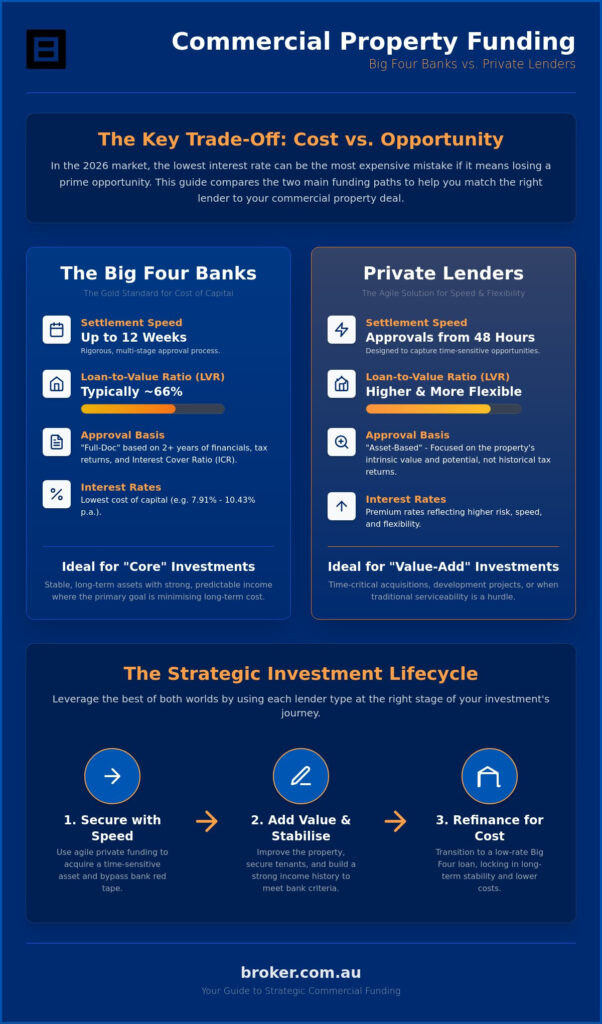
In the fast-moving 2026 market, the lowest interest rate can sometimes be the most expensive mistake you make. We understand the frustration of watching a prime commercial opportunity slip away while a major bank spends twelve weeks debating your interest cover ratio. It is a common hurdle that leaves many investors feeling stuck between rigid traditional policies and the need for speed. When weighing up the pros and cons of private lenders vs big four banks for commercial property, the decision often comes down to a trade-off between the cost of capital and the cost of a missed opportunity.
This article will help you discover whether the security of a Big Four bank or the agility of a private lender is the right move for your next commercial property acquisition. We will provide a clear comparison of current LVR limits, settlement speeds, and serviceability requirements to ensure you feel confident in your funding strategy. You’ll gain a transparent look at how to match the right lender to your specific deal so you can move from uncertainty toward a streamlined, stress-free settlement.
Key Takeaways
- Understand why the choice between private lenders vs big four banks for commercial property is now a strategic decision between the lowest interest rate and the lowest opportunity cost.
- Learn how to navigate the strict “Full-Doc” requirements of the Big Four to secure the gold standard for cost of capital on stable, long-term assets.
- Discover how asset-based lending can bypass traditional serviceability hurdles, providing the agility needed for 48-hour approvals on time-sensitive acquisitions.
- Identify the critical differences between “Core” and “Value-Add” investment profiles to select the lender that best aligns with your project’s risk and reward.
- Gain insights into how an expert guide can manage the transition from rapid private funding to long-term bank refinancing for a seamless investment lifecycle.
Table of Contents
- The 2026 Australian Commercial Lending Landscape
- Major Banks: The Gold Standard for Cost of Capital
- Private Lenders: Speed, Flexibility, and Asset-Based Lending
- Direct Comparison: Side-by-Side Evaluation
- Strategic Advice: How to Choose Your Lender
The 2026 Australian Commercial Lending Landscape
The Australian commercial property sector in 2026 is defined by a stark divergence in how deals are funded. While physical assets remain robust, the path to financing them has split into two very different lanes. On one side, we have the traditional banks, bound by increasing regulatory constraints. On the other, private capital has matured into a sophisticated, mainstream alternative. This shift isn’t just a temporary trend; it’s a structural change in how the market functions.
Dealing with the debate of private lenders vs big four banks for commercial property has become the primary challenge for modern investors. Banks have significantly reduced their commercial real estate exposure, dropping from 10% to just 5.5% of total assets over the last fifteen years. This retreat, coupled with APRA’s strict 3.0% serviceability buffer, means that even high-quality deals are frequently getting knocked back. This is where an expert broker steps in, acting as a high-level fixer to bridge the gap between traditional safety and private agility.
The Big Four: Institutional Stability vs. Rigid Policy
The Big Four, consisting of CBA, Westpac, ANZ, and NAB, remain the pillars of the Australian financial system. As Authorised Deposit-taking Institutions (ADIs), they offer the security of institutional stability and the lowest cost of capital. However, their reliance on a “checkbox” approach often creates friction for modern SMEs. If your financials don’t fit perfectly into a pre-defined template, the approval process can grind to a halt. In 2026, their rigid debt-to-income limits and conservative servicing models mean that “outside the box” deals rarely find a home here.
The Rise of Private Lending Syndicates
Private lending syndicates have evolved far beyond their old reputation as a last resort. Today, a private lender is typically a Non-bank financial institution that draws capital from high-net-worth individuals and dedicated investment funds. They aren’t restricted by the same APRA mandates as the Big Four, allowing them to prioritise the asset’s value and potential over a borrower’s historical tax returns. This shift toward strategic partnership allows for more flexible, tailored solutions that the major banks simply cannot match.
When comparing private lenders vs big four banks for commercial property, the private sector’s ability to offer asset-based lending is often the deciding factor for time-sensitive acquisitions. Rather than waiting months for a committee to review your entire life’s financial history, these syndicates focus on the deal in front of them. This allows for a more efficient path to settlement, ensuring you don’t miss out on prime opportunities due to institutional red tape.
Major Banks: The Gold Standard for Cost of Capital
The Big Four banks remain the primary choice for investors seeking the lowest possible interest rates. In July 2026, Westpac’s Small Business Loan Rate sits at 7.91% p.a., while CBA’s Commercial Variable Base Rate is 10.43% p.a. These figures represent the baseline for the industry. When comparing private lenders vs big four banks for commercial property, the major banks win on price every time. However, this lower cost of capital is earned through rigorous vetting and a high degree of transparency from the borrower.
Approval from a major bank requires a “Full-Doc” approach. This means providing at least two years of clean, profitable tax returns and demonstrating a strong Interest Cover Ratio (ICR). Banks essentially want to see that your business or property income can comfortably cover the interest payments, even if rates rise. This scrutiny is part of the conservative bank lending practices that have seen average LVRs drop from 74% in 2022 to approximately 66% in 2026. While the barrier to entry is high, the long-term benefit of an institutional relationship can provide a stable foundation for a growing portfolio.
The Strict Criteria for Major Bank Approval
Beyond your own financials, banks also look at “industry concentration.” If a bank already has significant exposure to retail shopping centres in a specific postcode, they might decline your application regardless of your personal creditworthiness. They seek a balanced portfolio to mitigate risk. If you are unsure where your deal fits, you can explore commercial property loans to see how your current position aligns with major bank appetites.
The Hidden Strings: Covenants and Conditions
Low rates often come with complex strings attached. Most major bank loans include annual reviews where you must provide updated financial statements. You might also face restrictive covenants, such as maintaining a certain debt-to-equity ratio. Additionally, banks typically require a General Security Agreement (GSA) over your business assets. This gives them a broad claim if things go wrong. While institutional banking offers stability, the administrative burden and “red tape” are significant factors to weigh against the flexibility of a private alternative.
Private Lenders: Speed, Flexibility, and Asset-Based Lending
While major banks focus on the rearview mirror of your historical tax returns, private lenders look at the road ahead. The choice between private lenders vs big four banks for commercial property often hinges on whether you need a partner who values your asset’s potential as much as you do. In 2026, private capital has become the primary tool for investors dealing with specialised assets or short-term lease profiles that traditional institutions simply won’t touch.
The defining feature of this sector is agility. In a market where a prime development site can be snapped up in days, waiting weeks for a bank credit committee is a recipe for missed growth. Leading private syndicates now offer 48-hour approvals, focusing on the strength of the security rather than a rigid serviceability calculation. This flexibility allows for tailored loan structures, such as capitalised interest, which preserves your cash flow during the critical early stages of a project.
Asset-Based Lending vs. Serviceability
Traditional banks prioritise your ability to pay today, but private lenders prioritise your “Exit Strategy.” They want to know how the loan will be repaid at the end of the term, whether through a sale, a renovation that increases value, or an eventual transition to a major bank. This approach opens doors for “Low-Doc” and “No-Doc” applications, where the property’s value does the heavy lifting. For those requiring a rapid injection of capital, second mortgages and caveat loans provide a seamless way to unlock equity without disturbing existing first-mortgage arrangements.
When Time is More Expensive than Interest
Consider a scenario where a commercial site is listed for a quick sale at 20% below market value. A major bank might offer a lower rate but take three months to settle. By then, the opportunity is gone. A private lender can settle in five days. In this case, the higher interest is a small price to pay to secure a significant capital gain. Using private funds for a 12-month “fix” allows you to bridge the gap, stabilise the asset, and then refinance with a Big Four bank once the “red tape” requirements are met. It’s a strategic growth tool, not a last resort for those with poor credit.
Direct Comparison: Side-by-Side Evaluation
In 2026, the gap between bank rates and private capital has narrowed, but the difference in execution remains vast. Major banks like NAB and CBA currently offer commercial rates between 10.15% and 10.43%, while private first mortgages typically range from 9.5% to 13%. While the interest rate is a primary headline, it rarely tells the full story. When evaluating private lenders vs big four banks for commercial property, you must account for the establishment costs and the speed of delivery. Private lenders often require a mandate fee to begin formal due diligence, whereas banks charge application and valuation fees that can be lost if the credit committee declines the deal after eight weeks of waiting.
Settlement timeframes are where the two paths diverge most sharply. A major bank will generally take 60 to 90 days to move from an initial enquiry to a funded settlement. In contrast, private syndicates can often settle within 5 to 10 business days. This difference isn’t just about convenience; it’s about the ability to execute on a contract. Ongoing management also differs. Banks require annual reviews and adherence to strict covenants. Private loans are often structured as “set and forget” for the duration of the 12 to 24 month term, allowing you to focus on the asset rather than the paperwork.
The Cost of Capital Analysis
Justifying a higher interest rate requires a clear look at your projected Return on Investment (ROI). If a private loan allows you to secure a property with a 15% yield while a bank delay would cause you to lose the deal entirely, the “expensive” money is actually the more profitable choice. Opportunity cost in commercial property is the potential profit lost when capital or time is tied up in a slow approval process instead of being deployed into a high-yield acquisition. If you are ready to compare your options, you can get started with our AI-driven loan matching to see which path fits your specific deal.
Refinancing: The Private-to-Bank Bridge
Many of our clients use private debt as a temporary bridge rather than a long-term solution. This “stabilisation” period allows you to complete renovations, secure new tenants, or wait for two years of tax returns to mature. Once the asset meets the “Full-Doc” requirements of the Big Four, we manage the transition to a lower-cost bank facility. When managing the transition between private lenders vs big four banks for commercial property, the key is timing the refinance to match your asset’s peak serviceability. We pride ourselves on being the high-level fixer that organises this entire lifecycle, ensuring you never feel stuck in a high-rate product longer than necessary.
Strategic Advice: How to Choose Your Lender
Choosing between private lenders vs big four banks for commercial property is not about finding a “better” lender; it is about matching the right capital to your specific project DNA. A “Core” investment, such as a fully tenanted medical suite with a long lease, is a perfect candidate for the institutional stability of the Big Four. However, if you are pursuing a “Value-Add” deal like a warehouse conversion or a site requiring a rapid settlement to beat a competitor, private capital is often the only tool that can move fast enough. The key is knowing which lane your deal belongs in before you start the process.
The “Stress-Free” path to funding involves moving away from the trial-and-error approach of traditional applications. We act as your expert guide, using proprietary AI technology to scan over 100 lenders nationally. This allows us to find the specific “needle in the haystack”—the lender with a current appetite for your particular asset class and LVR requirements. By managing the narrative from the outset, we ensure you move from uncertainty toward a feeling of streamlined confidence.
The Five-Point Commercial Lending Checklist
Before approaching any institution, you must have a clear plan for these five critical factors:
- Timeline: Do you need to settle in 10 days or can you wait 90?
- Documentation: Are your tax returns up to date or do you require a Low-Doc solution?
- Asset Type: Is the property a standard industrial unit or a specialised asset?
- LVR: Are you comfortable with a 65% limit or do you need higher leverage?
- Exit Strategy: How will you repay or refinance the debt within 24 months?
You should never apply to a Big Four bank without a professional strategy in place. Multiple bank rejections can result in “credit hits” that stay on your file, potentially spooking other lenders and making an “outside the box” deal much harder to fund later.
Inside Access to Australia’s Best Rates
We provide our clients with inside access to wholesale rates and exclusive private syndicates that aren’t available to the general public. Our award-winning team, featuring specialists like Matt, Kylie, and Flavio, acts as your high-level fixer to ensure your application is positioned for success. We believe the path to settlement should be a low-pressure conversation rather than a high-stakes gamble. If you are ready to see where your deal fits in the current market, we are here to help.
I’m interested in commercial property finance
Secure Your Next Acquisition with Confidence
The 2026 lending landscape requires a sophisticated approach that moves beyond simple interest rate comparisons. Success now hinges on matching your project’s specific profile to the right capital source, whether that is the institutional safety of a major bank for stable assets or the rapid execution of a private syndicate for time-sensitive opportunities. When weighing up private lenders vs big four banks for commercial property, the most effective investors focus on the total return on investment and the agility needed to secure prime sites before competitors can act.
As an award-winning commercial brokerage, we provide inside access to over 100 private and institutional lenders across Australia. Our stress-free, AI-powered application process ensures you find the perfect match for your deal without the anxiety of endless red tape or damaging credit hits. We’re here to act as your expert guide, managing everything from rapid private funding to long-term bank refinancing so you can stay focused on your growth. You’re in good hands with a team dedicated to making your next settlement seamless and efficient.
I’m interested in a commercial property loan strategy
Frequently Asked Questions
Do private lenders in Australia have the same regulations as Big Four banks?
Private lenders are not Authorised Deposit-taking Institutions (ADIs), meaning they aren’t subject to the same APRA-mandated serviceability buffers as the Big Four. While they must still comply with ASIC regulations and Australian Consumer Law, their lack of institutional red tape allows for much greater flexibility. This distinction is the primary reason they can offer asset-based lending solutions that traditional banks simply cannot match.
Can I get a commercial property loan with a private lender if I have bad credit?
Yes, you can often secure funding with a private lender despite a less-than-perfect credit history. These lenders prioritise the value of the commercial asset and your specific “exit strategy” over your historical credit score. If the property is strong and there’s a clear path to repayment or refinancing, a private syndicate will focus on the deal’s future potential rather than past financial hurdles.
How much higher are private lender interest rates compared to ANZ or CBA?
In the July 2026 market, CBA’s commercial variable rate is approximately 10.43% p.a., while private first mortgages typically range from 9.50% to 13.0% p.a. When comparing private lenders vs big four banks for commercial property, the rate gap is often smaller than investors expect. The slightly higher cost is generally viewed as a strategic premium paid for the speed and flexibility that major institutions lack.
What is the minimum loan amount for private commercial lending?
Most private lending syndicates in Australia set their minimum loan amount at $250,000 for commercial property transactions. While some niche providers may consider smaller amounts for caveat loans or second mortgages, the $250,000 threshold ensures the deal is viable for the complex legal and valuation work involved. For larger acquisitions over $1 million, rates can become significantly more competitive, sometimes starting from 6.49% p.a. for premium assets.
How long does it take to switch from a private lender to a Big Four bank?
The transition from private debt to a major bank typically takes between 60 and 90 days. This timeframe is dictated by the bank’s “Full-Doc” requirements, including a new valuation and a comprehensive review of your last two years of tax returns. We often manage this “stabilisation” period for our clients, ensuring all documentation is organised to make the refinancing process as seamless and stress-free as possible.
Are establishment fees higher with private lenders?
Establishment fees are generally higher in the private sector, often ranging between 1% and 2% of the total loan amount. Major banks may offer lower upfront fees, but these can be offset by ongoing service charges and the high cost of a missed opportunity if the approval takes months. In the private lenders vs big four banks for commercial property debate, the higher establishment fee covers the cost of rapid due diligence and 48-hour approval times.
Does a private lender require a full valuation of the commercial property?
Most private lenders require a formal valuation, but they are often more flexible regarding the type of report they accept. While a Big Four bank insists on a full “bank-ordered” valuation that can take weeks, a private lender might accept a desktop valuation or an Automated Valuation Model (AVM) for lower LVR deals. This pragmatic approach is a key factor in their ability to settle loans in as little as five business days.
Can I use my Self-Managed Super Fund (SMSF) with a private lender?
Yes, you can use an SMSF to secure commercial property finance through a private lender. This is an excellent solution for “outside the box” scenarios where a traditional bank might find the fund’s structure or the asset type too complex. While the compliance requirements remain strict, private capital can provide the tailored terms needed to help your super fund acquire high-yield commercial assets efficiently.