
A grant isn’t automatically the better option for your business. Government grants vs loans for a small business comes down to what you need to fund: grants support specific eligible projects, while loans provide money that must be repaid. A grant’s purpose and eligibility criteria can restrict how you use the funds, while loan repayments need to fit your cash flow.
It’s understandable to look for funding that keeps costs manageable, especially when you’re growing or considering buying a business. The right option depends on your plans, eligibility and ability to manage repayments, not simply whether the funding is called a grant or a loan.
This guide compares the two options in Australia and outlines targeted support programs, including grants for research and development, innovation and disaster recovery. You’ll also find practical ways to explore programs and consider how business acquisition funding may suit the purchase of an existing business.
Key Takeaways
- Match funding to its purpose: grants support eligible projects, while loans provide funds that need to be repaid.
- Explore targeted programs such as CSIRO Kick-Start, TechVouchers and MVP Ventures to see whether their focus aligns with your project.
- Use the Australian Government’s Grants and Programs Finder to search by industry, sector and region, then review each program’s eligibility and conditions.
- Consider how repayments could affect cash flow before choosing a loan, especially when buying an existing business.
- For a business purchase, explore acquisition finance options such as Business Acquisition Funding and consider how the proposed loan fits your plans.
Table of Contents
- Australian government business grants and programs
- Examples of targeted grant programs
- Government grants
- Grants compared with loans
- Small business grants
- Broker.com.au
Australian government business grants and programs
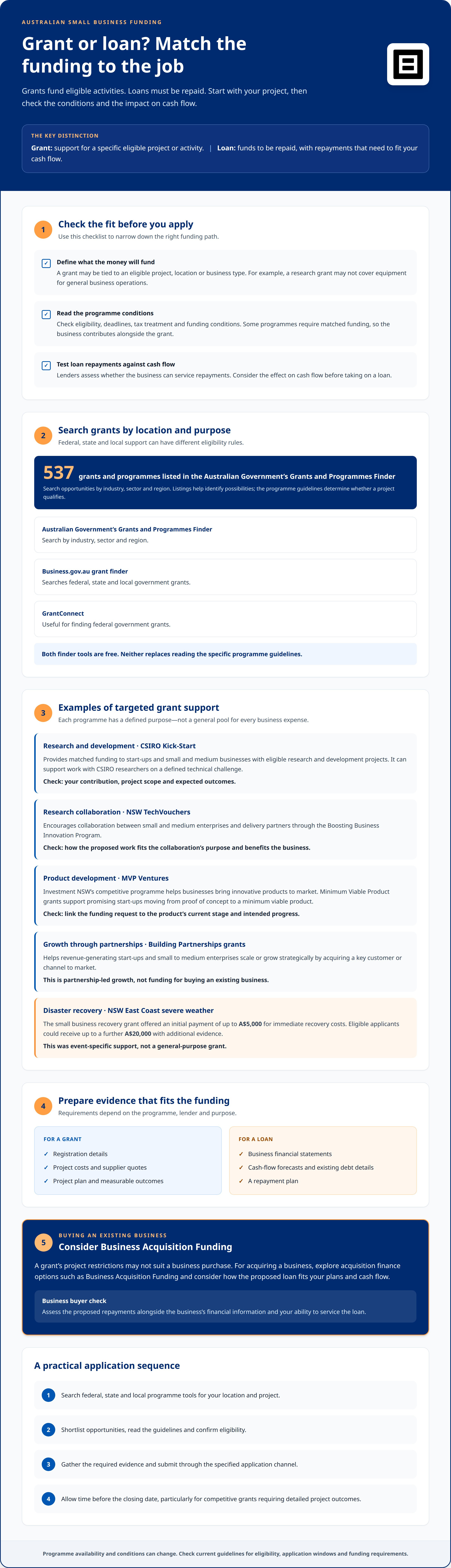
Australian governments offer business grants and programs at federal, state and local levels. Their aims include research and development, training, exporting and disaster recovery. Funding is usually tied to an eligible activity, location or business type. For example, a research grant may not cover equipment for general business operations.
The Australian Government’s Grants and Programs Finder lists 537 grants and programs for businesses. Use it to search opportunities by industry, sector and region. Business.gov.au’s online grant finder searches federal, state and local government grants. GrantConnect is useful for finding federal government grants. Both tools are free, and neither replaces reading the specific program guidelines.
Program conditions matter as much as the advertised purpose. Some Western Australian grants support research and development, capability building, innovation or exporting. Some require matched funding, meaning the business contributes alongside the grant. In South Australia, co-investment funds can match a percentage of investment from other sources. Before applying, review each program’s eligibility, deadlines, tax treatment and funding conditions.
The documents you need depend on the program and funding purpose. For a grant, prepare registration details, project costs, supplier quotes, a project plan and measurable outcomes, such as training or reduced energy use. A loan application may also require business financial statements, cash-flow forecasts, existing debt details and a repayment plan. Lenders assess whether the business can service the repayments.
To apply, search federal, state and local program tools, then shortlist opportunities that match your location and project. Read the guidelines, confirm eligibility, gather the required evidence and submit through the application channel specified. Allow time before the closing date, especially for competitive grants requiring detailed project outcomes.
Yes, opportunities can depend on the state or territory where the business operates. Federal programs may be available nationally, while state and local grants often target particular regions, industries or events. Search by location, then assess the relevant program’s eligibility rules.
Targeted support may also involve universities or industry bodies. Partnerships can provide access to research facilities, training or sector-specific grants. Voucher programs may help businesses access specialist services or tools. The Entrepreneurs’ Programme supports competitiveness and productivity through initiatives including Accelerating Commercialisation, Business Management, Incubator Support and Innovation Connections.
Grant opportunities change as programs open, close or receive new funding. Make searching an ongoing business task rather than a one-off exercise. Keep a record of relevant programs, application dates and project requirements. For a competitive grant, align your proposal with the program’s objectives and explain the intended outcomes clearly.
Examples of targeted grant programs
Targeted grants fund defined projects, not every business expense. The right fit depends on the program’s purpose, your project and its eligibility criteria. These examples show how support can vary across research, innovation, partnerships and recovery. Review current program guidelines for application windows and conditions before preparing a proposal.
Research and development: CSIRO Kick-Start provides matched funding to start-ups and small and medium businesses with eligible research and development projects. It can help a business work with CSIRO researchers on a defined technical challenge. Applicants should plan how to meet their contribution and set out the project’s scope and expected outcomes.
Research collaboration: NSW TechVouchers encourage collaboration between small and medium enterprises and delivery partners through the Boosting Business Innovation Program. This may suit a business seeking specialist research input or innovation support. Match the proposed work to the collaboration’s purpose, describe the project clearly and explain how it could benefit the business.
Product development: Minimum Viable Product grants support promising start-ups progressing from proof of concept to a minimum viable product. Investment NSW’s MVP Ventures Program is a competitive grant that helps businesses bring innovative products to market. Both examples focus on development milestones, not general operating expenses. Link the funding request to the product’s current stage and intended progress.
Growth through partnerships: Building Partnerships grants help revenue-generating start-ups and small to medium enterprises scale or grow strategically by acquiring a key customer or channel to market. This differs from buying an existing business. A proposal should explain how the partnership supports the business’s growth strategy and what measurable change the funding will enable.
Disaster recovery: The NSW East Coast severe weather small business recovery grant offered an initial payment of up to A$5,000 for immediate recovery costs. Eligible applicants could receive up to a further A$20,000 with additional evidence. This example illustrates why disaster grants have event-specific eligibility and evidence requirements. It’s not a general-purpose grant for businesses outside the defined event.
The Australian Government’s Grants and Programs Finder can search opportunities by industry, sector and region. GrantConnect is useful for federal government grants, while Business.gov.au’s finder covers federal, state and local opportunities. These tools identify possibilities, but each program’s guidelines determine whether a project qualifies.
Match the grant to the work before building a funding plan. For research, identify the technical question; for product grants, define development milestones; for recovery, document eligible impacts and costs. If your main goal is funding to acquire a business, a purchase-finance pathway addresses a different need than these project-based grants.
Government grants
Government grants can reduce the cost of a defined business project, but they aren’t general-purpose funding. Each program has its own objectives, eligible applicants and conditions. A grant for workplace safety, for example, serves a different purpose from one supporting women-led start-ups or commercialisation. Start with the project you need to fund, then look for a program designed for that activity.
The funding range makes it important to match the proposed project and requested amount to the program’s requirements. Applicants should explain the business need, planned work and expected outcomes, rather than treating the maximum grant amount as an automatic entitlement.
Some programs focus on a particular state or activity. Eligible small businesses in New South Wales can apply for a SafeWork rebate of up to A$1,000 towards workplace health and safety items. In Western Australia, grant opportunities may support research and development, innovation, exporting or capability building for specific events. These examples show why location and project purpose can shape eligibility.
Not every form of government support is a grant. The South Australian Venture Capital Fund invests in companies through private-sector fund managers. Each initial investment must be matched with at least 50% investment from other sources. The R&D Tax Incentive is different again: it provides a tax benefit to help offset some costs of eligible research and development activities. Businesses should distinguish these mechanisms before building a funding plan.
For a grant application, connect the project directly to the program’s objectives. Set out the work, expected benefits and how the funding would support delivery. Outcomes might include jobs, staff training or reduced energy use. Competitive applications also need clear evidence that the project meets eligibility rules and offers tangible benefits.
Before applying, review the terms, tax implications and conditions attached to the funding. Build an internal schedule that allows time to gather documents and prepare the proposal before the closing date. Keep a record of relevant opportunities, since programs and application windows change. A grant may suit a defined development project, while buying a business generally calls for funding structured around the acquisition and its cash-flow impact.
Use the Australian Government’s Grants and Programs Finder to search by industry, sector and region. Business.gov.au’s finder covers federal, state and local opportunities, while GrantConnect focuses on federal grants. Treat results as a shortlist, then use each program’s guidelines to assess suitability, eligibility and application requirements.
Grants compared with loans
For a business buyer, the choice between grants and loans starts with the purpose of the purchase. Grants support specified projects under program conditions; acquisition finance is structured around buying an existing business and managing repayments. A government grants vs loans for small business comparison should therefore consider whether the funding can be used for the purchase, not just whether the business might qualify for support.
Which Australian government small business loans are available, and who provides them? The Australian Government’s Small Business Export Loan supports businesses seeking to export products or services. The NSW Rural Assistance Authority offers low-interest recovery loans for small businesses affected by natural disasters. These target export and recovery needs rather than general business acquisitions.
Eligibility differs between grants and lending. A grant applicant must meet the program’s requirements for business type, location and intended project. For acquisition lending, the lender assesses the proposed purchase and the buyer’s ability to service repayments. Buyers should be ready to explain the purchase purpose, available contribution and how the business’s cash flow supports ongoing debt.
How much funding can Australian small businesses receive through grants or loans? There’s no single amount that applies across programs or lenders. Grant funding depends on the program and eligible project; acquisition finance depends on the transaction, the buyer’s contribution and the lender’s assessment. The purchase price alone doesn’t determine how much a lender will advance.
When buying a business, consider the deposit or equity contribution alongside the funds needed after settlement. A larger contribution can reduce the amount borrowed, while retaining working capital can help cover operating costs. Model repayments against expected cash flow, including a realistic view of income and expenses after ownership changes.
What are the risks and tax implications of grants and loans for Australian small businesses? Grant conditions can restrict spending or require project reporting; loans involve repayments and interest costs. Tax treatment depends on the funding and the business’s circumstances. For an acquisition, include debt servicing and post-purchase cash flow in your forecasts, and account for any grant conditions separately.
Use the Australian Government’s Grants and Programs Finder to search opportunities by industry, sector and region. GrantConnect focuses on federal grants. These tools can help identify support for eligible projects, but buying a business requires a separate assessment of purchase funding, equity and repayment capacity.
Buying a business can involve different funding needs from a grant-funded development project. Compare proposed loan repayments with the business’s projected cash flow, then allow for working capital after the purchase. The government grants vs loans for small business decision is clearest when each option matches its permitted purpose and the buyer’s ability to manage the resulting commitments.
Small business grants
Small business grants can support a specific project, business capability or eligible hire. The useful first step is to match the business’s need to a program’s purpose. A grant aimed at exporting, for example, won’t necessarily fund day-to-day expenses. Eligibility can also depend on the business’s location, structure, industry and proposed activity.
Some support is delivered through wage subsidies rather than project grants. Eligible Australian businesses may receive up to A$10,000 when hiring eligible individuals into ongoing jobs. The subsidy can help with hiring costs, but the business still needs a suitable role and must meet the program’s conditions. Build the expected employment outcome into the funding plan.
Other programs target capability or access to international markets. The Australian Government’s Landing Pads Program provides Australian start-ups with workspace for up to 90 days in a global innovation hub. This is practical support for businesses pursuing international connections, rather than unrestricted cash for general costs. A business considering it should connect the opportunity to a clear market-entry plan.
For businesses developing new ideas, the Grid Enhancing Technologies Program provides a funding stream that supports innovation and business growth. Some grants may support projects that promote gender equality and leadership opportunities. These programs have distinct purposes, so shape proposals around their stated outcomes.
Small business assistance can also be non-financial. In Western Australia, much government support comes through free or low-cost advisory services, information and guidance. Australian Government advice services for small firms also provide access to free advice. These resources may help clarify a project before a business commits time to a grant application.
Use a practical screening process before applying:
- Define the need: identify the project, purchase, training or hiring outcome requiring support.
- Search by location and sector: use the Australian Government’s Grants and Programs Finder to find relevant opportunities.
- Read the conditions: confirm eligibility, eligible costs, required contributions and application dates.
- Set out the benefits: explain measurable outcomes, such as jobs, training or improved capability.
- Plan the timing: set internal deadlines ahead of cut-offs and allow time to prepare evidence.
Grant searches work best as an ongoing task because programs and opportunities change. Keep a simple record of relevant programs, closing dates and project requirements. If the funding need is purchasing an existing business rather than delivering a defined grant project, explore funding for a business acquisition as a separate option.
Broker.com.au
Broker.com.au helps Australian businesses assess lending options when a grant doesn’t cover the full funding need or a project isn’t eligible for one. For a business buyer, that may mean considering Business Acquisition Funding alongside the purchase plan and expected cash flow. Other needs may call for a Secured Business Loan, an Unsecured Business Loan or Working Capital Finance.
The right lending structure depends on the purpose of the funds, the business’s financial position and its ability to manage repayments. Broker.com.au can help you consider how a loan may fit alongside eligible grant support, without treating grants and borrowing as interchangeable. This can be useful when purchasing an existing business or planning for operating costs after the acquisition.
For a conversation about your funding options, contact Broker.com.au.
Plan your next funding move
A clear decision on government grants vs loans for a small business starts with the outcome you need to fund. Set out the purpose, timing and amount required, then distinguish project funding from the capital needed to buy or operate a business. A concise funding brief can make your next conversation more focused.
If you’re buying a business, consider how acquisition finance fits with your purchase plans and ongoing cash-flow needs. Broker.com.au offers Business Acquisition Funding, Secured Business Loans and Unsecured Business Loans for businesses considering borrowing. The right pathway depends on the funding purpose and the business’s ability to manage repayments.
Bring your funding priorities into focus and discuss how borrowing may fit your plans. Explore your options with Broker.com.au, then take the next step with a clearer view of what your business needs.
Frequently Asked Questions
What Australian government grants are available for small businesses in 2026?
Examples include CSIRO Kick-Start for eligible research and development, Austrade’s Export Market Development Grants for exporters, and the Landing Pads Program for start-ups seeking international connections. The Australian Government’s Grants and Programs Finder lists 537 grants and programs for businesses. Use it to identify relevant opportunities, then check each program’s current status, application dates and criteria before planning around its funding.
Do Australian government small business grants need to be repaid?
Grants generally don’t need to be repaid when recipients meet the program’s conditions and use the funding for approved purposes. However, a grant may require matched contributions, project evidence or reporting on outcomes. For example, CSIRO Kick-Start uses matched funding for eligible research and development projects. Read the funding agreement carefully, as failing to meet its conditions can affect the grant and create repayment obligations.
How do grants and loans compare for small businesses in Australia?
A grant can suit a defined project, such as product development, while a loan may suit a purchase that needs repayable capital. For instance, a business developing research outputs could investigate CSIRO Kick-Start; someone buying an existing business needs to assess acquisition finance instead. Compare the funding purpose, application conditions and cash-flow impact, including whether repayments will remain manageable after the project or purchase.
How can I find current, legitimate Australian government small business funding programs?
Start with the Australian Government’s Grants and Programs Finder to explore opportunities across industries and regions. Business.gov.au’s finder covers federal, state and local programs, while GrantConnect focuses on federal grants. Treat search results as leads: confirm the program’s administering agency, eligibility, application channel and closing date in its official guidelines. This helps distinguish a current government opportunity from outdated information or an unrelated commercial offer.