
The traditional belief that you must bring a massive cash deposit to the table to acquire a profitable Australian company is a myth that keeps many talented entrepreneurs on the sidelines. While the Big Four banks have tightened their belts following the RBA’s move to a 4.10% cash rate in March 2026, the path to ownership hasn’t closed; it’s simply evolved. Achieving financing a business purchase with no money down isn’t about finding a magic loan. Instead, it’s about mastering a strategic funding stack that combines asset leverage with creative equity solutions.
We understand the frustration of seeing a perfect acquisition opportunity slip away because of rigid lending criteria or complex financial jargon. You deserve a clear roadmap that moves you from uncertainty to streamlined confidence. In this guide, you’ll discover how to look beyond the balance sheet to secure 100% funding. We’ll show you how to utilise the target business’s own assets, tap into the booming private credit market, and structure seller finance to ensure you’re in good hands throughout the entire transaction.
Key Takeaways
- Master the “funding stack” method to layer different financial products, allowing you to cover the full purchase price without a traditional cash deposit.
- Explore how financing a business purchase with no money down relies on leveraging the target company’s existing assets, such as machinery or vehicle fleets, through tailored asset finance.
- Learn to negotiate vendor finance and earn-out structures that align the seller’s interests with your success while significantly reducing upfront capital needs.
- Discover how to access the private credit market and non-bank lenders who offer more flexible, “covenant-lite” terms than traditional institutions in 2026.
- Understand why a sophisticated broker using proprietary AI is essential for navigating the new mandatory merger notification regime and complex M&A regulations.
Table of Contents
- The Reality of Financing a Business Purchase with No Money Down in Australia
- Strategic Deal Structuring: The ‘Funding Stack’ Approach
- Leveraging the Target Business’s Assets to Fund the Buyout
- The Seller’s Role: Navigating Vendor Finance and Earn-outs
- Navigating the 2026 Lending Landscape with a Specialist Broker
The Reality of Financing a Business Purchase with No Money Down in Australia
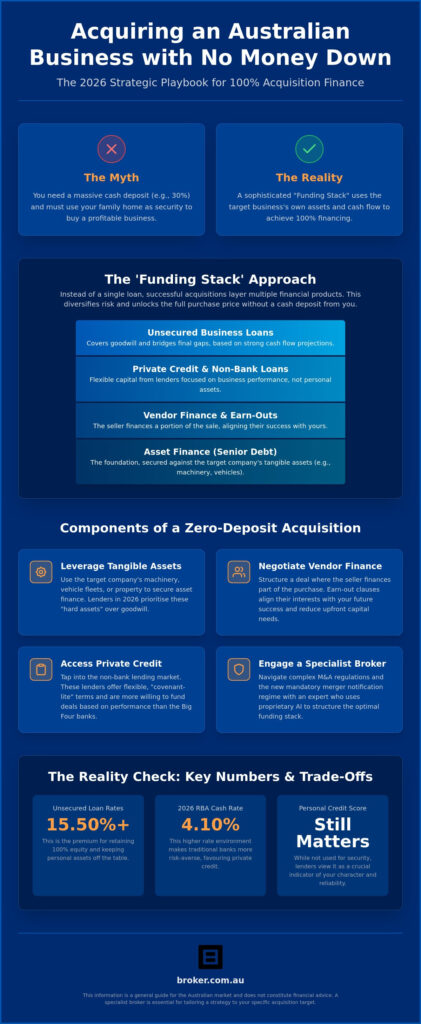
In the 2026 Australian corporate landscape, the phrase “no money down” has moved away from the world of late-night infomercials and into the boardroom. While it sounds like a magic trick, it’s actually a sophisticated financial strategy known as a Leveraged Buyout (LBO). This structure involves using the target company’s own balance sheet and future cash flows as the primary collateral for the acquisition. For ambitious entrepreneurs, this means your ability to run a company is becoming more valuable than the cash sitting in your bank account.
Traditional “Big Four” banks often say no to 100% finance because their models are built on personal security, typically requiring a 30% deposit or a charge over your family home. In a market where the RBA cash rate sits at 4.10%, these institutions have become even more risk-averse. However, this rejection is often a blessing in disguise. It pushes buyers toward the private credit sector and non-bank lenders who are far more interested in the business’s performance than your mortgage. The shift from personal security to business-backed security is the cornerstone of financing a business purchase with no money down in the current market.
Success hinges on the balance between “Goodwill” and “Tangible Assets.” Lenders in 2026 are pragmatic; they prefer assets they can see, touch, and value, such as machinery, vehicle fleets, or commercial property. If a business has significant tangible assets, you can often use asset finance to unlock the capital needed for the purchase price. If the business is heavy on goodwill, such as a software firm or a service agency, the path is narrower but still achievable through high-level cash flow modelling and unsecured business loans.
Is 100% Financing Actually Possible?
Yes, but you must distinguish between zero-deposit and zero-equity deals. You might not bring cash to the table, but you will need to “stack” different products to reach the full purchase price. High-cashflow businesses are the prime candidates for this approach. With the right strategic advisory, you can layer a secured loan against equipment with a line of credit or invoice finance to bridge the gap. In 2026, market liquidity is high, and lenders are hungry for deals that show strong operational history and clear debt-servicing capabilities.
Common Misconceptions About Zero-Deposit Buyouts
Many believe these structures are “scams” or only for distressed businesses. This is a myth. Legitimate corporate finance uses these tools every day to facilitate growth. The real trade-off is the cost of capital. You will likely face higher interest rates, often starting from 15.50% for unsecured portions, compared to a standard home-equity backed loan. You are essentially paying a premium to retain your equity and keep your personal assets safe. It’s also vital to remember that your personal credit score still matters. Lenders use it as a proxy for your character; they need to know you’re a safe pair of hands before they fund your acquisition dream.
Strategic Deal Structuring: The ‘Funding Stack’ Approach
Successful entrepreneurs don’t look for a single loan to cover an acquisition. Instead, they build a “funding stack.” This method involves layering different financial products to reach the total purchase price, effectively achieving financing a business purchase with no money down. By diversifying your sources of capital, you reduce the pressure on any single lender and increase your chances of approval. While exploring Australian government funding options is a great starting point for understanding the basics, complex deals often require a more tailored approach that combines senior debt with more flexible mezzanine layers.
The structure of your deal is often more critical than the interest rate for long-term ROI. A low rate is useless if the repayment schedule chokes your cash flow in the first twelve months. Smart buyers prioritise structures that include working capital facilities to cover the first 90 days of operation. This ensures the business remains stable while you implement your growth strategy. If you’re unsure how to piece these elements together, our team can help you explore Business Acquisition Funding options that fit your specific goals.
Layering Senior and Junior Debt
In a typical stack, senior debt comes from a primary lender and usually covers 50 to 70% of the deal. This debt is “senior” because it has first claim on assets. To reach 100%, you then introduce junior or subordinated debt. This mezzanine layer fills the gap between the senior loan and your equity. Because junior lenders take on more risk, they charge higher rates, but they allow you to keep your cash in your pocket. Negotiating inter-creditor agreements is essential here to ensure both lenders are comfortable with their position in the hierarchy.
The Role of Private Lenders and Boutique Firms
Private lenders are the “High-Level Fixers” of the 2026 lending market. Unlike traditional banks, these boutique firms specialise in specific industries and are far more willing to consider “no money down” applications. They look at the intrinsic value of the business and your expertise rather than just a list of personal assets. At Broker.com.au, we use proprietary AI to scan the market and identify the most compatible partners for your specific stack. This “inside access” gives you a competitive edge, matching you with lenders who understand the nuances of your sector and are ready to back your vision.
Leveraging the Target Business’s Assets to Fund the Buyout
The secret to financing a business purchase with no money down often lies in plain sight: the target company’s own balance sheet. While traditional lenders fixate on your personal savings, sophisticated buyers identify “hidden” value within the business they are acquiring. This approach, known as asset-based lending, allows you to use the enterprise’s own strengths to fund its takeover. By looking at tangible items like machinery, vehicle fleets, and even stock, you can create a pool of capital that serves as your deposit. It’s a proactive way to ensure you’re in good hands from day one without draining your personal accounts.
When you explore various no money down strategies, you’ll see that leveraging existing assets is a cornerstone of successful M&A. This isn’t just for heavy industry. Retailers can use stock and inventory finance to unlock cash tied up in warehouse shelves, while wholesalers can use unpaid invoices to generate immediate liquidity. This strategy shifts the focus from what you have in the bank to what the business has on its floor. It transforms the acquisition from a personal financial burden into a self-funding corporate transition.
Refinancing Existing Equipment and Vehicles
Many established Australian businesses own their machinery or vehicle fleets outright. You can utilise a “Sale and Leaseback” arrangement to refinance these assets during the acquisition process. A lender buys the equipment from the business at its current market value and leases it back to you. This provides an immediate cash injection that can fund the “goodwill” portion of the purchase price. We often help clients structure Asset Finance and fit-out finance to ensure that refurbished premises or upgraded fleets are accounted for during the transition, keeping your personal capital untouched.
Invoice Finance: The Secret Weapon for Cash-Heavy Businesses
If the target business has a long list of outstanding debtors, you’re sitting on a goldmine. Invoice finance allows you to access up to 85% of those unpaid invoices on the first day of ownership. This creates an immediate “deposit” from the company’s own earnings. You can choose between factoring, where the lender manages the collections, or confidential invoice discounting, which keeps the arrangement private from your customers. Combining this with a Line of Credit ensures you have day-to-day liquidity to handle operational costs while the business’s own cash flow pays down the acquisition debt.
The Seller’s Role: Navigating Vendor Finance and Earn-outs
While most buyers look outward to banks or private credit, the most effective partner for financing a business purchase with no money down is often the person sitting across the negotiating table. Vendor finance, where the seller agrees to receive a portion of the sale price over time, has become a cornerstone of the 2026 Australian M&A landscape. This isn’t a sign of a weak deal; it’s a sophisticated signal of confidence. When a seller leaves “skin in the game,” it proves to your senior lenders that the business is as profitable as the books suggest, often satisfying their requirement for a cash deposit without you touching your own savings.
A seller might agree to this structure for several pragmatic reasons. Spreading out the sale proceeds can offer significant tax benefits by managing capital gains liabilities over multiple financial years. Additionally, they earn a competitive interest rate on the loan, usually ranging from 6% to 10% p.a., which provides a steady income stream post-exit. By turning the seller into a junior lender, you transform a potentially adversarial negotiation into a collaborative partnership focused on the long-term success of the enterprise.
Pitching Vendor Finance to the Seller
Success lies in how you frame the proposal. Don’t simply ask for a loan; offer a structured deal that protects their legacy while securing your cash flow. You might suggest paying 70% upfront through asset-backed debt and the remaining 30% via a vendor note over a five-year term. This acts as a vital “buffer” during the transition period. In the current market, these agreements are common for 5 to 7 years, providing the seller with security and the buyer with the breathing room needed to implement growth strategies without immediate capital pressure.
Earn-outs and Performance-Based Payments
Earn-outs are another powerful tool to reduce your upfront capital requirement. By defining clear EBITDA targets, you can defer a significant portion of the purchase price, paying it only when the business hits specific milestones. This bridges the gap between a seller’s high valuation and a lender’s more conservative assessment. It also protects you from hidden liabilities or a sudden drop in revenue after the handover. If you’re looking to structure a deal that minimises your initial outlay, we can help you explore Business Acquisition Funding options that integrate these creative seller-led solutions into your total stack.
Legal protections are paramount. A “Best in Class” vendor loan agreement must clearly define the hierarchy of debt and what happens if targets aren’t met. This level of professional detail ensures the process remains seamless and that you’re in good hands throughout the entire buyout journey.
Navigating the 2026 Lending Landscape with a Specialist Broker
Securing financing a business purchase with no money down in 2026 requires a level of sophistication that goes far beyond a standard loan application. With the Australian Competition and Consumer Commission (ACCC) now enforcing a mandatory merger notification regime as of January 1, 2026, and the RBA cash rate sitting at 4.10%, lenders have become significantly more analytical. They are no longer just looking at your credit score; they are scrutinising the viability of the entire deal structure. To succeed, you need a partner who acts as a High-Level Fixer, capable of presenting a deal that satisfies both regulatory requirements and strict debt-servicing ratios.
At Broker.com.au, we utilise proprietary AI to cut through the complexity of the current market. This technology allows us to rapidly assess your deal against hundreds of non-bank and private credit options, identifying the most compatible “funding stack” in a fraction of the time it takes traditional institutions. We help you prepare a comprehensive “Corporate Advisory” pack that includes detailed P&L analysis and balance sheet projections. This ensures that when we approach a lender, your application is seen as a professional, low-risk opportunity rather than a speculative request.
The Power of Professional Presentation
Your business plan must function as a strategic roadmap for the lender. It needs to demonstrate exactly how you will maintain operations during the transition and where the growth will come from to service the new debt. High-quality financial modelling is non-negotiable; you must show that even with the average business loan interest rate hovering around 15.95% p.a. for unsecured portions, the company’s cash flow remains robust. A specialist broker’s inside access to niche lenders is the catalyst that transforms a rejected bank application into a successful zero-deposit acquisition.
Beyond the Loan: Long-Term Strategic Support
Our role doesn’t end when the contracts are signed. Once you’ve acquired the business, we provide ongoing support to help you restructure debt for better cash flow. As you settle into your new role, you may want to scale operations by upgrading machinery or expanding your fleet. We can assist with Asset Finance or equipment finance to ensure your growth is seamless and efficient. Starting this journey is as simple as a low-pressure conversation about your goals and the specific “dream” you’re chasing.
Ready to explore your options? I’m interested in business acquisition funding
Take the Next Step Toward Business Ownership
Acquiring a profitable company without a massive upfront deposit is a strategic reality in 2026. By layering asset-backed security with vendor participation, you can bypass traditional bank hurdles and keep your personal capital intact. Success in this landscape requires more than just a good idea; it demands a sophisticated funding stack and a proactive approach to deal structuring. Mastering the art of financing a business purchase with no money down allows you to focus on growth rather than debt anxiety.
As an award-winning Australian brokerage, we provide inside access to over 80 specialist lenders who look beyond the standard balance sheet. Our proprietary AI ensures faster, more accurate matches for your specific acquisition goals, ensuring the process is seamless and professional. We’re here to act as your expert guide, moving you toward a feeling of streamlined confidence and relief.
I’m interested in exploring 100% business finance
Your dream of ownership is within reach. It’s simply a matter of finding the right structure to unlock the door and start your next chapter with confidence.
Frequently Asked Questions
Can I really buy a business in Australia with zero dollars in my bank account?
Yes, it is possible to acquire a business without personal cash, though it requires a sophisticated “funding stack” rather than a single loan. You achieve this by layering asset finance against the target’s equipment, invoice finance against their debtors, and negotiated vendor finance. While rare at traditional banks, private lenders often support these structures for high-cashflow acquisitions where the business’s own performance provides the primary security.
What is the minimum credit score required for a no-money-down business loan?
Most non-bank lenders look for a credit score of 600 or higher, but your industry experience often carries more weight in 2026. Because these deals rely on the business’s assets and cash flow, lenders focus on your ability to manage the enterprise effectively. A lower score isn’t an automatic rejection if you have a strong track record and a professional corporate advisory pack demonstrating the deal’s viability.
Does ‘no money down’ mean I don’t have to provide a personal guarantee?
No, a personal guarantee is almost always required for 100% debt-funded acquisitions in the Australian market. While you aren’t providing a cash deposit, the lender needs to ensure you are personally committed to the business’s success. This guarantee acts as a secondary layer of security, giving the lender recourse if the business fails to meet its debt obligations, ensuring you remain in good hands through mutual accountability.
What types of Australian businesses are easiest to finance with 100% debt?
Businesses with significant tangible assets, such as transport companies with large fleets or manufacturing firms with specialised machinery, are the most straightforward to finance. High-recurring revenue models, like established accounting practices or service firms, also perform well due to their predictable cash flow. These attributes make financing a business purchase with no money down more achievable as they provide clear collateral and debt-servicing evidence for private lenders.
How do interest rates for no-deposit loans compare to traditional business loans?
Interest rates for these structures are typically higher than traditional bank loans because they represent a greater risk to the lender. In July 2026, while secured bank rates might start from 7.49% p.a., the unsecured or mezzanine layers of a no-deposit stack often start from 15.50% p.a. You are essentially paying a premium for the flexibility of keeping your own capital unencumbered while the business’s cash flow handles the repayments.
What is the difference between an unsecured business loan and vendor finance?
An unsecured business loan is capital provided by a third-party lender without requiring physical collateral, often based on the company’s historical cash flow. Vendor finance is a loan provided by the seller, where you pay a portion of the purchase price over an agreed term after the handover. Both are essential components of a zero-deposit stack; however, vendor finance often carries lower interest rates and signals high seller confidence to other lenders.
How long does the approval process take for a complex acquisition stack?
A complex acquisition stack typically takes between four and eight weeks to finalise from the initial application. The timeline depends on the speed of due diligence and the coordination between different lenders in the stack. Using proprietary AI tools allows us to accelerate the initial matching process, but the legal work and inter-creditor agreements required for a seamless transition take time to ensure every detail is best in class.
Can I use my home as security for a business purchase without a cash deposit?
Yes, using the equity in your home is a common method to achieve 100% finance without using a liquid cash deposit. By providing a mortgage over your property, you can access lower interest rates from traditional banks. This often serves as the “senior debt” layer of your stack, which you can then combine with asset finance or a line of credit to cover the full purchase price without touching your savings.