
What if the biggest threat to your company’s future isn’t the partner leaving, but the way you choose to pay them out? In the 2026 market, many Australian business owners mistakenly believe they must risk their family home or drain their working capital to achieve full ownership. While the RBA cash rate sits at 4.35%, the real challenge lies in securing goodwill financing for business partner buyouts without suffocating your daily operations. You’ve worked hard to build this enterprise. It’s natural to feel anxious about the complexity of valuations or the fear of personal liability during such a significant transition.
We understand that you want a clean break and a clear path forward for your staff and clients. This expert-led guide provides the strategic roadmap you need to master the buyout process while protecting your business cash flow. You’ll learn how to navigate 2026’s shifting valuation metrics, tap into specialised non-bank lending options, and structure a repayment plan that supports growth rather than stifling it. We’re here to help you move from the uncertainty of a partnership exit to the streamlined confidence of being the sole captain of your ship.
Key Takeaways
- Identify the most efficient funding pathways for 2026, comparing how secured and unsecured loans can protect your personal assets while enabling full ownership.
- Master the nuances of securing goodwill financing for business partner buyouts to ensure the intangible value of your company is fully funded without stifling growth.
- Understand the primary metrics Australian lenders use to assess applications, focusing on the Debt Service Cover Ratio (DSCR) and current 2026 RBA interest rate trends.
- Follow a structured five-step roadmap to prepare your business for a buyout, from preliminary legal reviews to building robust 2026 serviceability models.
- Discover how “inside access” to non-bank lenders and expert corporate advisory can help you navigate complex debt structures and ensure a seamless transition for your team.
Table of Contents
- The Strategic Landscape of Partner Buyouts in 2026
- Funding Pathways: Comparing Secured, Unsecured, and Hybrid Solutions
- How Australian Lenders Assess Buyout Applications in 2026
- The 5-Step Roadmap to Securing Buyout Finance
- Optimising Your Buyout: Why an Expert Broker is Essential
The Strategic Landscape of Partner Buyouts in 2026
Transitioning from shared control to total ownership is a defining milestone for any Australian entrepreneur. It marks the moment you take full responsibility for the company’s vision and future. Structurally, this process often functions as a Leveraged Buyout (LBO), where the business’s future earnings or existing assets provide the security for the debt used to acquire your partner’s equity. In the 2026 market, we’re seeing specific triggers driving these transitions. A significant wave of retirements is coinciding with strategic pivots, particularly as partners disagree on the speed of digital transformation or capital expenditure for AI integration.
You might feel tempted to use company cash reserves to fund the exit, but this often creates a “liquidity trap.” Draining your accounts can starve the business of the working capital it needs to grow once you’re in charge. Opting for a debt-funded solution keeps your cash flow intact. This is where goodwill financing for business partner buyouts becomes essential. It allows you to borrow against the intangible value of the business, such as its reputation and client base, rather than just its physical equipment or property. A robust Buy-Sell Agreement is the cornerstone of a financeable exit; without a clear, legally binding mechanism for valuation and transfer, lenders will view the transaction as high-risk.
Amicable vs. Hostile Buyouts: Financing Implications
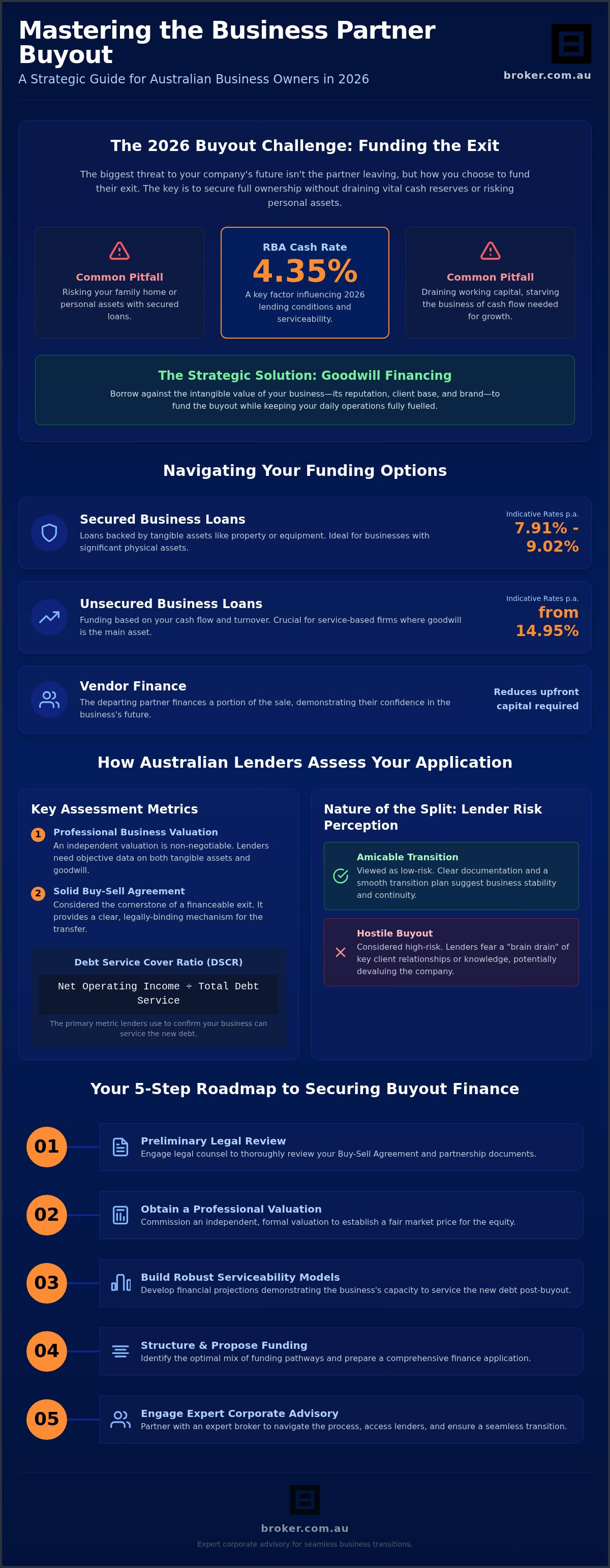
Lender appetite shifts dramatically depending on the nature of the split. Credit risk departments prioritise stability. An amicable transition, documented with clear minutes and a transition plan, suggests the business will continue without a hitch. Hostile buyouts are more complex. If the exiting partner holds key client relationships or technical knowledge, lenders fear a “brain drain” that could devalue the company. In these “outside the norm” cases, our corporate advisory team acts as a high-level fixer, structuring the deal to mitigate these risks and reassure the lender that the business remains a safe bet.
Valuation: The Foundation of Your Finance Application
Your 2026 valuation must reflect the current economic climate, including the RBA cash rate of 4.35%. Lenders distinguish sharply between tangible assets, like vehicles or machinery, and goodwill. While some specialised lenders in sectors like healthcare may fund up to 100% of a practice’s value, most 2026 applications require a balanced view. An independent, professional valuation is non-negotiable. It provides the objective data points needed to secure goodwill financing for business partner buyouts, ensuring the loan amount aligns with the company’s actual serviceability and market standing.
Funding Pathways: Comparing Secured, Unsecured, and Hybrid Solutions
Choosing the right funding vehicle is rarely a binary decision between one loan or another. While international models like the SBA 7(a) loan program offer structured government support for acquisitions in the US, Australian business owners must strategically piece together local solutions. Secured business loans remain a staple for those with tangible assets, allowing you to access rates often ranging between 7.91% and 9.02% p.a. depending on your security type. However, for many modern firms, the most valuable asset isn’t a warehouse or a truck; it’s the client list and brand reputation. This is where unsecured business loans provide a vital lifeline. These facilities, often starting around 14.95% p.a. in the 2026 market, allow for high-speed funding based on your cash flow and turnover.
Vendor finance is another powerful tool where the departing partner carries a portion of the purchase price as a loan. It reduces the upfront capital you need to raise and ensures the seller has a vested interest in the company’s ongoing success. If you’re aiming for goodwill financing for business partner buyouts, the goal is to create a structure that satisfies the seller’s exit needs without draining your bank account on day one. Equity finance remains an option if you’re willing to bring in private investors, though this often means trading one partner for another rather than achieving total control.
The Hybrid Approach: Maximising Borrowing Power
A sophisticated strategy involves layering different finance types to maximise your borrowing power. You might use a secured loan for the tangible assets and an unsecured line of credit for the goodwill portion. This hybrid model ensures you aren’t over-leveraging a single asset class. By using equipment finance to refinance existing machinery, you can often unlock the equity needed for the buyout deposit. This structured approach keeps your business growth-ready and prevents the debt-heavy stagnation that ruins many solo ventures. Balancing these repayment terms is essential to ensure your 2026 cash flow can comfortably support both the debt and your future expansion plans.
Avoiding the Cross-Collateralisation Trap
One of the most dangerous moves you can make is securing a business buyout against your family home. Cross-collateralisation links your personal sanctuary to your commercial risks, a move our Best in Class brokers strongly advise against. We focus on asset protection by ring-fencing your personal life from business liabilities. If you’re feeling overwhelmed by the technicalities of these structures, it might be time to explore tailored finance options that keep your assets safe while you expand your empire. Our high-level fixers specialise in “outside the norm” situations where protecting your personal wealth is just as important as the buyout itself.
How Australian Lenders Assess Buyout Applications in 2026
Securing approval for a buyout requires more than just a healthy balance sheet; it demands a deep understanding of how credit risk is perceived in the current economic climate. In 2026, the primary metric Australian lenders use to evaluate your application is the Debt Service Cover Ratio (DSCR). This ratio compares your company’s net operating income to its total debt obligations. With the RBA cash rate holding at 4.35%, lenders have increased their serviceability buffers. They want to see that your business can handle repayments even if rates fluctuate. While Tier 1 banks often maintain conservative criteria, non-bank specialists and private lenders are increasingly stepping in to provide goodwill financing for business partner buyouts where traditional collateral might be lacking.
Lenders also scrutinise “Key Person” risk during a transition. If the departing partner was the primary rainmaker or technical lead, the bank will worry about a potential revenue drop. You must demonstrate that the business’s value resides in its systems, brand, and remaining team rather than a single individual. Utilising specific financial tools for a partner buyout, such as earn-outs or deferred compensation, can help reassure lenders by aligning the seller’s exit with the ongoing stability of the firm. Our role is to help you present a narrative of continuity that turns this perceived risk into a strength.
Financial Modelling and Future Projections
Your 2026 application needs a robust, three-year forward-looking cash flow model. This shouldn’t just be a hopeful estimate; it must be a data-backed projection that accounts for the removal of the departing partner’s salary and any associated overheads. Lenders will also look closely at your tax obligations, particularly Division 7A implications if you’re using company profits to fund the buyout. We work with you to ensure your serviceability model is airtight, proving that the business can comfortably absorb the new debt while maintaining enough liquidity for daily operations and future growth.
The Inside Access Advantage
Identifying the right lender is half the battle. Our proprietary AI matching technology analyses over 50 Australian lenders to find those with a specific appetite for goodwill financing for business partner buyouts. This “inside access” allows us to bypass the generic “no” of a local branch and connect you with boutique lenders who look beyond standard credit scores. These specialists often value industry experience and recurring revenue models more highly than physical property. By polishing your application through our corporate advisory team, we move you from a state of uncertainty to a position of streamlined confidence, ensuring your buyout is funded on terms that actually work for your business.
The 5-Step Roadmap to Securing Buyout Finance
Securing the capital to go solo is a high-stakes move that requires a methodical approach. While some competitors might suggest a simple three-step application, we know that 2026’s economic environment demands a more robust strategy. This roadmap ensures you aren’t just getting a loan; you’re securing the long-term future of your company. By following a structured path, you can alleviate the anxiety of high-stakes debt and move toward streamlined confidence as the sole owner.
- Step 1: Preliminary Valuation and Legal Review. Start by reviewing your Buy-Sell Agreement. This legal document should define the valuation method and the terms of the exit. An independent 2026 valuation ensures the price is fair and financeable in the current market.
- Step 2: Financial Audit and Serviceability. Prepare your 2026 serviceability models. Lenders want to see that the business can support the debt at the current 4.35% RBA rate. This is where goodwill financing for business partner buyouts is stress-tested against your future cash flow.
- Step 3: Strategic Broker Consultation. We help you select the right funding mix. Whether it’s a secured loan or a hybrid of asset finance and unsecured debt, we ensure the structure prioritises your business continuity and protects your personal assets.
- Step 4: Formal Application Submission. We use AI-optimised portals to submit your application with high accuracy. This reduces the back-and-forth with credit risk departments and speeds up the time to approval, often securing terms that “outside the norm” situations require.
- Step 5: Settlement and Share Transfer. The final stage involves the official share transfer and loan drawdown. We coordinate with your legal team to ensure a seamless transition of ownership while helping you manage post-buyout cash flow for immediate growth.
Documentation Checklist for 2026
Lenders in 2026 are increasingly selective. They’ll require two years of BAS and P&L statements, but they also want to see your most recent tax returns. A “Partner Exit Statement” is often the missing piece. It explains the transition in a way that satisfies credit risk departments and addresses any “Key Person” concerns. Including interim financial reports shows them your current-year performance is holding steady during the change. Our AI-powered systems prioritise goodwill financing for business partner buyouts by matching your profile with lenders who look beyond physical assets to value your brand’s reputation.
Navigating the Settlement Process
Settlement is the moment theory becomes reality. You’ll need to coordinate closely with your solicitors and accountants to ensure a stress-free handover. Timing is everything. You want the loan drawdown to sync perfectly with the official share transfer to avoid any legal or operational gaps. Most importantly, ensure you have enough day-one working capital left over. A successful buyout shouldn’t leave your cupboards bare or your growth plans on hold. We act as your high-level fixer during this stage, managing the moving parts so you can focus on leading your team through the transition.
If you’re ready to take the first step on this roadmap, you can get started with a tailored finance strategy today. Our team is ready to help you navigate the complexities of your specific buyout and ensure you remain in good hands from application to settlement.
Optimising Your Buyout: Why an Expert Broker is Essential
Navigating the Australian lending landscape in 2026 requires more than just a spreadsheet; it requires a partner who understands that behind every transaction is a person’s dream and years of hard work. Transitioning from a state of uncertainty to streamlined confidence is the hallmark of a professionally managed buyout. As your Expert Guide, we act as a high-level fixer, untangling the technicalities of serviceability while you focus on your team. Our “I’m interested” approach isn’t a high-pressure sales tactic. It’s the beginning of a low-pressure, high-value conversation. We listen to your specific needs before providing tailored insights that a traditional bank branch simply cannot offer.
Securing goodwill financing for business partner buyouts is often the most complex part of the journey. Because goodwill is an intangible asset, many lenders are hesitant without professional mediation. We leverage our award-winning corporate advisory team to present your business’s value in the best possible light. This isn’t just about getting the loan approved today; it’s about structuring debt that allows for long-term growth post-buyout. By using our inside access to over 50 lenders, we ensure you aren’t just taking on debt, but rather investing in your future as a solo owner.
Tailored Solutions for Complex Scenarios
Every business has a history, and sometimes that history includes ATO debt or minor credit blemishes. While these might lead to a generic rejection from a major bank, our proactive “can-do attitude” allows us to find solutions where others see dead ends. We specialise in non-conforming commercial loans that look at the bigger picture. This includes bespoke structures for SMSF-involved business ownership, ensuring your retirement strategy and business goals work in harmony. Whether you’re dealing with complex tax obligations or a unique partnership structure, we have the expertise to organise a seamless path forward. Our focus is on the result, ensuring your transition is as efficient as possible.
Your Path to Total Ownership Starts Here
The emotional relief of a finalised partnership exit is often just as significant as the financial gain. Knowing that you have full control over your company’s destiny provides a level of clarity that shared ownership rarely allows. A professionally brokered buyout ensures that this transition is efficient and stress-free. You move from the complexities of shared decision-making to a position of total authority, backed by a structured repayment plan that doesn’t stifle your cash flow. Your journey toward becoming the sole captain of your ship is just a conversation away. Let us handle the complexities so you can focus on the vision.
I’m interested in securing buyout finance
Your Path to Total Ownership in 2026
Achieving full control of your business is a transformative step that requires both strategic foresight and the right financial backing. By mastering the five step roadmap and understanding how lenders assess risk in the current market, you can protect your cash flow while securing your company’s future. We’ve explored how a hybrid approach to funding can ring-fence your personal assets, ensuring your family home remains safe while you expand your commercial footprint. Securing goodwill financing for business partner buyouts doesn’t have to be a source of anxiety when you have inside access to the right specialists.
As an award-winning Australian business loan broker, we provide access to over 50 lenders, including private and non-bank options that look beyond traditional credit scores. Our AI-powered technology ensures your application is fast and accurate, moving you from uncertainty toward streamlined confidence. You’ve built something remarkable; now it’s time to lead it on your own terms. We’re here to ensure the process is seamless and professional every step of the way.
I’m interested in exploring buyout finance options
Frequently Asked Questions
Can I buy out a business partner with no deposit in Australia?
Yes, it’s possible to achieve a no-deposit buyout through vendor finance or by leveraging existing equity in business assets. While traditional lenders often request a 20% to 40% deposit, specialised non-bank options may consider high-performing businesses with strong cash flow. This often involves a hybrid structure where the departing partner carries part of the debt. Our team can help you explore these “outside the norm” configurations to keep your capital intact.
How long does it take to get finance for a partner buyout?
The process from initial application to settlement typically takes between three and six weeks. This timeframe accounts for the necessary financial audits, independent valuations, and the lender’s credit assessment. Using AI-powered application technology can significantly reduce documentation hurdles and speed up the approval process. We prioritise efficiency to ensure your business transition remains seamless and your team experiences minimal disruption during the handover phase.
Will a partner buyout loan affect my personal credit score?
A partner buyout loan will likely impact your personal credit score because most SME lenders require a personal guarantee. This means the debt is linked to your credit profile even if the business is the primary borrower. It’s essential to ensure your serviceability models are accurate before applying. Maintaining a structured repayment plan will protect your credit standing while you work toward achieving full ownership of the company.
What happens if the departing partner still has personal guarantees on business loans?
Personal guarantees held by the departing partner must be formally released by the lender as part of the settlement process. This usually requires the remaining partner to provide a replacement guarantee or demonstrate that the business can support the debt solo. Failing to address this can delay the share transfer and create legal complications. We coordinate with your solicitors to ensure all previous liabilities are cleared, providing you with a stress-free transition.
Can I use an unsecured business loan for a buyout if we have no property?
You can certainly use an unsecured business loan for a buyout if you don’t wish to use commercial or residential property as security. These facilities focus on your turnover and cash flow rather than physical assets. This is a common pathway for goodwill financing for business partner buyouts in service-based industries. While interest rates may be higher, starting from 14.95% p.a., the speed and lack of asset-backing requirements offer significant flexibility.
How is a business valued for the purpose of a partner buyout in 2026?
In 2026, business valuations are typically based on a multiple of EBITDA, adjusted for the current RBA cash rate of 4.35%. Lenders look closely at recurring revenue and the “Key Person” risk associated with the departing partner. A professional valuation must account for current market volatility and the company’s future growth potential. We use financial modelling to ensure your valuation is robust enough to satisfy the most conservative credit risk departments.
Are partner buyout loan interest payments tax-deductible?
Interest payments on a partner buyout loan are generally tax-deductible if the funds are used to produce assessable income for the business. Because you are acquiring a larger share of the company’s future profits, the ATO typically views the interest as a legitimate business expense. However, you must carefully manage Division 7A implications if company profits are used for repayments. We recommend discussing your specific structure with an accountant to ensure total compliance.
What is the difference between vendor finance and a bank loan for a buyout?
Vendor finance involves the seller leaving a portion of the purchase price in the business as a loan, whereas a bank loan is a lump sum provided by an external lender. Vendor finance often features more flexible terms and shows the lender that the seller has confidence in the company’s future. Combining both methods is a popular strategy for goodwill financing for business partner buyouts, as it reduces the total upfront cash required from the buyer.