
The greatest risk to your family business isn’t a market downturn or a new competitor; it’s the financial friction of a poorly funded succession plan. We understand that handing over the keys is rarely just about the numbers. It’s about protecting a legacy while managing the very real anxieties of family conflict, high interest rates, and the ATO’s evolving rules. When structuring a family business buyout loan, the goal is to find a sophisticated balance between a fair retirement payout and the business’s need for operational cash flow.
This guide will show you how to fund a seamless transition while keeping your family wealth protected. You’ll learn exactly how to navigate the current lending landscape, where the RBA’s 4.35% cash rate is tightening serviceability and traditional banks are becoming more conservative with goodwill financing. We will preview the latest tax-effective structures for 2026, explain how to maintain business liquidity, and provide the roadmap for a transition that leaves everyone in the family feeling secure and respected.
Key Takeaways
- Learn how to combine debt, equity, and vendor finance when structuring a family business buyout loan to ensure the transition is financially sustainable for both generations.
- Discover strategic ways to de-link your personal residential real estate from business debt, ensuring your family home isn’t at risk during the succession process.
- Understand how to bridge the “funding gap” by using independent valuations that satisfy both the ATO and your lender’s serviceability requirements.
- Explore how Business Acquisition Funding can provide the necessary capital for a primary buyout phase while maintaining your business’s essential working capital.
- Find out how proprietary AI technology and expert corporate advisory can streamline your application by identifying the best-fit lenders for your specific niche.
Table of Contents
- The Landscape of Family Business Succession in Australia
- Choosing the Right Finance Structure for Your Buyout
- Navigating Valuations and Funding Gaps
- Protecting Personal Assets and Managing Risk
- How Broker.com.au Streamlines the Succession Funding Process
The Landscape of Family Business Succession in Australia
Family businesses are the quiet engine of the Australian economy. In 2026, approximately 98% of all businesses in our country are classified as small businesses, and a vast majority of these are family-owned or operated. This economic weight means that when a founder decides to step back, the stakes are incredibly high for both the family and the local community. Succession planning is no longer a “one day” conversation; it’s a critical strategic requirement. Common triggers like reaching retirement age, sudden health changes, or a desire for a strategic pivot are driving more owners to the negotiating table this year.
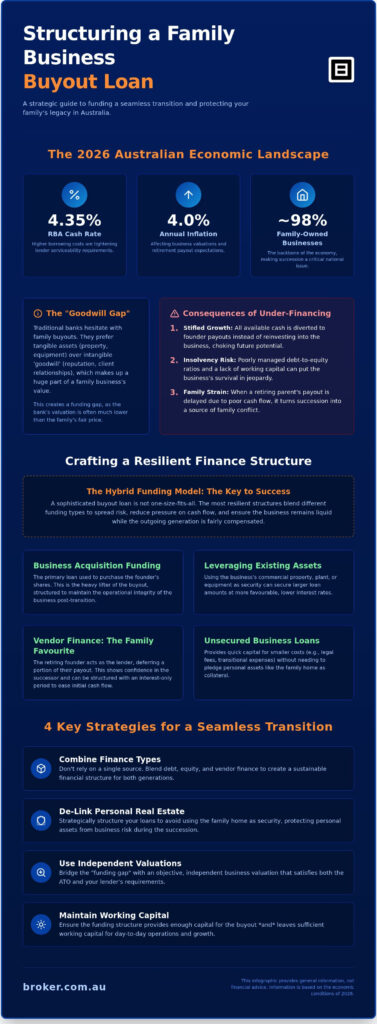
2026 is a particularly complex time for these transitions. With the Reserve Bank of Australia (RBA) maintaining a cash rate target of 4.35% and annual inflation sitting at 4.0% as of May 2026, borrowing costs are higher than in previous decades. Additionally, the upcoming CGT and stamp duty rollover relief window, set to begin in July 2027, means many families are currently in the vital phase of structuring a family business buyout loan to ensure they’re ready to act. While a management buyout (MBO) involves the existing leadership team taking over with external funding, a family transfer is more personal, often requiring a delicate mix of debt and equity to keep the asset within the bloodline.
Why Traditional Banks Often Hesitate with Family Deals
Traditional lenders often struggle with the “Goodwill Gap.” They prefer tangible assets like machinery or property. In a family transfer, much of the value lies in reputation and relationships, which banks find difficult to quantify. Because these aren’t always “arms-length” transactions, lenders worry about emotional pricing. If a founder sets a price based on what they need for retirement rather than what the business can actually service, banks see a significant risk. Without objective market valuations, getting a standard loan approved can be a slow, frustrating process.
The Consequences of Under-Financing a Succession
Getting the funding wrong has ripple effects. If you don’t secure enough capital, the business’s growth is often stifled because all available cash goes toward founder payouts rather than reinvestment. This lack of working capital can lead to insolvency if debt-to-equity ratios aren’t managed with precision. Beyond the balance sheet, under-financing creates immense family strain. When a retiring parent’s payout is delayed due to poor cash flow, it turns a quiet family dinner into a boardroom battle. Proper structuring a family business buyout loan prevents these emotional and financial collapses by ensuring the business remains liquid while the outgoing generation is fairly compensated.
Choosing the Right Finance Structure for Your Buyout
Success in structuring a family business buyout loan depends on flexibility. Relying on a single source of capital is often too rigid for the complexities of a family transition. Instead, a hybrid funding model offers a more resilient path. By blending traditional debt with equity and vendor finance, you spread the financial risk and reduce the immediate pressure on the company’s cash reserves. This tailored approach ensures the retiring generation receives their payout without stripping the business of its ability to grow.
For the primary buyout phase, Business Acquisition Funding is the heavy lifter. It allows the successor to purchase the founder’s shares while keeping the operational integrity of the firm intact. If the business owns commercial property or significant plant and equipment, leveraging these existing assets is a smart move to secure lower interest rates. With the RBA cash rate sitting at 4.35% as of July 2026, finding ways to reduce the interest margin is essential for long-term serviceability. If you’re feeling overwhelmed by the options, you can discover more about our bespoke funding models to see which combination fits your specific goals.
In some cases, speed is the priority. Unsecured business loans provide quick cash flow injections to cover transitional costs or smaller stakeholder buyouts without the need to pledge the family home as collateral. While these carry higher rates, they are invaluable for bridging gaps that traditional bank products won’t touch.
Vendor Finance: The Family Favourite
Retiring founders often choose to act as the lender, a process known as vendor finance. It’s a popular choice because it demonstrates confidence in the successor’s ability to lead. You can structure this with an interest-only period for the first 12 to 18 months, giving the new owner breathing room to settle in before principal repayments begin. It’s vital, however, to have formal legal protections in place. A clear loan agreement ensures the founder’s retirement remains secure and the expectations are transparent for everyone involved.
Secured vs Unsecured Options in 2026
In the current lending market, balancing secured and unsecured debt is a strategic necessity. Use secured loans to maximise your borrowing power and lock in the most competitive rates for tangible assets like property or machinery. Conversely, unsecured funding is the ideal tool for purchasing “goodwill” or intellectual property, which traditional banks often find difficult to value. By balancing the two, you preserve the business balance sheet while ensuring the full purchase price is covered.
Navigating Valuations and Funding Gaps
Obtaining a rigorous independent valuation is the first non-negotiable step in the succession process. Lenders and the ATO both require a defensible figure to ensure the transaction isn’t just a “gift” in disguise or an overinflated retirement plan. In 2026, traditional banks are tightening their criteria for goodwill, which often leads to a “Funding Gap” where the bank’s Loan-to-Value Ratio (LVR) doesn’t meet the agreed price. When structuring a family business buyout loan, you must identify this gap early. If debt from a primary lender falls short, you might consider mezzanine debt or even a small injection of private equity to bridge the difference without selling the entire legacy to outsiders. Detailed financial modelling is your best tool here; it proves to lenders that the business can comfortably service higher debt levels even if interest rates fluctuate.
Managing Cash Flow During the Transition
Transitioning ownership is a heavy administrative burden that can distract from daily operations. To prevent a slump, many successors use Working Capital Finance to maintain momentum. If your business has a large debtor book, Invoice Finance is an efficient way to unlock liquidity from unpaid invoices, providing immediate cash for the buyout. We also recommend organising a Line of Credit as a safety net for those “unforeseen” transition costs that inevitably crop up during the handover. This level of foresight is vital when structuring a family business buyout loan to ensure the company remains robust during the change of guard.
Tax-Effective Funding: ATO Considerations
The tax implications of a buyout are significant for both generations. You should explore the four small business CGT concessions to potentially reduce or eliminate the tax on the sale of business assets. Be mindful of Division 296, which introduces a 15% tax on earnings for superannuation balances exceeding A$3 million from the 2025-26 financial year. Retiring founders can use debt recycling to convert non-deductible debt into tax-deductible investment debt, strengthening their financial position after they step away from the firm.
Protecting Personal Assets and Managing Risk
In many Australian family firms, the boundary between business and personal wealth is dangerously thin. Founders often have decades-old personal guarantees tied to the family home, a setup that many lenders default to by habit. When structuring a family business buyout loan, your first priority must be de-linking these two worlds. Leaving your residence as collateral for a commercial transition is a high-stakes gamble that can be avoided with the right expertise. By moving business debt toward specialist commercial lenders who understand the value of your enterprise, you can silo your risks and ensure that a business hiccup doesn’t lead to a personal catastrophe.
Risk management isn’t just about collateral; it’s about continuity. Key Person insurance is a vital component of any robust succession plan, providing a financial buffer if the successor or the outgoing founder is suddenly unable to work during the transition. To add another layer of security, we recommend establishing a corporate advisory board. This group of impartial experts provides oversight for financial milestones, ensuring that debt repayments and operational goals are met without emotional bias. If you’re ready to secure your legacy, I’m interested in a tailored risk assessment to see how we can protect your assets.
Avoiding Cross-Collateralisation
Cross-collateralisation occurs when your home and business are tied to the same lender, giving the bank total control over your entire portfolio. If the business faces a cash flow crunch, the bank can technically call on your residential equity to cover the gap. To prevent this, you should use different lenders for your home and your business. Refinancing your existing legacy debt during the buyout allows you to clean up the security structure, ensuring each asset is siloed and your personal wealth remains untouchable by business creditors.
The Importance of a Loan Restructure
The loan that served the founder for twenty years is rarely the right fit for the new owner. A succession event is the perfect time for a clean break. You need to organise a formal release from the founder’s personal guarantees to ensure their retirement is truly stress-free. By consolidating legacy debt into a fresh facility, you can often improve serviceability. With the RBA cash rate at 4.35% as of July 2026, a well-timed restructure can simplify your monthly obligations and provide a clear, sustainable path forward for the next generation.
How Broker.com.au Streamlines the Succession Funding Process
Transitioning a family legacy is one of the most significant financial events you’ll ever lead. It’s a process fraught with emotional weight and technical hurdles. At Broker.com.au, we act as your high-level fixer, simplifying the high-stakes decisions involved in structuring a family business buyout loan. We don’t just look at the debt; we provide comprehensive corporate advisory to ensure the entire restructure is tax-effective and sustainable. Our expertise in structuring a family business buyout loan means we can navigate the ATO’s Division 296 rules and CGT concessions with precision. Our proprietary AI technology streamlines the application process by instantly identifying which of our 50+ lenders have the highest appetite for your specific niche, saving you weeks of manual searching.
Our team, including experts like Matt and Flavio, understands that every family dynamic is different. We focus on your specific dreams and needs, moving you away from the cold, impersonal feel of a traditional bank. By using our “I’m interested” approach, we start a low-pressure conversation that prioritises your business continuity over a quick transaction. This empathetic yet professional method ensures you feel in good hands from the very first meeting.
Inside Access to the Best Rates
We leverage a vast network of over 50 lenders, including major banks and boutique private funds, to find the perfect fit for your buyout. Being an award-winning broker gives us the leverage to negotiate terms that direct lenders often won’t provide for family transfers. We specialise in tailoring finance for diverse sectors, from the heavy equipment needs of transport to the specialised requirements of medical practices. This inside access ensures you receive the best rates available in 2026, helping you manage the impact of the current 4.35% cash rate on your serviceability.
Get Started with Confidence
The path to a successful transition is built on preparation. Your first step is a low-pressure discovery call where we listen to your goals and identify potential funding gaps. You’ll need to prepare key documents, including independent business valuations, three years of tax returns, and a clear leadership transition plan. We guide you through this documentation phase to ensure your application is professional and persuasive. If you want a stress-free path to your next chapter, I’m interested – let’s discuss your succession plan and turn your vision into a reality.
Secure Your Legacy with a Seamless Transition
Transitioning your family business is as much about emotional peace of mind as it is about financial precision. By de-linking your family home from business debt and utilising a hybrid funding model, you can ensure the retiring generation is fairly compensated without crippling the company’s future growth. Success in structuring a family business buyout loan requires a delicate balance of secured debt, vendor flexibility, and proactive risk management. It’s about protecting the work of the past while providing the capital needed for the future.
As an award-winning Australian business loan broker, we offer inside access to over 50 competitive lenders, from traditional banks to boutique private funds. Our AI-driven application process is built for faster approvals, helping you navigate the 2026 lending landscape with streamlined confidence. We’re here to act as your expert guide, ensuring your hard-earned legacy remains in good hands for the next generation. You don’t have to face these high-stakes financial decisions alone.
I’m interested – let’s chat about your family business succession
Frequently Asked Questions
Can I use vendor finance for 100% of the family business buyout?
You can use 100% vendor finance, but it’s rarely the most efficient path for long-term growth. Most external lenders want to see the successor has “skin in the game” through their own capital or a bank-backed facility. A hybrid model is usually more sustainable because it ensures the outgoing founder gets some cash upfront while the business maintains a healthy valuation for any future borrowing needs.
How does the ATO view a business sold to a family member below market value?
The ATO typically applies the “market value substitution rule” if a business is transferred for less than it’s worth. This means they’ll calculate capital gains tax based on the actual market value rather than the discounted family price. It’s vital to have a professional valuation to justify your price and avoid unexpected tax bills during the 2026-27 financial year.
What is the best way to fund the goodwill of a family business?
Funding goodwill is best handled through specialised Business Acquisition Funding or unsecured business loans. Traditional banks often have a low appetite for intangible assets. When structuring a family business buyout loan, we often look for lenders who value the company’s historical cash flow and brand reputation rather than just its physical plant and equipment or commercial property.
Do I need to put up my family home as security for a succession loan?
You don’t always need to pledge your family home as security. While secured loans offer lower interest rates, we can often organise structuring a family business buyout loan using only business assets or unsecured facilities. This approach silos your personal residential real estate from business risks, ensuring your family’s primary residence remains protected if the company faces a temporary downturn.
How much working capital should we keep in the business during the transfer?
You should aim to keep at least three to six months of operating expenses as a cash buffer during the handover. Transitions are often more expensive than anticipated due to legal fees and administrative changes. Using a Line of Credit or Working Capital Finance can help you maintain this liquidity without draining the funds needed for the founder’s initial retirement payout.
Can a Self-Managed Super Fund (SMSF) be used to buy the business premises?
Yes, an SMSF can purchase the business’s commercial premises through a Limited Recourse Borrowing Arrangement (LRBA). The business then pays market-rate rent back into your super fund. This is a highly tax-effective way to manage the property side of a succession while ensuring the business has long-term security of tenure in its current Australian location.
What happens if the successor defaults on a vendor finance agreement?
The consequences of a default are governed by the specific terms of your loan agreement. Usually, a vendor finance contract includes “step-in rights” that allow the founder to resume control of the business or reclaim their shares. It’s a stressful scenario that highlights why formal legal documentation and realistic financial modelling are essential before the first payment is ever made.
How long does it typically take to secure business acquisition funding in Australia?
Timelines vary significantly depending on the lender you choose. Traditional Australian banks typically take between two to four weeks to process complex acquisition applications. In contrast, many of the non-bank lenders on our panel can provide conditional approval within 24 to 72 hours, which is vital if your succession event is time-sensitive or requires urgent bridging finance.