
What if the reason your acquisition deal is stalling isn’t your balance sheet, but a single missing document in your ‘deal-ready’ folder? In a market where the RBA cash rate sits at 4.35 per cent, lenders have become increasingly selective about the ventures they’ll support. Meeting the current business acquisition finance requirements is no longer just about finding a profitable target; it’s about proving you have the management depth and cash flow resilience to thrive. We understand the deal fatigue that sets in when bank processes drag on, leaving you worried that a seller might lose patience while your funding is stuck in a queue.
This guide will help you master the essential documentation and financial benchmarks needed to secure funding with confidence. You’ll get a clear roadmap of the criteria lenders use to assess risk in 2026, from debt-service coverage ratios to management experience. We’ll also explore how non-bank lending options can provide a faster, more flexible alternative to traditional banks, ensuring you have the inside access to competitive rates and the insight to choose the right path for your next big move.
Key Takeaways
- Master the concept of “Deal Velocity” to ensure you don’t lose a competitive acquisition due to slow funding approvals or bank delays.
- Discover how to demonstrate your “Management Equity” and prove the target business’s profitability to satisfy modern lender scrutiny.
- Understand the critical trade-offs between low-cost “Big Four” bank debt and the flexible, high-speed solutions offered by private credit providers.
- Use our step-by-step readiness checklist to organise your documentation and meet all business acquisition finance requirements, including tax returns and Letters of Intent.
- Learn how to gain inside access to the best rates by leveraging corporate advisory expertise and advanced technology to streamline your funding journey.
Table of Contents
- Understanding Business Acquisition Finance in the Australian Landscape
- The Three Pillars of Lending Requirements
- Comparing Funding Structures: Banks vs. Private Credit
- Your Acquisition Readiness Checklist: A Step-by-Step Guide
- Securing Best-in-Class Terms with Broker.com.au
Understanding Business Acquisition Finance in the Australian Landscape
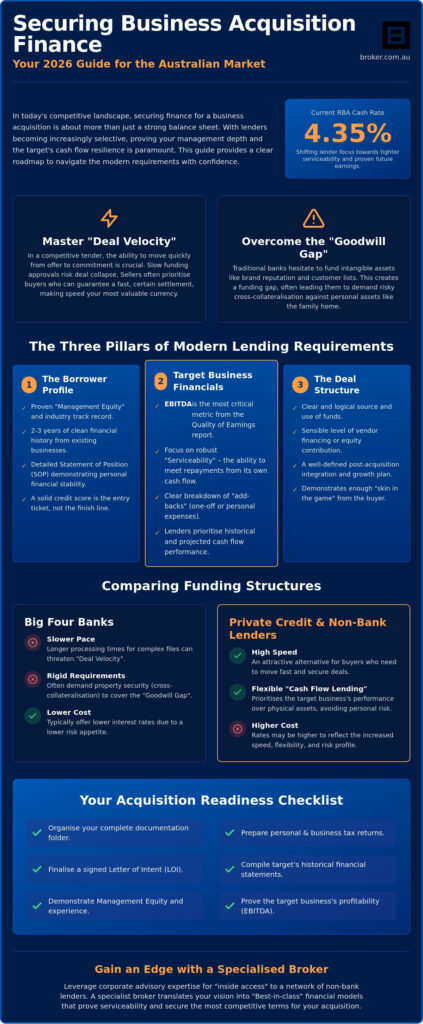
Business acquisition finance isn’t just a standard loan; it’s a specialised tool designed to facilitate the purchase of a company’s goodwill, intellectual property, and physical assets. In the high-stakes arena of Mergers and acquisitions, having your funding ready is often the difference between a successful settlement and a collapsed deal. As of July 2026, the RBA cash rate holds steady at 4.35 per cent, which has shifted the focus of business acquisition finance requirements toward tighter serviceability and more robust evidence of future earnings. This economic climate means your borrowing power is more closely tied to the target business’s performance than ever before.
Speed is your most valuable currency. In a competitive tender, a seller often prioritises a buyer who can provide “Deal Velocity”, which is the ability to move from an offer to a firm commitment without months of bank-induced delay. Traditional lenders are currently taking longer to process complex files, making modern, flexible private credit an increasingly attractive alternative for those who need to move fast. By securing a lender who understands the urgency of M&A, you protect yourself from the risk of a deal falling through because the clock ran out.
Why Traditional Loans Often Fall Short
Many buyers find that traditional bank loans hit a wall called the “Goodwill Gap”. This happens because most established Australian businesses derive their value from intangible assets like brand reputation and customer lists, which banks are notoriously hesitant to fund. To bridge this gap, banks often demand cross-collateralisation. This means they’ll want a mortgage over your family home to secure the business debt, creating a level of personal risk that can be incredibly stressful. Instead, the market has pivoted toward “Cash Flow Lending”. This modern approach prioritises the historical and projected performance of the target business rather than just the physical assets you can pin a tag on, allowing for more flexible business acquisition finance requirements.
The Role of a Specialised Broker
Securing best-in-class terms requires more than just a good credit score. It requires “inside access” to a network of non-bank lenders that aren’t available to the general public. A specialised broker acts as a high-level fixer, translating your vision into the language lenders respect through “Best-in-class” financial modelling. This modelling proves the acquisition can comfortably service the debt even if market conditions fluctuate, providing the reassurance you need during a high-stakes transition. Acquisition finance is a strategic lever for inorganic growth in 2026, allowing you to scale through purchase rather than just organic effort.
The Three Pillars of Lending Requirements
While some traditional lenders still focus heavily on asset-based security, modern Acquisition Finance in Australia relies on a more holistic assessment of risk. In the 2026 market, lenders prioritise “Serviceability” over simple asset backing. This means they care more about whether the business can comfortably meet its interest and principal repayments from its own cash flow than they do about the liquidation value of its equipment. To satisfy current business acquisition finance requirements, your application must stand firmly on three distinct pillars: the borrower profile, the target’s financials, and the deal structure itself.
Pillar 1: The Borrower Profile
Lenders need to see that you are a safe pair of hands. This is where “Management Equity” becomes vital. If you already own a business, you’ll typically need to provide two to three years of clean financial history to prove your competence. A detailed Statement of Position (SOP) is also required to demonstrate your personal financial stability. While a solid credit score is your entry ticket, it isn’t the finish line. Lenders look for an industry track record that suggests you can manage the specific challenges of the target business without stumbling. They want to see that you have enough “skin in the game” to remain committed if market conditions fluctuate.
Pillar 2: Target Business Financials
The target business is the engine that services the debt. Lenders will scrutinise a “Quality of Earnings” report, where EBITDA (Earnings Before Interest, Taxes, Depreciation, and Amortisation) is the most important metric. You’ll need to provide a clear breakdown of “add-backs”—those one-off or personal expenses the current owner runs through the business that won’t continue under your leadership. This allows for a normalised profit assessment. Be prepared to address “Key Person Risk”. If the business’s success is tied solely to the current owner’s personal relationships, you’ll need a plan to mitigate that risk to meet standard business acquisition finance requirements.
Pillar 3: The Deal Structure
How you piece the transaction together can make or break your funding chances. A well-structured deal often involves a combination of senior debt, vendor finance, and sometimes earn-outs. Vendor finance signals to a bank that the seller has confidence in the business’s future, which significantly reduces the lender’s perceived risk. Earn-outs, which tie a portion of the purchase price to future performance, protect you from overpaying if the business doesn’t meet its projections. If you’re unsure how to balance these elements, you might want to talk to our team about a tailored funding plan that fits your specific acquisition strategy.
Comparing Funding Structures: Banks vs. Private Credit
Choosing between a major bank and a private credit provider is a decision that shapes your post-settlement cash flow. Traditional senior debt from the “Big Four” remains the most cost-effective way to meet business acquisition finance requirements, with secured rates typically ranging from 6 per cent to 9 per cent. However, these low rates come with high stringency. Banks often demand significant real estate security and impose restrictive financial covenants that can limit your operational freedom. If your target business relies heavily on intangible assets or goodwill, the bank’s conservative valuation might leave you with a funding gap that needs a different solution.
Private credit and mezzanine finance serve as the high-level fixers of the M&A world. While interest rates are higher, often between 10 per cent and 18 per cent, the speed and flexibility they offer are unmatched. A recent Reserve Bank of Australia analysis of SME financial conditions indicates that many businesses are looking beyond traditional banks to find tailored terms that match their specific growth trajectories. For smaller “bolt-on” acquisitions, unsecured business loans can provide a quick capital injection without the need for property security, though these typically carry rates between 8 per cent and 12 per cent. If you’re looking at private options, the business acquisition finance requirements are often more focused on your “Management Equity” and the target’s cash flow than on your personal property portfolio.
When to Choose Private Credit
Private credit is the logical choice when deal velocity is your priority. If you need to settle a transaction in under 30 days to beat a competitor, traditional banks simply won’t keep pace. This path is also ideal for businesses with low physical asset bases, such as software firms or service agencies, where the value lies in recurring revenue rather than plant and equipment. You’ll avoid the restrictive covenants that often give banks the power to veto your future business decisions.
The Hybrid Approach: Multi-Tranche Funding
Smart acquirers often use a multi-tranche strategy to optimise their capital structure. You might secure a bank loan for the core purchase while using invoice finance to unlock immediate liquidity from the target’s accounts receivable. Combining these with a line of credit ensures you have the working capital to fund the integration phase without straining your cash reserves. Asset-based lending can also leverage the target’s plant and equipment to provide additional headroom. The cheapest rate is often the most expensive if it lacks the flexibility to support your business as it evolves.
Your Acquisition Readiness Checklist: A Step-by-Step Guide
Transitioning from the theoretical pillars of lending to a successful settlement requires a disciplined approach to your paperwork. In the current Australian market, being “deal-ready” is about more than just having a profitable target; it’s about presenting a bulletproof case to your lender. Following a chronological order of operations ensures you don’t miss critical business acquisition finance requirements that could stall your momentum or lead to a rejection. This checklist serves as your roadmap to a stress-free application process, moving you from uncertainty toward streamlined confidence.
Step 1: Organise your tax returns. Gather your personal and business tax returns for the last two financial years. Lenders use these to verify your historical income and financial stability before they even look at the target business. Step 2: Secure a signed Letter of Intent (LOI). You need a formal document or a Contract of Sale, even if it’s conditional. This establishes the deal’s parameters and proves you have a live transaction. Step 3: Prepare a 12-month cash flow forecast. This financial modelling must include the new acquisition to show how the combined entity will service the debt. Step 4: Conduct a due diligence audit. Scrutinise the target’s aged accounts receivable and all outstanding liabilities. Hidden debts or poor collection histories are major red flags for credit teams. Step 5: Engage a specialised broker. Before you hit submit, have an expert stress-test your application against current market benchmarks to ensure it meets every requirement.
Essential Documentation List
- A comprehensive business plan detailing post-purchase synergies and growth strategies.
- Aged accounts payable and receivable listings to verify the target’s liquidity.
- A copy of the commercial lease or a professional property valuation if real estate is involved.
- Evidence of your “Management Equity”, such as a professional CV or industry-specific certifications.
Pre-Submission Financial Ratios to Check
Lenders will run your numbers through their own internal calculators, but you should know your position first. Aim for a Debt Service Cover Ratio (DSCR) of 1.25x or higher. This indicates you have a 25 per cent buffer after paying all operating expenses and debt obligations. Your Gearing Ratio should also remain within healthy limits, typically ensuring your total debt doesn’t overwhelm your equity. Finally, confirm your Working Capital Ratio is positive; you must be able to cover short-term liabilities immediately after the buy without needing an emergency injection of funds. If you’re ready to put these steps into action, get started with our expert advisory team today to ensure your application is best-in-class.
Securing Best-in-Class Terms with Broker.com.au
Meeting business acquisition finance requirements doesn’t have to be a source of deal fatigue or anxiety. While the RBA cash rate of 4.35 per cent has made traditional lenders more cautious, our proprietary AI technology changes the game for Australian buyers. We use advanced algorithms to identify the right lender for your specific deal in minutes, not weeks. This technology provides the “Deal Velocity” needed to keep a seller engaged. It ensures you don’t lose a life-changing opportunity to a slower competitor while waiting for a bank’s credit committee to meet.
Our team acts as your expert guide, bringing a corporate advisory background to every transaction. We understand that high-stakes financial decisions are inherently stressful; our goal is to move you from a state of uncertainty toward streamlined confidence. By positioning your business for long-term success through strategic debt restructuring and asset finance, we ensure your new venture has the liquidity it needs from day one. You aren’t just getting a loan; you’re getting a tailored funding strategy that respects your specific goals.
Our Seamless 3-Step Process
- Initial Discovery: We start by understanding your “dream” and the specific mechanics of the deal. We look at the target’s EBITDA and your management track record to build a compelling narrative for lenders.
- Market Triage: Our technology scans over 50 lenders to find the perfect fit. We look beyond the “Big Four” to find niche acquisition lenders who understand your industry and its unique risks.
- Execution: We manage the heavy lifting. From organising the paperwork to negotiating with credit teams, we handle the process through to a successful settlement. You stay focused on the business transition while we secure the capital.
Why Business Owners Choose Us
Business owners partner with us because we provide inside access to specialised rates that aren’t available on the open market. This advantage is paired with a human-led advisory service; you’ll work with experienced professionals who treat your acquisition with the personal attention it deserves. We bridge the gap between technical financial expertise and client-facing clarity, ensuring you feel informed rather than rushed. Our “can-do attitude” means we go above and beyond for deals that fall outside the norm, providing the high-level fixing required for complex M&A scenarios.
I’m interested — let’s discuss your acquisition funding
Turn Your Acquisition Vision into Reality
Winning your next deal in the 2026 market requires more than just a vision; it requires precise alignment with current business acquisition finance requirements. You’ve seen that deal velocity is your greatest competitive advantage and that the choice between traditional bank debt and flexible private credit is a strategic decision that shapes your future cash flow. By following a structured readiness checklist and proving your management track record, you’ve already moved ahead of the competition.
As an award-winning business loan broker, we provide inside access to over 50 Australian lenders. Our proprietary AI technology matches you with best-in-class funding solutions in minutes, ensuring your journey is both seamless and stress-free. Whether you need a secured business loan or specialised acquisition funding, our team acts as your high-level fixer to unlock the best possible rates.
I’m interested — Get a tailored acquisition finance quote
Your goal of scaling through a strategic purchase is within reach. With a clear roadmap and a seasoned partner by your side, you can navigate the complexities of the lending landscape with streamlined confidence and relief.
Frequently Asked Questions
How much deposit do I need for a business acquisition loan in Australia?
Banks typically require a deposit of 30 per cent to 50 per cent of the total business purchase price. While some private lenders may accept a lower cash contribution if the target business has exceptional cash flow, traditional institutions remain conservative in the 2026 market. Providing a larger deposit often helps you secure a lower interest rate and more favourable terms. We can help you determine the exact equity required based on your specific deal structure.
Can I use the assets of the business I am buying as security for the loan?
Yes, you can leverage the assets of the target business through asset-based lending or equipment finance. Lenders often take a charge over the plant, machinery, or accounts receivable of the company you are buying to secure the funding. However, most lenders will still prioritise the business’s ability to service the debt from its ongoing profits rather than just the liquidation value of its physical assets. This ensures the venture remains sustainable post-settlement.
What is the difference between secured and unsecured acquisition finance?
The primary difference is the collateral required to back the loan. Secured acquisition finance uses physical assets like residential or commercial property to lower the lender’s risk, resulting in rates typically between 6 per cent and 9 per cent. Unsecured options rely on your credit strength and the business’s cash flow. These often have higher rates, typically ranging from 8 per cent to 12 per cent, but offer greater flexibility for buyers who don’t want to pledge personal property.
How long does the approval process for a business acquisition loan usually take?
Bank approvals generally take between four and eight weeks from the initial application to settlement. This timeline can be significantly shorter if you use private credit providers, who often provide funding in under 30 days. Using our proprietary AI technology, we can often speed up this process by matching you with the right lender immediately. This helps you maintain deal velocity and avoid the anxiety of losing a competitive acquisition due to bank delays.
Is vendor finance a requirement for getting a bank loan approved?
Vendor finance is not a strict requirement, but it is highly favoured by traditional Australian banks. When a seller leaves a portion of the purchase price in the business as a loan to you, it signals their confidence in the company’s future success. This reduces the bank’s perceived risk and can make it much easier to satisfy the business acquisition finance requirements for a senior debt facility while also preserving your initial capital.
Can I get acquisition finance if I don’t have a residential property to offer as security?
You can certainly secure funding without offering a residential property as security. Many non-bank lenders and private credit providers offer cash flow lending, which focuses on the target business’s EBITDA and your management experience instead of real estate collateral. This approach allows you to scale your portfolio while keeping your family home separate from your business liabilities. It provides a stress-free path for talented operators who lack a large property portfolio.
What are the typical interest rates for business acquisition loans in 2026?
In 2026, secured bank loans typically range from 6 per cent to 9 per cent, while unsecured bank options sit between 8 per cent and 12 per cent. Private or non-bank lenders usually offer rates from 10 per cent to 18 per cent. For context, the Westpac Business Development Rate is currently 9.02 per cent. These rates reflect the current RBA cash rate of 4.35 per cent and the lender’s assessment of the specific risks involved in your deal.
Do I need a business plan to apply for acquisition funding?
A comprehensive business plan is essential for any successful application. Lenders need to see a clear strategy for how you will manage the business and achieve the synergies mentioned in your proposal. Your plan should include 12-month cash flow forecasts and detail how you will meet all business acquisition finance requirements. This document proves to the lender that you are a safe pair of hands with a professional approach to growth.