
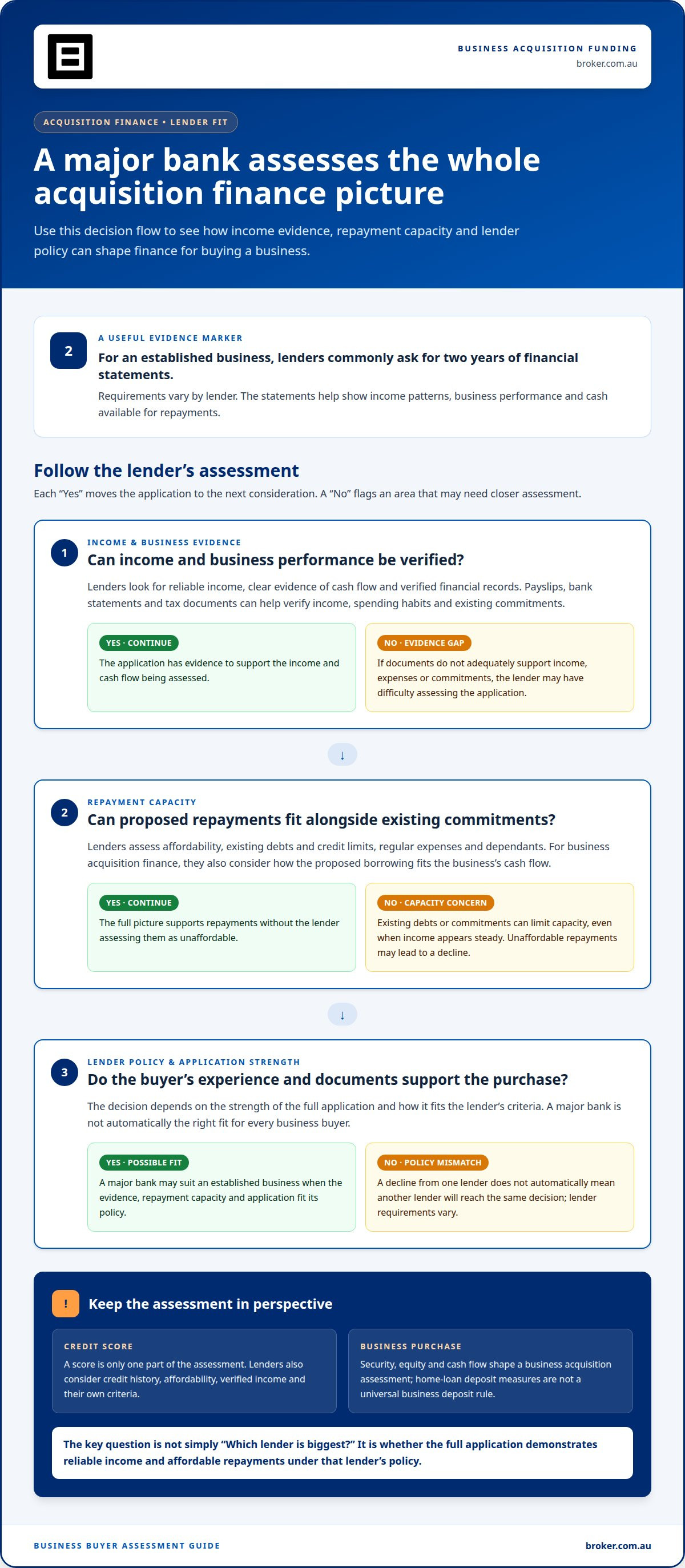
A major bank isn’t automatically the right fit for buying a business. What top tier lenders look for in an application includes reliable income, clear evidence of cash flow, manageable debts and verified financial records. Established businesses are commonly asked for two years of financial statements, but requirements vary by lender. The decision also depends on the strength of the full application.
A strong business and a solid deposit may not be enough on their own. Lenders also assess whether the proposed repayments are affordable, how existing commitments affect capacity, and whether your experience and documents support the purchase. Requirements vary, so a decline from one lender doesn’t automatically mean another will reach the same decision.
This guide explains how income stability, lender policy, spending habits and verified documents can affect an acquisition finance application. You’ll learn when a major bank may suit an established business, what can strengthen your position as a buyer, and how to prepare for a funding discussion with a clear view of cash flow and repayment capacity.
Key Takeaways
- For an established business, two years of financials can support a major-bank application; income stability and evidence of repayment capacity also matter.
- A lender’s policy and the strength of the complete application influence approval, so the largest lender isn’t automatically the best fit.
- Clear payslips, bank statements and tax documents help lenders verify income, spending habits and existing commitments.
- Credit scores are only one part of the assessment. Lenders also consider credit history, affordability and their own lending criteria.
- When assessing business acquisition finance, lenders consider how existing debts and the business’s cash flow affect your capacity to repay.
Table of Contents
- Income and employment stability
- How lender policy and application strength affect approval
- Payslips, bank statements and income verification
- What credit score and credit history do Australian lenders look for?
- What debt-to-income ratio do Australian lenders accept?
- Broker.com.au
Income and employment stability
Lenders assess whether your income is consistent, verifiable and sufficient for repayments alongside existing commitments. For a home loan, they may look for genuine savings of at least 5% of the property value and evidence those savings accumulated over 3-6 months; they also consider the deposit’s source.
Assessing non-standard income
Non-standard income includes earnings from self-employment, a trust or a company, rather than a regular salary from an employer. Its structure matters because lenders need to understand how reliable the income is and whether it can support repayments.
For self-employed home loan applicants, Australian lenders generally want 1-2 years of financial records. Business lending commonly uses financials covering two years as part of a standard bank-loan application. Those records help assess income patterns, business performance and the cash available for repayments.
Recent employment changes can also affect how a lender views income stability. Employment stability of 6-12 months is commonly sought for home loans, while major banks tend to apply stricter criteria when work falls outside standard PAYG employment. Some non-bank lenders may consider recent job changes or income from a trust or company.
For example, an Australian non-bank lender may consider a profitable business with an 18-month ABN, even with a 14-day settlement deadline. This is an example, not a standard lending rule. When buying a business, the lender’s assessment still needs to account for the business’s earnings and proposed repayments.
Financial accounts for self-employed applicants
Financial accounts show a self-employed applicant’s income and business position. Lenders use them to distinguish consistent earnings from figures that fluctuate across trading periods.
For home loan applications, self-employed borrowers generally need 1-2 years of financial records. For business lending, two years of financials commonly form part of the standard bank-loan profile. Lenders may review those records alongside bank statements to understand income, expenses and existing commitments.
Employment type doesn’t tell the whole story. A PAYG applicant with regular payslips still has expenses and debts assessed, while a business owner’s records need to support the income included in the application. A personal loan, overdraft or credit limit can affect the capacity calculation, even when income appears steady.
Living costs count too. Lenders may use the Household Expenditure Measure as a benchmark, but consider actual expenses when they are higher. They may also review dependants, debts and bank statement activity. Stable spending before applying helps show a clear pattern, while unexplained changes can prompt closer assessment.
How lender policy and application strength affect approval
Australian lenders assess whether repayments are manageable and the borrower can meet them without financial hardship. The lender’s policy and the evidence in the application matter more than its size. Understanding what top tier lenders look for in an application starts with how well the borrower’s circumstances fit the lender’s criteria.
Debt-to-income ratio
The debt-to-income ratio compares a borrower’s debts with their income. It helps lenders assess how existing commitments may affect their ability to make new payments.
Lenders consider income alongside debts and credit limits, including unused credit card limits. They also assess regular expenses, dependants and repayment capacity. A borrower with stable income may still have limited capacity if existing commitments absorb much of it. For business acquisition finance, lenders also need to understand how the proposed borrowing fits the business’s cash flow.
Deposit and loan-to-value ratio
The loan-to-value ratio compares the loan amount with the property’s value. It helps lenders assess the security and risk of a home loan, while the deposit affects how much the borrower needs to borrow.
Australian home loan deposits commonly range from 5-20%, depending on the lender and borrower’s circumstances. An 80% loan-to-value ratio is generally safer for lenders and does not require Lenders Mortgage Insurance. A 90-95% ratio is considered higher risk and may require Lenders Mortgage Insurance. These home-loan measures aren’t a universal deposit rule for buying a business, where security, equity and cash flow shape the assessment.
Credit score and history
A credit score summarises information in a borrower’s credit history, but doesn’t decide an application by itself. Lenders also assess affordability, verified income and their own lending policy.
Equifax classifies scores from 0 to 459 as below average, 460 to 660 as average, 661 to 734 as good, 735 to 852 as very good, and 853 to 1,200 as excellent. Scores can differ between reporting agencies because they use different algorithms. A strong score may support an application, but it cannot offset repayments the lender considers unaffordable.
Common application decline reasons
An application may be declined if the lender’s assessment finds insufficient repayment capacity or if documents don’t adequately support income, expenses or commitments. High credit limits, existing debts, unstable employment or a deposit that doesn’t meet the lender’s policy can also affect the outcome.
Credit history is another factor. Account dishonours, overdrafts or adverse credit information may influence how a lender views financial behaviour. A decline from one lender doesn’t mean another will reach the same decision, because criteria vary. For business buyers, lenders also weigh the business’s financial performance and the proposed repayments.
The question of what top tier lenders look for in an application comes down to how clearly the evidence fits a lender’s policy. A review of your lending options can help match the application to that policy and clarify how existing commitments affect capacity.
Payslips, bank statements and income verification
For business acquisition finance, documents help lenders check whether the buyer’s declared income and expenses match account activity, and whether the proposed repayments are affordable. Payslips, bank statements, identification and tax documents can each support part of the assessment.
Payslips show salary, pay frequency and employer details, which lenders can compare with deposits into the business buyer’s bank account. If income varies, a single payslip may not show the full pattern. Bank statements provide more context, including recurring income and regular outgoing payments.
Statements also show how spending and commitments affect repayment capacity. A lender may consider existing loan repayments, household expenses, dependants and account conduct. Regular transfers to another account can help explain where funds go, while recurring payments may indicate ongoing commitments.
Credit limits matter even when they’re unused. Lenders may include credit card limits when calculating borrowing capacity, so statements can show account activity alongside declared limits. A broker can organise documents so income, expenses and commitments are presented consistently.
Self-employed applicants may need tax documents and financial accounts to support business income. Australian lenders generally seek 1-2 years of financial records for self-employed applicants. Business acquisition lending commonly uses the target business’s financials covering two years. Bank statements can add transaction detail, but they don’t replace records used to assess business performance.
For acquisition finance, the evidence needs to make the proposed repayments clear. A business buyer’s personal income, existing debts and regular expenses may be considered alongside the target business’s accounts and cash flow. If figures differ between an application, tax documents and accounts, the lender may need clarification to complete its assessment.
Prepare a consistent set of documents: payslips for employment income, statements showing account activity, identification and tax documents where needed. Self-employed applicants should include relevant financial records for themselves and the business being acquired. Each document should support the same picture of income and expenses, without unexplained differences.
Statements can show account dishonours or overdrafts, which lenders may consider when assessing financial behaviour. These are distinct from a credit default, which relates to credit history. Explaining a transaction can provide useful context, while unexplained payments may prompt follow-up questions.
What credit score and credit history do Australian lenders look for?
For a business acquisition loan, Australian lenders consider your credit history alongside verified income, expenses and their lending policy. There’s no single score that guarantees approval: lenders may use different reporting bodies, scoring models or internal scores.
Equifax groups scores into five bands:
- 0-459: below average, according to Equifax.
- 460-660: average, according to Equifax.
- 661-734: good, according to Equifax.
- 735-852: very good, according to Equifax.
- 853-1,200: excellent, according to Equifax.
Your score may differ across agencies such as Equifax and Experian, so treat it as one indicator rather than an approval threshold. For acquisition finance, lenders may also review the credit history behind the score and whether repayments fit your verified income and expenses.
Existing debts and other financial commitments affect how much you can afford to repay. When assessing a business buyer, lenders consider the proposed borrowing and the business’s capacity to support repayments. A strong score can’t replace evidence that the loan is affordable, while a lower score doesn’t automatically mean every lender will reach the same decision.
Formal loan applications can create credit enquiries, although the impact varies by lender. Multiple applications, particularly rejected ones, can affect a credit score. Applying to several lenders in quick succession may leave multiple enquiries for lenders to consider. A broker can help assess lender criteria before you make a formal application to purchase a business.
Financial hardship information is treated differently from a default and cannot be used to calculate a credit score. A hardship arrangement and a missed credit commitment are not interchangeable entries. Lenders still assess the wider application, including repayment capacity and your financial circumstances.
Before applying for acquisition finance, review your credit reports and correct any errors. Australian consumers can usually request a free copy from a credit reporting agency every three months. Check for unfamiliar enquiries or inaccurate details, and have errors corrected before they affect a lender’s assessment.
What debt-to-income ratio do Australian lenders accept?
The debt-to-income ratio compares a borrower’s total debt with annual income. Australian lenders don’t apply one universal ratio: their policies and the full application shape the assessment. The ratio provides useful context, but doesn’t decide approval by itself.
For a home loan, lenders assess income alongside existing debts, credit limits, regular expenses and dependants. They also test whether repayments remain manageable if interest rates rise. The serviceability assessment commonly uses an interest rate buffer of 3% above current rates. This means a borrower’s capacity is assessed against a higher repayment calculation, not just today’s payment.
Two applicants with similar incomes can have different borrowing capacities. One may have a personal loan and unused credit card limits, while the other has fewer commitments. Lenders may count unused card limits when assessing capacity. Reducing or closing a limit can change the commitments in an application, while taking out a car loan before applying can affect the same assessment.
For a business acquisition, household debt is only part of the picture. Lenders also consider the proposed loan, the business’s financial performance and its ability to support repayments. A business buyer with a strong personal income still needs to show how acquisition finance fits the business’s cash flow. Business revenue alone doesn’t establish the buyer’s personal repayment capacity.
Debt-to-income is different from a deposit or loan-to-value ratio. A deposit contributes equity towards a purchase; debt-to-income measures existing debt against income. For a business purchase, lenders consider the proposed funding alongside available equity, security and repayment capacity. These factors help explain why a ratio may fit one lender’s policy but fall outside another’s.
To understand the assessment, separate your obligations into clear categories:
- Record personal debts, including loans and credit card limits.
- Identify regular household expenses and dependants that affect available income.
- For a business purchase, show the business’s income and existing commitments separately.
- Compare the proposed repayments with cash flow after operating costs and current debt payments.
This view helps reveal what drives the ratio and where repayment pressure comes from. It also gives lenders context beyond a single figure. A business acquisition finance assessment can help structure the funding request around the purchase, equity contribution and repayment capacity.
Broker.com.au
Broker.com.au helps business buyers understand how lender policy, financial evidence and repayment capacity fit their funding application. If you’re buying a business, its team can assess your circumstances and explore Business Acquisition Funding alongside options such as Secured Business Loans or Unsecured Business Loans. This can be useful when your income structure, deposit or the business’s cash flow makes a standard application more complex. A clear view of your funding needs and supporting documents helps focus the lending discussion on the purchase. Broker.com.au uses proprietary AI technology to facilitate loan applications. Contact Broker.com.au to discuss your business purchase and finance options.
Plan your next move with confidence
Understanding what top tier lenders look for in an application can help you approach a business purchase with a clearer funding plan. Align the finance structure with your purchase objectives, the business’s cash flow and the repayments you can manage. This gives you a focused basis for discussing acquisition finance before committing to a purchase.
Broker.com.au can help you explore options for your business acquisition, including Business Acquisition Funding, Secured Business Loans and Unsecured Business Loans. The right approach depends on your circumstances and the transaction. A considered discussion can help clarify which funding option may fit, without treating every application or business purchase as the same.
If you’re preparing to buy a business, contact Broker.com.au to discuss your options and take the next step with a clearer plan.
Frequently Asked Questions
When might a major bank suit a business acquisition?
Major banks may suit an established business with clear financial records, security and repayment capacity. This may fit a business buyer purchasing a profitable operation with a well-documented trading history and assets available as security. The bank’s policy still needs to accommodate the acquisition structure and the buyer’s financial position. For a newer business or a purchase with unusual circumstances, finding a suitable acquisition finance policy is especially important.
Can two business buyers with the same credit score get different results?
Yes. A credit score is only one part of a lender’s assessment, so two applicants with the same score can receive different decisions on acquisition finance. One may have more existing debt, higher credit limits or dependants that affect repayment capacity. Lenders may also use different reporting bodies, scoring models and internal assessments, so the score shown to an applicant may not be the one used for a particular decision.
Do multiple acquisition-loan applications affect my credit report?
Formal loan applications can create credit enquiries, and their impact varies by lender. Several applications lodged close together may leave multiple enquiries for lenders to consider, particularly if some were declined. Before making a formal application to fund buying a business, it can help to understand which lender’s policy best fits your circumstances. General finance enquiries are different and don’t necessarily involve submitting a formal loan application.
Does an old default always prevent business acquisition finance approval?
No, an old default doesn’t automatically mean every lender will decline an acquisition finance application. Lenders assess credit history alongside the buyer’s equity, business cash flow and servicing capacity, as well as their own criteria. The details of the default and the rest of the application may affect the assessment. If a credit report contains inaccurate information, correcting the error can help ensure the lender reviews an accurate record.
What do Australian lenders assess in a business acquisition loan application?
Australian lenders assess whether borrowers can manage repayments using verified information about income, expenses, debts and existing commitments. They also review credit history, savings or deposit, assets and, for a business acquisition, the purchase details and the business’s financial performance. Buyers may need to show how much equity they can contribute and how the business’s cash flow supports the proposed borrowing. Each lender applies its own policy to the complete application.
How do lenders assess income, business cash flow and servicing?
Lenders verify income using relevant records, then consider how reliably it can support repayments. For self-employed applicants, Australian lenders generally request 1-2 years of financial records; employment stability of 6-12 months is commonly considered for home loans. For income from a trust or company, the way earnings are documented matters. When purchasing a business, buyers should distinguish personal income from the business’s cash flow and show how both support loan servicing.
How can a broker improve a business buyer’s chances of acquisition finance approval?
A broker can help align an application with lender policy, organise supporting information and present the buyer’s circumstances and proposed business acquisition clearly. This can reduce avoidable gaps or inconsistencies, but can’t guarantee approval or change a lender’s decision. Broker.com.au uses proprietary AI technology to facilitate loan applications. Its process is: “Complete one simple to use form → Get connected with an expert broker → Work directly with your broker → Financing secured.”