
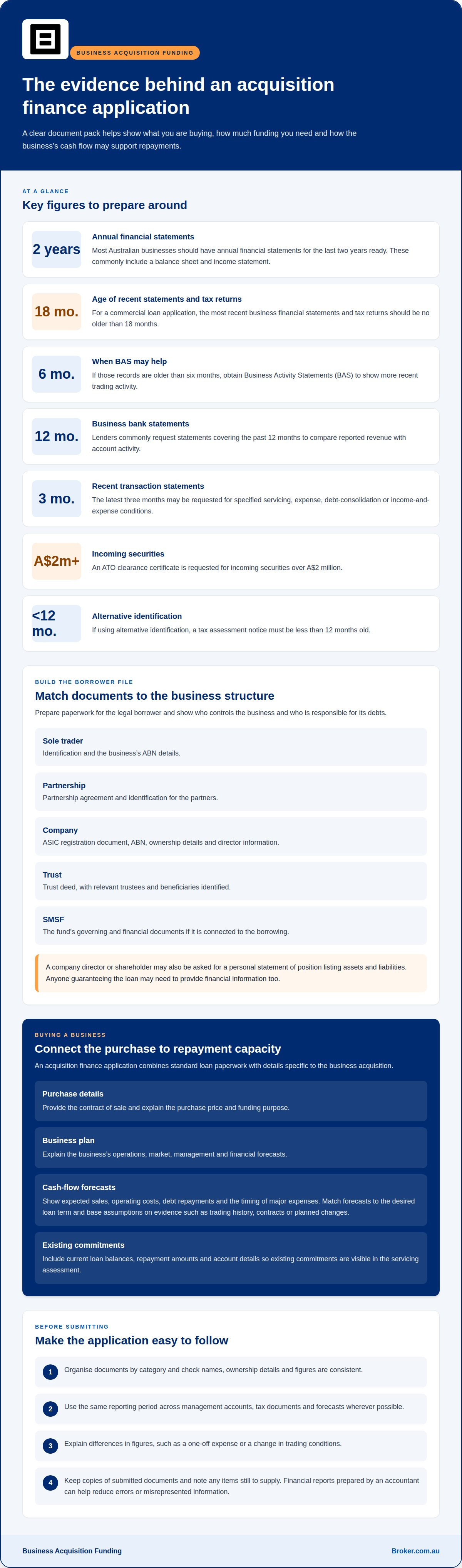
A well-prepared business acquisition funding application is supported by clear financial evidence, not just a request for an acquisition loan. A checklist for buying a business in Australia should cover identification, business structure documents, financial statements, tax returns or BAS, bank statements, and details of income, expenses, debts and assets. Most businesses should have annual financial statements for the last two years ready. If you’re purchasing a business, you may also need a business plan, cash-flow forecasts and the contract of sale.
Gathering paperwork can feel like a task in itself, particularly when you’re balancing lender requirements with the day-to-day demands of running a business. This guide explains which documents and financial details to prepare, what lenders may assess when financing a business acquisition, and how to present a clear case for the amount you want to borrow.
You’ll also find practical checks for a business buyer seeking acquisition finance, including how to show that the business can support repayments and how the purchase fits your plans. Use the checklist to get organised before discussing your application with a lender.
Key Takeaways
- Match your supporting documents to your business structure, and account for any extra information a trust or SMSF may require when seeking acquisition finance.
- For a business acquisition, connect the purchase plan to realistic forecasts so a lender can assess whether the business may support loan repayments.
- Set out income, expenses, existing debts and cash flow to show how you can service the acquisition loan alongside the business’s finances.
- Check a finance company’s name or ABN on the ASIC register, and treat unexpected loan offers with caution.
- A business loan broker can help compare acquisition finance options across lenders and shape an application around your purchase funding needs.
Table of Contents
- What do you need to apply for a business loan?
- Financial statements and cash-flow forecasts
- Business income, expenses and liabilities
- Checking lender legitimacy and avoiding scams
- Working with a business loan broker
- Broker.com.au
What do you need to apply for a business loan?
When applying for Business Acquisition Funding to purchase an existing business, show the lender what you are buying, how much funding you need and how the business’s cash flow can support repayments. Acquisition finance applications usually combine standard loan paperwork, such as identification and financial reports, with documents specific to the business acquisition, including the contract of sale and purchase details. A business plan should explain the business’s operations, market, management and financial forecasts, supported by historical statements and relevant personal information.
Start with identification. New customers may need photo identification, such as a driver’s licence or passport; existing customers may not need to repeat this step. If using alternative identification, a tax assessment notice must be less than 12 months old. Lenders may also request identification from every business owner and company director, particularly for partnerships or companies with multiple directors.
Prepare structure documents that match the legal borrower. The relevant paperwork may include:
- Sole trader: Provide identification and the business’s ABN details.
- Partnership: Include the partnership agreement and identification for the partners.
- Company: Include the ASIC registration document, ABN, ownership details and director information.
- Trust: Include the trust deed and identify trustees and beneficiaries relevant to the application.
- SMSF: Prepare the fund’s governing and financial documents if the fund is connected to the borrowing.
Documents should show who controls the business and who is responsible for its debts. A company director or shareholder may also be asked for a personal statement of position listing assets and liabilities. Anyone guaranteeing the loan may need to provide financial information too. A clear credit history is generally important when applying for new or increased lending.
For a business acquisition, provide the contract of sale and explain the purchase price, funding purpose and expected cash flow in the business plan. These acquisition-specific documents help the lender assess the business buyer’s repayment capacity alongside standard financial paperwork. If the application involves commercial property, include the property purchase documents. An ATO clearance certificate is requested for incoming securities over A$2 million. For a construction project, gather the relevant building contract, plans and cost breakdown to explain the proposed work and funding need.
Before submitting, organise documents by category and check that names, ownership details and figures are consistent. Financial reports prepared by an accountant can help reduce errors or misrepresented information. For a business buyer, a business loan application checklist in Australia can help connect purchase terms with forecasts of expected income, costs and repayment capacity. Keep copies of submitted documents and note any items still to supply so the application is easy to follow.
Financial statements and cash-flow forecasts
Financial statements help a lender assess whether your business can meet existing and proposed repayments. Most Australian businesses applying for a loan need annual financial statements for the last two years. These commonly include a balance sheet and income statement. A cash-flow statement provides further detail about money moving through the business.
Keep financial statements and tax records aligned. For a commercial loan application, self-employed applicants are asked for the latest two years of business financial statements and business tax returns, with confirmation of lodgement. The most recent statements and tax returns should be no older than 18 months. If those records are older than six months, obtain Business Activity Statements (BAS) to show more recent trading activity.
Prepare forecasts that connect the requested borrowing to the business’s expected performance. Lenders commonly request growth and cash-flow forecasts that match the desired loan term. Show expected sales, operating costs, debt repayments and the timing of major expenses. For example, a seasonal business can explain when customer receipts arrive and when supplier bills fall due. Base assumptions on evidence such as trading history, contracts or planned changes.
- Business bank statements: Lenders commonly request statements covering the past 12 months, which can help them compare reported revenue with account activity.
- Recent transaction statements: The latest three months may be requested for specified servicing, expense, debt-consolidation or income-and-expense conditions.
- Tax records: Gather tax returns, confirmation of lodgement and BAS, so the lender can compare declared income with current trading.
- Existing loan statements: Include current balances, repayment amounts and account details to make existing commitments visible in the servicing assessment.
Use the same reporting period across management accounts, tax documents and forecasts wherever possible. If figures differ, explain why, such as a one-off expense or a change in trading conditions. This helps a lender interpret the numbers rather than mistake timing differences for inconsistent reporting. For an SMSF application, financial statements more than nine months old require interim figures.
For a business acquisition, separate the target business’s historical performance from your forecast after purchase. Show how proposed operating changes affect sales, expenses and available cash flow, and account for existing debts alongside the new repayments. This gives the lender a clearer basis for its decision. Buyers preparing business acquisition finance can use this evidence to connect the purchase case with realistic repayment capacity.
Business income, expenses and liabilities
When assessing acquisition finance, lenders consider the target business’s income alongside its expenses, debts and available assets to assess servicing capacity. Prepare a simple summary that separates regular trading income from one-off receipts, then list operating costs, tax commitments, loan repayments and credit-card liabilities. If you’re buying a business, show the target business’s income and expenses separately from your personal finances so the proposed acquisition and repayments can be assessed clearly.
If you’re relying on other income to support an application, evidence requirements vary by source. Match each amount with a document showing its timing and reliability:
- Rental income: Provide bank statements showing rental credits for the last 3 months. Short-term residential rental income can be supported by a rental statement covering 12 months or the latest tax return.
- Interest or dividends: Gather evidence of income generally earned in the last 12 months.
- Foreign, superannuation, pension, annuity or government income: Prepare evidence covering the last 3 months.
- Managed superannuation or pension income: Include bank statements showing regular fund income over a three-month period, plus a fund-provider statement or letter no older than 12 months.
Directors and shareholders may be asked for their two most recent individual tax returns. For a commercial application, self-employed applicants are asked for the latest two years of personal tax returns with corresponding tax assessment notices. If you’re self-employed but receive regular wages from your company, an ATO Income Statement showing at least 6 months of income and one recent payslip may support that income. Employees may provide their two most recent consecutive payslips.
Commission needs a longer view than a single payslip. For quarterly or monthly commission, evidence may include payslips or an income statement covering at least 12 months of payments, or formal confirmation from the employer. This helps show whether variable earnings can reliably contribute to servicing the proposed acquisition finance, rather than being an isolated payment.
List every liability that affects your capacity to service the acquisition loan, including business loans, credit cards, leases and other ongoing commitments. If a commercial application uses more than A$10,000 for debt consolidation, excluding mortgage refinance, personal transaction account statements may be required. Continuing rental expenses may be evidenced by three consecutive months of bank statements showing outgoing rent. Include assets and their related debts together, so the figures show net position rather than asset values alone.
A broker can help organise income evidence around the proposed borrowing and repayment plan. If you’re purchasing a business, make sure forecasts account for your personal commitments as well as the business’s trading costs when assessing whether the acquisition is affordable. Keep supporting statements consistent with the income and expenses recorded in tax documents, giving the lender a coherent set of figures to assess.
Checking lender legitimacy and avoiding scams
Before sharing financial records, confirm the finance company is a real Australian business. Search its name or ABN on the ASIC register and check that the details match the business contacting you. An unsolicited call or email about a loan you didn’t apply for is almost certainly a scam. Don’t send identification, bank statements or account passwords in response. Suspected loan scams can be reported to ScamWatch.
Requirements differ between banks, non-bank lenders and online lenders because each sets its own application and assessment process for acquisition finance. When buying a business, compare the documents requested, how the lender assesses the purchase price and repayment capacity, whether security or a guarantee is required, and the loan’s fees and terms. Your existing banking relationship may help organise an application, but your bank may not offer the acquisition loan you need or the option best suited to the purchase.
Security depends on the loan type. A secured acquisition loan uses collateral that a lender can take to cover losses if the borrower doesn’t repay. Lenders financing a business purchase may ask for a personal guarantee, and most commercial loans with a corporate borrower require a director guarantee. A guarantee can expose personal assets if the borrower cannot repay, so understand who guarantees the debt and what obligations apply before accepting.
Assess the full cost and conditions of business acquisition funding, not just the proposed repayments. Check the interest rate, fees, repayment schedule, loan term, security, guarantee and any conditions for accessing funds. Before accepting a bank loan offer, read the plain English document setting out key general terms and conditions. If legal terminology is unclear, seek advice before signing.
Before meeting a lender, decide how much you need to purchase the business, how you’ll use the funds and your preferred loan term. Be ready to discuss the business, its financial needs, cash flow and repayment plan. Explain how the acquisition fits your business plan and how forecast trading supports repayments. Once the lender has all requested information, it will tell you how long a decision is likely to take.
Applications for acquisition finance can be unsuccessful if the lender can’t establish a clear case for repayment, understand the borrowing purpose or reconcile the documents provided. Avoid gaps by submitting complete, consistent records and explaining unusual figures or changes in trading. A clear credit history is generally important for new or increased lending. If your application is declined, ask the bank for feedback on how it assessed the application and what may strengthen a future submission.
Compare business acquisition funding options on the same basis: purchase purpose, repayment obligations, security and conditions. For a business acquisition, consider whether the proposed loan structure fits the purchase and leaves the business able to manage its operating costs. Keep the lender’s written offer and supporting documents together so you can review the obligations before deciding.
Working with a business loan broker
A business loan broker can assess options from multiple lenders and organise a finance application around your circumstances. This can help when a business has several income sources, existing debts or a purchase that doesn’t fit a standard lending scenario. For a business buyer, the broker connects the purchase purpose, business performance and repayment plan with suitable lender criteria.
Start by defining the decision you need to make: how much to borrow, what the funds will cover and how repayments could be serviced. For acquisition finance, explain the proposed purchase and separate the target business’s trading history from your existing commitments. A broker can use this information to assess which loan options may suit the transaction and what supporting documents each lender may require.
A broker can compare business loans by looking beyond the headline rate. Ask for a clear comparison of relevant features, including:
- Purpose: Does the facility suit buying a business, working capital or another defined need?
- Repayments: How do the repayment amount, frequency and term fit the business’s forecast cash flow?
- Security: What business assets or personal guarantees does the lender require?
- Conditions: Which fees, loan terms and ongoing obligations apply to the proposed facility?
Product fit matters. An overdraft can help bridge a short-term cash-flow gap, but it shouldn’t fund a capital purchase or long-term borrowing need. For a business purchase, a broker can assess the transaction against acquisition finance options and the evidence available, including sale details, financial performance and forecasts. This keeps the funding structure connected to the purpose rather than treating every borrowing need alike.
Use a broker conversation to clarify gaps before an application reaches a lender. If income has changed or a forecast relies on post-purchase improvements, for example, explain the assumptions and show how they affect repayment capacity. A broker can help present your circumstances clearly, identify lender information requirements and prepare the application for assessment. The lender still makes its own decision and sets the offer’s conditions.
For acquiring a business, bring together the purchase timeline, proposed borrowing, available contribution and cash-flow plan. These details help a broker assess the funding need and identify questions that may affect the application. Discuss your business loan options when you’re ready to connect your funding purpose with a lender-ready application.
Broker.com.au
Broker.com.au helps business owners organise finance applications around their borrowing purpose, financial position and lender requirements. If you’re buying a business, a broker can shape the funding case around the purchase, the business’s cash flow and your repayment capacity. The team can also assess whether secured or unsecured business finance, Business Acquisition Funding or Working Capital Finance better suits your needs.
Bring your current financial documents, details of existing liabilities and a clear outline of how you plan to use the funds. Broker.com.au uses proprietary AI technology to facilitate loan applications, while its brokers help you navigate lender requirements and available options. A broker can be especially useful when an application involves an acquisition or circumstances that need careful explanation. To prepare your application, contact Broker.com.au to start a conversation.
Turn preparation into a clear next step
A business acquisition funding checklist for Australia is most useful when it supports a specific purchase decision, not just a pile of paperwork. Before proceeding, clarify how much purchase funding you need, how repayments fit your plans and what you need to understand about the lender’s acquisition finance offer. If you’re buying a business, consider how the purchase and your plans connect to its post-purchase cash flow.
You don’t need to have every decision settled before discussing your options. A conversation can help you identify the key considerations for your circumstances and decide what to prepare next. Take the next step when you’re ready: contact Broker.com.au for support.
With a clear purpose and a considered approach, you can move towards acquisition finance that supports the purchase and the business’s cash flow after settlement.
Frequently Asked Questions
What documents do Australian lenders require for business acquisition finance?
Australian lenders commonly ask for identification, business structure records, financial information and details of the acquisition. The exact documents depend on the borrower: a partnership may need its partnership agreement, while a company may need its ASIC registration document and director details. A trust or SMSF connected with the application may require additional records. For a purchase, include the contract of sale and explain how the proposed funding supports the business acquisition.
What financial statements and tax records should buyers provide for acquisition finance?
Prepare annual financial statements for the business being acquired for the last two years, alongside business tax returns and confirmation of lodgement. Lenders may also request BAS, ATO portal print-outs, recent management accounts and cash-flow projections. If the annual accounts don’t show a recent change in trading, interim figures can help explain the current position. Keep dates and figures consistent across statements, tax records and forecasts to help lenders assess servicing and the proposed acquisition loan.
What eligibility criteria do Australian lenders use for a business acquisition loan?
Lenders assess credit history, trading performance, cash flow, existing debts and the business’s ability to meet proposed acquisition-loan repayments. They also consider the business buyer’s financial position, business structure and, where relevant, available security or guarantees. There isn’t a single credit score threshold that applies to every business acquisition. A buyer acquiring a business without a year of trading history may need extra supporting material, such as a business plan and cash-flow forecasts.
What are the steps and typical processing times for applying for acquisition finance in Australia?
First, define the amount needed to purchase the business, the funding purpose and preferred term. Then prepare the lender’s requested documents and submit the application. The lender assesses the information and may ask for further details before making a decision. There’s no single processing time for every application, because assessment depends on the lender and whether the file is complete. After receiving all requested information, a bank will tell you how long a decision is likely to take.
What Australian tax, GST and ABN records may lenders request for acquisition finance?
Lenders may request business tax returns, BAS and ATO portal print-outs to review reported income and recent trading activity. ABN details and company registration documents can identify the borrowing entity and connect the application with its business records. For example, if the annual financial statements are more than six months old, obtain BAS for the acquisition finance application. Keep tax and business records organised by period so they’re straightforward to match.