
What if the business you’re buying takes longer to deliver the returns you’ve forecast than the repayments allow? For an Australian business buyer, that’s a central risk to weigh when using debt for an acquisition. Business Acquisition Funding can help fund the purchase of an existing business, but scaling a business with debt financing still means matching the funding structure to the deal and testing whether the buyer and business can manage repayments if growth is slower than planned.
This guide explains how to assess acquisition finance against your purchase plan, cash flow and repayment capacity. It covers funding options, deposit and equity contributions, security and the information to prepare for a finance discussion. The aim is to help you approach buying a business with clearer questions and compare options against the full cost and demands of the transaction.
Key Takeaways
- For scaling a business with debt financing, start with a defined growth purpose and test whether projected cash flow can support repayments.
- Match the funding structure to its use, such as equipment finance for assets or Business Acquisition Funding when buying an existing business.
- Compare the trade-offs of borrowing, including security, repayment obligations and the flexibility your business may need if growth takes longer than planned.
- Prepare a growth plan, financial records and cash flow forecasts to explain the funding need and assess servicing capacity.
- Broker.com.au provides access to 100+ lenders through one broker, with proprietary FinMatch® technology matching client information to lender products.
Table of Contents
- What scaling a business with debt financing actually involves
- How business debt financing works across different funding needs
- Debt financing trade-offs: repayment capacity, security and flexibility
- How to prepare a business growth finance plan and application
- How Broker.com.au supports scaling a business with debt financing
What scaling a business with debt financing actually involves
Debt financing means borrowing money and repaying it under agreed terms, including interest. The funds may help a business expand sooner than retained earnings alone would allow, but repayments are still due if growth arrives later than expected. Start by identifying the specific outcome the funds will support, rather than borrowing simply because capital is available. The general mechanics of debt financing are straightforward; deciding whether the commitment suits your business requires a closer look at purpose, timing and cash flow.
For example, a business might borrow to buy equipment that increases production capacity, fit out premises for a larger operation or fund working capital while it takes on a major contract. Each is a different growth case. Set out what needs to change, how the funding will enable it and whether the business could meet repayments if the benefit takes longer to materialise. A defined growth purpose and a realistic repayment plan should go hand in hand.
Scaling a business with debt financing works best when the growth objective is clear and projected cash flow can support repayments, even if results take time to arrive. This helps distinguish a considered investment from borrowing based on optimism alone. For a business buyer, acquisition finance can support expansion by funding the purchase of an existing business. In that case, assess how the acquired operation fits the buyer’s plan and how its cash flow may contribute to servicing the debt.
What does debt financing fund when a business scales?
Match the funding structure to the need. A one-off purchase, such as equipment or business premises, has a different funding profile from ongoing working capital or a line of credit intended to manage fluctuating cash needs. The timing of the benefit matters too: new capacity may take time to generate additional income, while expenses can arise earlier. Set out the intended use and expected timing before comparing options. Avoid choosing a structure without considering whether it fits the duration and pattern of the need.
For an acquisition, separate purchase funding from any further funds needed to integrate the business or support its day-to-day operation. Buying a business involves evaluating the target’s financial performance alongside the buyer’s existing commitments. A clear breakdown of the funding purpose helps assess the whole growth plan, rather than treating the purchase price as the only financial consideration.
How is debt different from equity funding?
Debt must be repaid, usually with interest, but it doesn’t require the business to share ownership with a lender. Equity funding involves giving an investor an ownership interest, which may mean sharing control or future returns under the agreed arrangement. Neither route is automatically better. Consider how important retaining ownership is, whether cash flow can carry repayments and what form of capital best supports the growth plan.
Keeping ownership through debt doesn’t remove business risk. Repayments remain a commitment if sales fall short, costs rise or expansion takes longer than expected. Security may also be part of a borrowing arrangement, depending on the finance structure. Weigh these obligations against the value of retaining ownership, and model a less favourable trading scenario before deciding how to fund growth.
How business debt financing works across different funding needs
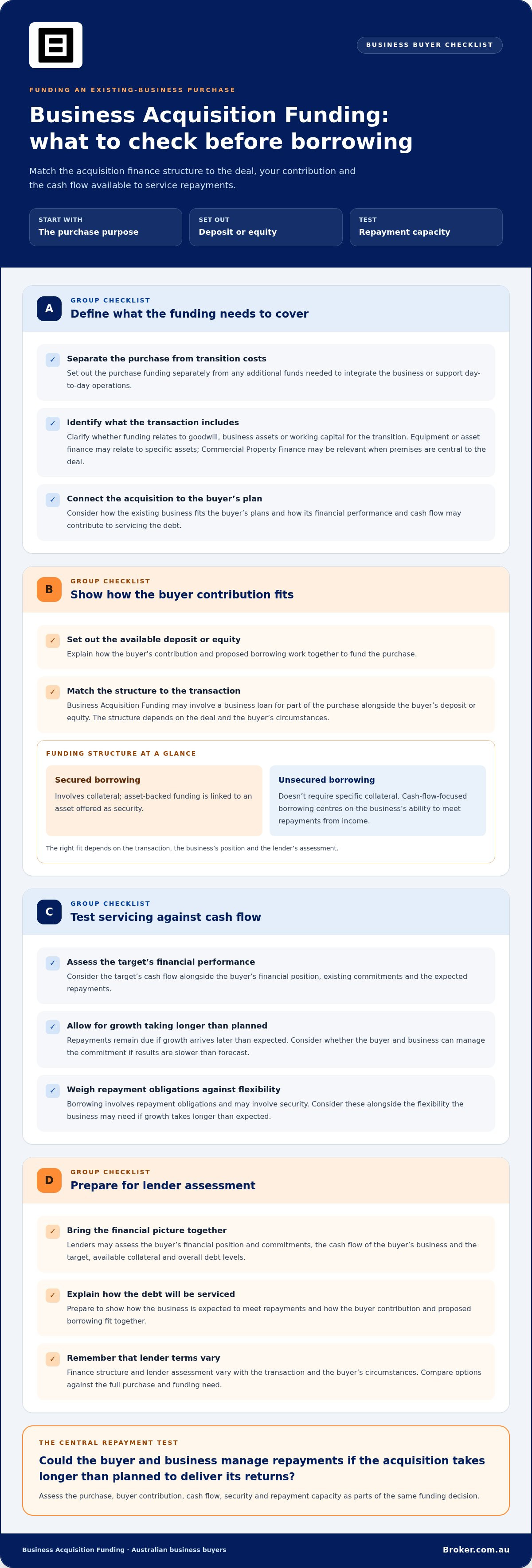
For a business buyer, compare finance options in relation to the purchase: what the sale includes, how much the buyer can contribute and how the acquired business may support repayments. Business Acquisition Funding can help fund the purchase of an existing business. The funding structure depends on the transaction and the buyer’s circumstances, while lender terms and assessments vary.
Acquisition finance may involve a business loan to fund part of the purchase, alongside the buyer’s available deposit or equity. Depending on the deal, funds may be needed for goodwill, business assets or working capital for the transition. Lenders may assess the buyer’s financial position and existing commitments, the cash flow of the buyer’s business and the target, available collateral and overall debt levels. Prepare to explain how the buyer contribution and proposed borrowing fit together, as well as how the business is expected to service repayments.
Asset-backed funding is linked to an asset offered as security, while cash-flow-focused borrowing centres on the business’s ability to meet repayments from income. Secured borrowing involves collateral; unsecured borrowing doesn’t require specific collateral. The right fit depends on the transaction, the business’s position and lender assessment.
Which finance types may support a growth investment?
For buying a business, Business Acquisition Funding is the most directly relevant starting point. Its fit depends on the purchase structure, the buyer’s contribution and the financial performance supporting the proposed repayments. A business loan may also be considered for a defined funding need, while equipment or asset finance can relate to specific assets included in or required by the acquisition. Commercial Property Finance may be relevant if premises are central to the transaction.
- Acquisition purchase: set out what the purchase funding covers, the buyer’s deposit or equity contribution and how the target’s cash flow may support servicing.
- Business assets: consider equipment or asset finance where machinery, vehicles or other assets are a distinct part of the plan.
- Premises: consider commercial property finance where acquiring property is part of the business purchase strategy.
Keep purchase funding distinct from additional funds needed for post-acquisition operations. For example, a buyer may need to consider the target’s ongoing working capital separately from the amount needed to complete the purchase. This clarifies the total funding purpose and gives lenders a more complete view of the proposed transaction.
When might working capital or invoice finance be relevant?
Working capital finance may help with day-to-day expenses during a transition, while Invoice Finance can provide access to funds tied up in outstanding invoices. A Business Line of Credit may suit fluctuating needs, subject to lender assessment and terms. These options address different cash-flow requirements, so consider how each would fit alongside acquisition borrowing and existing commitments.
For an acquired business, consider how quickly customers pay, when operating expenses fall due and whether the buyer’s current operations add further commitments. Business finance options are best considered in the context of the purchase, the funds required and the cash flow available to service borrowing.
Debt financing trade-offs: repayment capacity, security and flexibility
For a business buyer, the purchase price is only part of the funding decision. The deposit or equity contribution affects how much needs to be borrowed, while the acquired business’s cash flow may influence whether repayments are manageable. There’s no single contribution level that suits every transaction. Consider the buyer’s available funds, the target’s financial performance and existing commitments together when assessing the proposal’s capacity to service debt.
Debt can help a buyer fund a purchase while retaining ownership, but the obligation to repay continues if expected returns are delayed. Compare that commitment with other funding considerations:
| Consideration | Debt financing | Equity funding |
|---|---|---|
| Ownership | Doesn’t usually involve sharing ownership with a lender. | Involves sharing an ownership interest with an investor. |
| Repayments | Repayments are due under the agreed finance terms. | Doesn’t create scheduled loan repayments, but involves sharing ownership and potential returns. |
| Security | May involve collateral, depending on the arrangement. | Involves an ownership stake rather than loan security. |
| Flexibility | Repayment obligations and other terms are set by the finance arrangement. | Control and decision-making depend on the agreement with the investor. |
For acquisition finance, assess the buyer’s contribution alongside the proposed borrowing, not in isolation. Then consider whether the target’s trading income can support repayments after operating costs and the buyer’s existing debt commitments. A business that appears profitable may still have cash-flow timing pressures, so consider when income is received as well as the overall forecast.
Can expected cash flow support repayments?
Build a repayment view using the buyer’s current position and the target’s available financial information. Separate the target’s existing cash flow from any extra income the buyer expects the acquisition to generate. Test a downside case in which customer receipts fall or expected benefits take longer to appear. If repayments rely on immediate growth, the plan may have little room for disruption.
Ask whether the business could still meet repayments while paying suppliers, wages and other operating costs during a slower period. For a seasonal target, compare cash availability across busy and quiet periods rather than relying on an annual total alone.
What do secured and unsecured options trade off?
Secured finance involves collateral; unsecured finance doesn’t require specific collateral. The structure, terms and assessment depend on the lender and application. A business buyer should weigh the assets involved in any security arrangement against the proposed borrowing and consider the effect on the business if trading weakens.
Scaling a business with debt financing calls for a realistic buffer between forecast income and repayments. Review the forecast against a slower-growth scenario, including existing obligations, before deciding whether the proposed acquisition leaves enough cash-flow capacity to operate sustainably.
How to prepare a business growth finance plan and application
A well-prepared finance discussion starts with a specific business decision, not a preferred loan amount. Set out what you want to achieve, what the funding will pay for and how the investment is expected to contribute to the business. This gives a broker useful context for considering structures, security and repayment capacity. It can also reveal gaps in the plan before you take on a commitment.
A clear use of funds makes a finance discussion more useful because it connects the amount sought to a defined business purpose, timeline and repayment plan.
Build a clear funding request
Keep the request practical and evidence-based. If you’re buying a business, distinguish purchase funding from additional working capital or investment needed after settlement. Explain how the target fits your strategy, what buyer contribution or equity is available, and how the purchase may affect the combined business’s cash flow. Supporting information will depend on the transaction and finance structure.
- Define the objective. Describe the intended outcome, such as increasing production capacity, entering a new market or acquiring an existing business.
- Break down the use of funds. Identify the purpose of each part of the request, such as equipment, premises, acquisition costs or working capital. Base the amount sought on the plan, rather than choosing a figure without a clear rationale.
- Map the timing. Note when funding would be needed, how long implementation may take and when you expect the investment to begin contributing to revenue or savings. Explain the assumptions behind those expectations.
- List relevant commitments and assets. Summarise existing borrowing, regular obligations and assets relevant to the proposal. For an acquisition, include information available about the target’s financial performance and the buyer’s contribution.
- Review servicing capacity. Bring together current financial information and realistic projections. Consider whether repayments remain manageable if revenue growth, cost savings or acquisition benefits arrive later than planned.
Prepare to discuss servicing and downside scenarios
Organise records that explain the business’s trading position and the assumptions behind your forecasts. These may include financial statements, management accounts, cash-flow projections, details of existing commitments and information about the proposed investment. They’re useful preparation, though the information required depends on the lender and application. For a business purchase, keep buyer and target information clearly distinguishable.
Run a downside case alongside your expected scenario. For example, model slower sales growth or a delayed integration after buying a business, then consider how day-to-day costs and repayments would be handled. This makes pressure points visible and helps you discuss the proposal clearly.
Before the discussion, note questions about repayment structure, security, flexibility and how the proposed funding could interact with existing commitments. Broker.com.au’s business finance services include finance options for acquisitions and other defined business needs.
How Broker.com.au supports scaling a business with debt financing
Once you’ve defined the growth purpose, considered repayment capacity and prepared the supporting information, comparing finance options can help focus the discussion. Broker.com.au provides access to 100+ lenders through one broker, using proprietary AI-driven FinMatch® technology to analyse client information and match it to lender products. This helps bring finance possibilities into view against the proposed use of funds and the business’s circumstances, without assuming one structure or outcome will suit every application.
This can be useful for a business buyer considering Business Acquisition Funding. A purchase plan may need to account for the buyer’s contribution, the target business’s financial position and the capacity to service repayments after the transaction. A clear summary of the purpose, amount sought and repayment plan gives the discussion a practical starting point.
What happens in Broker.com.au’s four-step finance process?
The process moves from an initial outline of your needs to a broker-led finance discussion. You’ll work with a single point of contact through settlement, providing continuity as the finance process progresses. The steps are:
- Complete a simple form to outline your finance needs and growth purpose.
- Get matched via FinMatch®, Broker.com.au’s proprietary AI-driven matching process.
- Work directly with a broker to discuss the proposal and relevant finance options.
- Finance is secured through the process, subject to the lender’s assessment and decision.
The steps provide a clear path for exploring options, but don’t guarantee approval, a particular rate or funding outcome. For a business acquisition, explain how the purchase fits your growth plan, what equity or deposit you can contribute and how the business expects to manage repayments. For other growth needs, identify whether the funding relates to a business loan, equipment or asset purchase, or cash-flow support.
Choose a next step that fits your growth plan
Prepare a concise brief before discussing finance: state the purpose, amount sought, timing, relevant assets or existing commitments, and repayment assumptions. If you’re buying a business, include the information you have about the target and how you expect the combined operation to perform. Keep projections reasoned, with assumptions you can explain rather than relying only on an optimistic growth case.
Broker.com.au has originated $1.5 B+ in business loans since late 2021, supported by 65+ yrs combined senior experience across three senior advisors. This experience sits alongside access to lender options, helping frame a finance conversation around your plan rather than a product in isolation.
For finance options related to a growth plan or acquisition, Broker.com.au provides business finance solutions. Bring your funding purpose and repayment plan to start a focused conversation about options that may fit your circumstances.
Take the next step with a clear growth plan
Before committing to a growth opportunity, decide how you’ll track whether it’s delivering the results your finance plan anticipated. Set practical review points for progress, costs and cash flow, then compare actual performance with your assumptions. This keeps borrowing connected to the business’s needs as the plan unfolds, rather than treating funding as the finish line.
For a business buyer, the same discipline can keep an acquisition focused on its purpose, whether that’s building capability, reaching new customers or expanding operations. If the opportunity changes, revisit the plan and its impact on repayments before making further commitments. Thoughtful scaling a business with debt financing is about making deliberate choices as conditions evolve, not pursuing growth at any cost.
Ready to explore finance options for your business or acquisition? Discuss your finance plan with Broker.com.au. Bring your funding purpose and repayment assumptions to start a focused conversation about options that may suit your circumstances.
Frequently Asked Questions
Is debt financing suitable for a business with seasonal cash flow?
It may be worth considering if you can show how repayments would be managed through both busy and quiet periods. Map cash inflows and outflows across the business’s seasonal cycle, including when customers typically pay and when key expenses fall due. Then test a weaker season or delayed project income against existing commitments. Seasonal revenue alone doesn’t determine suitability; the facility structure and lender assessment also matter.
Can a business combine more than one type of debt finance?
A business may explore separate facilities for distinct needs, such as equipment finance for a machinery purchase and working capital finance for operating costs. Consider their combined effect, not just whether each facility appears suitable on its own. Map the purpose, repayment profile and cash-flow impact of each. When scaling a business with debt financing, Broker.com.au can help compare lender options, but approval isn’t guaranteed.
How much should a business borrow to fund growth?
Start with the cost of the defined plan, then assess what the business could service under realistic assumptions. For example, separate a one-off purchase from any extra funds needed to support implementation, rather than treating the whole project as one unexplained amount. Include current commitments and consider a slower return on the investment. There’s no single borrowing amount that suits every business; lender assessment and circumstances differ.
What happens if expected growth does not generate enough cash flow?
Repayments remain due under the agreed finance terms, even if growth takes longer or delivers less income than planned. Before borrowing, model how the business would respond, such as delaying discretionary spending or drawing on available operating reserves, if those options are genuinely available. If trading changes, review the position early and seek professional guidance about possible next steps. Don’t assume a lender will change terms or provide more funding.
Can debt finance be used alongside retained earnings?
Yes, a business can consider using retained earnings, borrowing or a mix of both to fund a growth plan. For example, it might use internal funds for initial implementation costs while exploring borrowing for a larger asset purchase. Compare the effect on available cash with the repayments a loan would create. The right balance depends on liquidity needs and the investment, rather than a rule that internal funds or debt should always come first.
Can a business refinance existing debt while planning to scale?
Reviewing existing debt may be relevant if current repayments affect cash flow or limit room for a new investment. Gather details of current facilities, balances, repayment arrangements and any security, then set these alongside the proposed growth funding. A restructure isn’t automatically suitable, and any replacement arrangement depends on the business’s circumstances and lender assessment. Broker.com.au offers Business Debt Restructure, which can be discussed as part of a broader finance plan.