
Could another layer of debt make a development fundable, or leave you with a repayment plan that’s too tight? When senior funding falls short, mezzanine finance for property developers may help bridge the capital gap. It also brings its own cost, security and repayment considerations.
It’s worth weighing that option against contributing more equity. Additional debt may reduce the cash you need to commit upfront, while increasing the project’s obligations and the importance of a workable exit strategy. The right comparison depends on the development’s feasibility, funding structure and assumptions, not on leverage alone.
This guide explains where mezzanine finance sits in an Australian development capital stack and how its security and repayment priority can interact with senior debt. You’ll learn how to compare it with additional equity using project-specific figures, and what financial information and term-sheet questions to prepare before discussing funding. The aim is to help you assess whether mezzanine could support a sound project, without mistaking a funding bridge for a solution to weak feasibility.
Key Takeaways
- See where mezzanine finance for property developers may fit when senior debt and available equity leave a project funding gap.
- Understand why debt and preferred equity are different structures, and how transaction documents shape security, ranking and repayment rights.
- Compare mezzanine finance with adding equity or revisiting senior funding across ownership, repayment priority and exposure to project outcomes.
- Prepare a clearer funding proposal by reconciling project costs, funding sources, draw timing and repayment assumptions.
- Learn how Broker.com.au’s broker-led Property Developer Finance process uses FinMatch® to match project information with lender products.
Table of Contents
- What mezzanine finance means for property developers
- How mezzanine finance can be structured and assessed
- Mezzanine finance versus more equity or senior debt
- How to prepare and review a mezzanine finance proposal
- Explore property developer finance with Broker.com.au
What mezzanine finance means for property developers
A development can still have a funding gap after the senior lender has set its limit and the developer has committed the equity they can reasonably contribute. That shortfall doesn’t automatically mean the project is unworkable. It does mean you need to examine the project’s funding needs, timing and capacity to repay additional finance.
Mezzanine finance is a possible layer of funding between senior debt and the developer’s equity, often called sponsor equity. It can bridge part of the gap, but it adds a repayment obligation and may involve a different risk and security position from the senior facility. The term can also cover distinct structures, so the label alone doesn’t tell you the rights or obligations involved. This overview of mezzanine capital in real estate finance provides broader context for the concept.
Where mezzanine finance sits in a development capital stack
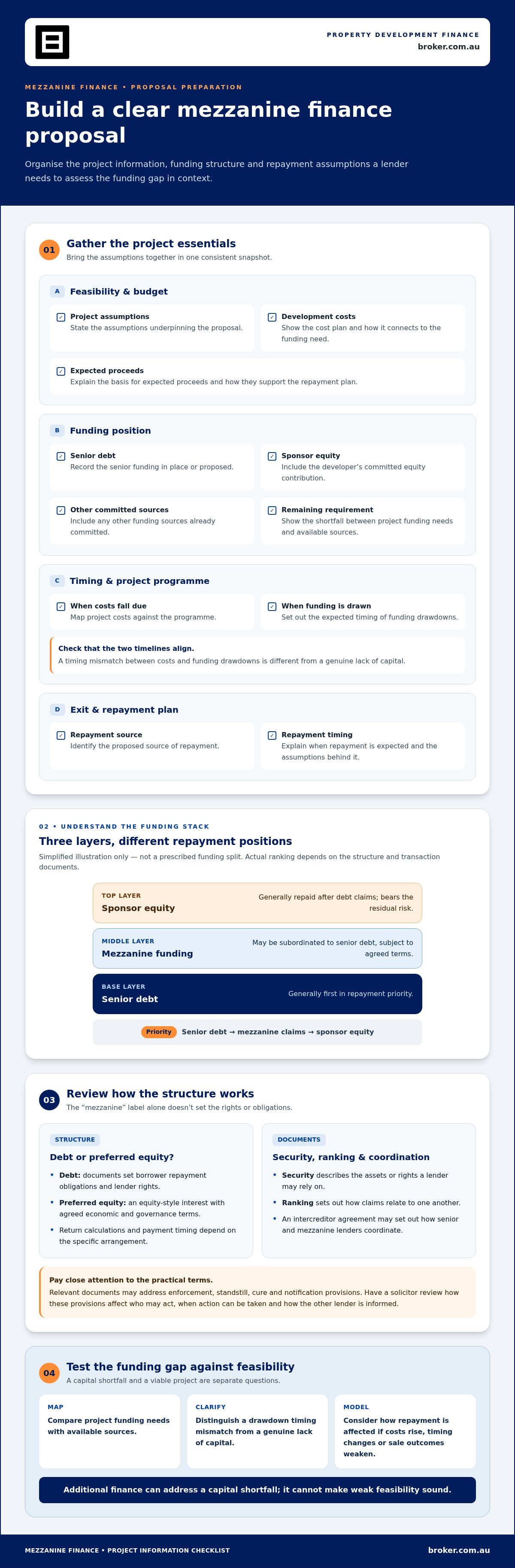
The diagram below shows a simplified repayment order, not a prescribed funding split. Senior debt is generally paid first, mezzanine claims rank behind it, and sponsor equity bears the residual risk. The transaction documents and funding structure determine the actual ranking.
Illustrative development capital stack
Top: Sponsor equity, generally repaid after debt claims
Middle: Mezzanine funding, potentially subordinated to senior debt
Base: Senior debt, generally first in repayment priority
Subordination describes the relationship between financing claims: one claim may be paid or enforced after another. It isn’t a universal product template. The facility documents and any arrangements between lenders determine how priority works in practice, including what happens if the project encounters difficulty.
What funding gap might mezzanine address?
Mezzanine finance is an additional funding layer that may sit between senior debt and sponsor equity, subject to the project structure and agreed repayment priorities.
For example, a developer’s cost plan may show that senior debt and committed equity together won’t cover all project funding needs across the build and sale period. Mezzanine may be considered to address some of that difference. First, map the shortfall clearly. Is it a timing mismatch between costs and funding drawdowns, a limit on senior lending, or a genuine lack of capital?
That distinction matters. A funding gap describes how the project’s sources of capital compare with its uses. Commercial viability is a separate question: whether the project’s assumptions and expected proceeds can support its costs, debt obligations and repayment plan. Extra finance can address a capital shortfall, but it can’t make weak feasibility sound.
Whether mezzanine finance for property developers suits a particular proposal depends on the project’s feasibility, funding structure and lender assessment. Model how the additional repayment would affect the project if costs rise, timing changes or sale outcomes weaken. Don’t treat the funding gap alone as a reason to borrow. The structure and terms determine how the funding works alongside senior debt and equity.
How mezzanine finance can be structured and assessed
The word “mezzanine” describes a position in the funding structure, not one standard contract. A proposal may involve subordinated debt or preferred equity. These are different arrangements, and their payment rights, return mechanisms and relationship to the senior facility need to be understood from the documents, not inferred from the label.
With debt, the documents set out the borrower’s repayment obligations and the lender’s rights. Preferred equity is an equity-style interest with agreed economic and governance terms. It isn’t simply another name for a mezzanine loan. How returns are calculated, when they’re payable and what happens if the project underperforms depend on the specific structure.
Which security and priority terms need close attention?
Security describes the assets or rights a lender may rely on, while ranking sets out how claims relate to one another. A mezzanine lender may rank behind a senior lender, but the security package and priority arrangements vary by transaction. The documents should explain how both facilities work together, including the practical effect of their relationship.
An intercreditor agreement can set out how the senior and mezzanine lenders coordinate, including rights and processes if a borrower defaults. Have a solicitor review relevant enforcement, standstill, cure and notification provisions. These terms can affect who may act, when action can be taken and how the other lender is informed. Don’t assume every facility uses the same protections or restrictions.
What project information supports a lender assessment?
Prepare a consistent snapshot of the proposal so its funding need and repayment plan can be assessed in context. Connect the project assumptions to the amount and timing of funding sought. Organise information such as:
- Feasibility and budget: project assumptions, development costs and the basis for expected proceeds.
- Funding position: senior debt, sponsor equity, other committed sources and the remaining funding requirement.
- Timing: when costs fall due, when funding is expected to be drawn and how that aligns with the project programme.
- Exit plan: the proposed source and timing of repayment, including the assumptions that support it.
- Project and sponsor details: relevant development experience and information about the entity undertaking the project.
Keep figures aligned across the feasibility, budget and funding request. If the cost plan changes, update the funding gap and repayment assumptions too. This makes it easier to discuss what the proposed facility needs to achieve and where uncertainty remains. No document guarantees lender approval.
Headline pricing alone doesn’t describe a facility’s full terms. Repayment rights, security, ranking, fees and lender coordination can all shape its cost and risk. Review the complete proposal with appropriately qualified legal and financial advisers, paying particular attention to how it interacts with senior finance and the project’s exit plan.
For a broker-led discussion of project funding options, explore Property Developer Finance with Broker.com.au.
Mezzanine finance versus more equity or senior debt
A funding gap can have more than one possible response. A developer might model mezzanine, contribute additional sponsor equity, or revisit the senior funding structure. Each choice changes the project’s cash requirements, repayment obligations and exposure to weaker outcomes. There’s no universal best option. Compare the alternatives against the same project assumptions and proposed terms.
| Consideration | Mezzanine funding | Additional sponsor equity | Revised senior funding |
|---|---|---|---|
| Capital availability | May add funding above the senior facility, subject to the project and proposed terms. | Depends on the sponsor’s ability and willingness to contribute more capital. | Could address some of the gap if the senior lender is willing to review the facility. |
| Repayment position | Creates an additional financing obligation, with priority and repayment governed by the documents. | Generally doesn’t create a scheduled lender repayment, but capital remains exposed to project results. | Changes the senior debt position and its obligations only if revised terms are agreed. |
| Ownership implications | May avoid issuing additional ownership, depending on the structure. | Existing ownership can be maintained if the sponsor funds the contribution itself; outside equity may affect ownership. | Doesn’t inherently change ownership, though the facility terms may change. |
| Sensitivity to project outcomes | Repayment obligations can heighten pressure if timing or proceeds weaken. | The sponsor’s capital is at risk if project costs rise or returns fall. | More senior borrowing may increase debt exposure and affect repayment capacity. |
Use actual project-specific proposals to populate the comparison. Include quoted fees, interest or return assumptions, repayment timing and any ownership terms. A headline rate or indicative structure isn’t a complete cost comparison.
When might mezzanine be worth modelling?
Model mezzanine when a defined funding gap remains after reviewing committed equity and senior debt, and the project’s feasibility indicates capacity to support the proposed obligations. Compare the sponsor’s equity retained with the financing cost and repayment pressure added. The model should show the effect on cash flow and the sponsor’s position if the project takes longer or produces less than planned. Don’t assume mezzanine improves returns or makes a weak project viable.
When could more equity or a revised project be preferable?
Test whether a larger equity contribution or changes to scope and timing reduce the funding need or make repayments more manageable. Cost increases can lift the amount required; delays can extend funding needs; weaker sales assumptions can reduce available repayment proceeds. Run downside scenarios alongside the base case, including combined pressures where appropriate. A project-specific financial model should reflect the actual proposal and its assumptions.
For mezzanine finance for property developers, the decision isn’t simply which option adds capital. It’s whether the resulting structure remains workable under less favourable conditions. Compare the same project, costs, timing and exit assumptions across each scenario, then review how the proposed terms affect the result. This gives you a clearer basis for deciding whether to pursue more debt, bring in equity or reshape the project.
How to prepare and review a mezzanine finance proposal
A well-prepared proposal makes it easier to see whether the funding request matches the project’s actual requirements. Before discussing mezzanine finance for property developers, bring the feasibility, funding schedule and repayment plan together so the figures tell one consistent story. Then review proposed terms against that model, not in isolation.
Build a clear funding and repayment picture
Start with the latest feasibility model. Show project costs, funding sources, expected drawdowns and the assumptions behind projected proceeds. Reconcile the total amount needed with the timing of each cost and funding source. A facility that appears sufficient overall may still leave a cash shortfall if funds aren’t available when project expenses fall due.
Use an ordered preparation process:
- Confirm the current position: list project costs, committed equity, senior funding and any remaining gap. Note which figures are estimates and which are supported by current documents.
- Map the timing: align expected costs with proposed drawdowns, including when funding may be needed and when repayment is planned.
- Show repayment priority: set out how the proposed mezzanine facility interacts with senior debt and the planned exit, using proposed terms rather than assumed arrangements.
- Test key assumptions: model cost overruns, delays and uncertainty around the exit as downside scenarios, not predictions. Identify which changes have the greatest effect on available repayment funds.
For example, a delayed exit may mean the project needs funding for longer than the base case assumes. A higher cost forecast may also increase the capital required. Model these pressures separately and together, and show how they affect the funding need and ability to repay. Clear assumptions make it easier to see what the proposal depends on.
Review the term sheet before relying on headline terms
Once a proposal is available, compare it with the model and the rest of the project funding. Review the complete documents, including conditions, fees, security, draw mechanics and repayment provisions. Check that timing, amounts and repayment assumptions align with the feasibility, and note any differences that need clarification before relying on the proposal.
Give particular attention to default and enforcement clauses, the interaction with senior funding, intercreditor arrangements and exit provisions. These can affect what happens if the project changes course or repayment doesn’t occur as planned. A headline rate alone won’t show the full financial and operational effect of a facility.
Have appropriately qualified finance and legal professionals review the relevant documents and explain their implications for your project. This isn’t a substitute for legal or tax advice; those conclusions should come from the professionals advising on your circumstances. A broker-led discussion can help organise the funding information and explore available project finance options.
To discuss how your project’s funding position could be presented, explore your development finance options with Broker.com.au.
Explore property developer finance with Broker.com.au
Once you’ve mapped the funding gap, tested the project assumptions and identified terms that need careful review, the next step is to explore funding options that fit the proposal. Broker.com.au arranges Property Developer Finance through a broker-led process, helping Australian developers consider lender products against their project information and funding needs.
FinMatch® is Broker.com.au’s proprietary technology for matching client information with lender products. It informs the options explored, but a match isn’t a promise of approval, a particular rate or specific terms. Each lender assesses proposals according to its own approach, and not every lender will suit every project. The project’s feasibility and funding structure remain central when considering proposed terms.
What happens when you discuss a development finance requirement?
Start by completing a simple form with information about your development finance requirement. FinMatch® uses that information to match the project with lender products. You can then discuss the project and funding options directly with a broker, with one point of contact through to settlement. This provides continuity as the enquiry progresses, without implying a particular turnaround time or outcome.
Reconciling project costs, funding sources, draw timing and repayment assumptions beforehand can make that discussion more focused. You’ll be better placed to explain the gap you’re seeking to address and consider how a proposed facility may sit alongside existing finance. The matching process helps explore options; it doesn’t replace feasibility work or professional review of proposed terms.
Why use a broker to explore lender options?
Broker.com.au provides access to 100+ lenders via one broker. This gives developers a way to explore a range of lender products without assuming the same structure, conditions or appetite will apply across the market. Project details remain central: funding needs, timing, repayment assumptions and overall feasibility all help shape the discussion.
The senior advisory team brings 65+ yrs combined senior experience across three senior advisors. Broker.com.au has originated $1.5 B+ business loans since late 2021. This figure relates to business loans overall, not solely to property development finance. Each development proposal still needs to be assessed on its own merits.
If you’re weighing mezzanine finance for property developers against additional equity or a change to senior funding, a broker-led conversation can help you explore how lender options may relate to your project. Bring your current funding position and key assumptions so the discussion stays grounded in the proposal, without treating an initial match as a funding decision.
I’m interested in exploring property developer finance
Turn your funding assessment into a clear next step
Turn your funding analysis into a decision you can explain: what the project needs, why the proposed structure fits, and how repayment holds up if assumptions change. That clarity helps keep discussions focused on the development itself, rather than on a funding gap in isolation.
Mezzanine finance for property developers should be considered in the context of the whole project, including feasibility, funding sequence and exit plan. If the figures support further exploration, take your current model and funding position into a broker-led discussion. If they don’t, refine the project assumptions first to establish a stronger basis for deciding what to do next.
Broker.com.au can help you explore Property Developer Finance options and consider how lender products may relate to your project. Explore property developer finance with Broker.com.au.
A well-tested funding decision starts with clear assumptions. With those in hand, you can move forward with greater confidence.
Frequently Asked Questions
Is mezzanine finance always secured by a second mortgage?
No. A second mortgage is one possible security arrangement, but it isn’t universal. The form of security and its priority depend on the facility and agreements with other funders. Review the actual documents to see what assets or rights are involved, how claims rank, and what steps lenders may take if there’s a default. A solicitor can explain how the proposed terms apply to your project and existing finance.
How much equity or deposit does a property developer need for mezzanine finance?
There’s no single equity or deposit amount that applies to every development. The required contribution depends on the project’s funding structure and the lender’s assessment of that proposal. Prepare a sources-and-uses schedule showing total project funding needs, senior debt, equity already committed and the remaining gap. This clarifies what additional capital is sought, but a project-specific assessment is needed to establish whether a proposed structure is workable.
Can mezzanine finance be used for land acquisition as well as construction?
It may be considered as part of a development funding structure that includes land acquisition, construction or both, depending on the transaction and lender assessment. A proposal should show how the land purchase relates to the project budget, what other funding is in place and how the overall facility is expected to be repaid. Don’t assume that a lender considering one project stage will fund every stage.
What happens if a property development runs over budget or is delayed?
A cost overrun or delay can increase the funding requirement, extend the time before repayment or affect the planned exit. Check the facility documents for notification requirements, draw conditions and provisions dealing with project changes. Update the feasibility model and discuss material changes with your broker and relevant funders early. The available response depends on the agreed terms; extra funding or an extension shouldn’t be assumed.
Can mezzanine finance be repaid by refinancing at project completion?
Potentially, if refinancing is available at that point and the new facility provides enough funds to repay existing obligations. Don’t assume this outcome at the start of the project. Model refinancing as an exit scenario, including what could happen if lender appetite, project value or timing differs from your assumptions. Also identify an alternative repayment path so the plan doesn’t rely on a future refinance alone.
Does mezzanine finance always require a personal guarantee?
No, a personal guarantee isn’t an automatic feature of every mezzanine facility. Whether a guarantee is requested, who may be asked to provide one and what it covers depend on the transaction documents and lender assessment. Review any guarantee wording with a qualified solicitor before signing, including its scope and how it interacts with other obligations. Don’t rely on a general description of a facility to determine personal exposure.
How is mezzanine debt different from preferred equity?
Mezzanine debt is a borrowing arrangement with repayment obligations set out in its facility documents. Preferred equity is an equity interest with its own agreed return and rights. They aren’t interchangeable, even if both sit between senior finance and ordinary sponsor equity in a project structure. The distinction can affect repayment, control and risk, so compare the actual documents and seek professional advice on how each proposed structure operates.