
Could your latest BAS and business bank statements make a stronger case for a home loan than tax returns that haven’t caught up with your business? If you’re a company director, this is the question behind low doc home loans for company directors: how can you demonstrate reliable income when your company’s returns aren’t finalised or don’t reflect current earnings?
A standard PAYG assessment may not show the full picture of a profitable company. Directors often need to explain how salary, dividends, retained profits and company assets fit together, while keeping personal and business finances clear. Low doc doesn’t mean no checks. Lenders may assess alternative evidence, such as BAS, bank statements or an accountant’s declaration.
This 2026 guide explains which documents lenders may consider, how your deposit, equity and servicing can shape your options, and what to compare when weighing low doc against full doc lending. It also covers how home equity and borrowing capacity may connect to Business Acquisition Funding when buying an existing business, and what to consider when arranging acquisition finance.
Key Takeaways
- Low doc home loans for company directors use alternative ways to demonstrate income, but lenders still assess whether repayments are affordable.
- BAS and an accountant’s declaration can help explain your company’s current trading position when supported by consistent records.
- Compare the flexibility of low doc lending with potential rate differences, fees and the timing of your property plans.
- A business purchase may affect personal borrowing capacity, so consider both applications and their cash-flow impact together.
- Prepare for an application by reviewing company cash flow, gathering income evidence and comparing lender criteria for director income structures.
Table of Contents
- Understanding Low Doc Home Loans for Company Directors
- Beyond the Pay Slip: How Income is Verified in 2026
- Comparing Low Doc vs. Full Doc for Business Owners
- Integrating Property and Business Acquisition
- The Roadmap: Applying for Your Director Home Loan
Understanding Low Doc Home Loans for Company Directors
A company director’s income can be sound without appearing as a neat salary on a payslip. Traditional applications often centre on personal payslips and completed tax returns, which may not show how money moves through a company or reflect its current position. Low doc home loans for company directors are designed to assess income using alternative evidence when standard documents don’t tell the whole story.
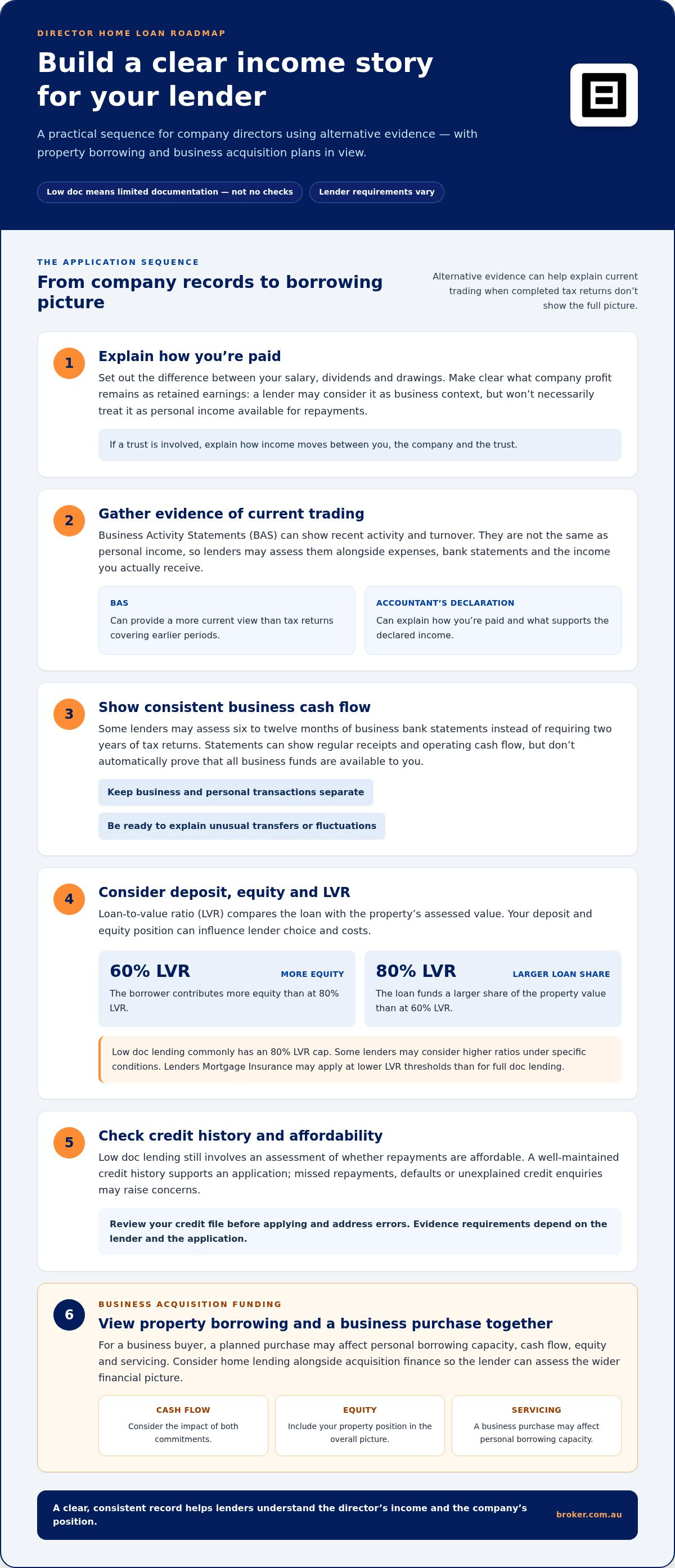
“Low doc” means limited documentation, not no documentation. In Australia, lenders still assess whether a loan is suitable and affordable. The term alt doc, short for alternative documentation, describes the process more accurately: instead of relying only on conventional tax returns, a lender may consider evidence such as Business Activity Statements (BAS), business bank statements or an accountant’s income declaration. The evidence required depends on the lender and application.
This approach may help when company tax returns aren’t finalised or cover a past period that differs from current trading. BAS can show recent business activity, while an accountant’s letter can explain the director’s income position. Neither guarantees approval. Together with other records, they can help provide a clearer, verifiable picture for assessment.
Why Company Directors Face Unique Challenges
Company income and personal income aren’t interchangeable. Salary, dividends and drawings describe different ways a director may receive money, while company profit can remain in the business as retained earnings. A lender may consider retained earnings as context for business strength, but won’t necessarily treat them as personal income available for repayments. Clear records help distinguish funds accessible to the director from money the company needs to retain.
Trusts add another layer. Lenders may need to understand how income flows between the director, company and trust, and how each entity is structured. A standard form built around one employer and one payslip may not capture these details. A well-organised application sets out the structure and income flows clearly.
The Benefits of a Tailored Director Loan
Alternative evidence may let an application proceed without waiting for a new set of tax returns. The lender still assesses the documents and the overall application. For a director buying a business, restructuring or managing a period of growth, timing matters. The assessment should account for the connection between business cash flow and personal borrowing capacity.
A tailored application focuses on evidence that explains current income and affordability, rather than relying on documents that may not reflect the company’s position. For a business buyer, it is also useful to consider home lending alongside Business Acquisition Funding. A planned purchase may affect cash flow, equity and personal servicing. The aim is to give lenders a clear account of your finances and the evidence needed to assess them.
Beyond the Pay Slip: How Income is Verified in 2026
A director’s income needs to be understood in the context of the company, rather than treated as if it came from a standard employer. For low doc home loans for company directors, lenders may use alternative evidence to assess whether earnings are genuine, ongoing and sufficient for repayments. The documents should tell a consistent story across business activity, money received and income declared.
Evidence that shows the full picture
Business Activity Statements (BAS) can show recent turnover and trading patterns, offering a more current view than tax returns covering earlier periods. BAS figures aren’t the same as personal income. Lenders may consider them alongside business expenses, bank statements and the director’s actual income to understand what the company can sustain.
Some lenders may assess six to twelve months of business bank statements instead of requiring two years of tax returns. Statements can show regular receipts and operating cash flow, but they don’t automatically prove that all business funds are available to the director. Keep business and personal transactions clearly separated, and prepare to explain unusual transfers or fluctuations.
An accountant’s letter or income declaration, sometimes called a self-certification, can provide context for the figures. It should accurately describe how the director is paid and what supports the declared income. It doesn’t bypass verification: lenders may assess it alongside other records, and evidence requirements differ.
Alt doc assessment, LVR and credit history
Digital tools and AI can help organise financial information and match an application with lenders whose criteria suit a director’s circumstances. Broker.com.au uses proprietary AI to facilitate loan applications, while the application still needs to reflect the company’s structure and income evidence.
LVR, or loan-to-value ratio, compares the loan amount with the property’s assessed value. At 60% LVR, the borrower contributes more equity than at 80% LVR, where the loan funds a larger share of the property value. Low doc lending commonly has an 80% LVR cap, while some lenders may consider higher ratios under specific conditions. Lenders may also require Lenders Mortgage Insurance at lower LVR thresholds than for full doc lending. A larger deposit can affect both lender choice and costs.
A well-maintained credit history supports an application. Missed repayments, defaults or unexplained credit enquiries may raise concerns. Review your credit file before applying and address errors early. A clean record won’t replace income evidence, but it helps lenders assess the overall risk.
Dividends, director loan accounts and servicing
Dividends may support an income assessment when records show they are consistent and backed by company performance. A one-off payment may be viewed differently from a reliable pattern. Director loan accounts also need clear explanations, as money moving between the director and company can affect how available income and liabilities are understood. Servicing is the lender’s assessment of whether verified income can cover proposed repayments and other financial commitments under its criteria.
Prepare a concise explanation of salary, dividends and director loan movements to make a complex file easier to follow. To discuss your director income and home loan options for directors, organise your BAS, statements and accountant’s declaration together.
Comparing Low Doc vs. Full Doc for Business Owners
A full doc home loan generally relies on completed personal and business tax returns and financial statements. Low doc, often called alt doc, may instead allow a lender to assess alternative income evidence. The trade-off can be a higher rate or tighter lending criteria. Waiting for returns to be finalised may also affect the timing of a property purchase. Compare the full borrowing cost and timing, not just the interest rate.
Mozo reported in June 2026 that low doc rates typically carry a premium of 0.5% to 1.5% over standard variable rates. That is a market range, not a quote or a rule for every lender. The rate available depends on factors such as lender criteria, your evidence, equity and overall application strength. A lender may assess an application with strong equity differently from one with a smaller deposit or a more complex credit profile.
Weighing flexibility against cost
A higher rate for a period may be worth considering if a property purchase is time-sensitive and your current financial evidence supports repayments, while tax returns are not ready. But buying sooner doesn’t automatically outweigh the extra interest. Compare repayments, how long you expect to keep the loan and the implications of refinancing later. A move to a full doc loan may be possible once updated returns and financial statements are available, subject to the lender’s assessment at that time.
Equity can strengthen an application by reducing the loan-to-value ratio (LVR). It may improve lender choice or terms, but it doesn’t guarantee a lower rate. Low doc loans are commonly capped at 80% LVR, and some lenders may consider higher ratios in specific circumstances. Lenders Mortgage Insurance (LMI) may apply above a lower LVR threshold for low doc lending, often around 60% to 70%. Include potential LMI in your comparison rather than focusing only on the deposit.
A practical loan-readiness framework
Use these questions to prepare for a lender discussion. They’re a guide, not an approval test, because requirements vary.
- Income evidence: Can BAS, bank statements and accountant-prepared information support a consistent view of current income?
- Equity: What deposit is available, and how would different LVRs affect lender options and possible LMI?
- Credit and commitments: Is your credit history accurate, and have you listed existing debts and regular commitments?
- Next steps: Can you provide completed tax returns and financial statements if a full doc refinance becomes suitable later?
“Prime” and “near-prime” are broad labels used to distinguish lender risk appetites, not guaranteed product categories with identical rules across the market. A prime assessment may suit a straightforward file with strong evidence and credit conduct. Near-prime options may consider more complex circumstances, often with different pricing or conditions. Compare the actual criteria rather than relying on the label alone.
Broker.com.au helps directors compare lender options for low doc home loans for company directors. Its proprietary AI facilitates loan applications, while the application can account for director income structures and other commitments. If Business Acquisition Funding is also part of your plans, consider the home loan and purchase funding together so both commitments are reflected in servicing and cash-flow decisions.
Integrating Property and Business Acquisition
A home loan and a business purchase draw on the same director’s income, equity and capacity to manage repayments. If you’re buying an existing business while seeking a home loan, plan the funding as one connected strategy. A home-equity release, such as a cash-out refinance, may provide purchase capital, while dedicated Business Acquisition Funding can be structured around the acquisition. The right mix depends on the deal, available security and the cash you need to keep accessible.
Business Acquisition Funding may support the purchase of goodwill, business assets and working capital required for the transition. A business buyer may also consider a secured business loan or other acquisition finance alongside their own contribution. Lenders assess the proposed structure and available security, so don’t assume the full purchase price can be borrowed or that home equity will be treated separately from your existing mortgage.
Plan the acquisition and home loan together
Start by mapping the purchase price against the funds available from savings, property equity and proposed acquisition lending. Your contribution, or deposit, affects how much finance is required and how much personal liquidity remains after settlement. Keeping more cash available can provide a buffer for transition costs and business needs. Using more equity may reduce the cash contribution but increase debt secured against your home. Weigh both outcomes against the home deposit and repayments you need to manage.
For an existing business, lenders may examine the target’s financial performance and cash flow, the proposed purchase terms, the buyer’s contribution and the security offered. Prepare the business’s financial records, details of existing liabilities and a clear account of how it is expected to meet ongoing costs and proposed debt repayments. Requirements vary, and assessment may differ depending on whether the purchase is made personally or through a company or trust.
Financial modelling can help test whether expected business cash flow can cover operating costs and acquisition repayments while leaving enough income to support your personal borrowing. Consider a conservative trading scenario as well as the expected one. This can reveal whether the proposed funding mix leaves enough room for the home loan, without relying only on optimistic projections.
Keep the financial picture clear
If a corporate restructure is part of the purchase, set out which entity will own the business, receive its income and take on each liability. Separating business and personal liabilities helps lenders identify the director’s commitments, including personal guarantees or obligations connected to company borrowing. Disclose those commitments accurately so the home-loan assessment reflects the full position.
Broker.com.au offers Corporate Advisory services alongside residential lending, helping directors consider acquisition finance and home borrowing together. This joined-up view can help organise a multi-loan plan around the purchase, available equity, business cash flow and personal borrowing capacity.
If you’re planning a purchase alongside a home loan, discuss your acquisition and home loan strategy with Broker.com.au.
The Roadmap: Applying for Your Director Home Loan
A clear application starts with preparation, not a generic form. For low doc home loans for company directors, organise the evidence so a lender can understand how your business earns, how you receive income and what repayments your finances can support. A broker can help shape the application and compare lender criteria suited to your circumstances.
- Review company cash flow and BAS. Check that BAS figures, business bank activity and your records tell a consistent story. Note seasonal fluctuations, unusual transactions and recent changes that may need context.
- Map the lender fit. A broker can compare lender criteria for director income evidence, credit, deposit and LVR. The aim is to present your circumstances to lenders whose approach fits, rather than force a complex file into a standard PAYG assessment.
- Prepare your alternative-documentation pack. Gather the accountant’s income declaration, relevant BAS and business bank statements. Include clear explanations for director drawings, dividends or transfers between company and personal accounts, so the lender can follow the figures.
- Test the application. Review existing debts, expected repayments and household commitments against reliable income. Financial modelling can help stress-test cash flow and show how changes in trading or borrowing commitments may affect affordability. AI can facilitate application collation, but the assessment still needs to reflect your financial position.
- Compare options through to settlement. Consider the rate, fees, LVR, potential Lenders Mortgage Insurance and loan features together. An offer should fit your plans, including any Business Acquisition Funding or business purchase commitments, not just look competitive at first glance.
Why Broker.com.au is the expert choice
Broker.com.au is an award-winning Australian broker specialising in business acquisition, loan restructure, asset finance and home loans for business owners. Its proprietary AI technology helps facilitate loan applications. The team arranges home loans as well as business and property finance, which can be useful when a director’s personal borrowing and business plans overlap.
Start by outlining your goals, income structure and next steps. A clear discussion can help identify which documents to prepare and what to compare before deciding how to proceed.
Final checks before you apply
Before lodging, make sure your documents are current and your financial picture is consistent. Keep company and personal liabilities distinct, and prepare to explain any guarantees or obligations that connect them.
- Review whether superannuation and ATO obligations are up to date, and have relevant records ready.
- Outline a practical exit or repayment strategy for any business debt, including how it fits alongside the home loan.
- Check that the proposed repayments leave room for business cash-flow needs and personal commitments.
Ready to discuss a tailored application? Discuss your home loan application with Broker.com.au.
Shape Your Next Move with Confidence
Your next step is to decide how the loan fits the life and business you’re building. If a property purchase and business growth are both on the horizon, consider the timing, the cash you want to keep available and how each commitment may affect your plans. Looking at your personal and business finances together can help you make a more informed decision.
Low doc home loans for company directors can offer a path when conventional paperwork doesn’t reflect your current position. The lending strategy should suit your circumstances today and leave room for what comes next, whether that’s growing your portfolio, buying a business or strengthening your financial position.
Broker.com.au specialises in complex lending and business acquisition. Its proprietary AI supports the application process, and its brokers can help you compare lending options for your plans.
Discuss a tailored director loan strategy with Broker.com.au.
Frequently Asked Questions
Can I get a home loan as a company director with only 12 months of ABN registration?
Possibly, as lender requirements vary. Some lenders look for an ABN history of 12 to 24 months, while specialist lenders may consider a shorter trading history. The type of income you receive matters too: directors relying on fees or dividends may face different history requirements from those paid a regular salary. Be ready to show that the business is actively trading and provide income evidence for the period available.
How much deposit do I need for a low doc home loan in 2026?
A deposit of 20% to 30% is a useful target for low doc lending, though the amount a lender will accept depends on its criteria and your application. Low doc loans are commonly capped at 80% loan-to-value ratio (LVR), and Lenders Mortgage Insurance may apply above a lower threshold, often around 60% to 70% LVR. A smaller deposit may be possible with some lenders, but it can affect costs and options.
Is an accountant’s letter enough to prove my income to an Australian lender?
Not necessarily. A lender may accept an accountant’s declaration as part of your income evidence, but it can also ask for supporting records such as BAS or business bank statements. The aim is to verify that your declared income is consistent with business activity and can support repayments. Ask your accountant to explain how you’re paid, and ensure the figures align across the documents you provide.
What is the maximum I can borrow on a low doc loan as a company director?
There isn’t one maximum borrowing amount that applies to every director. A lender assesses verified income, existing debts, regular expenses, proposed repayments and the property’s value. The permitted LVR also affects the loan size relative to the property value. For a realistic estimate, prepare a current list of personal and business commitments and disclose any company obligations you’re responsible for.
How does business acquisition funding affect my personal home loan application?
Business Acquisition Funding can affect your home loan assessment because lenders consider the new repayments and how the purchase may change your income and available cash flow. For example, a director buying an existing business may need to show how the acquisition finance will be serviced and what funds remain for the home loan deposit and repayments. Present the purchase structure, liabilities and expected cash flow together for a clearer assessment.
Do low doc loans have higher interest rates than standard mortgages?
They can. Mozo reported in June 2026 that low doc rates typically carry a premium of 0.5% to 1.5% over standard variable rates, although the rate offered depends on the lender and application. Compare the total cost, not just the advertised rate. Consider fees, any Lenders Mortgage Insurance and how long you expect to keep the loan. A stronger equity position may affect the options available, but doesn’t guarantee standard rates.
Can I use a low doc loan for an investment property or just a home?
It may be possible to use alternative-documentation lending for an investment property, but the lender’s product purpose and criteria determine whether it’s suitable. State upfront how the property will be used, as investment borrowing may be assessed differently from an owner-occupied home loan. Prepare a clear view of expected rent, property costs and other commitments alongside your director income to explain how repayments will be managed.
What happens if my company has an ATO debt? Can I still get a home loan?
An ATO debt doesn’t automatically determine whether you can borrow. The lender will consider the details and your overall ability to meet repayments. Be transparent about the balance, whether a repayment arrangement is in place and how payments affect business cash flow. Gather current statements and payment records so the position is clear. Undisclosed liabilities or unexplained cash-flow pressure can make it harder for a lender to assess the application accurately.