
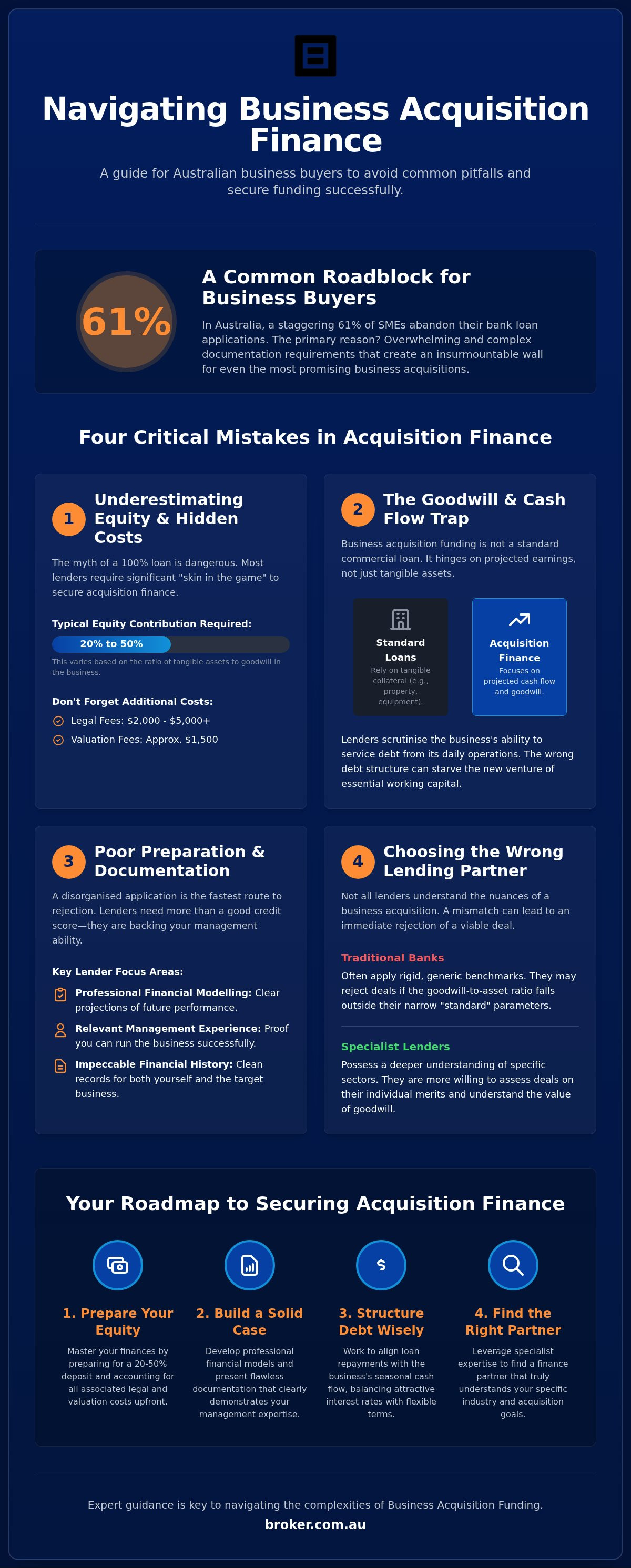
Did you know that in 2026, 61% of Australian SMEs abandoned their bank loan applications because the documentation requirements felt like an insurmountable wall? When you’re buying a business, the thrill of a new venture can quickly turn to anxiety when faced with the common mistakes in business acquisition loans that lead to a flat rejection. It’s a high-stakes environment where a single error in your financial modelling or a misunderstanding of equity requirements can derail months of careful negotiation.
We believe that securing Business Acquisition Funding shouldn’t feel like a gamble with your personal assets. You likely want a streamlined process that protects your cash flow and accounts for the true value of goodwill. This guide promises to show you how to avoid critical financing pitfalls and secure the right acquisition finance for your needs. We’ll provide a clear roadmap for approval, helping every business buyer understand how to structure debt effectively and find lenders who specialise in the nuances of a business acquisition.
Key Takeaways
- Understand why standard commercial lending often fails for a business acquisition and how specialised funding structures provide the necessary flexibility for a successful handover.
- Learn how to avoid common mistakes in business acquisition loans by preparing for current deposit benchmarks and ensuring you have sufficient “skin in the game” to satisfy lenders.
- Master the art of financing goodwill and discover how to structure debt effectively to maintain healthy cash flow throughout the ownership transition.
- Identify the essential documentation and professional financial modelling every business buyer must present to secure a streamlined approval from the right lender.
- Gain inside access to the best rates by leveraging specialist expertise and AI technology to find a finance partner that truly understands your specific industry and goals.
Table of Contents
- Navigating the Complexity of Business Acquisition Finance in Australia
- Underestimating Equity and Deposit Requirements
- Overlooking Cash Flow Servicing and the “Goodwill” Trap
- Common Due Diligence and Documentation Failures
- How to Secure Acquisition Finance with a Specialist Broker
Navigating the Complexity of Business Acquisition Finance in Australia
Securing finance for a business acquisition is fundamentally different from obtaining a standard commercial property or equipment loan. While a standard loan usually relies on tangible collateral, Business Acquisition Funding often hinges on the projected earnings and “goodwill” of the entity you’re purchasing. One of the common mistakes in business acquisition loans is assuming that a strong personal credit score or a residential property as security is the only thing that matters. Lenders in the Australian market are increasingly focused on the specific industry risks and the sustainability of the target’s cash flow.
Lender appetite fluctuates based on economic conditions and sector performance. While SME lending reached $153.7 billion in 2024, traditional banks often tighten their criteria for certain industries without notice. This creates a distinct divide between asset-backed loans, which are secured against physical wealth, and cash flow-based acquisition finance, which relies on the business’s ability to service debt from its daily operations. Navigating these Small business financing options requires a sophisticated approach to ensure the debt doesn’t overwhelm the very asset you’re trying to build.
The High Stakes of Acquisition Finance Structures
Setting up the wrong debt structure can cripple a new venture within its first twelve months. If your repayments are too aggressive, you’ll quickly starve the business of the working capital it needs to survive the transition phase. It’s a delicate balance. You need to weigh the benefits of a lower interest rate against the necessity of flexible repayment terms that align with seasonal cash flow dips. Additionally, every business buyer must demonstrate relevant management experience. Lenders aren’t just financing a balance sheet; they’re backing your ability to step into the driver’s seat and maintain profitability from day one.
Lender Requirements: What the Big Banks Won’t Tell You
Traditional banks often apply rigid, generic benchmarks that fail to account for the nuances of a specific business acquisition. They might reject a viable deal simply because the goodwill-to-asset ratio falls outside their narrow “standard” parameters. This is where “inside access” to specialist lenders becomes a game-changer. These providers often have a deeper understanding of specific sectors and are more willing to look at situations that fall outside the norm. To avoid the common mistakes in business acquisition loans, ensure your financial history is impeccable and your ABN is correctly structured for the new entity. A disorganised application is the fastest route to rejection in a market where 61% of SME buyers already abandon their finance journey due to documentation hurdles.
Underestimating Equity and Deposit Requirements
One of the most persistent myths in acquisition finance is the idea of the 100% loan. While some lenders offer high leverage for specific professional practices, the reality for most people buying a business is that you’ll need significant “skin in the game.” In 2026, Australian lenders typically require an equity contribution ranging from 20% to 50% of the total purchase price. This requirement fluctuates based on the ratio of tangible assets to goodwill; the higher the goodwill, the more cash or external equity you’ll likely need to bring to the table.
Falling into the trap of only budgeting for the purchase price is one of the common mistakes in business acquisition loans. A savvy business buyer must account for a range of additional costs that can quickly drain your working capital if not factored into the initial loan application. These include legal fees, which typically range from $2,000 to $5,000 for standard transactions, and professional valuation fees that often sit around $1,500. Ignoring these “hidden” costs can lead to a shortfall on settlement day, forcing you to tap into high-interest credit or personal savings that were meant to sustain the business during its first few months of operation.
Leveraging Assets vs. Cash Deposits
You don’t always need a pile of liquid cash to secure a business acquisition. If you own commercial property, using it as collateral can often unlock better interest rates and higher borrowing limits. Alternatively, you can sometimes separate the purchase. By using Equipment Finance for the physical assets and a specialised acquisition loan for the remainder, you can structure a more efficient debt profile. This approach helps bridge the equity gap without exhausting your cash reserves, ensuring you maintain a healthy buffer for day-to-day operations.
The Danger of Cross-Collateralisation
Many traditional banks will try to secure a business loan against your personal residence. This is a risky move that ties your family’s security to the performance of your new venture. We often recommend “ring-fencing” your personal assets wherever possible. This involves negotiating with lenders to limit their recourse to specific business assets or commercial property. If you’re feeling overwhelmed by these requirements, exploring your options for Business Acquisition Funding through a specialist can help you find a lender that accepts alternative security, keeping your home separate from your professional risks. It’s about moving toward your goal with streamlined confidence rather than unnecessary fear.
Overlooking Cash Flow Servicing and the “Goodwill” Trap
Goodwill represents the intangible value of a company, encompassing its reputation, customer loyalty, and brand recognition. While it often makes up the lion’s share of the purchase price, it remains the most challenging element to fund. Lenders are naturally cautious about goodwill because it cannot be seized or sold as easily as physical machinery or property. One of the common mistakes in business acquisition loans is assuming a lender will value goodwill as highly as you do. In 2026, many Australian banks have strict benchmarks for goodwill-to-asset ratios, often requiring higher equity contributions when the intangible value exceeds specific industry norms.
To determine if you can actually afford the debt, lenders look closely at your Debt Service Cover Ratio (DSCR). This calculation measures the business’s operating cash flow against its total debt obligations. A business buyer often falls into the trap of relying on the previous owner’s “optimistic” financial projections rather than hard data. Lenders, however, will stress-test your application against potential interest rate rises and industry downturns. You must also account for GST and ongoing tax obligations. If your post-acquisition cash flow doesn’t comfortably cover these while servicing the loan, your application will likely hit a dead end.
Historical vs. Projected Earnings: The Lender’s Lens
Lenders prioritising Business Acquisition Funding typically weight the last three years of tax returns far more heavily than your 2026 forecasts. They want to see a consistent track record of profitability. When preparing your acquisition finance application, you’ll need to carefully adjust “add-backs.” These are one-off expenses incurred by the previous owner, such as personal travel or non-recurring legal fees, that won’t continue under your leadership. Providing a robust, professionally prepared financial model that justifies these adjustments is essential to proving the business’s true earning potential.
Managing Working Capital Post-Acquisition
Many people buying a business exhaust their capital on the deposit and professional fees, forgetting to finance “day one” operating costs. You need enough liquidity to cover immediate payroll, rent, and supplier payments before your first invoices are settled. To protect your momentum, consider combining your primary loan with a Line of Credit or Invoice Finance facility. This ensures you have a safety net for seasonal fluctuations and unexpected expenses, allowing you to focus on growth rather than survival during the critical first few months of ownership.
Common Due Diligence and Documentation Failures
Approaching a lender for acquisition finance without a mountain of organised paperwork is a recipe for a quick rejection. One of the most common mistakes in business acquisition loans is treating the initial meeting as a casual conversation rather than a formal presentation of a high-value asset. Lenders don’t just want to see that the business makes money; they want to see that the earnings are sustainable and that you, as the business buyer, have a granular understanding of the numbers. Relying on “DIY” financial modelling is a major red flag. Without professional stress-testing and sensitivity analysis, your projections often look like wishful thinking rather than a viable repayment strategy.
During the due diligence phase, you must verify the “Quality of Earnings” with absolute precision. This goes beyond looking at the bottom line. You need to identify if the revenue is tied to a single major client or if it’s spread across a healthy, diverse base. If you can’t prove that the profit will continue once the current owner exits, the lender’s risk assessment will skyrocket. Presenting a professional business plan that speaks the lender’s language of risk mitigation and cash flow stability is the only way to move from uncertainty to a streamlined approval.
The Essential Acquisition Finance Checklist
Before you even think about buying a business, you must have your documentation in order. Lenders expect a comprehensive file that includes:
- Financial Statements: At least three years of audited financial statements and Business Activity Statements (BAS) for the target entity.
- Statement of Position: A detailed personal financial position (SOP) for all directors, proving your own financial stability.
- Legal Foundations: Copies of all industry-specific licences and current commercial lease agreements.
If these documents are missing or inconsistent, your application will likely stall before it even reaches a credit officer’s desk.
Ignoring Specific Lender “Red Flags”
Lenders are trained to look for reasons to say “no” to protect their capital. High customer concentration, where one client accounts for more than 20% of total revenue, is a common deal-killer. Similarly, if the commercial lease is set to expire in three years but you’re asking for a seven-year loan, the lender will see a massive security gap. You must also proactively address any outstanding ATO debt or employee entitlements within the target business. If you want to ensure your application is airtight from day one, our specialist team can help you prepare your Business Acquisition Funding application with precision.
How to Secure Acquisition Finance with a Specialist Broker
After navigating the technical hurdles of acquisition finance, the final piece of the puzzle is finding a partner who can translate your vision into a funded reality. Many buyers fail because they approach a single bank and accept a rejection as the final word. This is one of the most common mistakes in business acquisition loans. Instead, partnering with an expert guide allows you to leverage industry-specific insights and tailored solutions that traditional institutions often overlook. We move you from a state of uncertainty to streamlined confidence, ensuring your business acquisition is backed by the right capital structure.
Our approach utilises proprietary AI technology to scan hundreds of finance providers, matching your specific deal with lenders who have a high appetite for your industry. This “inside access” means you aren’t just getting a generic rate. You’re securing a facility designed for the nuances of buying a business in Australia. For mid-market transactions, our corporate advisory services act as a secret weapon. We help you navigate complex debt restructuring and financial modelling that satisfies even the most conservative credit committees, turning a “no” into a “yes.”
The Broker.com.au Advantage for Business Buyers
We specialise in situations that fall “outside of the norm.” Whether you’re a first-time business buyer or scaling an existing portfolio, we provide a stress-free bridge between your ambition and the necessary funding. You aren’t just a digital file in a massive corporate queue. You’ll work with dedicated advisors like Matt, Kylie, or Flavio, who understand the high-stakes nature of these decisions. By personifying the service, we ensure you feel supported throughout the entire acquisition finance journey, from initial enquiry to the final settlement day.
Next Steps: From “I’m Interested” to Settlement
The Australian lending landscape in 2026 is highly dynamic. While major bank applications can often stall for weeks, a streamlined approach through a specialist broker can significantly shorten your path to settlement. It begins with a low-pressure conversation about your goals and the target business. We’ve removed the anxiety of high-pressure sales tactics, opting instead for a process that prioritises your specific needs and long-term cash flow protection. Ready to scale? I’m interested in Business Acquisition Funding and want to explore my options today.
Take the Next Step Toward Your Business Ownership Dream
Navigating a business acquisition requires more than just a good eye for opportunity; it demands a sophisticated approach to acquisition finance. By ensuring you have realistic equity contributions and a professional financial model that accounts for the nuances of goodwill, you position yourself as a low-risk business buyer in the eyes of Australian lenders. Protecting your personal assets through smart “ring-fencing” strategies ensures that your professional growth doesn’t come at the cost of your family’s security.
Avoiding the common mistakes in business acquisition loans is much easier when you have an expert guide by your side. At Broker.com.au, we provide inside access to the best rates across hundreds of lenders, using proprietary AI technology to match your deal with the perfect finance partner. Whether you need help with complex debt restructuring or simply want a stress-free path to settlement, our award-winning team is ready to help you succeed. I’m interested in Business Acquisition Funding and ready to start a low-pressure conversation. Your next venture is within reach, and with the right support, the process will be seamless.
Frequently Asked Questions
What is the typical deposit required for a business acquisition loan in Australia?
Lenders typically require an equity contribution between 20% and 50% of the total purchase price for a business acquisition. This specific range depends on the industry, the value of tangible assets, and the total amount of goodwill involved. If a business has a high intangible value, you’ll likely need a larger cash deposit. We help you navigate these requirements by matching your application with lenders that have a higher appetite for your specific sector.
Can I use my home as security for buying a business?
You can use your home as security, but it’s often considered one of the common mistakes in business acquisition loans due to the risk of cross-collateralisation. Tying your family residence to a business loan means your home is at risk if the venture faces difficulties. We often recommend “ring-fencing” your personal assets and exploring Business Acquisition Funding options that rely on commercial property or the business’s own assets instead to ensure your home stays separate.
What is the difference between secured and unsecured acquisition finance?
Secured acquisition finance is backed by physical assets like commercial property or equipment, which generally results in lower interest rates and longer terms. Unsecured business loans don’t require specific collateral and instead rely on the business’s strong cash flow and your credit history. While unsecured options offer more flexibility and faster access to funds, they typically carry higher interest rates to compensate the lender for the increased risk associated with the lack of physical security.
How does a lender calculate “goodwill” when I am buying a business?
Lenders calculate goodwill by subtracting the value of tangible assets from the total purchase price. They then assess this intangible value against industry-specific benchmarks to determine if the price is justifiable. Because goodwill can’t be seized as easily as machinery, lenders often apply a “haircut” to its value during the assessment. Our specialist team uses advanced financial modelling to help you present a case that justifies the goodwill and secures loan approval.
Do I need a business plan to get a loan for a business purchase?
Yes, a comprehensive business plan is essential for every business buyer seeking finance. Lenders need to see that you understand the market, have a strategy for the transition, and can generate enough cash flow to service the debt. A professional plan should include detailed financial projections and a clear management strategy. We utilise our corporate advisory expertise to help you refine your plan so it speaks the lender’s language of risk mitigation and profitability.
How long does the business acquisition loan process usually take?
The timeline for a business acquisition loan usually ranges from four to eight weeks, depending on the complexity of the deal and the lender’s requirements. Major banks often take longer due to rigid documentation checks. However, we use proprietary AI technology to facilitate quicker applications by matching your deal with the right lender immediately. This streamlined process helps you move from “I’m interested” to settlement with minimal stress and far fewer delays.
What are the most common reasons lenders reject acquisition finance applications?
Rejections often stem from common mistakes in business acquisition loans such as poor documentation, inadequate cash flow servicing, or high customer concentration. If a business relies too heavily on one client, lenders see a massive risk. Other red flags include “DIY” financial modelling and unresolved tax debts. We help you identify these issues early in the due diligence phase, allowing you to address them before the application reaches a credit officer’s desk for review.
Can I get a loan to buy a franchise in Australia?
You can certainly obtain finance to purchase a franchise in Australia. Many lenders have “pre-approved” lists for well-established franchise systems, which can make the approval process much smoother. These loans often consider the franchisor’s historical performance alongside your personal financial position. We provide inside access to the best rates for franchise funding, ensuring you have the capital needed for both the initial purchase and the ongoing working capital requirements of the new business.