
The success of your business acquisition isn’t decided by the purchase price you negotiated, but by the liquidity bridge you build for the first ninety days of ownership. It’s a common shock for a business buyer to realise that while the deal is done, the target’s bank accounts are often swept clean on settlement day. Securing post-acquisition working capital finance Australia is the critical step that ensures you aren’t left scrambling to meet your first payroll cycle or supplier invoice. You’ve worked hard on the business acquisition, so don’t let a lack of Day 1 liquidity stall your momentum before you’ve even started.
At Broker.com.au, we understand that traditional banks often tighten their belts once the initial acquisition finance is drawn, leaving you with little breathing room for growth. This guide explores business acquisition funding strategies that help you master cash flow through the 2026 regulatory shift to “Payday Super” and complex working capital peg adjustments. You’ll discover how to unlock cash tied up in accounts receivable and secure a flexible line of credit, ensuring a stress-free transition for your new team and suppliers. By the end of this guide, you’ll have a strategic roadmap to fund your operations and turn your buying a business journey into a stable, profitable reality.
Key Takeaways
- Understand why the “Cash-Free/Debt-Free” deal standard usually leaves a business buyer with zero bank balance at settlement and how to bridge that gap.
- Discover how to unlock immediate liquidity by using invoice finance to leverage the value of the accounts receivable ledger you have just acquired.
- Learn how to structure your post-acquisition working capital finance australia to maintain cash flow stability through the 2026 “Payday Super” regulatory changes.
- Identify the specific financial modelling and Statement of Position requirements lenders use to assess a new director’s borrowing capacity.
- Find out how specialised brokers provide inside access to niche lenders who focus on business cash flow and goodwill rather than traditional property security.
Table of Contents
- The Reality of Post-Acquisition Working Capital in Australia
- Strategic Acquisition Finance Options for Your New Enterprise
- Secured vs Unsecured: Choosing the Right Debt Structure
- Preparing Your Application: What Australian Lenders Demand
- Why a Specialist Broker is Your Competitive Advantage
The Reality of Post-Acquisition Working Capital in Australia
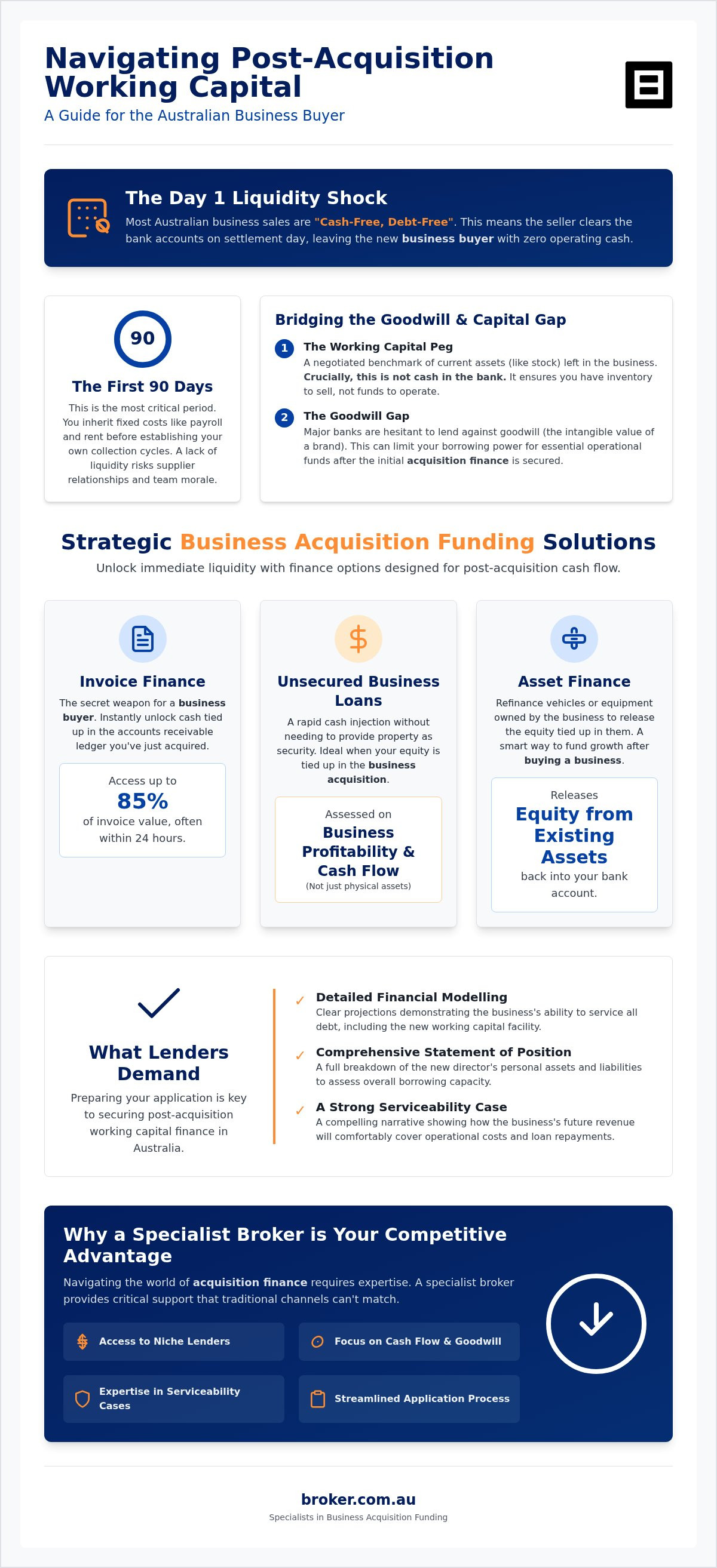
Starting a new chapter as a business owner is exhilarating, but many buyers face a sobering reality on Day 1. Most Australian business sales operate on a “cash-free, debt-free” basis. This means the vendor clears the bank accounts at settlement, leaving you with a functional entity but zero liquid cash. Working capital is the lifeblood of your new enterprise, representing the difference between your current assets and liabilities. Without specific post-acquisition working capital finance australia, you might find yourself owning a profitable company but unable to pay the first week’s electricity bill.
During the business acquisition process, you will likely encounter the “Working Capital Peg”. This is a negotiated benchmark of current assets, such as stock and debtors, that must remain in the business at settlement. If the actual level is lower than the peg, the purchase price is adjusted. However, the peg ensures you have inventory to sell, not money in the bank. Traditional acquisition finance often covers the purchase price but ignores the operational “runway” needed to reach your first revenue cycle. This leaves many new owners asset rich but cash poor during the most sensitive stage of the transition.
Why the First 90 Days are the Most Critical
The first three months are a high-stakes balancing act for any business buyer. You have inherited fixed costs like rent and payroll, yet you haven’t established your own rhythm of collections. There is a genuine risk of “over-trading”, where a new owner tries to chase aggressive growth without sufficient liquidity, leading to a cash flow crunch. If you can’t pay suppliers or staff on time, you damage the hard-earned reputation of the business you just bought. Having a dedicated line of credit provides the breathing room to manage these transitions without the stress of an empty account.
The Goodwill Gap and Operational Liquidity
When buying a business, a significant portion of the price often represents “goodwill”, which is the intangible value of the brand and customer base. Major banks are notoriously hesitant to lend against goodwill, often leaving a gap that limits your borrowing power. However, your balance sheet often hides potential. Unlocking cash from accounts receivable or using Business Acquisition Funding tailored to cash flow can bridge this gap. We specialise in presenting serviceability cases to non-bank lenders who understand that a business’s value lies in its future revenue, not just its physical assets.
Strategic Acquisition Finance Options for Your New Enterprise
Securing post-acquisition working capital finance australia often requires looking beyond the initial term loan used to close the deal. While you’ve likely spent months arranging the primary acquisition finance, the operational phase demands a different set of tools. Many a business buyer finds that their property equity is tapped out after settlement, making traditional secured loans difficult to obtain. While there are various Australian government funding options and grants available for specific industries, debt remains the most common route for immediate liquidity.
For a rapid cash injection, Unsecured Business Loans are a popular choice. These are assessed based on the business’s historical and projected profit rather than physical collateral. Additionally, if the target business owns a fleet of vehicles or heavy machinery, Asset Finance allows you to refinance these items. This effectively releases the equity tied up in the equipment back into your bank account, providing a non-dilutive way to fund growth or cover initial integration costs.
Invoice Finance: The Secret Weapon of M&A
When buying a business, you aren’t just purchasing equipment; you’re purchasing an accounts receivable ledger. Invoice finance allows you to borrow against these unpaid invoices immediately, often receiving up to 85% of the value within 24 hours. For a new owner, this is often the most scalable form of funding because as your sales grow, your credit limit grows with them. You can choose between “factoring,” where the lender manages your collections, or “invoice discounting,” which remains confidential so your customers don’t know a third party is involved. This ensures your cash flow keeps pace with your ambitions from the very first week.
Business Overdrafts and Lines of Credit
A flexible Line of Credit is essential for managing the seasonal ebbs and flows of a new venture. While traditional bank overdrafts are becoming harder to secure for new directors without property security, modern fintech lenders offer revolving facilities with rapid approval times. These can be structured with interest-only periods during the first six months of your business acquisition, allowing you to focus on staff integration rather than principal repayments. Setting up this “rainy day” facility before you actually need it is a hallmark of a prepared owner. If you’re unsure which structure fits your specific deal, we can help you discover more tailored options through our specialised lender panel.
Secured vs Unsecured: Choosing the Right Debt Structure
Choosing between secured and unsecured debt is often the most significant financial decision a business buyer makes after settlement. While the interest rate is a primary metric, it shouldn’t be the only one. You must weigh the lower cost of secured capital against the opportunity cost of slow approval times. In a fast-paced M&A environment, waiting six weeks for a bank to value a property can mean missing out on a critical inventory purchase or a key hire. This is where post-acquisition working capital finance australia through unsecured channels provides a distinct competitive edge, allowing you to move at the speed of your new business.
Most lenders will require a General Security Agreement (GSA) over the company’s assets. This document is registered on the Personal Property Securities Register (PPSR) and gives the lender a claim over the business’s inventory, equipment, and receivables. Beyond the company’s assets, you’ll likely be asked for a Personal Guarantee. It’s a common misconception that “unsecured” means “no risk”; in reality, a personal guarantee means your personal assets are still on the line if the business fails to meet its obligations. Understanding these nuances is part of the acquisition finance journey.
When to Use Property-Secured Working Capital
If you have significant equity in residential or commercial property, you can often secure interest rates between 6.8% and 9.5% per annum. This is significantly lower than unsecured alternatives. However, you must be wary of cross-collateralisation. This occurs when a lender links your business debt to your family home, potentially putting your primary residence at risk if the business faces a downturn. We generally recommend matching the loan term to the life of the asset you’re funding; use long-term secured debt for machinery and short-term facilities for operational breathing room.
The Rise of Cash-Flow Lending in 2026
The lending landscape has shifted dramatically. By September 2026, fintech lenders have perfected the use of real-time bank data to assess serviceability. Rather than looking for physical collateral, these lenders focus on your EBITDA and consistent cash flow. This “Low Doc” approach is ideal for a new owner who has limited trading history under their own tenure but can show the target’s historical performance. Unsecured options now range from 9.5% to 18% per annum, but they offer the speed and flexibility that traditional banks simply cannot match. This allows you to secure post-acquisition working capital finance australia in hours, not weeks, keeping your transition on track.
Preparing Your Application: What Australian Lenders Demand
Transitioning from a business buyer to an operational director requires a shift in how you present yourself to credit committees. Lenders aren’t just looking at the target business anymore; they’re looking at you. A “Clean” Statement of Position (SOP) is non-negotiable. This document must detail your personal assets and liabilities with absolute transparency. Even in commercial lending, your personal credit score through Equifax or Illion remains a significant factor. A single missed payment on a personal credit card can sometimes derail a complex post-acquisition working capital finance australia application.
You need robust financial modelling. This isn’t just a basic P&L; lenders demand a detailed 12-month cash flow forecast that incorporates the new debt service requirements. Accurate modelling is the backbone of securing post-acquisition working capital finance australia. If you’re using Business Acquisition Funding, you must prove the business can comfortably support both your director’s drawings and the loan repayments. A clear Profit & Loss statement showing historical performance is the foundation of any application nationwide.
The Essential Post-Acquisition Document Checklist
- Aged Receivables and Payables: These reports show how quickly the business collects cash and how well it manages its debts. Lenders look for “stale” invoices that might indicate poor management or potential bad debts.
- ATO Portal Transcripts: You must ensure all Business Activity Statements (BAS) and superannuation obligations from the previous owner are finalised. Lenders will rarely fund a business with outstanding tax debt without a clear, pre-approved repayment plan.
- The Business Plan: This should highlight your 100-day strategy. Lenders want to see exactly how you’ll maintain or improve the business’s current trajectory once the vendor has exited.
Demonstrating Management Capability
Lenders view the exit of the previous owner as a “key person risk”. To mitigate this, your application should emphasise your relevant industry experience or your plan to retain the existing management team. Work closely with your accountant to justify “Add-backs”. These are expenses the previous owner ran through the business that won’t continue under your tenure, such as a vendor’s private vehicle or one-off legal fees. Clearly explained add-backs can significantly improve your EBITDA and borrowing capacity. If you’re ready to get your application lender-ready, you can get started with our expert team to ensure your deal is matched with the right credit appetite.
Why a Specialist Broker is Your Competitive Advantage
Settling on a business is just the start of your journey. As you transition from the due diligence phase into daily operations, the complexity of managing cash flow can become overwhelming. Working with a specialised broker provides you with an Expert Guide who understands the nuances of the Australian lending market. Unlike a single bank that only offers its own limited products, we provide inside access to over 70 lenders. This includes niche, non-bank institutions that specifically target goodwill and cash-flow lending, which is often the missing piece in a post-acquisition working capital finance australia strategy.
We move beyond off-the-shelf debt. Every business acquisition has a unique cash flow profile, and your funding should reflect that. Whether it’s structuring an interest-only period to align with your first 90 days or securing a Line of Credit that grows with your revenue, we design bespoke financial architectures. This high-level fixer approach ensures you aren’t just getting a loan; you’re getting a strategic asset that supports your long-term vision. Our role is to handle the complex lender queries and paperwork, ensuring a stress-free process while you focus on leading your new team.
Leveraging Proprietary AI for Faster Liquidity
With the 2026 introduction of Payday Super regulations and the RBA cash rate currently at 4.35%, the margin for error in cash flow management is thinner than ever. We use proprietary AI technology to match your specific deal with the lenders most likely to approve it in real time. This digital precision eliminates application fatigue and protects your personal credit score from unnecessary enquiries. This speed advantage is vital when you need to secure post-acquisition working capital finance australia before your first payroll cycle is due. By only applying to lenders with a high appetite for your specific industry, we significantly increase your probability of a seamless approval.
Long-Term Corporate Advisory and Growth
Your relationship with us doesn’t end when the first facility is drawn. As a business buyer, your needs will evolve as you scale the enterprise. We remain your partner for future expansion, providing seamless access to Equipment Finance or Fit-out Finance when it’s time to upgrade your facilities or refresh your shopfront. Our goal is to make the financial side of your business predictable and efficient. We stay by your side through every refinancing and growth phase, ensuring you always have the best rates the market can offer. If you’re ready to secure your Day 1 liquidity, I’m interested-let’s talk about your working capital.
Securing Your Future as a Business Owner
Buying a business is a monumental achievement, but your long-term success depends on the liquidity bridge you build for those first ninety days. We have explored how to navigate “cash-free” settlements and the importance of selecting the right debt structure, whether you are leveraging property equity or business cash flow. Securing post-acquisition working capital finance australia is the final piece of the puzzle that transforms a successful purchase into a sustainable, thriving enterprise.
As award-winning business loan specialists, we provide inside access to over 70 bank and non-bank lenders. Our proprietary AI technology ensures your deal is matched with the right credit appetite for a faster, stress-free approval. You have done the hard work of finding the right business; now let us help you fund the dream with confidence. If you’re ready to ensure a seamless transition for your staff and suppliers, we’re here to guide you every step of the way.
I’m interested in post-acquisition working capital finance
Frequently Asked Questions
What is post-acquisition working capital and why do I need it?
Post-acquisition working capital is the liquid cash required to manage daily operations after a purchase is finalised. Since most Australian business acquisitions are settled on a cash-free basis, the bank accounts are usually empty on Day 1. You need this liquidity to cover immediate costs like rent and payroll while your own revenue cycles begin to churn. Having a facility in place ensures the transition is seamless for your new team and suppliers.
How much working capital should I have when buying an Australian business?
There is no single figure, but a prudent post-acquisition working capital finance australia strategy usually targets three months of operating costs. This buffer accounts for the 2026 Payday Super requirements and potential delays in debtor collections. You should work with your accountant to model a worst-case scenario. This ensures you have enough breathing room to implement your growth strategy without the constant stress of an empty bank account during the integration phase.
Can I get an unsecured business loan immediately after buying a company?
You can certainly secure an unsecured loan shortly after settlement. Lenders focus on the historical performance of the business rather than your personal time as the owner. If the company has demonstrated consistent EBITDA over the last two fiscal years, non-bank lenders are often happy to provide funding. This provides a rapid cash injection based on the business’s strength, making it a popular form of post-acquisition working capital finance australia for new directors.
What is the ‘working capital peg’ in a business sale agreement?
The working capital peg is a benchmark negotiated during due diligence that represents the normal level of current assets required to run the business. This includes inventory and accounts receivable minus accounts payable. If the vendor leaves less than this agreed amount at settlement, the purchase price is reduced accordingly. It’s a protection mechanism to ensure you aren’t buying a hollowed-out company that requires an immediate, unplanned capital injection just to survive.
How does invoice finance help during a business transition?
Invoice finance is a powerful tool because it turns the target company’s unpaid invoices into immediate cash. When you purchase a business, you often inherit a large ledger of money owed by customers. Rather than waiting for these debts to be paid, you can access up to 85% of their value within 24 hours. This provides instant operational liquidity, making it an ideal solution for businesses with long payment terms or high growth ambitions.
Do I need to provide my house as security for post-acquisition finance?
You don’t always have to use your home as collateral. While property-secured loans generally offer the lowest interest rates, many modern lenders specialise in cash-flow lending. These facilities are secured by a General Security Agreement over the business’s assets and a personal guarantee from the directors. This approach keeps your personal residence separate from your business debt, which is a significant priority for many Australian business owners looking to manage their risk.
How long does it take to get a working capital facility approved in 2026?
Approval times vary significantly depending on the lender. In 2026, fintech and non-bank lenders can often provide a “yes” within two to three business days by using AI-driven data matching. Traditional major banks typically require four to eight weeks to process a similar application. We use proprietary technology to identify lenders with the highest probability of approval for your specific deal, ensuring you get the funds you need before your first payroll cycle.
What happens if the vendor does not leave enough working capital in the business?
If the vendor fails to leave sufficient working capital, a post-settlement adjustment is usually calculated by your accountants. The vendor is then obligated to refund the shortfall to you. However, these disputes can take weeks or months to resolve. It’s vital to have a flexible line of credit or an unsecured loan ready to go on Day 1. This ensures your operations aren’t crippled while your legal and accounting teams finalise the adjustment.