
What if the most critical sales document for your acquisition isn’t your pitch deck, but your ability to prove the business’s skeletons have already been cleared out? You’ve likely felt that familiar knot in your stomach, worrying about a hidden liability or a missed tax debt that might derail your dream purchase at the eleventh hour. It’s a valid concern; the current Australian lending environment has become increasingly rigorous, and the pressure of a time-sensitive deal can leave many buyers feeling overwhelmed by complex, lender-specific requirements.
We believe you deserve a clear roadmap to loan approval that provides total peace of mind. This guide delivers the definitive due diligence checklist for business purchase loan applications to ensure you’re prepared for every level of scrutiny. By following these tailored steps, you’ll master the requirements needed to satisfy Australian lenders and gain the confidence that your new venture is a sound, profitable investment. We will explore the essential financial, legal, and operational pillars that transform a complex application into a seamless, stress-free settlement process, giving you the inside access needed to secure the best possible funding.
Key Takeaways
- Understand why Australian lenders view your verification process as the primary sales document for securing business acquisition funding.
- Master the financial scrutiny required to prove a business’s true earning capacity through precise P&L and balance sheet analysis.
- Identify critical legal checks, such as lease “right to occupy” clauses and intellectual property protection, that satisfy lender security requirements.
- Follow a structured due diligence checklist for business purchase loan approval, beginning with the assembly of a specialist advisory team.
- Discover how proprietary AI technology and corporate advisory insights can match your data with the ideal lender for a seamless, stress-free settlement.
Table of Contents
- Understanding Due Diligence for Business Purchase Funding
- Financial Scrutiny: What Lenders Look for in the Books
- Legal and Operational Checks to Secure Your Loan
- Your Step-by-Step Due Diligence Checklist for 2026
- How Broker.com.au Simplifies the Acquisition Loan Process
Understanding Due Diligence for Business Purchase Funding
Due diligence in the Australian commercial landscape is often misunderstood as a simple fact-checking mission for the buyer. In reality, it’s the bridge between a hopeful offer and a formal loan approval. When you seek business acquisition funding, the lender isn’t just looking at your personal credit score; they’re stress-testing the target business’s future stability. They require independent verification because their capital is at risk. While you want to avoid buying a “lemon,” the lender needs to guarantee the business can survive the transition and service the debt comfortably.
High-quality preparation during this phase is the secret to gaining inside access to the best rates. A comprehensive due diligence checklist for business purchase loan applications doesn’t just tick boxes; it builds a narrative of reliability. Lenders distinguish between buyer protection, which focuses on the purchase price, and lender risk mitigation, which focuses on asset security and cash flow consistency. When you present a “clean” deal with verified data, you reduce the lender’s perceived risk, which often translates into lower interest rates and more flexible repayment terms.
The Three Pillars of Loan-Focused Due Diligence
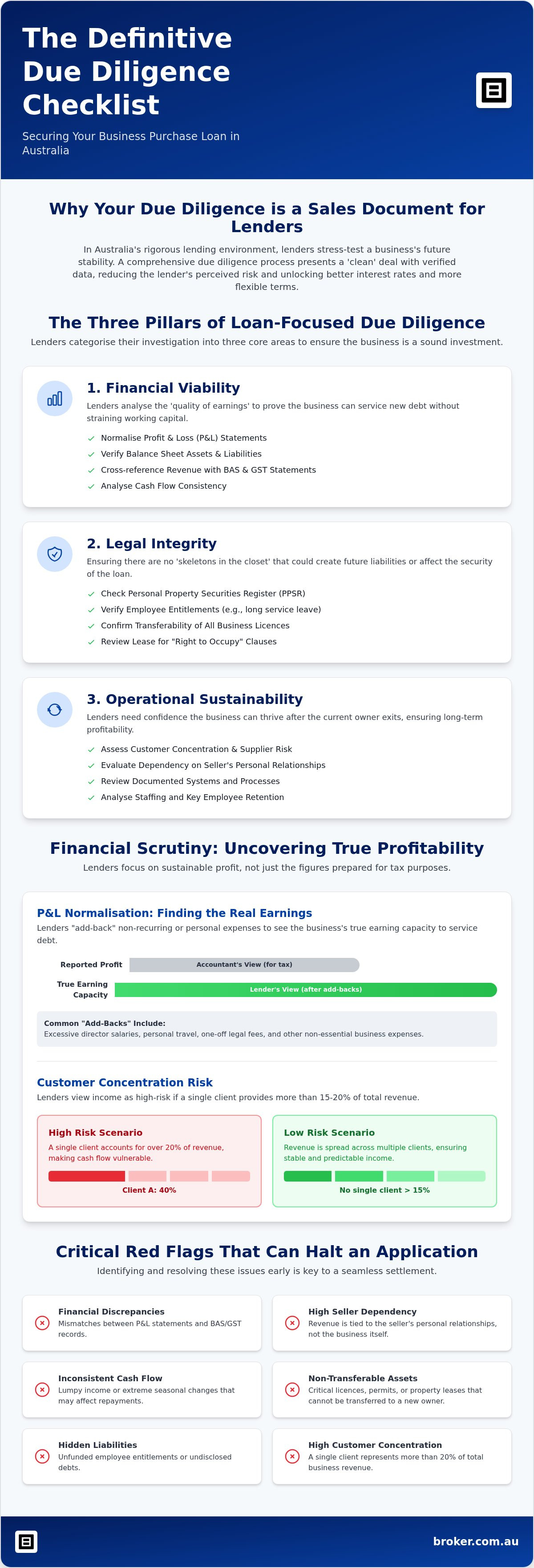
Lenders typically categorise their investigation into three core areas to ensure the business is a sound investment:
- Financial viability: This goes beyond basic accounting. Lenders look for “quality of earnings” to prove the business can service the new debt without straining working capital.
- Legal integrity: You must ensure there are no skeletons in the closet. This involves checking the Personal Property Securities Register (PPSR), verifying employee entitlements, and confirming that all licences are transferable.
- Operational sustainability: A lender wants to know the business can thrive after the current owner exits. If the revenue is tied solely to the seller’s personal relationships, the risk of default increases significantly.
Why 2026 Requires a More Rigorous Approach
The Australian lending environment in 2026 is more data-driven than ever. ASIC and the ATO have increased their scrutiny on business transfers to prevent illegal activity and ensure tax compliance. Consequently, lenders have integrated sophisticated AI into their credit assessment models. These systems can spot inconsistencies in financial modelling that a human might miss. Relying on “gut feel” or a handshake deal is no longer sufficient. To secure a professional business loan, your data must be transparent, digital, and independently verified to meet these modern standards.
Financial Scrutiny: What Lenders Look for in the Books
Lenders don’t see the world like your accountant. While an accountant focuses on minimising tax, a lender focuses on maximising visible, sustainable profit. Normalising the Profit and Loss (P&L) statement is the first major task on your due diligence checklist for business purchase loan success. You must identify “add-backs”—expenses that won’t continue under your ownership, such as personal travel, excessive director salaries, or one-off legal fees. Proving these figures effectively allows the lender to see the business’s true earning capacity.
The balance sheet requires equal attention. Lenders look for accuracy in secured business loans by verifying that assets actually exist and liabilities are fully disclosed. Unfunded employee entitlements, such as long service leave or accrued holiday pay, are often hidden debts that can reduce the business’s valuation and your borrowing capacity. If these aren’t accounted for, your settlement process could become a nightmare of unexpected costs. Getting these numbers right early allows you to secure inside access to the best rates before you even sign the contract.
Verifying Revenue and Profitability
Lenders will cross-reference bank statements against reported GST and Business Activity Statements (BAS). Discrepancies here are a major red flag that can halt an application. They also analyse customer concentration risk. If a single client provides more than 15% to 20% of the total revenue, the lender may view the income as high risk. Lumpy income or extreme seasonal fluctuations can also trigger concerns about your ability to meet monthly repayments during quiet periods. You need to demonstrate that cash flow remains consistent across different market cycles to satisfy strict credit models.
The Debt Service Coverage Ratio (DSCR)
The DSCR is the primary formula used to decide if you can afford the loan. It compares the business’s net operating income to its total debt obligations. Most Australian lenders look for a ratio of at least 1.25x, meaning the business makes 25% more than it needs to cover the debt. You can often improve this figure through better deal structuring or by increasing your initial capital contribution. Lenders also scrutinise the “Owner’s Draw.” If your personal living expenses are higher than what the business can reasonably provide after debt servicing, the loan will likely be declined.
Legal and Operational Checks to Secure Your Loan
Lenders view the legal framework of a business as the primary insurance policy for their capital. If the business lacks the legal right to operate or loses its premises shortly after settlement, the loan security evaporates. This is why legal health is a non-negotiable pillar of your due diligence checklist for business purchase loan approval. You must prove that the intangible assets, such as brand reputation and customer contracts, are legally enforceable and transferable to your new entity.
A critical friction point in Australian business acquisitions is the commercial lease. Lenders typically require the “Right to Occupy” to match or exceed the term of the loan. If you are applying for a five-year business acquisition loan but the lease only has two years remaining with no option to renew, the lender will likely view the deal as high risk. You must verify that the landlord consents to the transfer and that there are no hidden “make good” clauses that could create a massive, unbudgeted liability six months after you take over.
Intellectual Property (IP) and trademarks also require deep verification. If the business’s competitive edge relies on a specific brand name or a proprietary process, you must ensure these are properly registered with IP Australia. Lenders want to know that a competitor cannot simply enrol a similar name and steal the market share that justifies your valuation. Similarly, you must audit employee contracts to manage key person risk. If the business’s success is tied to a head chef or a lead engineer who isn’t bound by a solid contract, the lender may worry about revenue stability post-sale.
Modern Operational Risks in 2026
Cyber-security due diligence has become a standard requirement for Australian commercial lenders in 2026. Lenders now assess whether a target business has robust data protection protocols in place, as a single data breach can lead to catastrophic financial penalties and brand damage. You should also verify ESG (Environmental, Social, and Governance) compliance, especially if the business operates in manufacturing or transport. Many lenders now offer preferential rates for ESG-compliant businesses, while non-compliant firms may face stricter borrowing limits. Finally, ensure the business is fully compliant with the latest Privacy Act requirements for handling customer data to avoid future litigation.
Supply Chain and Contractual Security
Contractual security is the lifeblood of business continuity. You must audit all major supplier agreements for “change of control” clauses. These clauses can allow a supplier to terminate a contract if the business ownership changes, which could leave you with a loan to pay but no stock to sell. When it comes to physical assets, a professional valuation is essential for equipment finance. The lender needs to know that the machinery or vehicle fleet is in the condition the seller claims and isn’t already listed on the Personal Property Securities Register (PPSR) as security for another debt. Clearing these encumbrances is a vital step in ensuring your loan is secured against clean, high-value assets.
Your Step-by-Step Due Diligence Checklist for 2026
Success in a business acquisition isn’t just about finding the right opportunity; it’s about executing a flawless verification process. To move from a letter of intent to a funded deal, you need a structured approach that satisfies both your own investment criteria and the lender’s risk profile. This due diligence checklist for business purchase loan approval provides the specific milestones required to navigate the 2026 lending environment with confidence.
Step 1: Assemble your professional advisory team. You shouldn’t walk this path alone. Engage an award-winning finance broker, a specialised M&A accountant, and a commercial lawyer. This team acts as your high-level fixers, ensuring every document is polished before a lender sees it.
Step 2: Request the “Lender Information Pack” from the seller. Don’t wait for the lender to ask. Proactively request a comprehensive data room from the vendor that includes the specific documents detailed below. This speed often determines whether a deal settles on time or falls through.
Step 3: Conduct a deep-dive financial audit and tax compliance check. Verify that the numbers in the P&L match the tax returns filed with the ATO. In 2026, lenders have zero tolerance for tax arrears or undisclosed liabilities.
Step 4: Perform a physical asset and inventory count. If you’re seeking equipment finance, you must physically verify the existence and condition of the assets. A “paper-only” audit is a recipe for loan rejection.
Step 5: Review all legal obligations and third-party contracts. Ensure that every key supplier and customer contract is transferable. If you’re ready to start this process, you can get started with a tailored assessment to see how your target business stacks up.
The Financial Document Checklist
- Three years of certified financial statements (P&L and Balance Sheet) and corresponding tax returns.
- Current aged accounts receivable and accounts payable reports to assess cash flow health.
- A detailed asset register of all plant and equipment, including serial numbers and current market valuations.
- Recent Business Activity Statements (BAS) for the last four quarters to verify revenue.
The Legal and Statutory Checklist
- A current ASIC company extract and business name registration documents.
- Copies of all essential insurance policies, including Public Liability and Professional Indemnity.
- WorkCover compliance certificates and a statement of payroll tax status to ensure no hidden employee-related debts exist.
- Copies of all current material contracts with customers, suppliers, and lessors.
How Broker.com.au Simplifies the Acquisition Loan Process
While a due diligence checklist for business purchase loan applications provides the map, navigating the actual terrain requires a seasoned guide. At Broker.com.au, we transform your raw data into a compelling credit narrative. Our proprietary AI technology analyses your due diligence findings and instantly matches them with the specific lending appetite of our wide panel of lenders. This ensures you aren’t wasting time with institutions that don’t understand your industry or the specific risks of your acquisition.
Our corporate advisory team goes beyond basic brokerage. We help structure the deal for maximum funding, often identifying ways to improve your financial modelling or manage vendor finance arrangements. By acting as your “Expert Guide,” we manage the relentless stream of lender questions on your behalf. This boutique level of personal attention ensures the process remains stress-free, allowing you to focus on the operational transition while we handle the financial heavy lifting. Whether you require secured business loans or unsecured business loans, our team ensures the facility is tailored to your specific needs.
From Checklist to Settlement: Our Seamless Process
We use your due diligence findings as a tool for negotiation. By presenting a transparent, verified information pack, we gain inside access to the best rates and terms that aren’t available to the general public. Our process starts with a low-pressure conversation. We don’t believe in aggressive sales tactics; instead, we prefer the “I’m interested” approach. This allows us to understand your specific dream and provide the high-level fixer mentality needed to solve complex hurdles. As an award-winning broker, we have the industry leadership and competence to manage even the most intricate business acquisition funding requirements.
Beyond the Loan: Ongoing Support for Your New Business
Our partnership doesn’t end when the ink dries on the settlement papers. We provide ongoing support to ensure your new venture thrives from day one. This includes tailored working capital finance to manage the initial transition and equipment finance for any immediate upgrades needed to boost productivity. Whether you need a line of credit for seasonal fluctuations or asset finance for a new vehicle fleet, our team is here to ensure your business remains efficient and professional. Ready to start? I’m interested.
Secure Your Future with a Professional Funding Strategy
Mastering the due diligence process is about more than just avoiding risk; it’s about positioning yourself as the ideal borrower in a competitive Australian market. By following a structured due diligence checklist for business purchase loan applications, you’ve already cleared the biggest hurdle to a successful settlement. You now understand that financial transparency and legal integrity are the essential pillars that satisfy modern lenders and secure your investment’s longevity.
Moving from a checklist to a funded deal is where our team excels. As an award-winning Australian broker, Broker.com.au provides the expert corporate advisory and proprietary AI matching technology needed to navigate complex M&A deals with ease. We manage the lender’s detailed questions and refine your financial modelling for maximum success, ensuring a seamless transition into your new role as a business owner. Your dream is within reach, and with the right preparation, the funding process can be completely stress-free.
Ready to take the next step? I’m interested in business acquisition funding.
Frequently Asked Questions
How long does due diligence usually take for an Australian business purchase?
Due diligence typically takes between 30 and 60 days for most Australian small to medium enterprises. This timeframe allows your advisory team to verify financials, legal contracts, and operational health without rushing. Larger or more complex acquisitions may extend to 90 days or beyond. Using an award-winning broker can streamline the process by ensuring your information pack meets lender standards from day one, preventing unnecessary delays during the critical credit assessment phase.
Can I get a business loan if the seller’s books are not up to date?
Securing a business loan with outdated books is extremely challenging in the current lending environment. Lenders rely on recent Profit and Loss statements and Business Activity Statements to assess your ability to service debt. If the seller’s records are messy, our corporate advisory team can help you identify exactly what’s missing. We often recommend that the vendor brings their tax obligations up to date before you submit a formal application to ensure a smoother approval.
What is the most common red flag found during due diligence?
The most common red flag is a discrepancy between reported profits and actual bank deposits. This often indicates poor record-keeping or undisclosed personal expenses that shouldn’t be added back. Another frequent issue is undisclosed tax debt or long-standing employee entitlement liabilities. Using a comprehensive due diligence checklist for business purchase loan applications helps you spot these issues early. This allows you to renegotiate the purchase price or request specific warranties before committing your capital.
Do I need to pay for due diligence myself or can it be added to the loan?
Buyers generally pay for due diligence costs, such as accounting and legal fees, out of their own pockets. While some acquisition loans allow you to include certain transaction costs, professional advisory fees are typically considered upfront capital requirements. However, having a thorough report can often lead to better loan terms. This makes the initial investment worthwhile as it reduces the lender’s perceived risk and can potentially lower your interest rate over the life of the loan.
What happens if I find a problem during the due diligence period?
If you discover a material issue, you typically have three main options: renegotiate the purchase price, request a specific indemnity from the seller, or terminate the contract. The due diligence period acts as a critical safety valve for the buyer. It’s much better to walk away from a deal than to inherit a hidden liability that could bankrupt your new venture. Always ensure your contract has a clear “subject to due diligence” clause to protect your interests.
Is a “Letter of Intent” binding before I finish my due diligence?
A Letter of Intent (LOI) is usually non-binding regarding the final sale price and terms, but it often contains binding clauses. These typically include confidentiality agreements and exclusivity periods, which prevent the seller from talking to other buyers while you conduct your checks. You must have your solicitor review the LOI before signing. This ensures you have the freedom to walk away if your due diligence checklist for business purchase loan reveals a deal-breaking flaw in the business.
How does a business broker differ from a business loan broker during this process?
A business broker works for the seller to find a buyer and negotiate the highest price. In contrast, a business loan broker, like the team at Broker.com.au, works for you to secure the most competitive finance. While the business broker provides the information pack, the loan broker uses proprietary AI to match that data with the right lender. We act as your expert guide, ensuring the loan structure protects your interests rather than just the vendor’s.
What is the difference between goodwill and tangible assets in a loan application?
Tangible assets are physical items like machinery, vehicles, or property that a lender can take as security. Goodwill represents the intangible value of the business, such as its brand reputation, customer base, and location. Australian lenders generally prefer tangible assets because they are easier to value and liquidate. While you can fund goodwill through business acquisition funding, it often requires a stronger demonstrated cash flow or additional security to offset the lender’s increased risk.